Category
Agentic AI Workflow Automation: When It Fits
Last updated: May 2026
You are being told that every workflow in your business should become agentic. After three years deploying agents in production, Arkeo's most common finding is the opposite: most of the workflows teams ask to make agentic do not actually need it, and forcing the label on them is where the cost and the breakage start. Vendors pitch AI agents that plan their own steps, handle their own exceptions, and decide for themselves. The pressure is real: Gartner forecast in June 2025 that 15% of day-to-day work decisions will be made autonomously through agentic AI by 2028, up from 0% in 2024, and that 33% of enterprise software will include agentic AI by 2028. The capability is arriving fast. That is exactly why the harder question is not can a workflow be agentic, but should it be. Pick wrong and you pay for complexity, latency, and risk you never needed.
Quick Answer
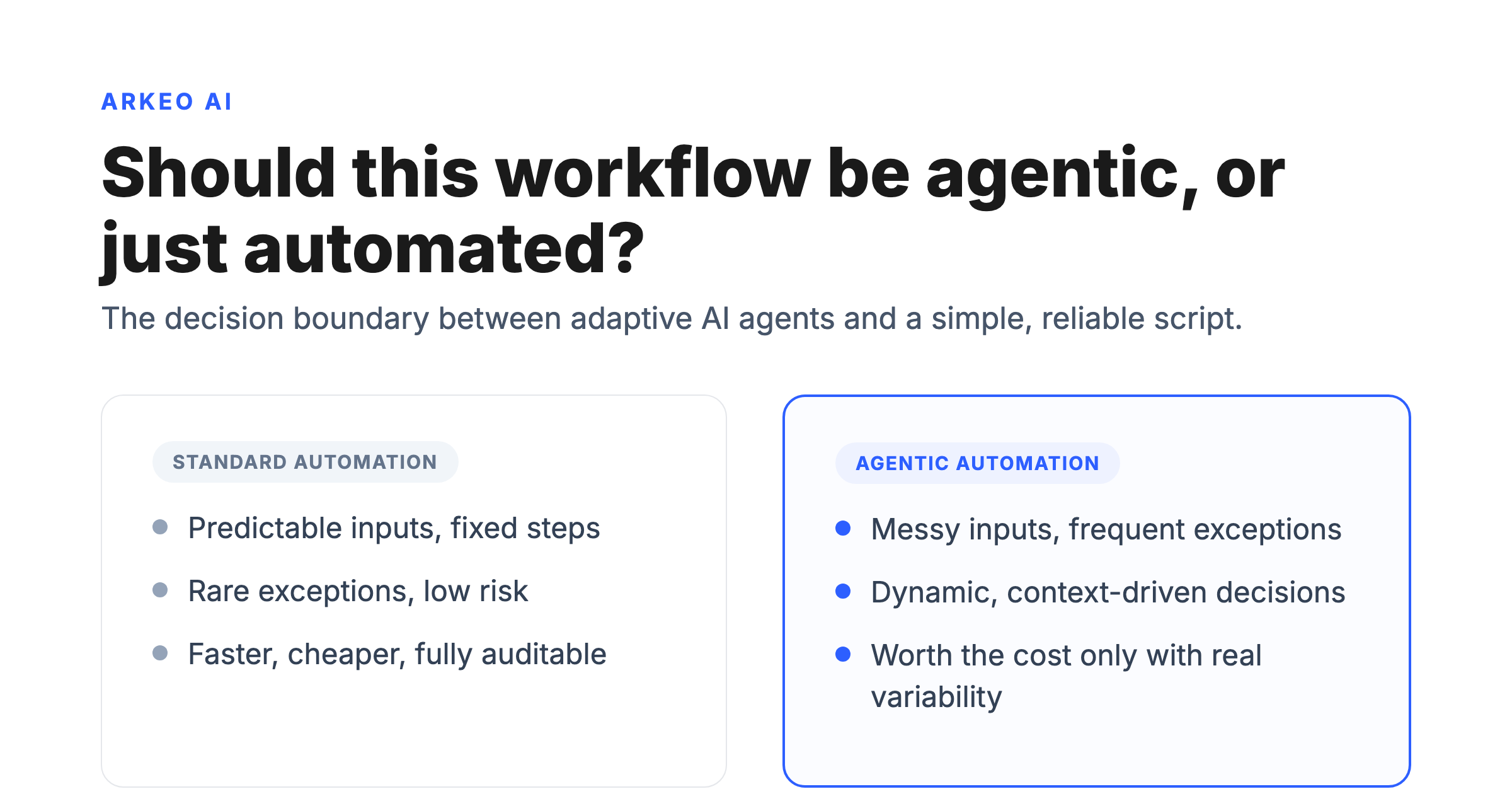
• What it is: Automation that decides its own next step through adaptive sequencing, exception handling, dynamic decisions, and escalation, instead of running a fixed script.
• When it's worth it: Only when a workflow has real variability, frequent exceptions, or judgment calls that a fixed rule set cannot cover.
• When it's overkill: Predictable, linear workflows where standard automation is faster, cheaper, and safer.
• Why it matters: Gartner expects more than 40% of agentic AI projects to be canceled by the end of 2027, mostly because the agentic label was applied where it did not belong.
What Does Agentic AI Workflow Automation Actually Mean?
Agentic AI workflow automation is automation that can decide its own next step rather than follow a fixed script. In practical workflow terms that means four behaviors: adaptive sequencing (it reorders or chooses steps based on what it finds), exception handling (it reacts to inputs the designer did not anticipate), dynamic decisions (it weighs context instead of matching a rule), and escalation (it knows when to hand a case to a human). Standard automation does the opposite. It runs the same sequence every time, and when reality does not match the script, it stops or errors out.
The distinction matters because the word is doing a lot of selling. Gartner has warned about "agent washing": chatbots, robotic process automation, and assistants rebranded as agentic, with only about 130 of the thousands of agentic vendors it reviewed offering genuinely autonomous behavior. Much of what is marketed as an agent is a chatbot with a loop. Knowing the real definition is your first defense against paying agentic prices for scripted work.
How Is Agentic Automation Different From Standard Automation?
Think of the difference as who owns the decision. In standard automation, you own every decision in advance. You map the path, encode the rules, and the system executes. It is deterministic, easy to audit, cheap to run, and predictable to the millisecond. In agentic automation, you delegate some decisions to the system at runtime. That delegation is the entire value proposition, and also the entire risk.
Here is the blunt truth a vendor brochure leaves out: agentic systems make mistakes that scripted systems cannot, because scripts only do what you told them and agents do what they decide. Deloitte's 2025 research found that AI agents are scaling faster than their guardrails, with only about 1 in 5 firms reporting a mature model for governing autonomous agents. Autonomy without controls is the fast path into the cancellation statistic. The decision to go agentic is therefore also a decision to invest in oversight, logging, and escalation, not just in the agent itself. Twenty-five years of running operations teaches the same lesson the brochures skip: any process that can act on its own needs an owner and a control, and an AI agent is no exception.
Where Does Agentic Behavior Actually Add Value?
Agentic behavior earns its cost in workflows where the variability is real and the script keeps breaking. Four patterns show up again and again:
• Exceptions are common. If a meaningful share of cases fall outside the happy path (a malformed invoice, a customer asking something the form did not anticipate), an agent that re-plans beats a script that halts.
• Inputs are messy. Free-text emails, scanned documents, and inconsistent formats are where adaptive interpretation pays off; a rigid parser cannot keep up.
• Decisions are dynamic. When the right next step depends on context that changes case by case, runtime judgment is worth more than a frozen decision tree.
• Coordination is multi-step. Workflows that span several systems and depend on intermediate results benefit from an agent that adjusts the sequence as it learns what each step returns.
Deloitte's 2025 work points to the same territory, naming customer support, supply chain, research and development, knowledge management, and cybersecurity as the highest-impact use cases. Notice the common thread: these are domains thick with exceptions and judgment, not predictable assembly lines.
Where Is Agentic Automation Overkill?
Most businesses think agentic AI is the upgrade every workflow should get. They are wrong. For a predictable, linear workflow, agentic behavior adds cost, latency, and risk for no benefit. If the inputs are clean, the steps never change, exceptions are rare, and the risk of a wrong call is high, you do not want a system improvising. You want a script that does the same correct thing every time.
Consider the recurring pattern Arkeo sees: a finance team of a dozen people wants to "make our invoice routing agentic" when the routing is a fixed table of approvers by amount. That is a deterministic rule. The typical result of wrapping that table in an agent is the wrong direction: the same approvals that used to clear in milliseconds now take several seconds each while the model reasons about a decision that was never ambiguous, and the routing that was once identical every run starts varying case to case, so the team loses the one thing the old script gave them for free, which is predictability. A five-line automation did it perfectly. The smarter move is to keep the linear part scripted and reserve the agent for the genuinely ambiguous edge, such as the invoice that does not match any purchase order. Drawing that line for each workflow is the first thing a free AI assessment does. It is the same boundary the broader discipline of AI workflow automation turns on, and it is worth getting right before you spend a dollar on agents.
The market data backs the caution. McKinsey's 2025 research found that 62% of organizations are at least experimenting with AI agents, but only 23% are scaling in even one function, and no more than roughly 10% are scaling in any given function. The gap between experimenting and scaling is not the technology. It is the hard part of agentic work: exceptions, controls, and ownership. For real-world illustrations of where the line falls, the AI workflow automation examples show both scripted and agentic patterns side by side.
Find the workflows that actually need an agent
The free assessment maps your real workflows and separates the ones with genuine exception load from the ones a simple script would run better, so you spend on the right complexity.
Book Your Free AI Assessment →
How Do You Decide Whether a Workflow Needs Agentic Automation?
Run the workflow through five questions before you decide. The matrix below maps each trait to the right tool, with a recommended pick in the last row. The honest answer for most workflows is the left column.
| Workflow trait | Standard automation | AI-assisted | Agentic |
|---|---|---|---|
| Inputs predictable? | Yes, clean and structured | Mostly, with some text | No, messy and varied |
| Exceptions common? | Rare | Occasional | Frequent and varied |
| Decisions dynamic? | Fixed rules | A human confirms | Context-dependent |
| Multi-step coordination? | Linear, fixed order | A few branches | Adaptive across systems |
| Risk level | Low, fully auditable | Medium, human in loop | Higher, needs guardrails |
| Recommended pick | Most workflows | When a human should sign off | Only with real variability |
Two checks finish the decision. First, the risk check: if a wrong autonomous call would cost money, breach a regulation, or damage a customer relationship, the workflow needs hard guardrails and a human escalation path before any agent touches it. Second, ownership: every agentic workflow needs a named human who owns its outcomes and reviews its escalations. An agent with no owner is the project that gets canceled. This is where Arkeo's approach starts. We use what we sell: the agents in our own operation run this same risk-and-ownership check before they go live. We also run them on private, on-premise infrastructure, which means the governance question is not theoretical for us, it is something we live with every day. If you want a structured pass through your own workflows against these criteria, a free AI assessment is the fastest way to draw the line.
What Happens When the Agent Hits an Exception?
The whole point of agentic automation is what it does on the unhappy path. The flow below shows the pattern Arkeo builds toward: the normal path runs automatically with no human involved, and only when the agent hits something it cannot resolve does it either re-plan or escalate to a person. That escalation node is not a failure. It is the control that keeps the agent inside its lane.
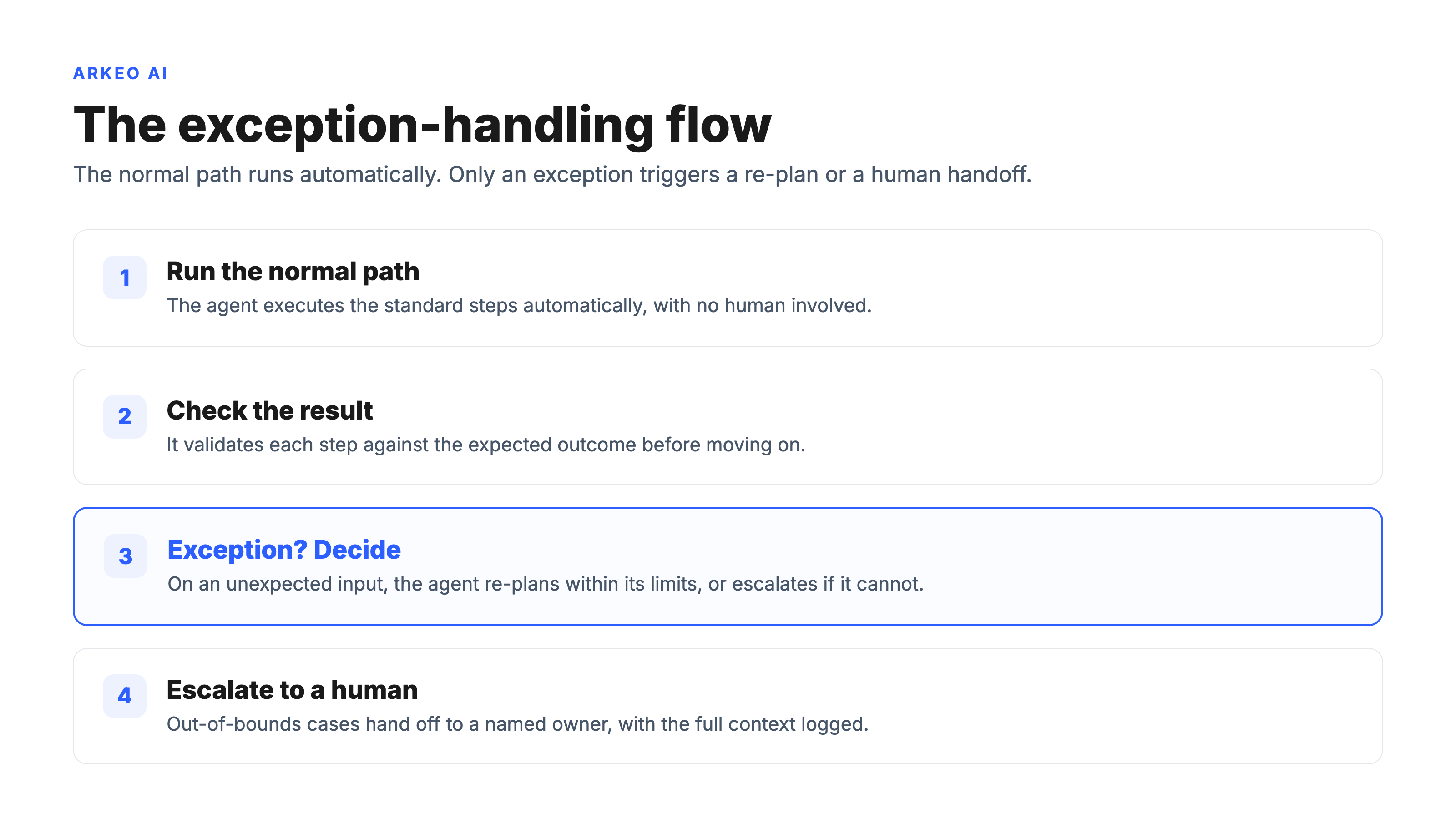
An agent that never escalates is more dangerous than one that escalates too often. The first quietly makes bad calls; the second is merely annoying. Design for the second, then tighten. Arkeo's AI workflow automation services build the escalation and logging layer alongside the agent so the autonomy is supervised from day one.
See where AI fits your operation
The free assessment separates the workflows that genuinely need agentic logic from the ones a simple script would run better, so you spend on the right complexity.
Book Your Free AI Assessment →