Category
AI Workflow Automation Platform: How to Choose
Last updated: May 2026
You are comparing AI workflow automation platforms, and every product page reads the same: orchestration, integrations, agents, analytics. The demos look polished. Yet you still cannot answer the question that actually matters to your operation: which one will run your real workflows, on your real systems, with the controls your business requires? That gap is where most platform purchases go wrong, and it has nothing to do with feature count.
The market is converging fast on features. Gartner forecast in August 2025 that task-specific AI agents will appear in 40% of enterprise applications by 2026, up from less than 5% in 2025. When everyone ships the same capabilities, the feature list stops being a useful way to choose. The decision moves to fit. If you want a structured read on where automation fits your operation before you sign anything, the free AI Assessment maps your bottlenecks and systems first.
Quick Answer
• What it is: The orchestration and control layer that runs AI agents and automations across your business workflows.
• What to evaluate: Workflow fit, system and integration fit, the control and approval layer, observability, and economic fit, not the demo.
• When it's enough: When your workflows are standardized and the platform reaches your core systems out of the box.
• Why it matters: Gartner expects over 40% of agentic AI projects to be canceled by the end of 2027, mostly for unclear value and weak controls.
What Should an AI Workflow Automation Platform Do?
An AI workflow automation platform is the orchestration and control layer that runs AI agents and automations across your business workflows, connecting them to your systems, governing what they are allowed to do, and giving you a record of what happened. The individual automation product is the engine; the platform is the chassis, the steering, and the brakes. A serious platform has to do four jobs well.
• Workflow orchestration. Sequence steps across people and agents, branch on conditions, handle retries, and pass state cleanly from one step to the next.
• System integration. Read from and write to the systems you already run, your CRM, ERP, ticketing, and data warehouse, without a custom build for every connection.
• Review and approvals. Insert a human checkpoint where the stakes are high, hold an action until someone signs off, and never let an agent commit an irreversible step unsupervised.
• Observability. Log every decision, surface failures, and let you audit what an agent did and why, after the fact.
Notice that only one of those four is about doing the work. The other three are about controlling and trusting the work. That ratio is the whole point, and it is the one buyers most often invert. For a wider view of how these automations operate end to end, the AI workflow automation pillar walks the full landscape; this guide stays on the platform decision itself.
What Do Buyers Overvalue and Undervalue?
Most buyers believe the platform with the most features wins. That is the wrong scorecard. The platform that fits your workflows, reaches your systems, and enforces your controls wins; every feature you never wire up is dead weight you still pay for and still have to secure.
Here is the blunt truth a vendor will not put in a demo deck: most platform demos run on clean, cooperative data and a happy-path workflow. Your data is neither. The demo never shows the half-filled records, the duplicate accounts, the approval step that finance refuses to skip, or the legacy system with no real API. Arkeo sees the same evaluation mistake repeatedly, and it is worth naming as a pattern: buyers score the demo, then discover after purchase that the platform cannot reach their CRM or enforce a mandatory approval. The capability they needed most was the one no demo highlights.
The data backs the caution. Gartner predicts that over 40% of agentic AI projects will be canceled by the end of 2027, citing escalating costs, unclear business value, and inadequate risk controls, and it warns of "agent washing," estimating that only around 130 of the thousands of vendors claiming agentic capabilities are real. Demos are cheap to make impressive. Control layers are expensive to build and easy to fake. Buyers consistently overvalue the first and undervalue the second.
See where automation actually fits
Before you weigh platforms against each other, the free AI Assessment maps your real workflows, systems, and control requirements so you score vendors against your operation, not their demo.
Book Your Free AI Assessment →
Two things buyers overvalue, two things buyers undervalue
The recurring procurement mistakes show up in the same places. Below are the four traps to watch for — the things that look impressive in the demo but rarely matter, and the things that look boring in the demo but decide whether the platform pays off.
Overvalued: Feature counts
A long feature list is easy to write and easy to copy. Most features are never used. Score the platform on what it does daily, not weekly.
Overvalued: Demo quality
A polished demo is the product team's output, not the engineering team's. The demo workflow is curated, your workflow is not.
Undervalued: Controls and audit
Audit logs, exception queues, approval gates. The things compliance reviews actually care about. Shipped, not promised.
How Do You Evaluate an AI Workflow Automation Platform?
Stop scoring features. Score fit, across four dimensions. The platform that wins is the one that earns the most points on the criteria your operation actually runs on. Use the scorecard below as a starting weighting and adjust the weights to your business.
| Evaluation criterion | What you are actually checking | Score |
|---|---|---|
| Workflow fit | Can it model your real sequence, branches, and exceptions, not just a clean linear flow? | _ / 5 |
| System / integration fit | Does it reach your CRM, ERP, and data warehouse out of the box, with read and write? | _ / 5 |
| Control & approval layer | Can you require human sign-off on high-stakes steps and block irreversible actions? | _ / 5 |
| Observability | Can you audit every decision and trace a failure to its cause after the fact? | _ / 5 |
| Economic fit | Does the total cost, including integration and oversight, stay below the value it returns? | _ / 5 |
Workflow Fit
Bring your messiest real workflow to the evaluation, the one with the conditional branches and the steps that occasionally fail. If the platform can only model the clean version, it will break the day it meets your operation. A useful read of the four fit dimensions is below.
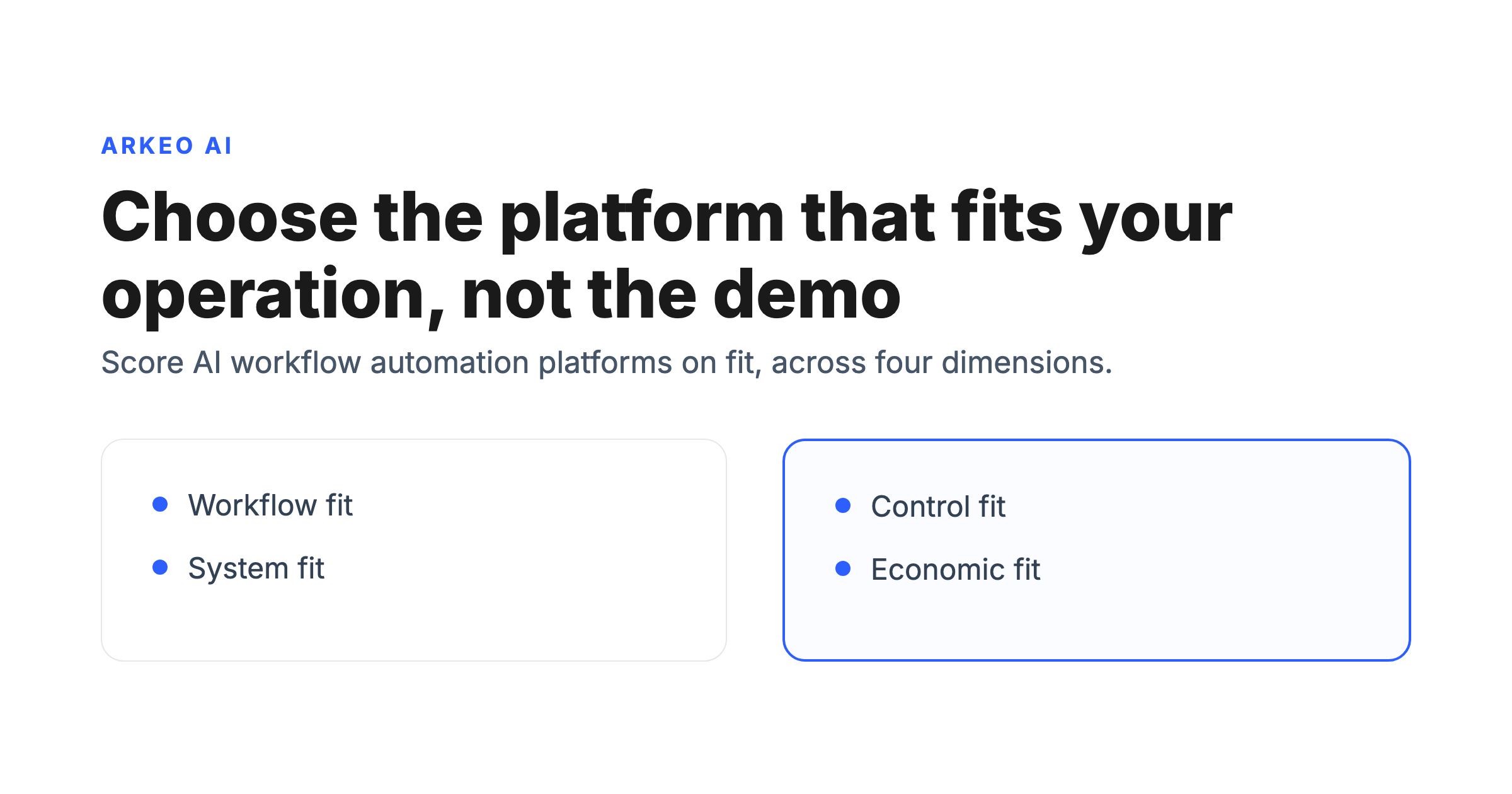
Score the platform on four fits before any feature comparison
The vendor demo emphasises features. The four fits below tell you whether the platform will actually carry your operation. None of them are about checkbox parity.
Workflow fit
Does the platform model your real workflows — multi-step, multi-system, with exceptions — or only the curated paths in the demo?
System fit
Native connectors to your systems of record. Custom integrations compound fast in cost and time, score them honestly.
Control fit
Confidence scoring, exception queues, audit logs, approval gates. Not a roadmap line, a shipped capability.
Economic fit
Pricing model survives your steady-state volume. Per-seat or per-run pricing that breaks at scale is a deferred bill.
System Fit
Integration is where platforms quietly fail. A platform that cannot read and write to your CRM, ERP, and warehouse without months of custom connector work is not automating your business; it is adding a new island. Confirm native connectors for your exact systems, and test write access, not just read.
Control Fit
This is the dimension buyers push on least and should push on hardest. Deloitte reported in 2025 that only about one in five companies has mature agent governance, even as roughly 85% expect to customize their agents. The approval layer, the permission scoping, and the audit trail are where most platforms are weakest. Ask to see a forced human checkpoint and a blocked irreversible action in the demo, not on a slide.
Economic Fit
Economic fit is the total cost of running the automation, including integration work, oversight time, and license fees, measured against the value it returns. A platform that needs a quarter of custom integration before it produces anything has a worse economic fit than a narrower tool that works on day one.
What Capabilities Are Non-Negotiable?
Below the four-fit framework sit specific capabilities a serious platform must carry. Treat any gap here as a reason to keep looking.
| Capability | Why it is non-negotiable |
|---|---|
| Orchestration | Sequences multi-step work, branches on conditions, and passes state between steps and agents. |
| System integration | Native read and write to your core systems, so automations act on live business data. |
| Human review and approvals | Forces a sign-off on high-stakes steps and holds irreversible actions until approved. |
| Observability and audit | Logs every decision and lets you trace and explain what an agent did after the fact. |
| Exception handling | Catches failures and bad inputs and routes them to a human instead of failing silently. |
The product layer that sits inside this platform deserves its own evaluation; the AI workflow automation software guide covers choosing the application itself, while this guide stays on the orchestration and control layer it runs in.
When Is a Platform Enough, and When Do You Need Custom Work?
A platform is enough when your workflows are standardized and the platform reaches your core systems out of the box. Standardized invoice routing, lead qualification, ticket triage, and document intake are well served by a configured platform. The work is in the setup and the controls, not in writing software.
Custom work is still required when your workflows are genuinely company-specific, when the logic encodes hard-won operational knowledge no off-the-shelf platform models, or when the systems involved have no usable API. McKinsey's State of AI in 2025 found that high performers are about 2.8 times more likely to fundamentally redesign workflows around AI rather than bolt it onto the existing process. That redesign is exactly the kind of work a generic platform cannot do for you; it has to fit your operation, not the other way around.
The honest answer for most operations is a blend: a platform for the standardized majority, with custom agents for the few workflows that are your actual competitive edge. Arkeo, founded in 2023 and built on three years of deploying agents in production, runs that same model internally under its Arkeo Operating System, and deploys on-premise where data has to stay inside your walls. We use what we sell, which is why the recommendation is a blend rather than a single product. The AI workflow automation services guide covers how that build-and-manage work is scoped.
Find out which workflows fit a platform
The free AI Assessment maps your current workflows and systems and shows you which ones a platform can handle today and which need a custom agent.
Book Your Free AI Assessment →
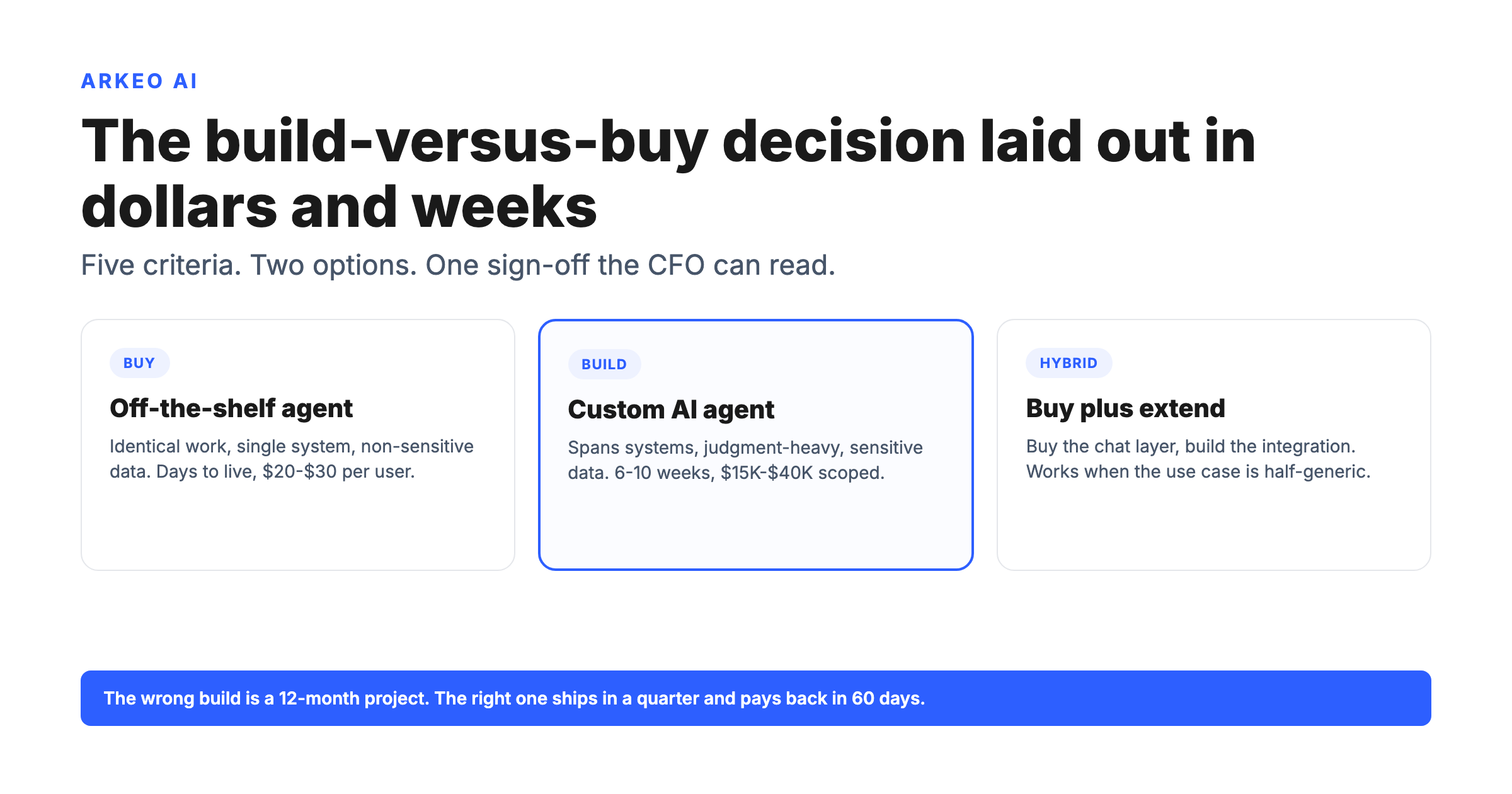
When the platform is enough, and when the workflow needs custom work
Most mid-market firms eventually run both. The platform carries the common, well-understood loops. Custom development carries the workflows where the moat lives. The fork below maps the decision.