Category
The 5 Stages of AI Strategy Development
Last updated: June 2026
By David Brennan · Arkeo AI · Building and Deploying Custom AI agents since 2023
Most descriptions of AI maturity stages are theoretical. They describe what an organization looks like at each stage without giving a business a clear signal for which stage it is in right now or what the specific move to the next stage requires.
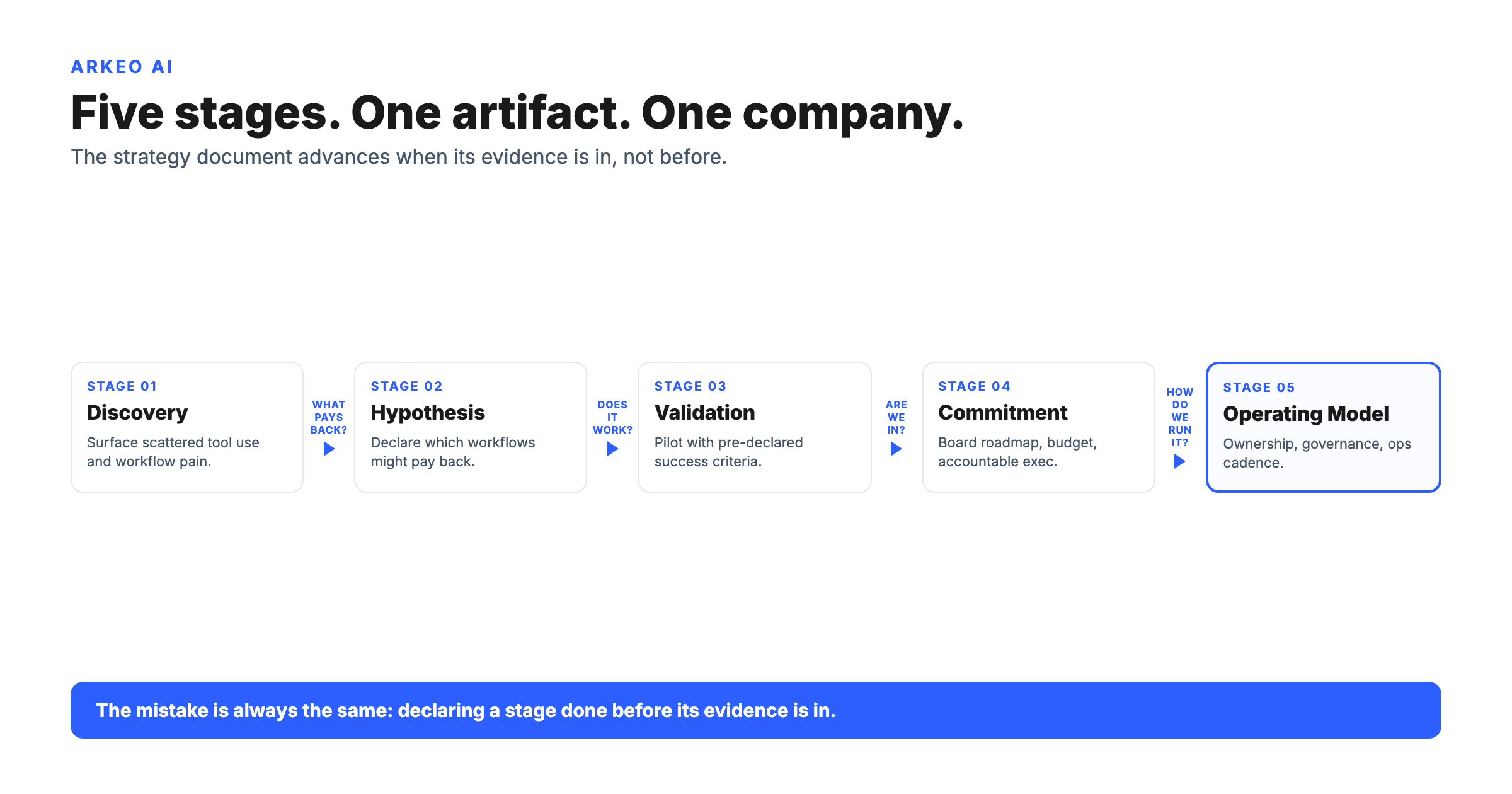
There are four stages of AI strategy development. Each stage has one defining characteristic, one stall symptom, and one unlock action. Here they are, without the theory.
Quick Answer
Stage 1: Interest without inventory. Characteristic: lots of AI conversations, no candidate list. Unlock: complete the current-state map.
Stage 2: Inventory without deployment. Characteristic: the candidate list exists, nothing is in production. Unlock: make the data-path decision in writing and name the first owner.
Stage 3: One deployment without a system. Characteristic: one workflow runs in production, no repeatable process for the second. Unlock: document the operating rhythm and run it as a template for workflow two.
Stage 4: System without board visibility. Characteristic: multiple workflows in production, no board-level metric linked to the deployments. Unlock: write the metric-link statement and present it at the next board review.
The free AI Assessment identifies your current stage, diagnoses the specific stall symptom, and produces the unlock action in a single working session. You leave knowing exactly what to do next.
Book Your Free AI Assessment →Why stage awareness matters
A business applying Stage 4 solutions to a Stage 2 problem is not accelerating. It is wasting budget on governance frameworks for systems that do not exist yet. A business applying Stage 1 solutions (more internal workshops, more vendor demos) to a Stage 3 problem is not building capability. It is avoiding the operating rhythm documentation that is the actual unlock.
BCG found 74 percent of companies struggling to capture AI value. The most common pattern in that 74 percent is a stage mismatch: the business is trying to solve the wrong problem for where it actually is. The four stages and their unlocks exist to prevent that mismatch.
The AI strategy framework covers the five components that span all four stages. The AI strategy development guide covers the full development methodology. This article is the diagnostic: which stage are you in, and what is the one move that advances you?
74%
of companies struggle to capture AI value. The most common pattern: applying the wrong stage solution to the actual problem.
Source: BCG AI Value Study
>66%
of organizations expect fewer than 30% of their AI experiments to scale. Most are stalled at Stage 1 or 2.
Source: Deloitte State of Generative AI
Stage 1: Interest without inventory
The defining characteristic of Stage 1 is that the business is having AI conversations without a candidate list. The conversations may be sophisticated: vendor evaluations, platform comparisons, peer benchmarking, board presentations about AI strategy direction. But no one has produced a written list of specific workflows scored against volume, pain, and data-readiness.
The stall symptom is motion without output. The team attends AI briefings. Leadership approves budget for an "AI initiative." A committee forms. Six months later, the committee is still meeting.
The unlock is the current-state map: a structured one-hour conversation with the three or four people who run the most labor-intensive processes in the business, producing a scored list of three to five workflow candidates. The output is a document with five rows and a first-place candidate. That document is Stage 1 complete.
Most businesses self-report at Stage 2 but are actually at Stage 1. The test: can you produce the scored candidate list right now, in writing? If the answer is a category (customer service, operations) rather than a specific workflow with a volume count, you are at Stage 1.
The operator test: Name your top AI workflow candidate in writing, with a volume estimate (how many times this task occurs per week) and a one-sentence explanation of why the data path is approved or not yet approved. If you cannot do that in 60 seconds, you are at Stage 1.
Stage 2: Inventory without deployment
The defining characteristic of Stage 2 is that the candidate list exists, the data-path decision has not been made, and nothing is in production. The business knows what it wants to build. The three binding decisions that start the build have not been made in writing.
The stall symptom is discovery loop. The build team starts scoping. Legal raises the data-path question. The scoping pauses for a security review. The security review produces a conditional approval. The build team restarts with a modified scope. The conditional approval expires. The loop restarts.
The unlock has two parts. First: the data-path decision in writing, signed by the person with legal or security authority, before the build starts. Not during scoping. Before. Second: the owner registry, with the executive owner and operational owner named and confirmed (a confirmation email from both) before the build starts. When both pieces exist in writing, Stage 2 is complete and the build can start.
The Deloitte State of Generative AI study found more than two-thirds of organizations expecting fewer than 30 percent of their AI experiments to scale. Stage 2 stall is the most common reason. The candidate list creates confidence that AI is possible. The data-path decision and owner registry are the actual structural work. Businesses that skip from the candidate list to vendor selection end up in the discovery loop.
Stage 3: One deployment without a system
The defining characteristic of Stage 3 is that one workflow is in production and operating well, but the process for building the second workflow does not exist in documented form. The first deployment required heroic effort: a specific combination of build team members, informal decisions, undocumented configuration choices, and a timeline that cannot be reproduced without the same people making the same informal decisions again.
The stall symptom is the second-workflow gap. The first agent runs. Everyone agrees the second workflow is obvious. But the second workflow is still in the candidate list nine months after the first deployment went live. The reason is that building it requires replicating the first build from memory, and the team is occupied maintaining the first deployment.
The unlock is the operating rhythm document: the three-page reference that captures the data-path template from workflow one, the owner-registry format, the 30/90-day milestone structure, the kill-criteria format, and the override-rate review schedule. Once that document exists, workflow two starts from a brief rather than from memory. The first deployment becomes a template. Stage 3 is complete when workflow two's brief is finished using the template, the data-path decision is made, and the build has started.
The 90-day implementation plan guide is the operating rhythm document for Stage 3 businesses. The 12-month roadmap places the second and third workflow builds within the Stage 3 to Stage 4 transition.
STAGE 3 UNLOCK: OPERATING RHYTHM DOCUMENT
The three-page reference that converts the first deployment into a repeatable template:
Stage 3 is complete when workflow two’s brief is finished using this template, data-path decision made, and build started.
The operator test: If a new team member joined tomorrow and needed to replicate the first deployment on workflow two, is there a document they could follow without asking the original build team for informal context? If not, Stage 3 is incomplete.
Stage 4: System without board visibility
The defining characteristic of Stage 4 is that multiple workflows are in production, the operating rhythm is documented and repeating, but the board cannot see the results in their existing metrics. The AI team reports override rates and time savings. The board reads revenue, margin, and cash conversion cycle. The two reports do not connect.
The stall symptom is budget pressure. AI is delivering operational results. Those results are not visible in the numbers the board tracks. At the next planning cycle, the AI budget is scrutinized because the value is anecdotal rather than quantified. The team spends energy defending the budget rather than building the next workflow.
The unlock is the metric-link statement for each deployed workflow: a one-sentence connection from the operational result to the board-level metric it affects. Document summarization time savings map to labor cost per document, which maps to services gross margin. Invoice matching accuracy maps to days payable outstanding, which maps to cash conversion cycle. Once the metric-link statements are written and reviewed at a board-level meeting, Stage 4 is complete. The AI program has a number the CFO can track, and the budget conversation changes from "defend the spend" to "increase the deployment rate."
The free AI Assessment diagnoses your current stage, identifies the specific stall symptom, and produces the unlock action document. You leave with a clear next step, not a framework with 12 components.
Book Your Free AI Assessment →Frequently Asked Questions
The free AI Assessment identifies your current stage, diagnoses the stall symptom, and produces the unlock action document. One session. No six-week consulting engagement required.
Book Your Free AI Assessment →