Category
Evaluating AI Strategy Consulting Services
Last updated: June 2026
By David Brennan · Arkeo AI · Building and Deploying Custom AI agents since 2023
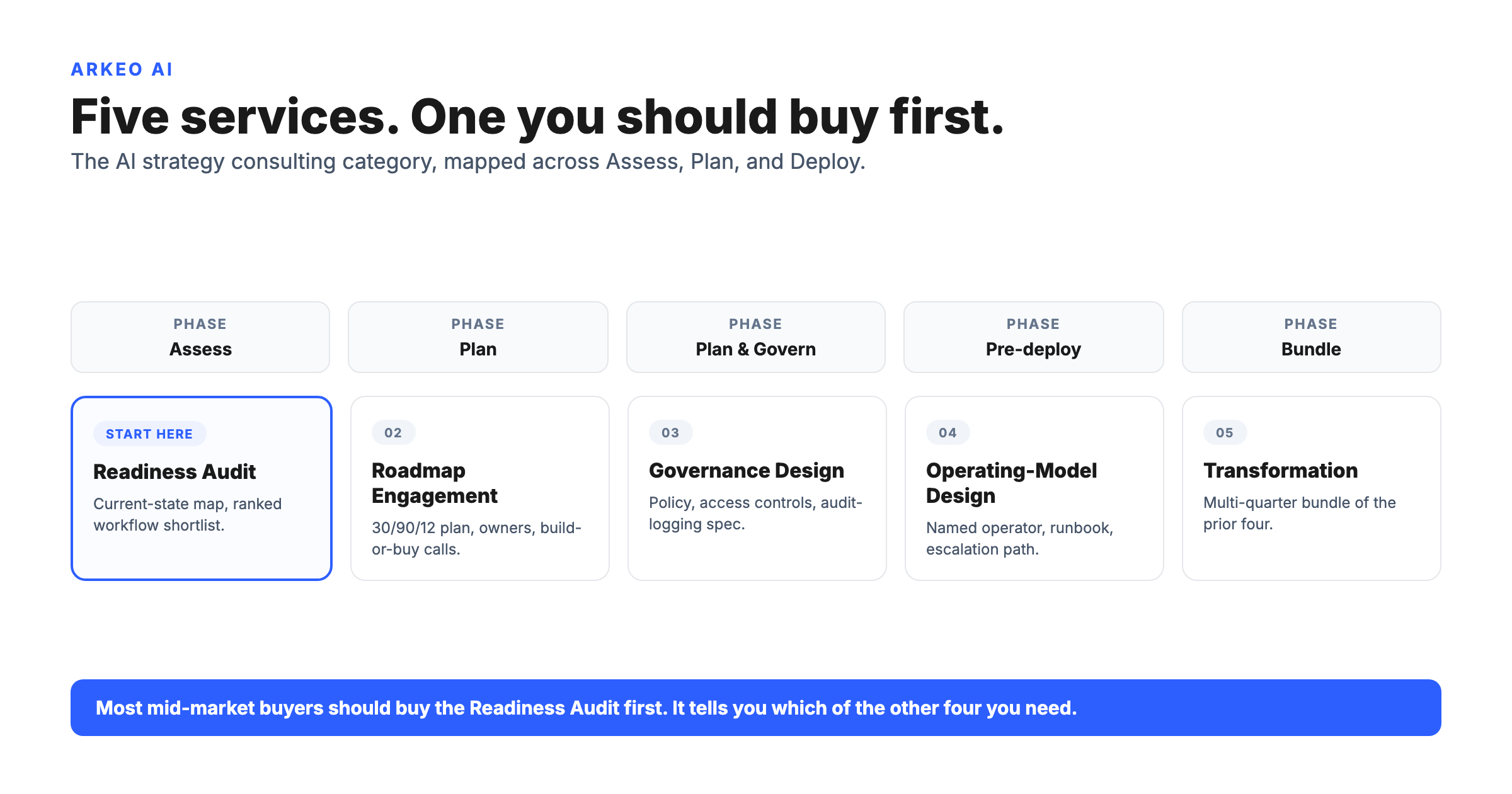
If you are evaluating AI strategy consulting services for a mid-market business and every vendor deck on your desk describes a different thing under the same name, this guide is the service-category map. One firm sells a $35K audit, another sells a $55K roadmap, a third sells a $180K transformation program, and the cheapest-and-correct answer is usually not the largest scope. Buy the wrong category and a six-figure engagement closes with a 40-slide deck instead of a ranked workflow shortlist, a data-path decision, or a named operator. In this guide, you'll get the five service categories (Readiness Audit, Roadmap Engagement, Governance Design, Operating-Model Design, Transformation Engagement), the defensible fee range for each, and the order most mid-market buyers should buy them in.
A scoped single-workflow agent reaches production in 6 to 10 weeks of build, or 8 to 12 weeks when private; that is the operating unit the strategy service has to lead toward, not a 40-slide deck. A free AI Assessment pre-scopes which of the five services you actually need before you sign a six-figure consulting engagement.
If you are choosing between firms rather than service categories, the shipped piece on comparing AI consulting firms is the right map. If the question is whether to hire a consultant at all or staff the work internally, the AI strategy consultant vs in-house decision covers it. This piece answers the question that comes before both of those: what kind of strategy service should you buy in the first place?
Quick Answer
• What it is: AI strategy consulting services break into five categories: Readiness Audit, Roadmap Engagement, Governance Design, Operating-Model Design, and Transformation Engagement.
• What each delivers: A current-state map, a sequenced plan, a policy and access framework, a post-launch ownership design, or a multi-quarter program bundle.
• Fee range: Audits land around $15K-$40K, roadmaps $25K-$60K, governance $20K-$50K, operating-model $15K-$35K, transformation $100K+.
• Which to buy first: A Readiness Audit. It is the cheapest service that tells you which of the other four you actually need.
Why do AI strategy consulting services come in five categories?
AI strategy consulting services are not one product. They are five distinct service categories sold under the same label, each with a different deliverable, duration, fee shape, and decision right. The reason buyers get confused is that the largest firms bundle all five into a single SOW and the smallest firms sell whichever one they happen to be good at, both calling the result "AI strategy."
The pressure to buy something is real. The Stanford HAI 2025 AI Index reports 78 percent of organizations used AI in 2024, up from 55 percent the year before. The PwC AI Agent Survey of 300 senior US executives found 88 percent of businesses are raising AI budgets this year. And the IBM IBV CEO Study of 2,000 CEOs across 33 countries found 54 percent already hiring for AI roles that did not exist a year ago, with "lack of expertise" cited as the top barrier and 65 percent planning to use automation to close skills gaps. The demand for outside help is at a peak. The supply is incoherent.
Most strategy work delivers a slide deck and disappears. Arkeo deploys a private, on-premise AI workforce where data never leaves the building, then operates it under the Assess, Deploy, Manage model. The reason the service-category map matters is that the slide deck is usually the wrong starting product. The audit is.
What are the five AI strategy consulting service categories?
Each category has a recognizable shape: a deliverable, a duration, a defensible fee range, and a clear buy-trigger. Read the grid below, then read the buying sequence under it. The categories are listed in the order most mid-market buyers should buy them, not in the order vendors prefer to sell them.
THE SERVICE LANDSCAPE
Five service categories, one buying map
Deliverable, duration, fee range, and the trigger that means you should buy this one.
SERVICE 01
Readiness Audit
A current-state map of workflows, data, and capability gaps, delivered in 4-6 weeks with a ranked shortlist of where AI would actually pay back.
FEE RANGE
$15,000 to $40,000
WHEN TO BUY
You do not yet know which workflow to put an agent on first.
SERVICE 02
Roadmap Engagement
A sequenced 30/90/12-month plan with a workflow shortlist, owner names, and a build-or-buy call on each line item, delivered in 8-12 weeks.
FEE RANGE
$25,000 to $60,000
WHEN TO BUY
The shortlist exists but the sequence, scope, and owners are unsettled.
SERVICE 03
Governance Design
A written AI policy, an acceptable-use framework, role-based access controls, and an audit-logging spec, delivered in 6-10 weeks.
FEE RANGE
$20,000 to $50,000
WHEN TO BUY
Security or regulated-data exposure is the deciding gate on any build.
SERVICE 04
Operating-Model Design
A named owner, a one-page runbook, an on-call rotation, and the escalation path for who runs the agent after launch, in 4-8 weeks.
FEE RANGE
$15,000 to $35,000
WHEN TO BUY
A build is queued and nobody can name who operates it in production.
SERVICE 05
Transformation Engagement
A 6-12 month program bundling audit, roadmap, governance, and operating-model work under a single program manager and a single SOW.
FEE RANGE
$100,000 and up
WHEN TO BUY
All four lower-tier services are missing and the board wants one throat to choke.
Most mid-market buyers should run a Readiness Audit first. It is the cheapest service that tells you which of the other four you actually need.
Picture a 400-person specialty distributor whose CEO has been told by the board to "have an AI strategy by Q3." The procurement team puts three vendors in the room: one quotes a $35,000 Readiness Audit, one quotes a $55,000 Roadmap Engagement, and one quotes a $180,000 Transformation Engagement. The temptation is to buy the largest scope because the board mandate sounds large. The cheaper-and-correct answer is the audit, because none of the workflows have been ranked yet and a roadmap built on an unranked workflow list is a slide deck. The Deloitte State of Generative AI Wave 4 study of 2,773 C-suite respondents found more than two-thirds expect 30 percent or fewer of their generative AI experiments to scale within three to six months. The audit is the cheapest way to bias your shortlist toward the 30 percent that will. BCG’s Where’s the Value in AI? report from October 2024 reached the same conclusion: 74 percent of companies struggle to capture value from AI, and the constraint is almost always sequencing rather than ambition.
Most engagements that fail were sold as Transformation when an Audit would have done. That is the blunt truth most slide decks bury. The expensive service is not the right service; it is the easiest service to sell to a nervous board, and the easiest line item to defend in a quarterly review when nothing has shipped.
The operator test: Pull the last AI consulting proposal you received. Which of the five categories does it actually fit? Write it down. Then check whether the deliverable described in the SOW matches what that category typically produces. If the category and the deliverable do not align, you are looking at a mispriced scope.
Cost shape matters as much as scope. The $35,000 audit pays back if it kills one workflow off the shortlist that would have absorbed a $200,000 build. Most strategy work delivers a slide deck and disappears. Arkeo’s differentiator is that the audit feeds directly into a deployed private AI workforce where data never leaves the building, then operates under the Assess, Deploy, Manage rhythm. We use what we sell, which is how the audit-to-deployment handoff stays connected instead of dropping at the slide-deck stage.
The free AI Assessment names which of the five service categories fits your situation, what good would look like in writing, and the one workflow worth running an audit against first.
Book Your Free AI Assessment →In what order should you buy AI strategy consulting services?
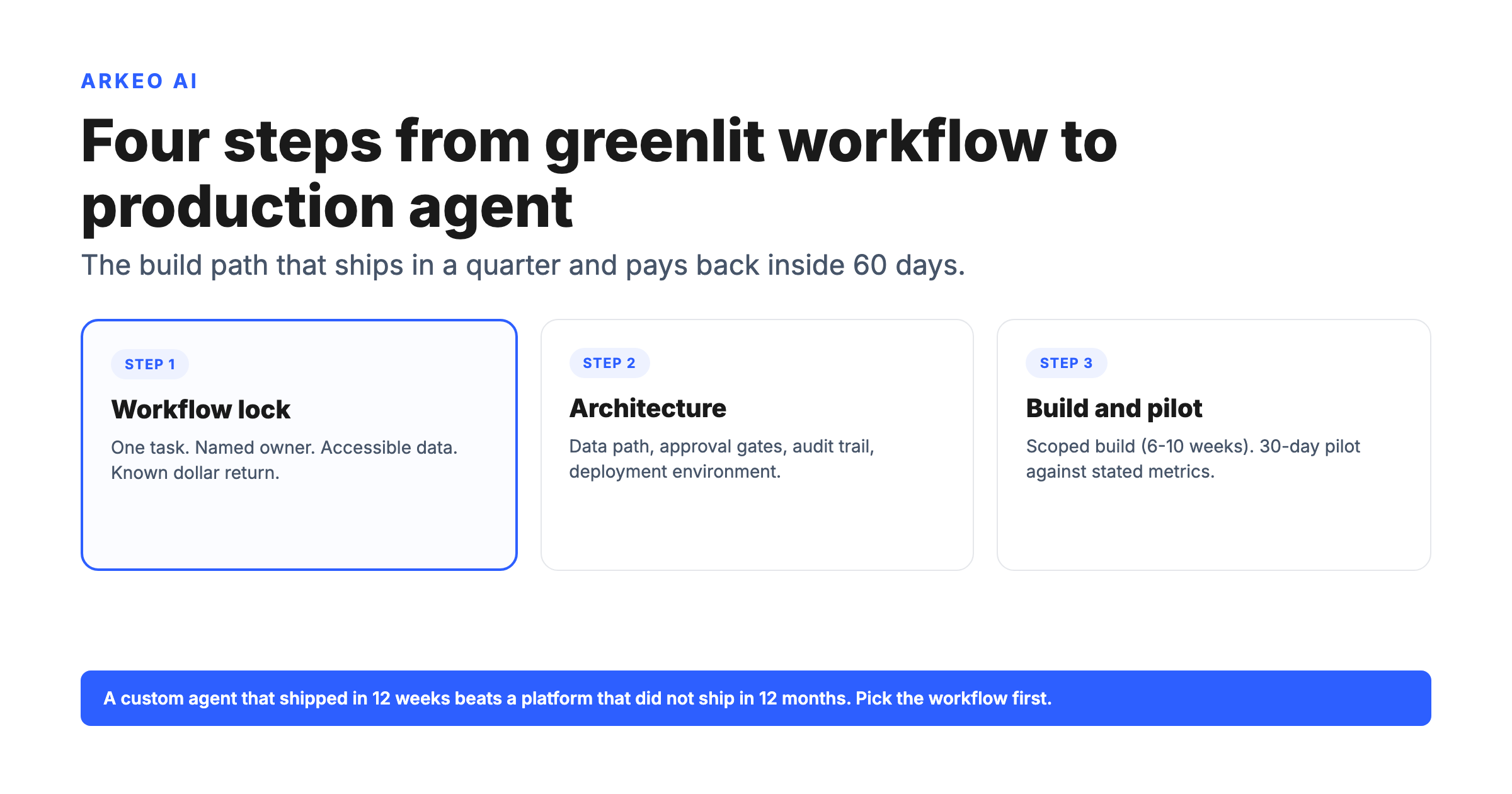
The buying sequence matters more than the category list. Most mid-market businesses arrive at the question with one of the lower-tier services already missing, and the fix is sequential rather than bundled. The order below is the one Arkeo’s build experience consistently rewards. The cost anchors in this section are operator prose from running Arkeo’s own scoped agent builds, not sourced statistics.
THE BUYING SEQUENCE
Four steps, in this order
Each step earns the right to buy the next one. Skipping ahead is the common mistake.
STEP 01
Start with the Readiness Audit
It is the cheapest service that names the one workflow to put an agent on first, and the one that decides whether you need roadmap or governance next.
STEP 02
Roadmap if scope is unclear; Governance if security is the bar
Buyers with a long, unranked shortlist need a roadmap. Buyers in regulated environments need governance before any build SOW is signed.
STEP 03
Operating-Model Design before the build, not after
Decide who runs the agent in production, on what cadence, with what escalation path, before any code is written. Added afterward, it rarely lands.
STEP 04
Transformation Engagement only when ALL THREE are missing
If audit, roadmap, governance, and operating-model are all absent and the program has board-level visibility, a bundled transformation is the right vehicle.
Most engagements that fail were sold as Transformation when an Audit would have done.
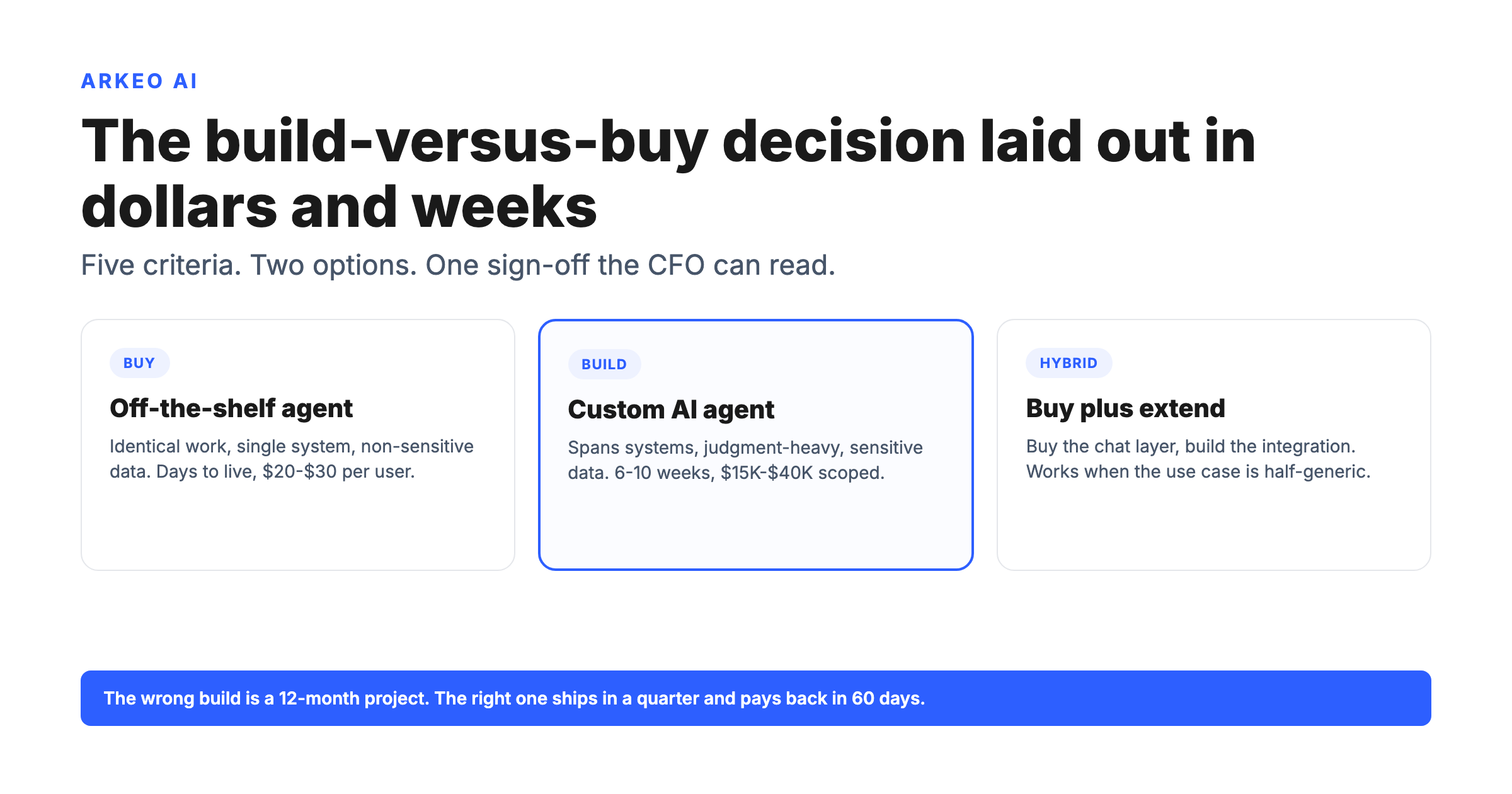
Picture a regulated mid-market services firm with 600 staff, an unresolved data-residency clause in its largest client contract, and one VP who has been running a chatbot pilot for fourteen months. The vendor on the table is proposing a $140,000 Roadmap Engagement. The correct order of operations is Governance Design first, because the data path will dictate which workflows are even buildable, then a narrow Readiness Audit on the two workflows that survive the governance pass, then a tightly scoped Roadmap on the survivors. The roadmap sold first would have been a slide deck with a residency footnote that voids half of it. Arkeo’s build experience here is consistent: a scoped, single-workflow agent runs about $15,000 to $40,000 and 6 to 10 weeks to production, or 8 to 12 weeks for private and enterprise deployments where data never leaves the building. Off-the-shelf copilots come in around $20 to $30 per user per month and live in days. The first quick win typically lands in 30 to 90 days. None of those timelines survive a governance surprise at week 30. Arkeo operates the same agents it deploys for clients; we use what we sell.
How do AI strategy consulting services differ from AI implementation services?
Strategy services produce a decision: which workflow, which sequence, which data path, which owner. Implementation services produce a deployed agent under that decision. The two are sold separately for a reason. Strategy without implementation is a slide deck; implementation without strategy is an expensive agent on the wrong workflow. The cleanest mid-market sequence is a Readiness Audit, a narrow Operating-Model Design, and then an implementation SOW on one workflow, with the rest of the shortlist sequenced for the next two quarters.
The operator test: Ask your current or prospective strategy consultant to name the four written artifacts their engagement produces. If the answer includes “a workshop” or “a board readout” but not a ranked workflow shortlist and kill criteria, the service will likely produce a deck rather than a decision.
The expertise gap is the structural pressure behind both services. The IBM CEO study found that 65 percent of CEOs plan to use automation to close skills gaps, and the same study reported "lack of expertise" as the top barrier to AI progress. The strategy service buys you the decision; the implementation service buys you the deployed work. Conflating them is how mid-market buyers spend $200,000 on a roadmap and have nothing in production a year later. The shipped piece on AI strategy framework covers the methodology that sits behind the audit-to-implementation handoff, and the pillar on enterprise AI strategy is the wider map.
What does a good AI strategy consulting engagement actually deliver?
A good engagement delivers four artifacts, in writing, regardless of which of the five categories was bought. A ranked workflow shortlist with named owners. A documented data path that legal and security have signed off on before any build SOW. A one-page operating runbook describing who runs the agent in production. A kill-criteria definition that names the measurable outcome and the date that would halt the program. If the deliverable is a 40-slide deck without those four artifacts, the wrong service was bought, or the right service was bought from the wrong firm.
Strategy that does not graduate into deployment is the dominant failure mode of the category, and the audit-first sequence is the cheapest way to avoid it.
How do you evaluate an AI strategy consulting proposal before you sign?
Three questions surface the proposals that will deliver. First, which of the five categories does this engagement actually fit, and is the fee defensible against the typical range? A $90,000 Readiness Audit is a roadmap mispriced. A $40,000 Transformation is one of the four lower-tier services with the wrong label. Second, what is the named deliverable, written as an artifact rather than a slide count? "A workshop and a board readout" is not a deliverable. "A ranked workflow shortlist, a documented data path, a one-page operating runbook, and a kill-criteria definition" is. Third, what is the handoff into implementation, and is the same firm willing to do that work, or will it disappear at the deck?
The PwC survey reported 79 percent of US businesses already adopting AI agents and 88 percent raising budgets, which is the pressure that makes the wrong proposal easy to sign. The discipline that protects the budget is the service-category map, and the Operating-Model Design step is the one most buyers forget until the agent is live and nobody is named to run it.
The free AI Assessment maps your situation to one of the five service categories, the defensible fee range, and the workflow worth piloting first, so the next SOW you sign matches the work you actually need.
Book Your Free AI Assessment →