Category
AI Implementation Services: The Four Delivery Models
Last updated: June 4, 2026
By David Brennan · Arkeo AI · Building and Deploying Custom AI agents since 2023
If you are the operator about to sign an SOW for AI implementation services, the proposals on your desk almost certainly do not compare on the same terms. One vendor is selling a monthly retainer, one is selling a fixed-fee build with a hand-off, one is selling a system-integration contract that leaves the running agent to your team. Picking the wrong delivery model is not a price mistake. It is an eighteen-month operating mistake: the team you do not have absorbs work it cannot carry, the vendor walks at go-live with no Manage phase, and the agent quietly degrades two model updates later. In this guide, you'll get the four delivery models side by side (managed services, project, integration-only, build-and-run), the situation each one actually fits, and the one question that decides which is right for your operation.
A scoped single-workflow agent reaches production in 6 to 10 weeks when it is built on shared cloud infrastructure, and 8 to 12 weeks when the deployment is private. Those numbers are deployment timelines, not operating-cost timelines, which is exactly where the four delivery models diverge. Before the SOW is signed, a free AI Assessment maps your internal capacity and operations preference to the model that actually fits.
If you are still pricing the work, the dedicated piece on AI consultant cost covers day rates, fixed fees, and retainers. If you are choosing between strategy service categories (audit, roadmap, governance), see AI strategy consulting services. This post is about how the build itself gets delivered and, more importantly, who runs it after.
Quick Answer
• What it is: AI implementation services break into four delivery models: managed services, project delivery, integration-only, and build-and-run.
• The deciding question: Where will the operations capability sit in 18 months, inside the vendor or inside your team?
• Cost shape: Project delivery wins year one. Build-and-run typically wins year three.
• Why it matters: The model decides retained knowledge, runaway monthly spend, and whether the agent survives the first vendor change.
What are the four AI implementation delivery models?
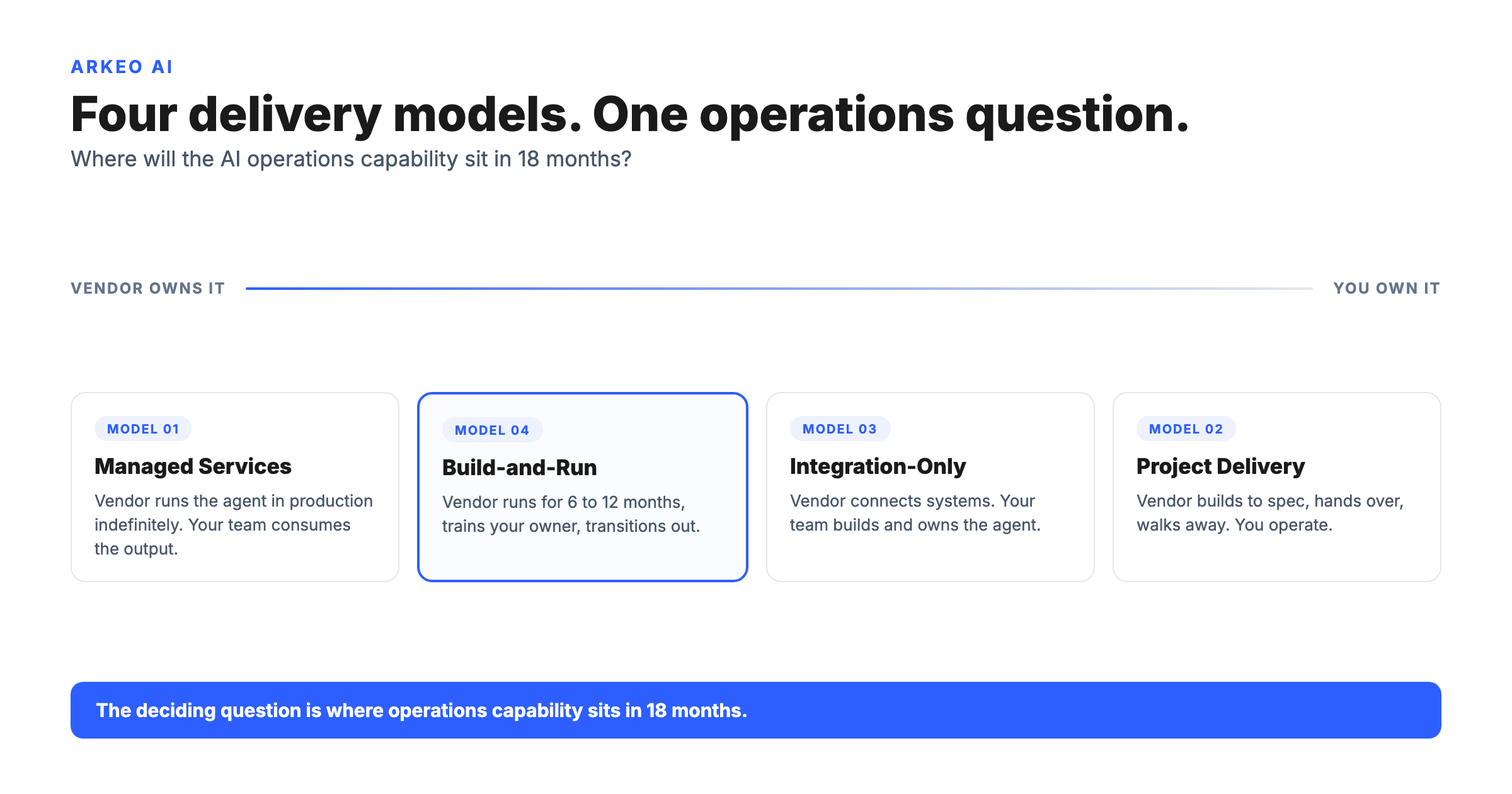
AI implementation services are delivered under four distinct models: managed services (vendor runs the agent in production indefinitely), project delivery (vendor builds to spec, hands over, walks away), integration-only (vendor connects systems while your team owns the agent), and build-and-run (vendor builds, runs the agent for 6 to 12 months, trains your internal owner, then transitions out). The technical work overlaps. The operating shape, the retained knowledge, and the cost curve do not.
The demand backdrop matters here. The PwC AI Agent Survey of 300 senior US executives found 79 percent of US businesses already adopting AI agents and 88 percent raising AI budgets, with 66 percent of adopters reporting measurable productivity gains. The Stanford HAI 2025 AI Index reports 78 percent of organizations used AI in 2024, up from 55 percent the year before. The work is being commissioned. The question is which delivery model the work is being commissioned under, and that is where most mid-market RFPs go wrong.
THE FOUR MODELS
How AI implementation services actually get delivered
Same agent. Four very different operating shapes.
MODEL 01
Managed Services
Vendor runs the agent in production indefinitely. Your team consumes the workflow output and routes exceptions.
WHO OPERATES
Vendor on-call. Your team does not touch the runbook.
COST SHAPE
Monthly retainer roughly $8K to $15K after build, ongoing.
MODEL 02
Project Delivery
Vendor builds to a fixed spec, hands the agent over, and walks away. Your team owns operations from day one of production.
WHO OPERATES
Your team, from go-live. No vendor on-call.
COST SHAPE
One-time build, roughly $40K to $120K, no monthly fee.
MODEL 03
Integration-Only
Vendor connects the agent to your systems, identity, and data path. Your internal team builds and owns the agent itself.
WHO OPERATES
Your team builds and runs. Vendor owns the plumbing only.
COST SHAPE
One-time engagement, roughly $25K to $60K, no monthly fee.
MODEL 04
Build-and-Run
Vendor builds, runs the agent for 6 to 12 months, trains your internal owner alongside it, and transitions out at month 12 to 18.
WHO OPERATES
Vendor first, your team takes over by month 12 to 18.
COST SHAPE
Build $15K to $40K + $5K to $10K monthly run-phase fee.
The deciding question is where operations capability sits in 18 months.
Picture a 280-person specialty insurer running a claims-summary agent that processes 1,200 first-notice-of-loss documents a week. Under managed services, the vendor watches the drift dashboard, retrains the agent when a new claim category appears, and is on-call when the model misclassifies a regulatory edge case. The internal claims team never sees a runbook. Eighteen months in, the agent works and zero internal employees know how to operate it. That trade is the right one when in-house capacity is genuinely unstaffable, and the wrong one when it was chosen by inertia.
When does managed AI services fit, and when does it trap you?
Managed services is the right answer when your team cannot hire or retain an AI operations role in your market. The IBM IBV CEO Study of 2,000 CEOs across 33 countries found 54 percent already hiring for AI roles that did not exist a year ago, with “lack of expertise” cited as the top barrier and 65 percent planning to use automation to address skills gaps. If that hire is impossible, managed is the path of least resistance. The trap is retained knowledge: 18 months in, your team still cannot run the agent without the vendor, and the monthly fee compounds.
Why does project delivery look cheap until year two?
Project delivery is the cleanest contract on paper: a fixed-fee build, a defined acceptance test, a documented hand-over, and no monthly relationship. Year one looks great on the budget. Year two is when the question gets uncomfortable: who fixes the agent when the upstream data schema changes, when the underlying model is deprecated, or when an exception class appears that nobody trained for? Project delivery is the right answer when your internal team is already running production AI with its own MLOps discipline. Outside of that, the saved monthly retainer often gets spent twice over in unbudgeted internal cycles. The Deloitte State of Generative AI Wave 4 study of 2,773 C-suite respondents found more than two-thirds expect 30 percent or fewer of their generative AI experiments to scale within three to six months, and the most common reason a pilot does not scale is exactly this: the vendor walked away from a working demo and the internal team could not pick it up. BCG’s Where’s the Value in AI? report from October 2024 reached the same conclusion from a different angle, finding 74 percent of companies struggling to capture value from AI.
What does integration-only AI implementation actually cover?
Integration-only is the model where the vendor handles the messy plumbing (identity, data path, system connectors, observability) while your internal team builds and owns the agent itself. The right buyer is an organization with a real data and ML team in place who needs the integration work done in weeks instead of quarters but does not want to outsource the modeling judgment. The silent cost is internal time. Integration-only contracts price the vendor’s hours. They do not price the 30 to 50 percent of an internal AI engineer’s time that gets spent on the agent for the next 12 months. Use this model only when you can name that internal owner today, with a job title and a calendar.
The free 60-minute AI Assessment maps your internal capacity, your budget shape, and your operations preference to one of the four delivery models, before you put a single SOW in front of legal.
Book Your Free AI Assessment →How does build-and-run AI delivery transition out of vendor dependency?
Build-and-run is the hybrid most mid-market operators end up wanting once the trade-offs are visible. The vendor builds the agent, runs it in production for 6 to 12 months alongside a named internal owner, trains that owner against the live workflow, and transitions operations to your team by month 12 to 18. The contract ends with internal capability, not vendor dependency. It is the right answer when two things are true at the same time: you do not have an in-house operator on day one, and you do not want to be paying a monthly retainer in year three. In Arkeo’s experience the build phase runs roughly $15,000 to $40,000 for a scoped single-workflow agent, with the run phase priced at roughly $5,000 to $10,000 per month, decreasing as the internal owner takes more of the load. The first quick win typically lands in 30 to 90 days. Arkeo deploys this under the Assess, Deploy, Manage rhythm on a private deployment where data never leaves the building, and runs its own operations on the same private agents it deploys for clients (we use what we sell), which is why the transition framework is designed to actually happen rather than quietly extend.
The operator test: Ask the build-and-run vendor one question before you sign: Who is the named internal owner you will train, and what does ownership mean when the run phase ends? If neither answer is in the SOW, the transition is aspirational rather than contractual.
For the vetting checklist on the human side of any of the four models, see vetting an AI implementation consultant. For broader market context across consultancies, boutiques, integrators, and managed services firms, see AI consulting firms. The methodology that wraps all four delivery models lives in the pillar on enterprise AI strategy.
How do you choose the right AI implementation model for a mid-market business?
The deciding question is not a budget question. It is an operations question: where will the AI operations capability sit in 18 months, inside the vendor or inside your team? Once that is answered honestly, the model that fits is usually obvious. The cost curves expose why.
COST SHAPE OVER 18 MONTHS
Same agent. Four cumulative spend curves.
Ranges reflect a scoped single-workflow agent in Arkeo’s experience. Not a quote.
MANAGED
Steady monthly burn
MONTH 0 (BUILD)
$20K to $50K one-time
MONTH 18 (CUMULATIVE)
$164K to $320K and still climbing
THE TELL
No retained capability. Year three keeps paying.
PROJECT
Flat after delivery
MONTH 0 (BUILD)
$40K to $120K one-time
MONTH 18 (CUMULATIVE)
$40K to $120K (no monthly fee)
THE TELL
Retained knowledge cost is real but unbudgeted.
INTEGRATION
Vendor cost flat, internal cost loaded
MONTH 0 (BUILD)
$25K to $60K vendor fee
MONTH 18 (CUMULATIVE)
$25K to $60K vendor + ~30-50% of an internal AI engineer
THE TELL
Internal team time is the cost the SOW doesn’t show.
BUILD-AND-RUN
Year-one peak, year-three minimum
MONTH 0 (BUILD)
$15K to $40K one-time
MONTH 18 (CUMULATIVE)
$105K to $220K, then ~$0 monthly
THE TELL
Highest year one. Lowest year three. Capability stays in-house.
Project delivery wins year one. Build-and-run wins year three.
Picture two 400-person mid-market firms commissioning the same back-office workflow agent. Firm A is a logistics company with a one-person ML team that is already over-extended and signs a managed services contract at roughly $12,000 a month. Eighteen months in, they have spent about $216,000 in run fees on top of the build, the agent works, and zero internal employees know how to operate it. Firm B is a regional bank with a small data engineering team and a directive from the COO that AI operations must be in-house by fiscal year-end. They sign a build-and-run contract. Eighteen months in, they have spent more than Firm A on month-one build plus run-phase fees, but the run-phase fee is now zero and one named employee runs the agent. By month 30, Firm B is well ahead. By month 36, the gap is not close.
The operator test: Look at the AI vendor contracts currently on your desk. For each one, write a single sentence that describes where the AI operations capability will sit in 18 months: inside the vendor or inside your team. If you cannot write that sentence confidently, the delivery model decision has not been made yet.
The honest blunt truth: most mid-market buyers default to managed services because it asks the least of them at signing. That is the right answer when in-house capacity is genuinely impossible to staff. It is the wrong answer when it was chosen by inertia. The point of the assessment is to make the choice consciously.
A 60-minute free AI Assessment names the delivery model that fits your operations capability, your budget shape, and your 18-month plan, and the one workflow worth taking to production first.
Book Your Free AI Assessment →