Category
AI Implementation Consultant: The Vetting Checklist
Last updated: June 2026
By David Brennan · Arkeo AI · Building and Deploying Custom AI agents since 2023
The question most operators ask wrong is: should we hire an AI consultant or build in-house? The question they should be asking is: which decisions require outside expertise to make correctly, and which decisions require inside context that no consultant will ever have?
Those are different questions. They produce different answers. Here is the framework for separating them.
Quick Answer
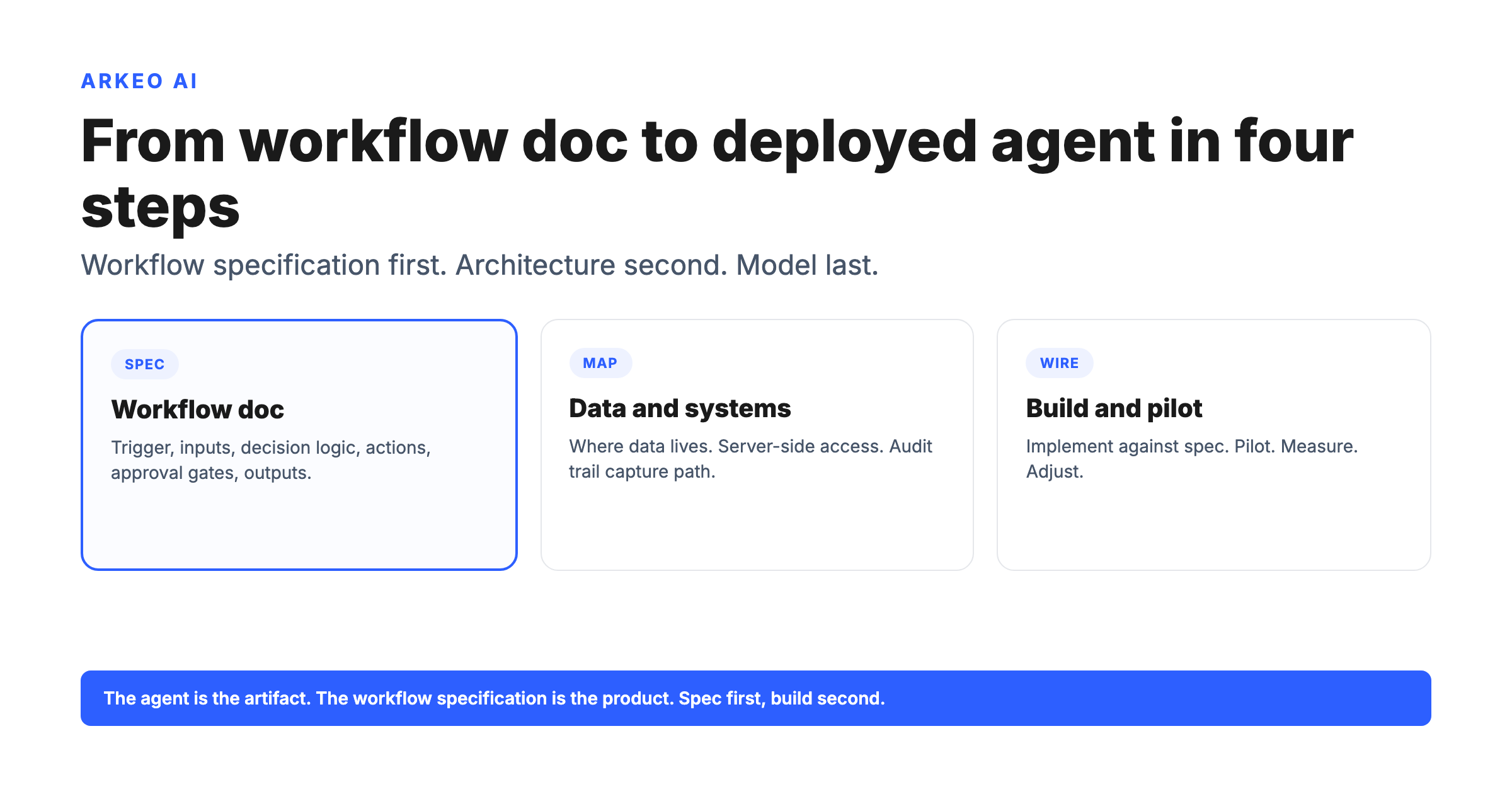
Use a consultant for: Technical build (agent architecture, integration engineering, private infrastructure setup). Structured assessment (current-state map, workflow scoring, data-path review). Any work where outside expertise accelerates a specific deliverable.
Keep in-house: Workflow selection. Owner registry. Kill criteria. Governance structure. Any decision where inside business context is the primary input.
The rule: A consultant who makes the business decisions (which workflow to build, who owns it, what the kill criteria are) is substituting for accountability rather than adding expertise. Those decisions stay inside the business.
The free AI Assessment runs the current-state map and workflow scoring in one session. You see what a well-run structured assessment produces, and you walk out with the inputs your build team needs to start, whether that build is internal or consultant-led.
Book Your Free AI Assessment →What an AI implementation consultant actually does
An AI implementation consultant accelerates technical decisions by applying expertise the business does not yet have. At the structural level: agent architecture (how the workflow is decomposed into prompts, tools, and evaluation loops), integration engineering (connecting the agent to the specific data sources, APIs, and approval workflows in the client's stack), and private infrastructure setup (configuring on-premise or private cloud deployment for data-sensitive workflows). At the assessment level: the structured current-state map, the workflow scoring methodology, and the data-path review that identifies which workflows are cloud-safe and which require private deployment.
Those are the activities where consultant expertise creates genuine acceleration. A consultant who has built 40 agents across 15 industries knows the integration failure patterns, the prompt brittleness risks, and the override-rate benchmarks that an internal team building its first agent does not know. That knowledge has a legitimate value.
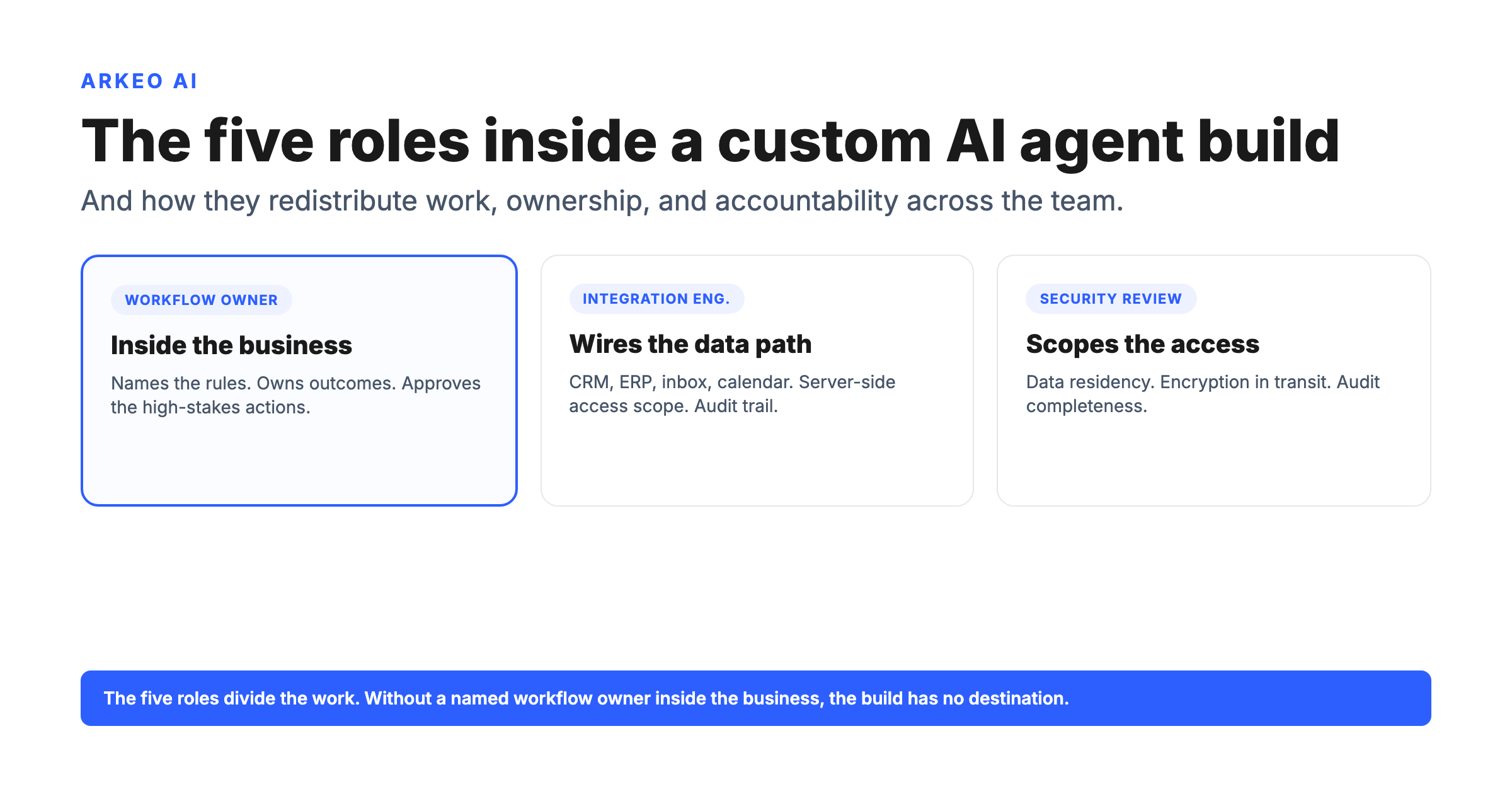
What a consultant does not have is the inside context required to make the three binding business decisions: which workflow has the most strategic value for this specific organization, who should own it given the internal accountability structure, and what the acceptable performance boundary is given the business's risk tolerance. Those decisions require the people who run the business. A consultant who makes them is substituting for accountability.
The full consultant vs. internal comparison covers the cost trade-offs in detail. This article is specifically about the decision boundary: where outside expertise adds value and where it substitutes for the business decisions that must be made internally.
DECISION BOUNDARY: CONSULTANT vs IN-HOUSE
Use a consultant for:
Keep in-house:
How to evaluate an AI implementation consultant
Four questions. Ask them in this order.
First: What was the override rate on the last three agents you deployed, and what was the threshold in the kill criteria? A consultant who cannot answer this question with specific numbers has not deployed agents with governance structures. They have deployed proofs of concept and called them deployments. The answer you are looking for is a specific override rate (under 8 percent for document processing workflows is a common benchmark) and a specific kill-criteria threshold (typically 15 to 20 percent override rate as the trigger for a paused review).
Second: What was your process for making the data-path decision on the last private-path deployment? A consultant who has done private-path deployments has a specific answer: how they structured the security review, what documentation they produced for the legal sign-off, and how long the approval process took. A consultant who gives a generic answer about data governance frameworks has not closed a data-path decision with a legal team under time pressure.
Third: Show me the build brief format you use. The build brief should contain the workflow name, data-path decision, owner registry (executive and operational), baseline methodology, kill criteria, and 30/90-day milestones. A consultant whose build brief is a project plan with no owner registry and no kill criteria produces the governance vacuum described in the AI implementation challenges article.
Fourth: What is your post-deployment role? A consultant whose post-deployment role is undefined or "available for ongoing support" has not built the governance structure into the deployment. The correct answer is: the consultant's post-deployment role is to run the first 90 days of monthly reviews with the operational owner, then hand off a documented operating rhythm that the internal team can run independently. A deployment that creates permanent consultant dependency is not a deployment. It is a managed service dressed as a strategy project.
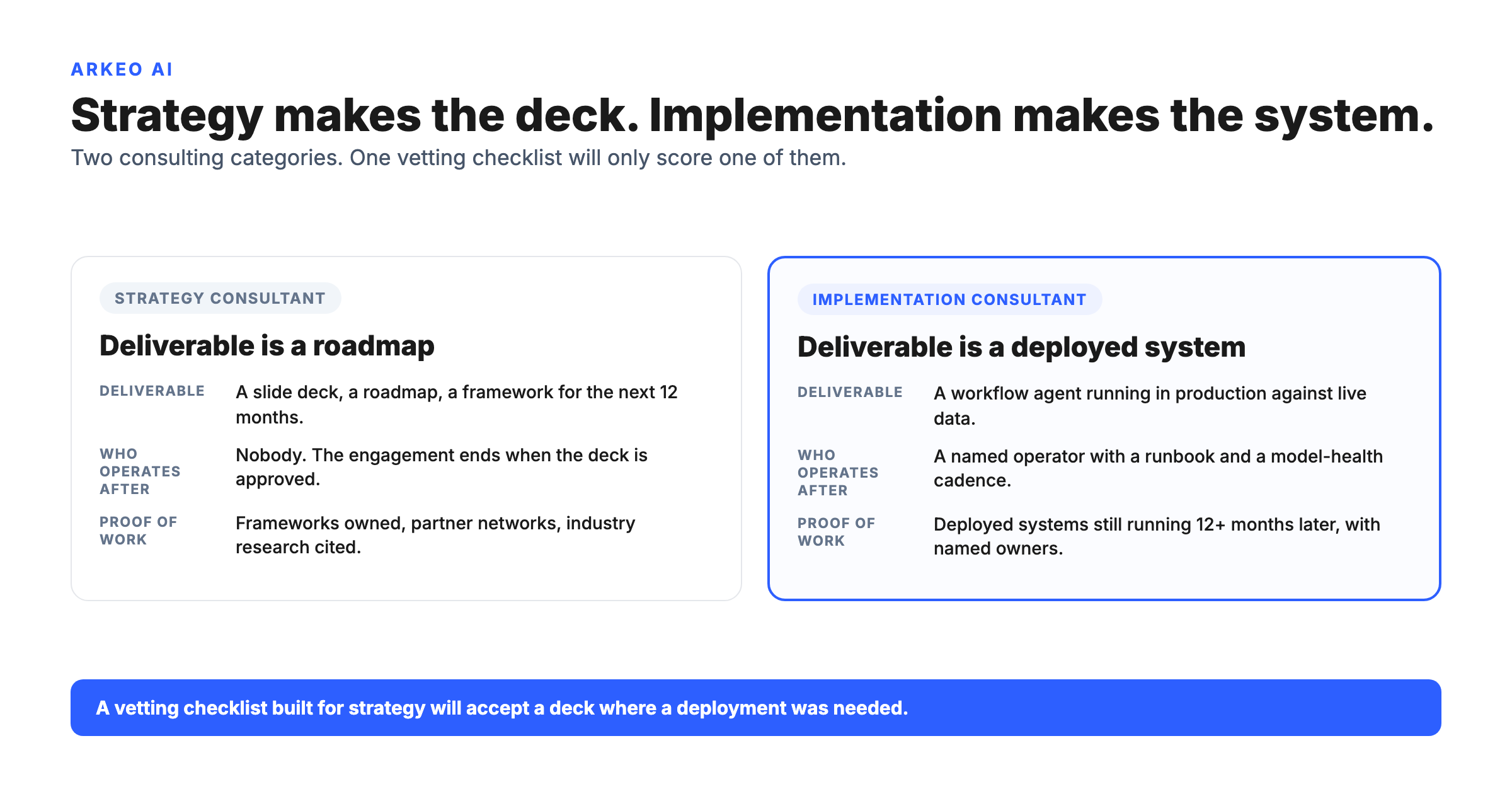
The operator test: Take the four questions above and use them in your next consultant evaluation conversation. If a consultant cannot answer all four with specific operational details rather than methodology frameworks, they are at the strategy tier rather than the implementation tier. The strategy tier is valuable for Stage 1 and Stage 2 problems. The implementation tier is what you need when the build starts.
THE 4 VETTING QUESTIONS
QUESTION 1
What was the override rate on the last three agents you deployed?
Looking for: specific numbers (under 8% for document processing). No specific answer = no production deployments with governance.
QUESTION 2
What was your data-path decision process on the last private-path deployment?
Looking for: specific process (security review structure, legal sign-off timeline). Generic answer = no private-path experience under real pressure.
QUESTION 3
Show me the build brief format you use.
Looking for: owner registry + kill criteria sections visible. A project plan with no kill criteria = governance vacuum guaranteed.
QUESTION 4
What is your post-deployment role?
Looking for: defined handoff timeline. “Available for ongoing support” = managed service dressed as a strategy project.
Cost structure: consultant vs. internal build
A scoped single-workflow agent built by an external consultant with Arkeo-tier expertise runs $15,000 to $40,000 on a cloud path, or $20,000 to $50,000 on a private path, including assessment, build, deployment, and 90-day post-deployment support. That is the total engagement cost for a workflow in production with governance structure in place.
An internal build for the same workflow, assuming a mid-level machine learning engineer at $160,000 annual fully loaded cost, runs $30,000 to $60,000 in staff time for a 90-day build cycle, plus the infrastructure and tooling costs. That estimate assumes the internal engineer has integration and deployment experience comparable to the consultant. A first-time internal build without prior agent architecture experience frequently runs 120 to 180 days rather than 90, raising the internal cost to $50,000 to $80,000.
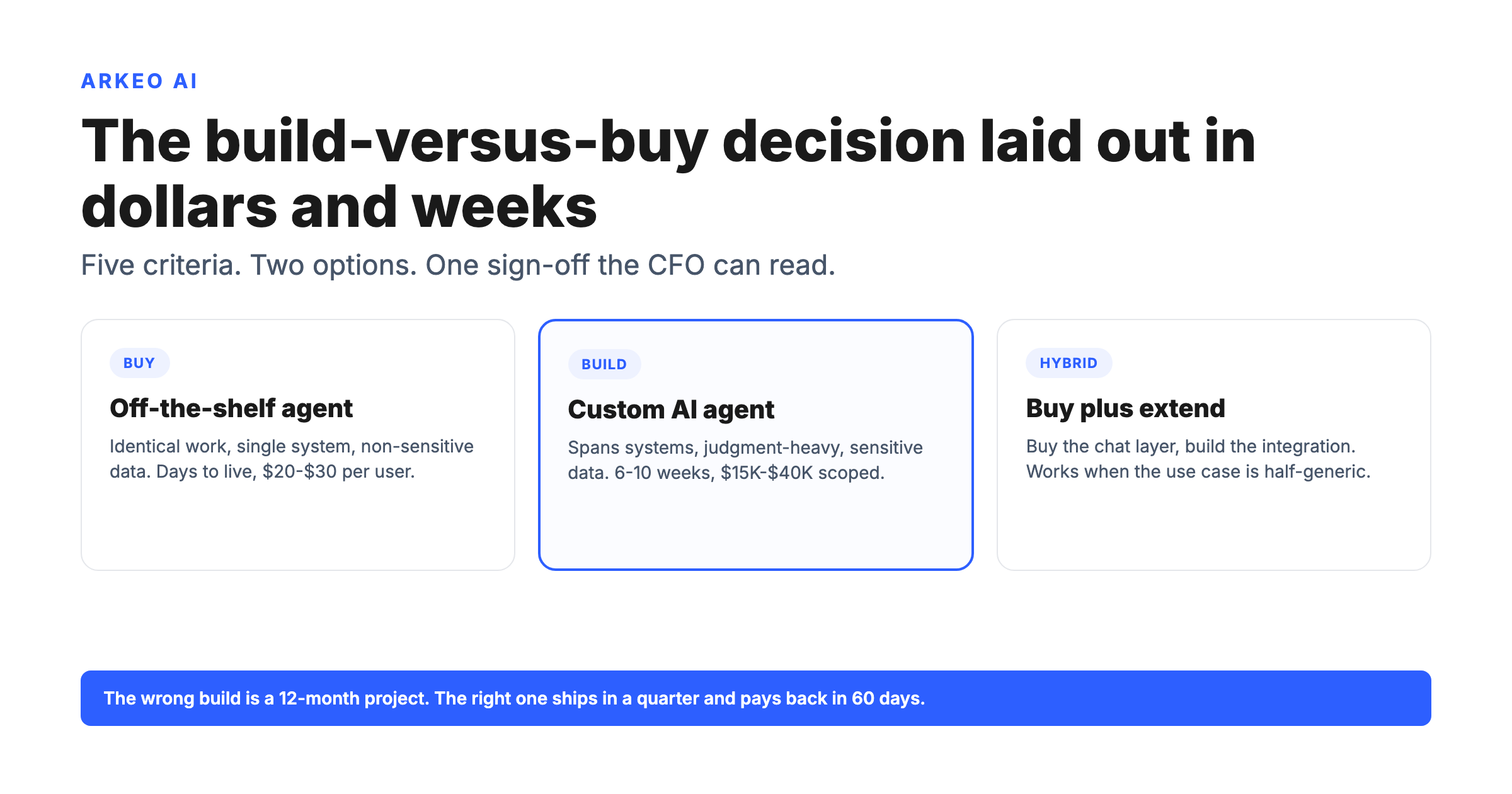
The cost comparison favors consultants for the first one to three workflows. It shifts toward internal for the fourth workflow and beyond, once the internal team has the build-brief template, the operating rhythm document, and the integration patterns from the first three deployments. A business that brings a consultant in for the first deployment with the explicit goal of knowledge transfer, operating rhythm documentation, and internal team capability building gets both the acceleration of the first deployment and the internal capability for subsequent ones.
The consultant vs. internal build article has the full cost model by deployment count. The reference costs above are consistent with Arkeo's 2023-to-2026 deployment data across industries.
The three consultant failure modes to avoid
The first failure mode is strategy without implementation. Some AI consultants are excellent at producing strategy documents: current-state maps, vendor assessments, transformation roadmaps. They have never built an agent that ran in production for 90 days with a documented override rate. The strategy document they produce is accurate and well-structured. It does not accelerate the build because it was not written by someone who has closed the seven pre-build decisions described in the AI implementation challenges article. Ask for the override rate before the engagement starts.
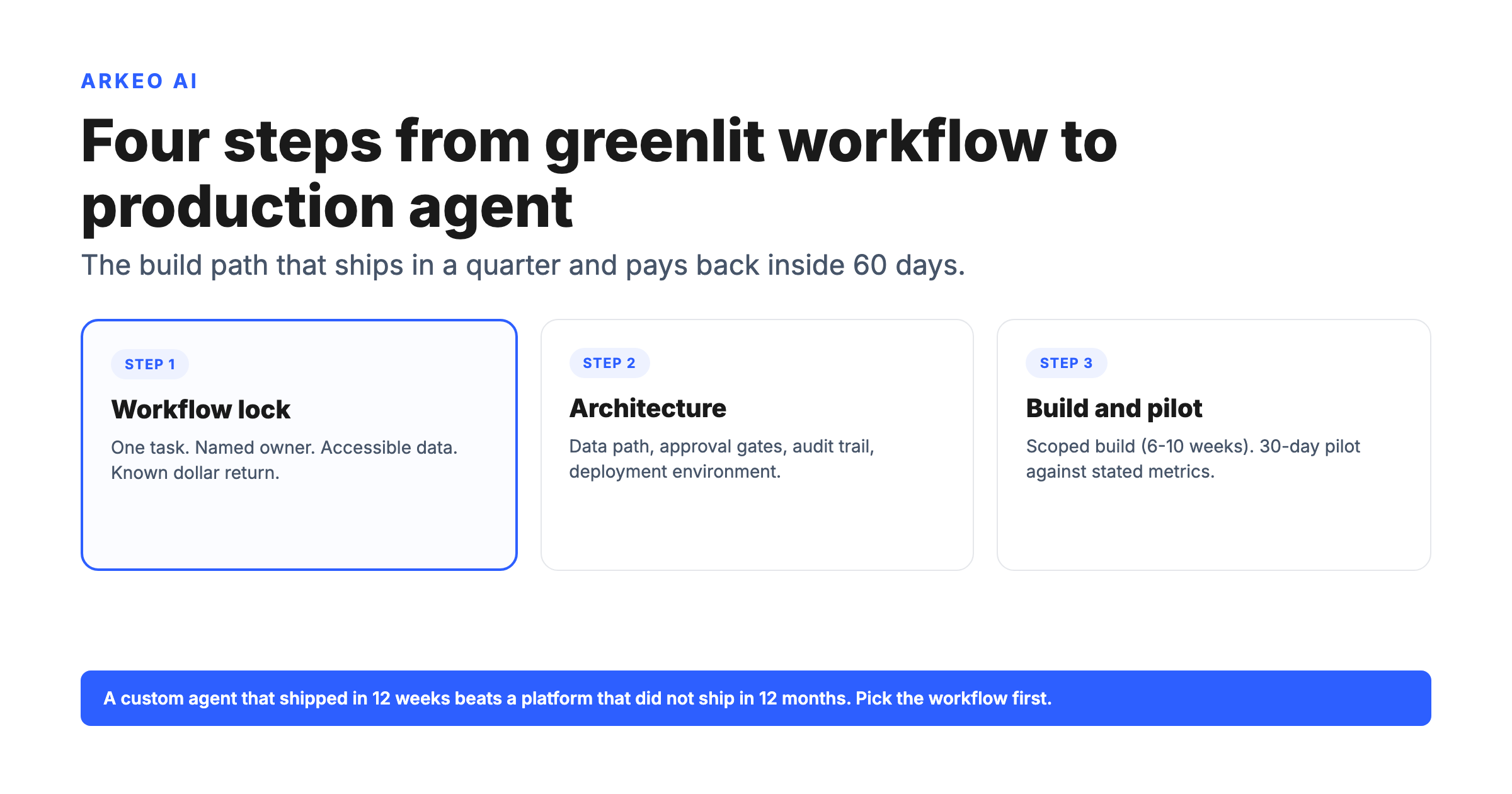
The second failure mode is the indefinite engagement. A consultant who structures the engagement without a fixed deliverable and a fixed end date is building in perpetual dependency. The correct engagement structure is: assessment phase (two to four weeks, deliverable is the build brief), build phase (30 to 60 days, deliverable is the agent in staging), deployment and governance phase (30 days, deliverable is the agent in production with operating rhythm handed off). Fixed deliverables. Fixed end dates. The post-engagement relationship should be optional ongoing support, not required maintenance.
The third failure mode is the platform recommendation that matches the consultant's partnership revenue. Consultants with reseller agreements or partnership tiers on specific AI platforms have a structural incentive to recommend those platforms regardless of fit. The fix is the sequence discipline from the AI strategy for business article: complete the current-state map and workflow shortlist before the consultant makes any platform recommendation. A recommendation that precedes the workflow shortlist is a sales motion, not a strategy recommendation.
The free AI Assessment is the assessment phase in action. You get the current-state map, workflow shortlist, data-path review, and the build brief inputs, whether you choose to continue with Arkeo or take the brief to another team. No platform recommendation until the shortlist is complete.
Book Your Free AI Assessment →Frequently Asked Questions
The free AI Assessment is the assessment phase from a team that has deployed agents in production since 2023. You get the current-state map, workflow shortlist, and data-path review. No ongoing commitment. No platform recommendation before the shortlist is complete.
Book Your Free AI Assessment →