Category
AI Agents for Operations Teams
Last updated: May 2026
Operations is where the recurring glue work piles up. Someone pulls the same status report every Monday, someone watches a dashboard for the alert that matters, someone chases three systems to confirm one job actually closed. AI agents for operations are software workers that run a defined operational workflow end to end: they gather data across systems, apply your rules, and produce an output, a report, an alert, an update, or a flagged exception, without a person driving each step. Arkeo AI was founded in 2023 by an operator with 25 years running real businesses, and across three years of deploying agents in real operations, including its own, one pattern holds: operations leaders do not need another productivity app, they need the boring repeatable work handled reliably. We use what we sell, and that is exactly where agents earn their keep first.
Quick Answer
• What they do: AI agents for operations handle the recurring cross-system work, status reporting, monitoring, coordination, and exception handling, so your team stops doing it by hand.
• Where to start: a recurring internal report or a status roll-up, because the payoff is fast, the risk is low, and the owner is obvious. A free AI Assessment ranks the workflows worth targeting first.
• Why it matters: the first operations agent reclaims hours every week and frees the team for the judgment work software cannot do.
What Can AI Agents Actually Do for Operations Teams?
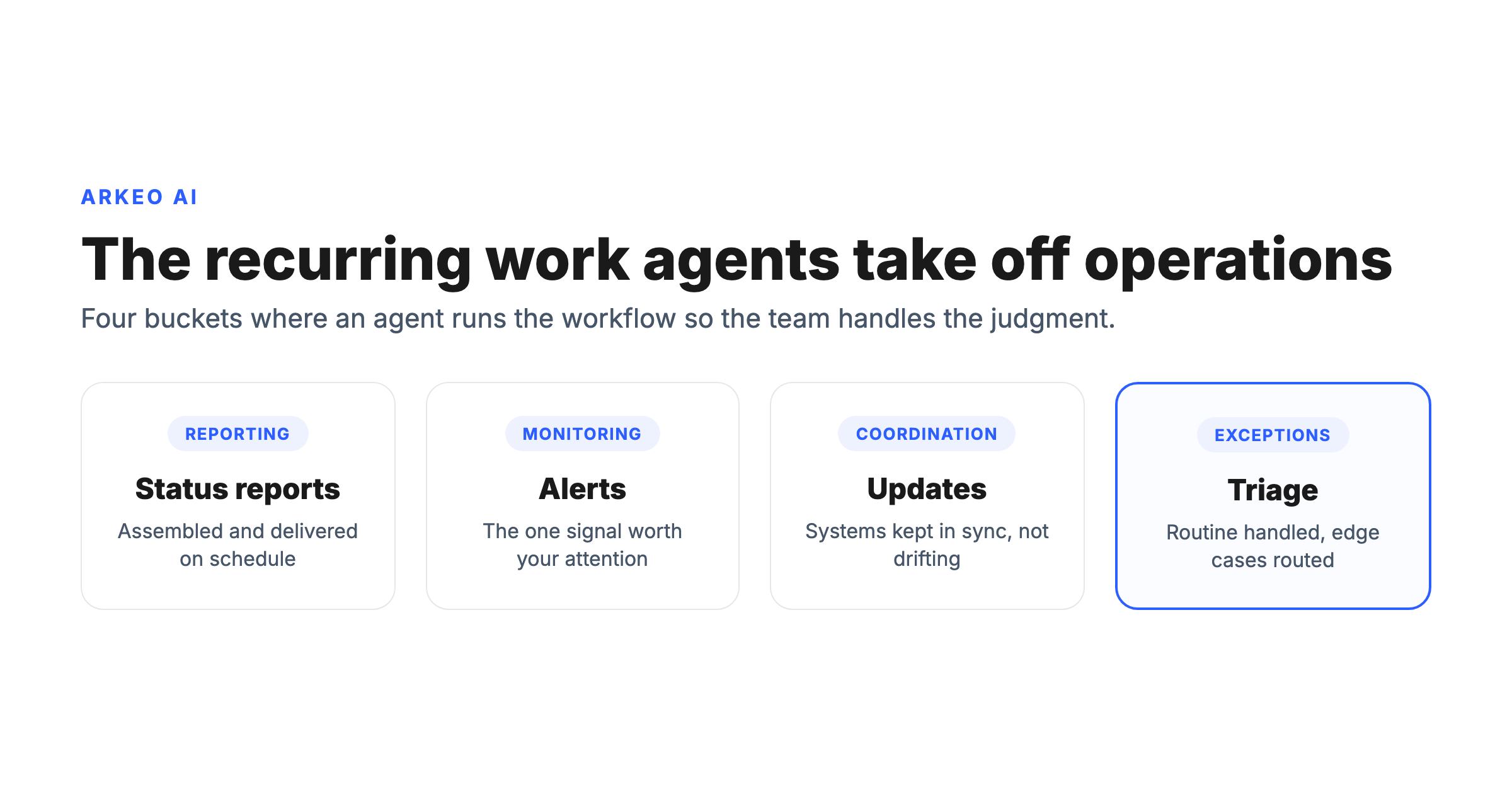
That end-to-end definition matters because the work an operations agent owns falls into four buckets that mirror how operations teams already think.
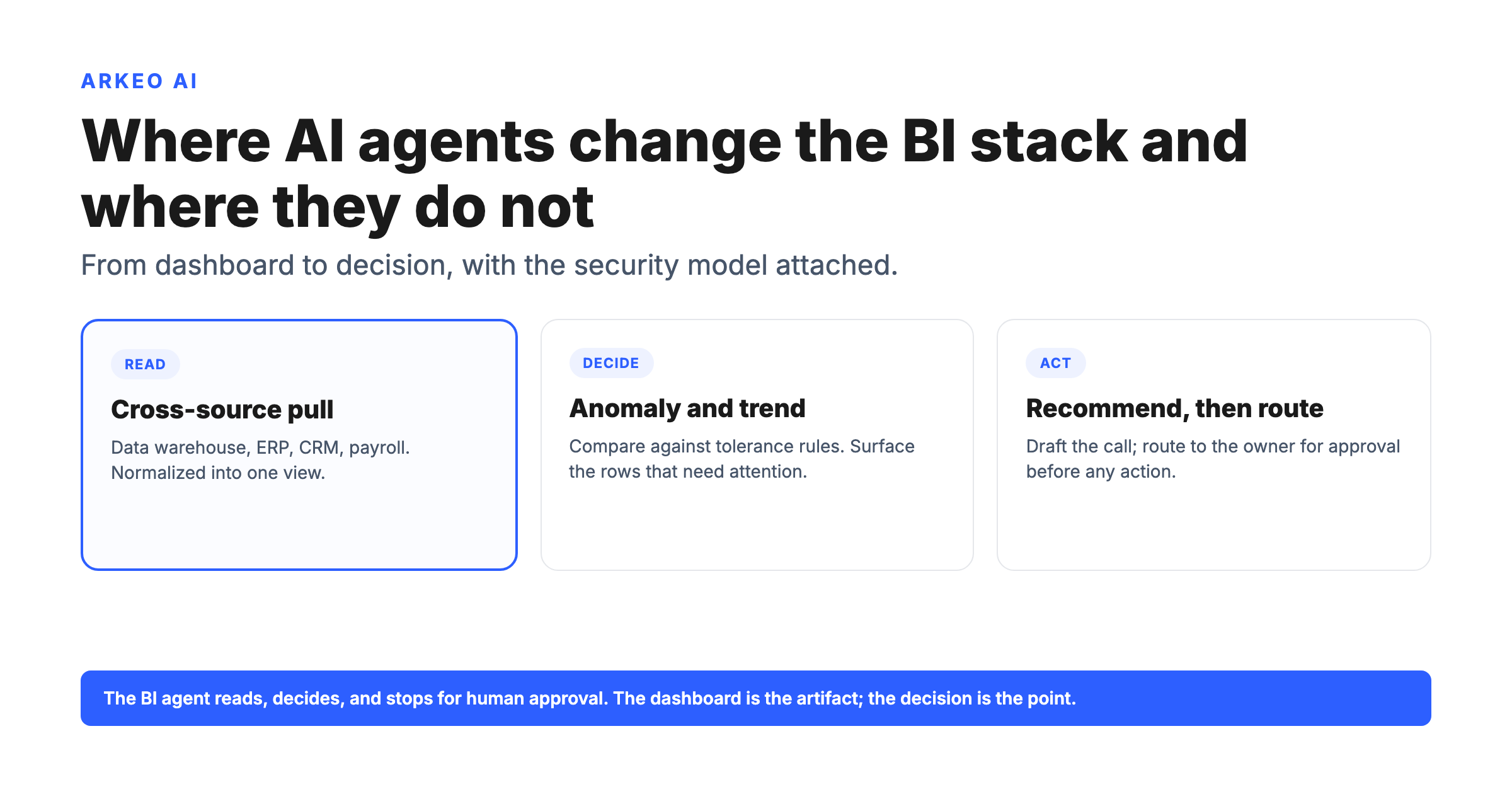
Reporting is the obvious one. An agent assembles the weekly or monthly status report from the systems that hold the numbers, writes the summary in your house format, and delivers it on schedule. Monitoring is the watchful one: the agent keeps an eye on the metrics and queues that matter and surfaces the one thing worth your attention instead of leaving a person to refresh a dashboard. Coordination is the connective one, pushing an update from one system into another so the CRM, the ticketing tool, and the schedule stop drifting apart. Exception handling is the judgment-adjacent one: the agent works the routine path automatically and routes the genuine edge case to a human, with the context already attached.
Notice what is not on that list. None of this is generic productivity advice about saving ten minutes a day. It is the specific operational plumbing that keeps a business running, and it is exactly the kind of work that is repeatable enough for an agent and tedious enough that nobody fights to keep doing it.
The market is moving in this direction fast. A 2025 PwC survey of US executives found 79 percent of companies are already adopting AI agents, and 66 percent of adopters report measurable value driven by productivity gains. Operations work, repeatable and measurable, is where that productivity shows up first. For a wider view of how this fits the whole business, the pillar on AI agents for business sets the broader context.
See which operations workflow to automate first
The free AI Assessment maps your recurring reports, alerts, and hand-offs, then ranks the one operations agent with the fastest, lowest-risk payoff.
Book Your Free AI Assessment →
Which Operations Workflows Are the Best Fit to Start With?
Not every workflow deserves an agent. The best first candidates share three traits: a fast payoff, low risk, and a clear owner. Three operations patterns hit all three.
Recurring internal reports are the strongest starting point. A report runs on a known cadence, pulls from known systems, and follows a format the team already trusts. The agent reproduces that exact output, and the value is immediate because the manual version has a measurable cost in hours. Escalation workflows are the next fit: an agent watches for the conditions that should trigger an escalation and routes the right item to the right person with the context attached, so nothing rots in a queue. Cross-system updates round out the list, where an agent keeps two or three systems in sync that today rely on someone remembering to copy a status across.
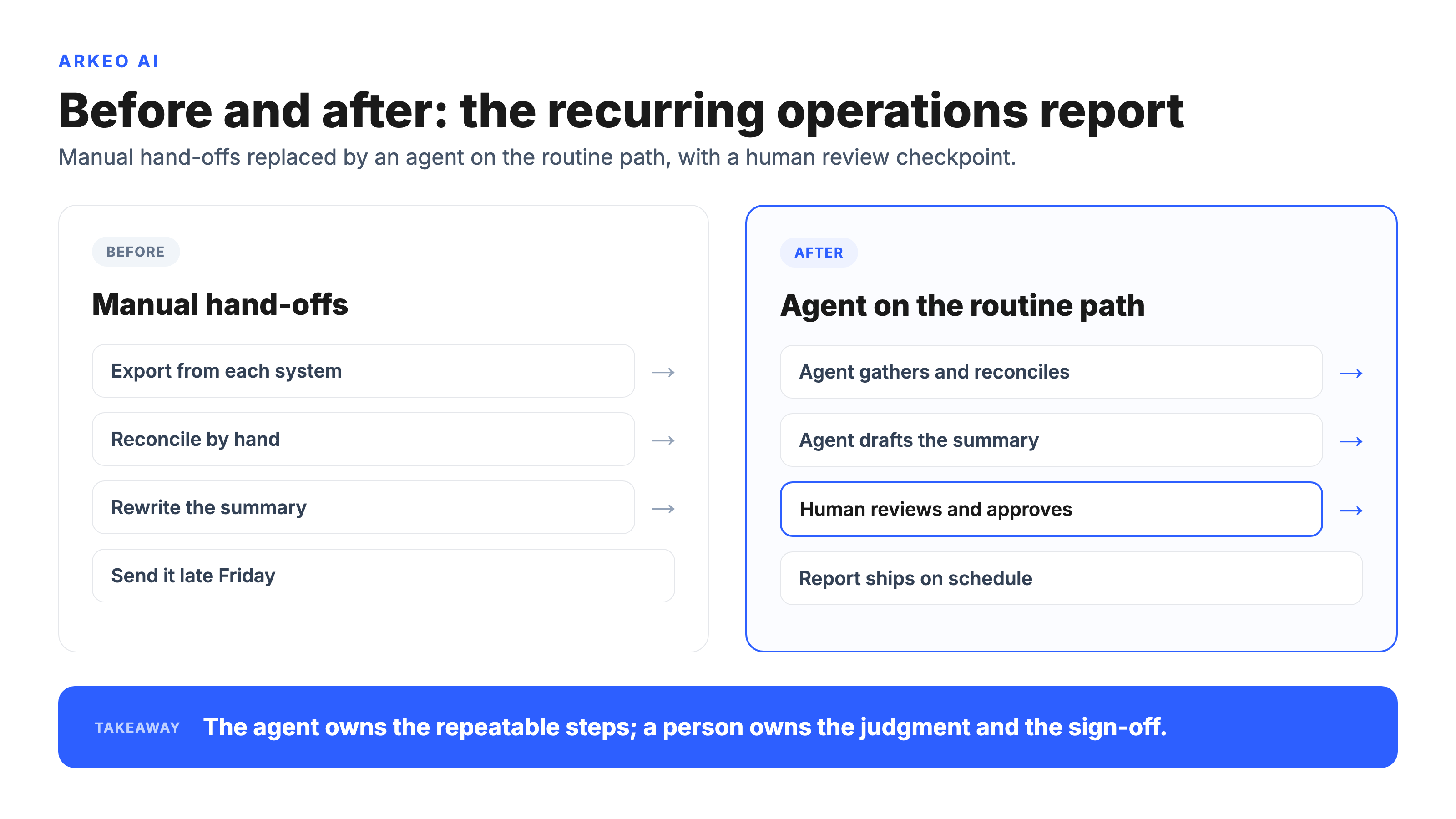
Picture an operations lead who owns the Monday morning operations report. Every Friday afternoon she exports three spreadsheets, reconciles the numbers against the project tracker, fixes the one cell that is always wrong because a field rep keys it in differently, and rewrites the same five-sentence summary. It eats roughly four hours a week and bleaks into her weekend more often than she would admit. An operations agent that assembles the report, applies her reconciliation rules, and drafts the summary for her review hands those four hours back, and the version she ships is more consistent than the one she rushed at 5pm on a Friday. That is the shape of a good first agent: an obvious owner, a measurable hour count, and a human who still signs off.
Here is the false belief worth retiring. Most operations leaders assume the first agent should tackle the most painful workflow, the tangled cross-team mess that everyone complains about. That is backwards. The most painful workflow is usually the most complex and the highest risk, which makes it the worst place to learn. Start where the payoff is clean and the blast radius is small, then earn the right to harder workflows.
Where Do Operations Teams Get AI Agents Wrong?
Blunt truth: AI agents break, and they break most often in operations because operations is where the messy real-world inputs live. A field gets renamed, a system changes its export format, an edge case nobody documented shows up, and an agent that was told to act on everything will confidently do the wrong thing at scale. The failures cluster into three avoidable mistakes.
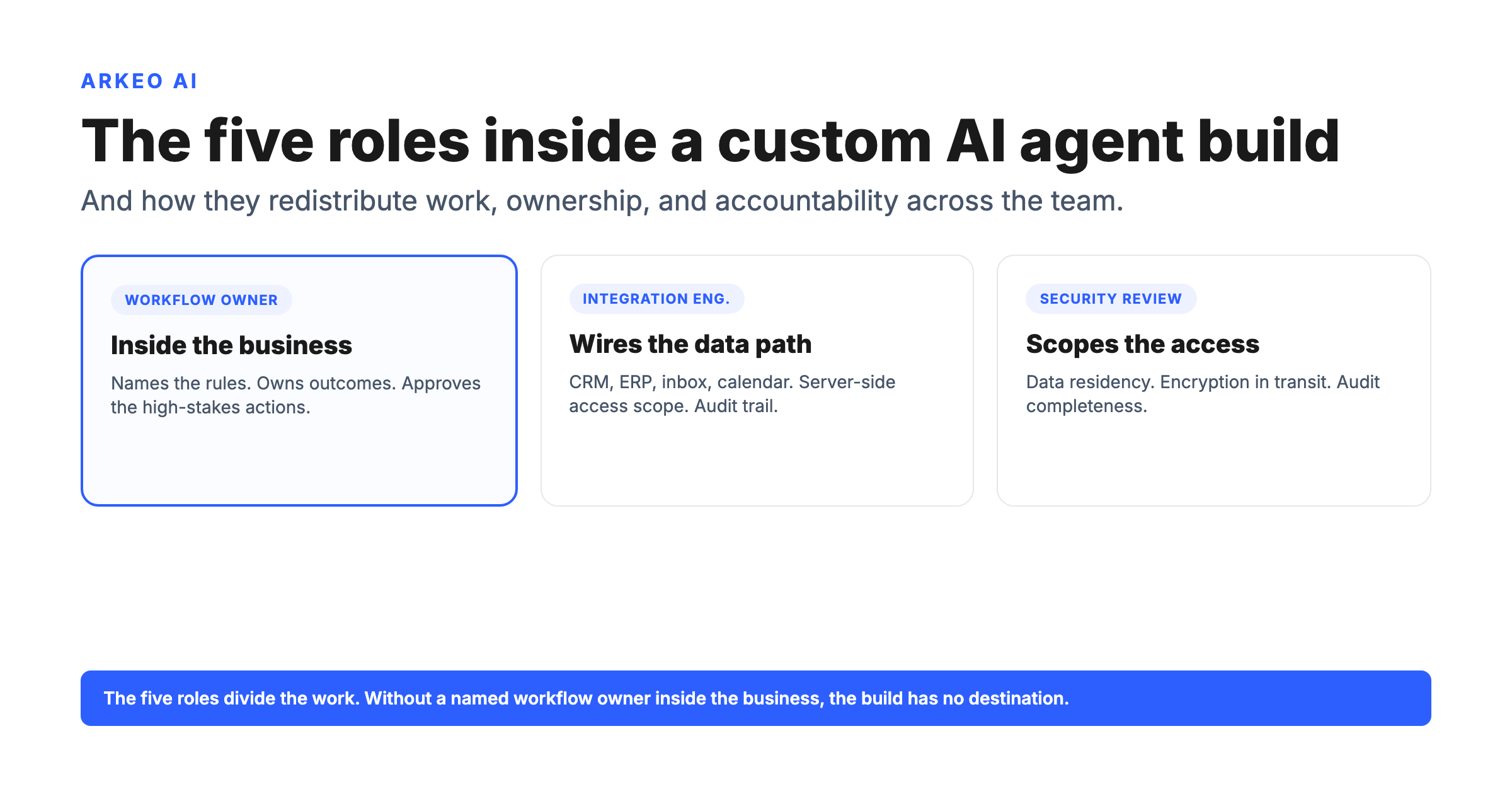
Over-automation is the first. Teams try to automate the judgment out of a workflow that needs judgment, so the agent makes decisions it should have escalated. The fix is to scope the agent to the routine path and design the exceptions to flow to a person, not to force the agent to guess. No review path is the second mistake. An agent that produces a report or pushes an update with no human checkpoint and no log is a liability, because when it gets something wrong, and it will, nobody catches it until a customer or an auditor does. Weak ownership is the third and most common. An agent without a named human owner drifts: nobody updates its rules when the business changes, nobody reviews its output, and it quietly degrades until someone declares the whole idea a failure.
This is why the slow-and-narrow approach wins. Capgemini's research on agentic AI found only 2 percent of organizations have deployed agents at scale, with 12 percent at partial deployment, 23 percent piloting, and 61 percent still exploring. The companies pulling ahead are not the ones automating everything at once; they are the ones that scoped a narrow operations workflow, kept a human in the loop, and expanded from a win. The detailed catalog in our guide to AI agent use cases shows how that narrow-first pattern repeats across functions.
How Do You Pick and Scope the First Operations Agent?
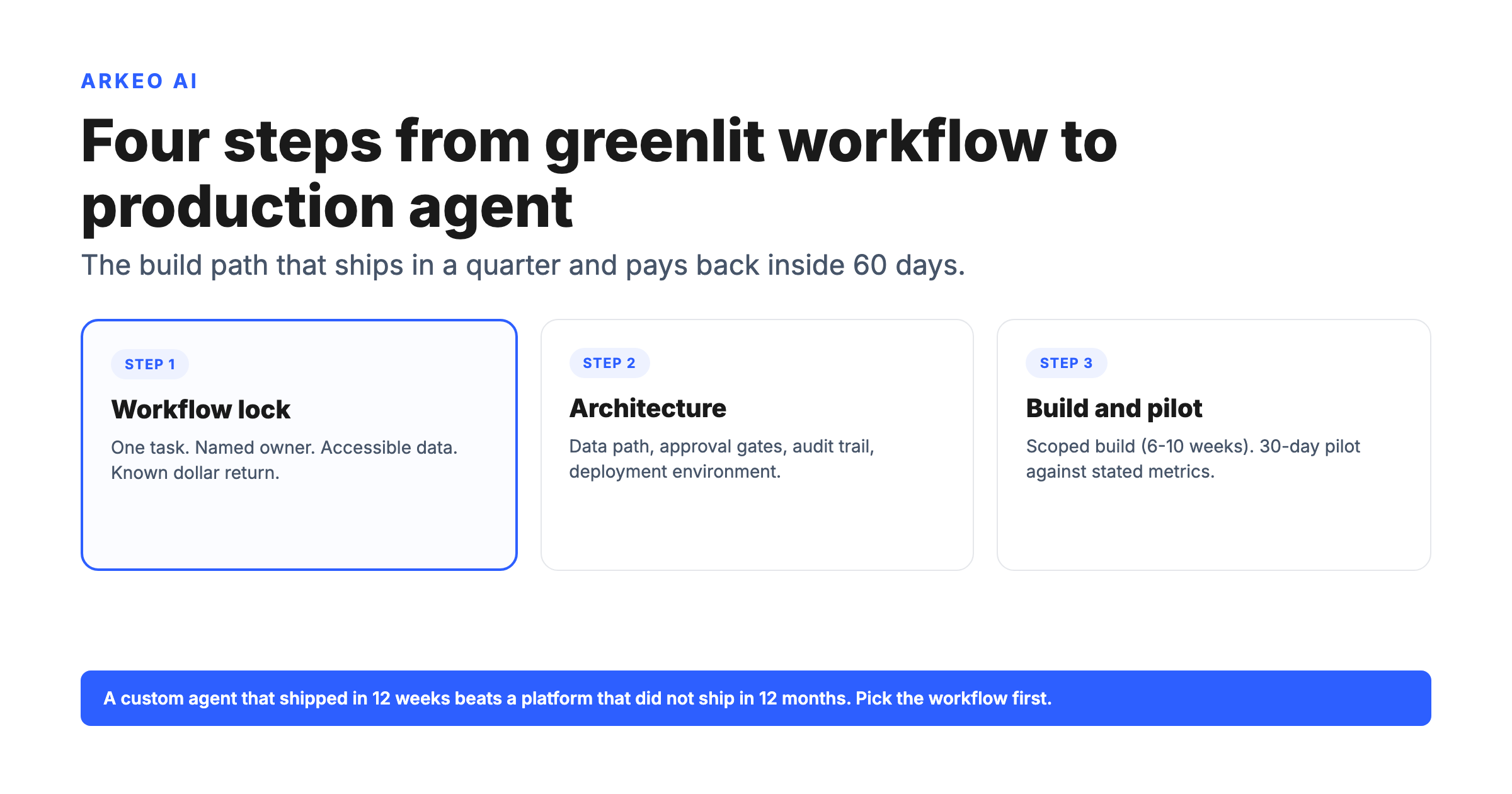
Run every candidate workflow through three questions. First, is the payoff fast and measurable? If you cannot name the hours per week or the errors avoided, it is not the first one. Second, is the risk low? A wrong report that a human reviews before it ships is recoverable; an agent silently moving money or closing customer tickets is not where you start. Third, is there a clear owner? Name the person who owns the workflow today and will own the agent tomorrow, before a line of it is built.
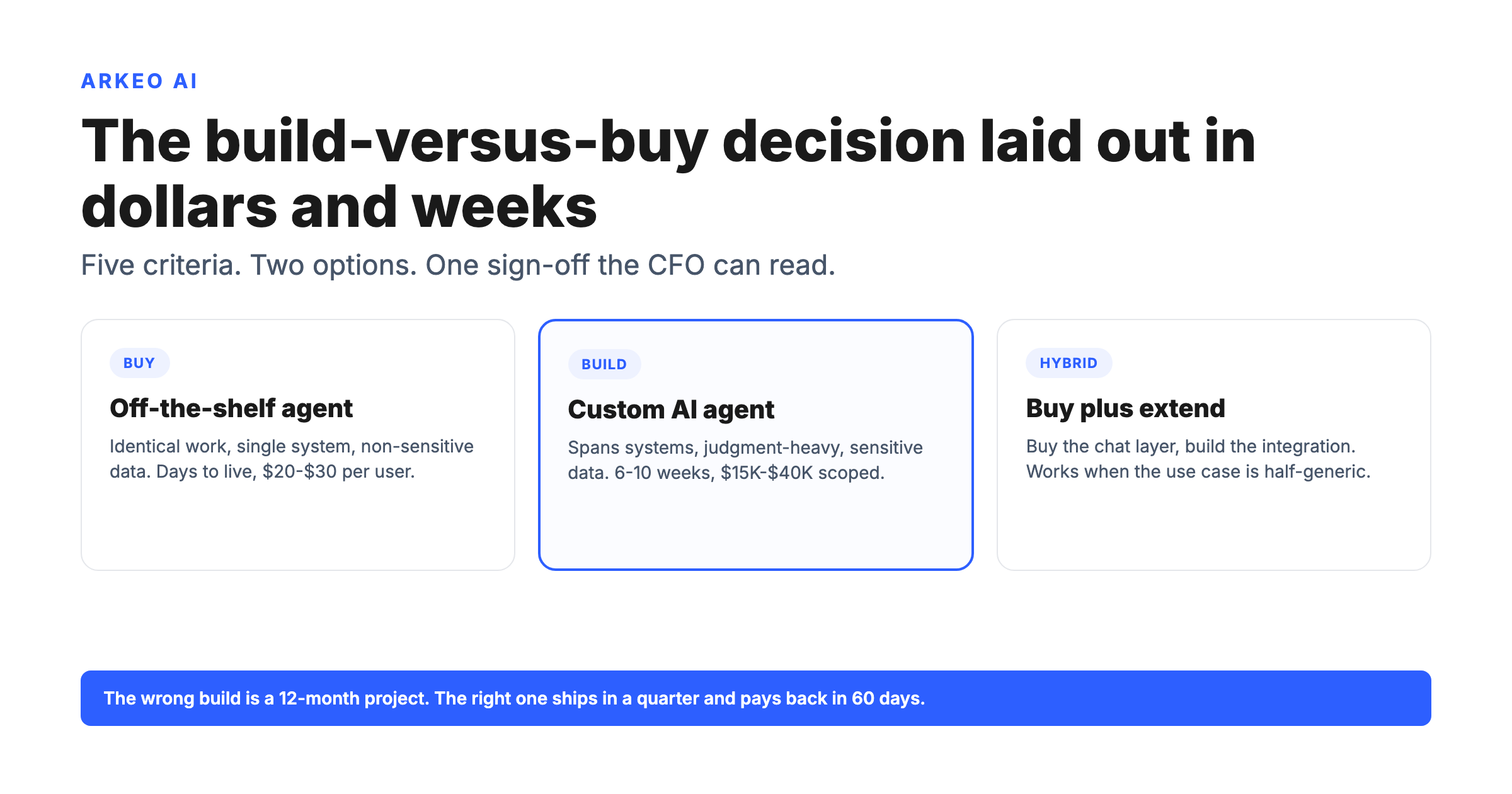
On timeline and cost, here is the operator-grade reality. A first operations agent, a recurring report or a status roll-up, is typically live in 30 to 90 days. A scoped custom build that connects to your real systems and encodes your real rules runs about 15,000 to 40,000 dollars. Off-the-shelf agent tools are faster and cheaper to switch on, but they are shallower: they handle generic patterns well and struggle the moment your workflow has a quirk, which operational workflows always do. The honest trade is speed and price now versus fit and durability later.
The momentum behind this is real and accelerating. Deloitte predicts 25 percent of companies using generative AI will deploy AI agents in 2025, rising to 50 percent by 2027. The teams that start now with one narrow, well-owned operations agent build the muscle to run the next five. For the broader playbook on turning these workflows into a repeatable system, see our guide to AI agents for business automation.
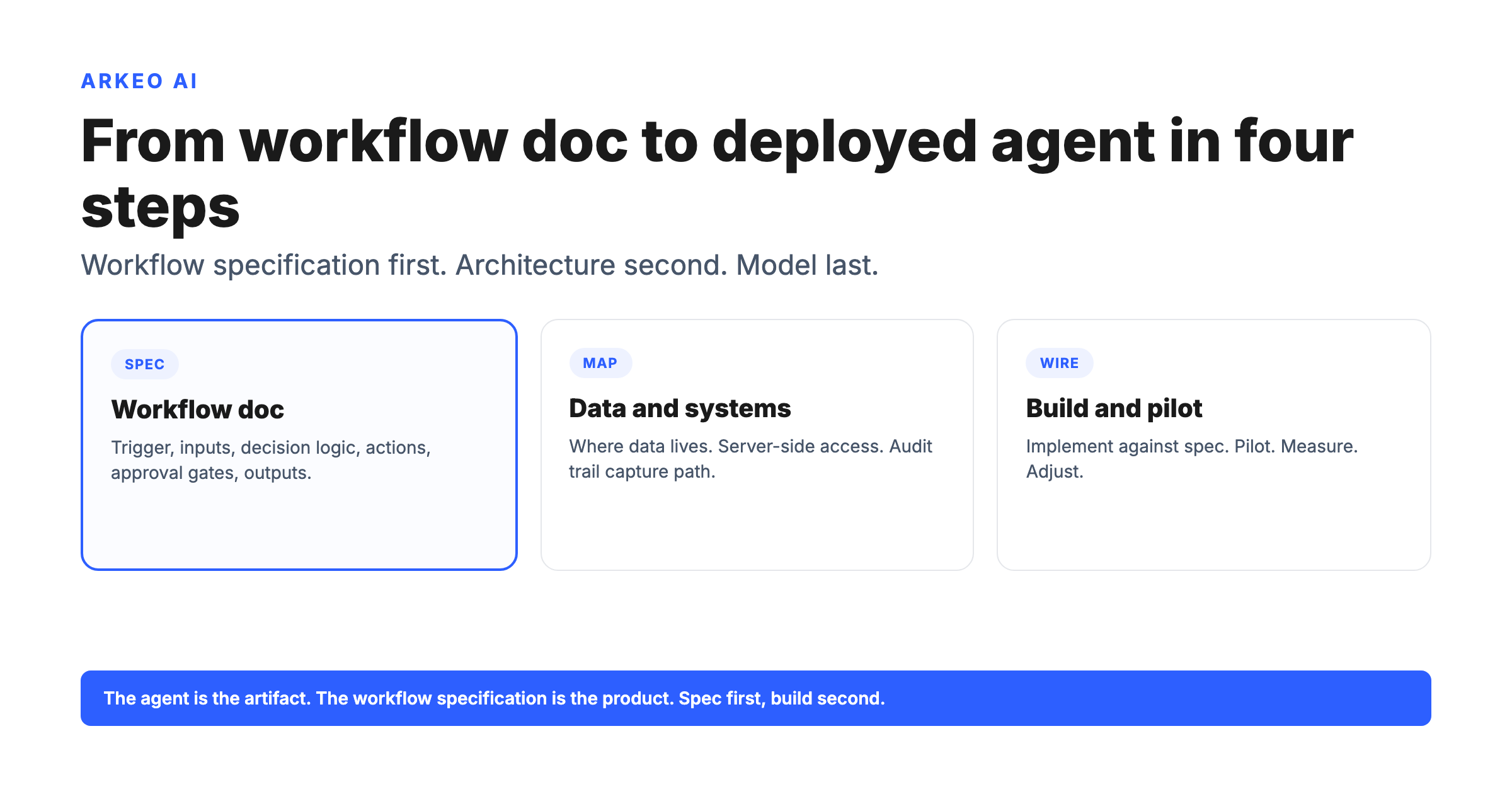
Arkeo's approach reflects three years of doing exactly this, including in its own operations: map the current state, find the 30-to-90-day easy win, then build the top custom workflow agents on private or on-premise infrastructure so operational data never leaves your control. Those agents are delivered and maintained on the Arkeo Operating System (AOS), the framework that keeps each agent scoped, owned, and updated as the business changes instead of left to drift. Running agents in its own operations every day is why the recommendations are grounded in what actually survives contact with a real operation rather than what looks good in a demo.
Turn the right workflow into your first agent
Bring your most repetitive operations workflows to the free AI Assessment and leave with a ranked, scoped plan for the agent worth building first.
Book Your Free AI Assessment →