Category
AI Agents for Business Automation: When You Need One
Last updated: May 2026
You have a backlog of manual work and a budget that finally allows for automation. The hard question is not whether to automate. It is what kind of automation each task actually needs, because the wrong tool wastes months and money. Arkeo AI was founded in 2023 on top of 25 years of running real businesses, and three years of deploying agents inside real operations, including our own, taught one blunt lesson: we use what we sell, and most of what we automate never needs an agent at all.
Quick Answer
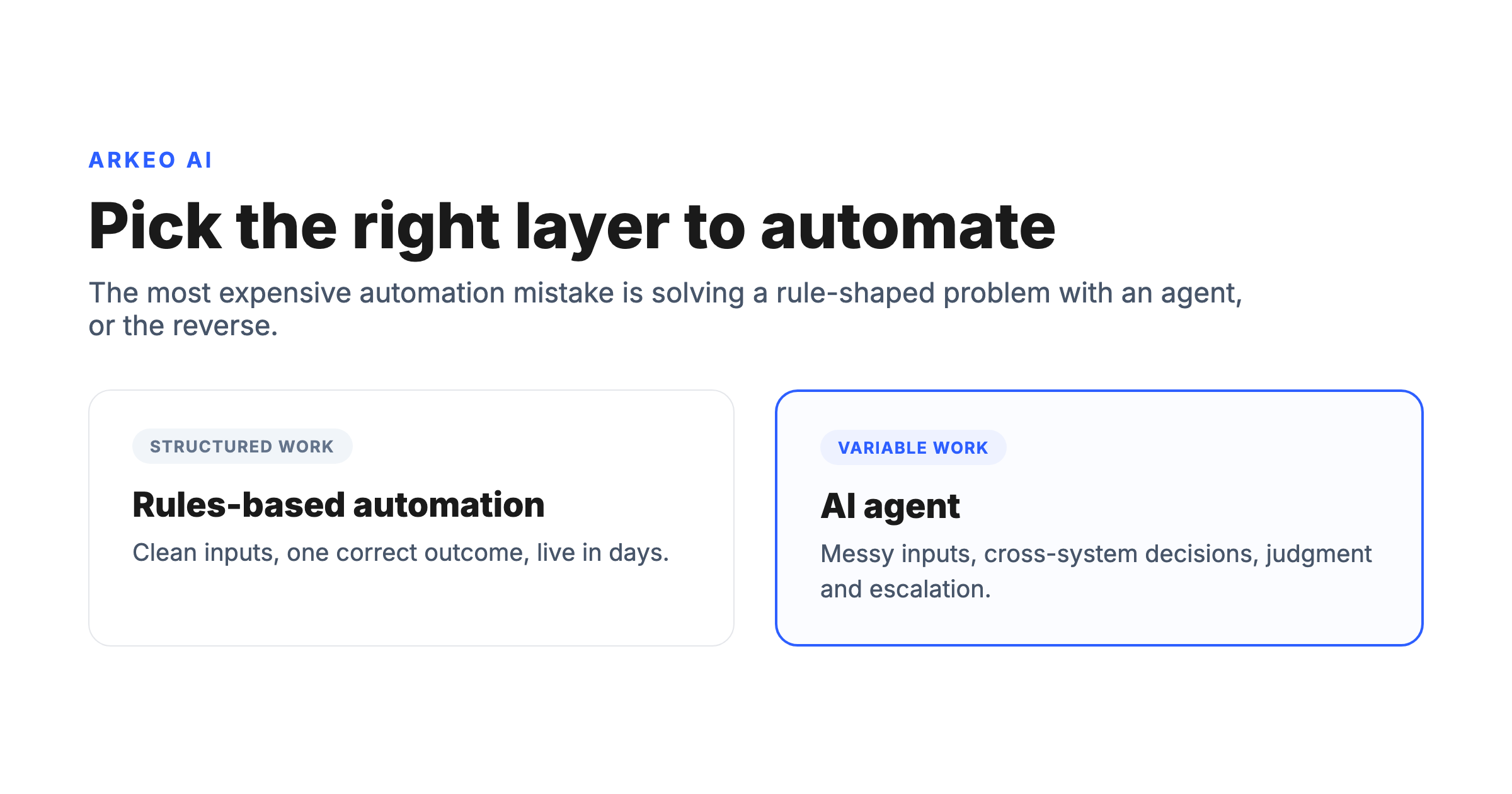
• The rule: Rules-based automation handles structured, repeatable, straight-through work; AI agents earn their place when inputs are messy, decisions cross systems, or escalation logic is involved.
• Cost and timing: Rules-based automation goes live in days; a scoped agent build runs about $15,000 to $40,000 and takes 6 to 10 weeks to production.
• Why it matters: Picking the wrong layer is the most expensive mistake in automation. A free AI Assessment sorts your tasks into the right buckets before you commit.
What Is the Difference Between Automation and AI Agents?
Rules-based automation follows a fixed path you define in advance; an AI agent interprets a goal, makes decisions across the way, and adapts when reality does not match the script. That single distinction decides most of your automation roadmap. A rule fires the same way every time: if invoice received, then route to approver. An agent reads the invoice, notices the vendor is new, flags a missing purchase order, and asks a human before it pays. One follows steps. The other exercises judgment.
Both have a place, and the market is still sorting out where the line falls. According to the Deloitte 2025 Technology, Media and Telecom Predictions, 25% of enterprises already using generative AI are expected to deploy AI agents in 2025, rising to 50% by 2027. Adoption is accelerating, but speed is not the same as fit. Plenty of those deployments will be agents pointed at problems a rule could have solved in an afternoon.
What Does Rules-Based Automation Do Well?
Rules-based automation is the workhorse, and it is criminally underrated in the rush toward agents. When a task is structured, repeatable, and runs the same way regardless of context, a rule is faster to build, cheaper to run, and far easier to audit than any model. Straight-through processing is its home turf: moving a record from one system to another, sending a templated reminder, calculating a fee from a known formula, syncing a calendar.
The honest math matters here. Rules-based automation is live in days, not weeks, and once it ships it costs almost nothing to keep running. If your task has clean inputs and one correct outcome, an agent is overkill that adds latency, cost, and a new category of failure. Most businesses think the newest tool is automatically the right tool. They are wrong. The right tool is the simplest one that reliably does the job.
Where Do AI Agents Create More Value?
Agents earn their cost when the work resists a fixed path. Three patterns reliably push a task across the line from rule to agent, and the broader market is leaning in: the Stanford HAI 2025 AI Index Report found 78% of organizations used AI in 2024, up from 55% the year before. The pressure to automate harder problems is real. The trick is recognizing which problems actually qualify.
Unstructured inputs. When the raw material is free-text email, a scanned PDF with no consistent layout, a customer voicemail, or a photo from a job site, no rule can reliably parse it. An agent can read the email, extract the order details, and reconcile them against your system even when every customer phrases the request differently.
Cross-system decisions. When a task requires pulling context from your CRM, your inventory system, and your accounting platform, then weighing that context to choose an action, you are past what a rule handles cleanly. An agent can check stock, confirm credit terms, and decide whether to hold or release an order, all in one pass.
Escalation logic. When most cases are routine but a meaningful slice need human judgment, an agent can handle the routine volume and recognize the exceptions worth escalating. A rule cannot tell the difference between a normal refund and a fraud pattern; an agent can flag the second for review and clear the first.
This is also where Arkeo deploys agents on the Arkeo Operating System (AOS), often on-premise or as private AI, so the messy inputs above never leave a regulated business. That control matters most exactly where agents earn their keep. The economic stakes are large enough to explain the hype. The Capgemini Research Institute estimates AI agents could generate up to $450 billion in economic value across surveyed markets by 2028. That number is the prize. The discipline is in capturing it without spending agent money on rule-shaped problems. To go deeper on the categories of work agents handle, see our breakdown of AI agent use cases.
When Is Simple Automation Still Enough?
Here is the part vendors rarely say out loud: AI agents break, regularly. They misread an edge case, call the wrong tool, or confidently produce a wrong answer when an upstream system changes its format. Every production agent needs monitoring, guardrails, and a human fallback, and that overhead is wasted if the task never needed judgment in the first place.
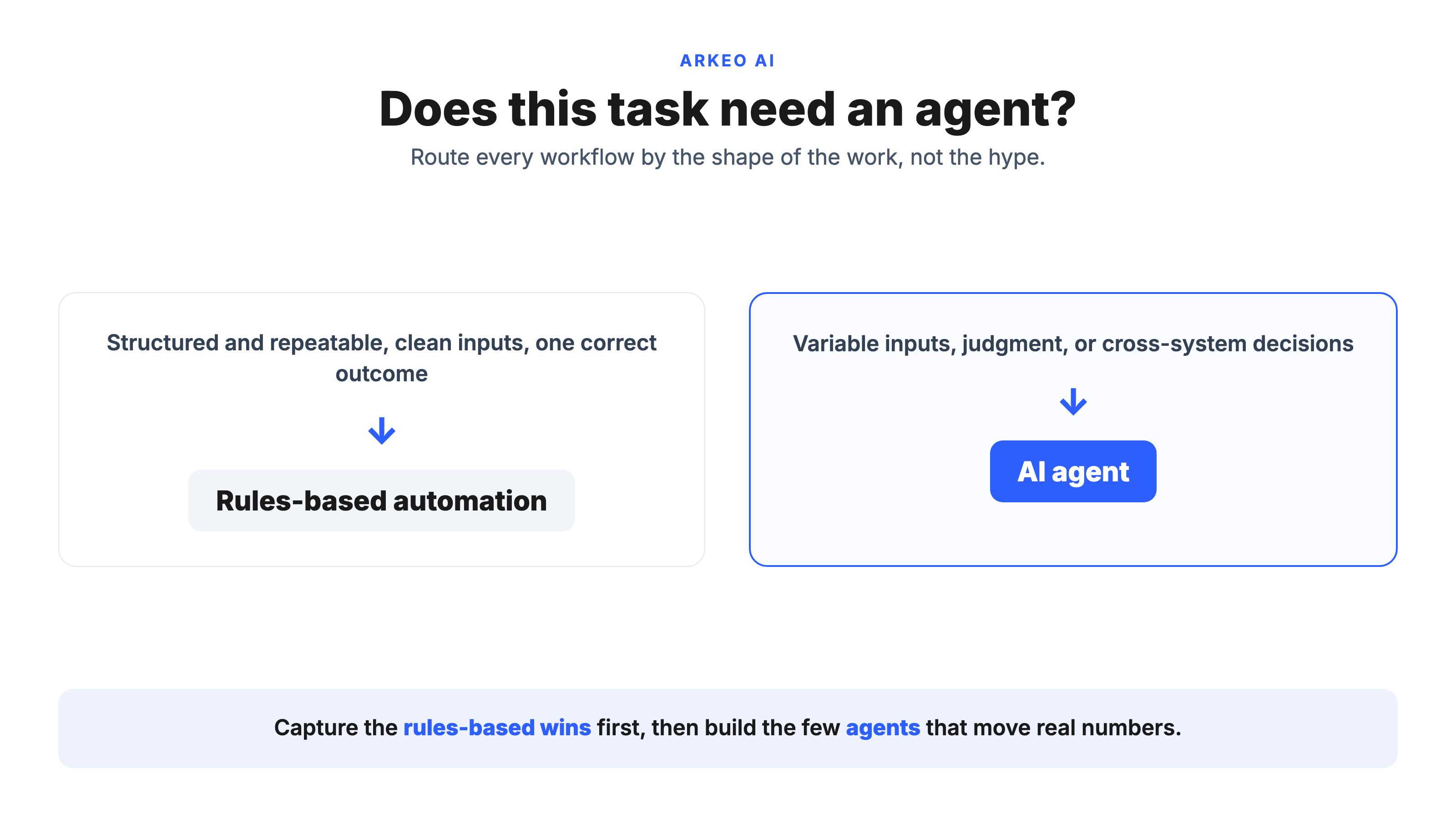
Straight-through repeat tasks are still better served by rules. If the input is clean and structured, the decision has one correct answer, and the same logic applies to every case, a rule will outperform an agent on cost, speed, and reliability. Reserve agents for the work that genuinely varies. The decision matrix below is the asset to keep on your desk when you are sorting a backlog.
| Task trait | Rules-based automation | AI agent |
|---|---|---|
| Structured, consistent inputs | Best fit | Overkill |
| Variable or unstructured inputs | Cannot cope | Best fit |
| Single system, one step | Best fit | Unnecessary |
| Cross-system decisions | Brittle | Best fit |
| Judgment or escalation needed | Cannot cope | Best fit |
Not sure which tasks need an agent?
The free AI Assessment maps your workflows and sorts each one into rules-based today or agent-worthy, so you stop paying agent prices for rule-shaped work.
Book Your Free AI Assessment →
How Do You Choose What to Automate First?
Start by sorting your backlog into two piles using the matrix above. The first pile is the 30-day wins: structured, single-system, straight-through tasks. Buy or configure off-the-shelf automation and a general copilot for these. A general copilot runs about $20 to $30 per user per month, and rules-based automation is live in days. These are the quick returns that fund the harder work.
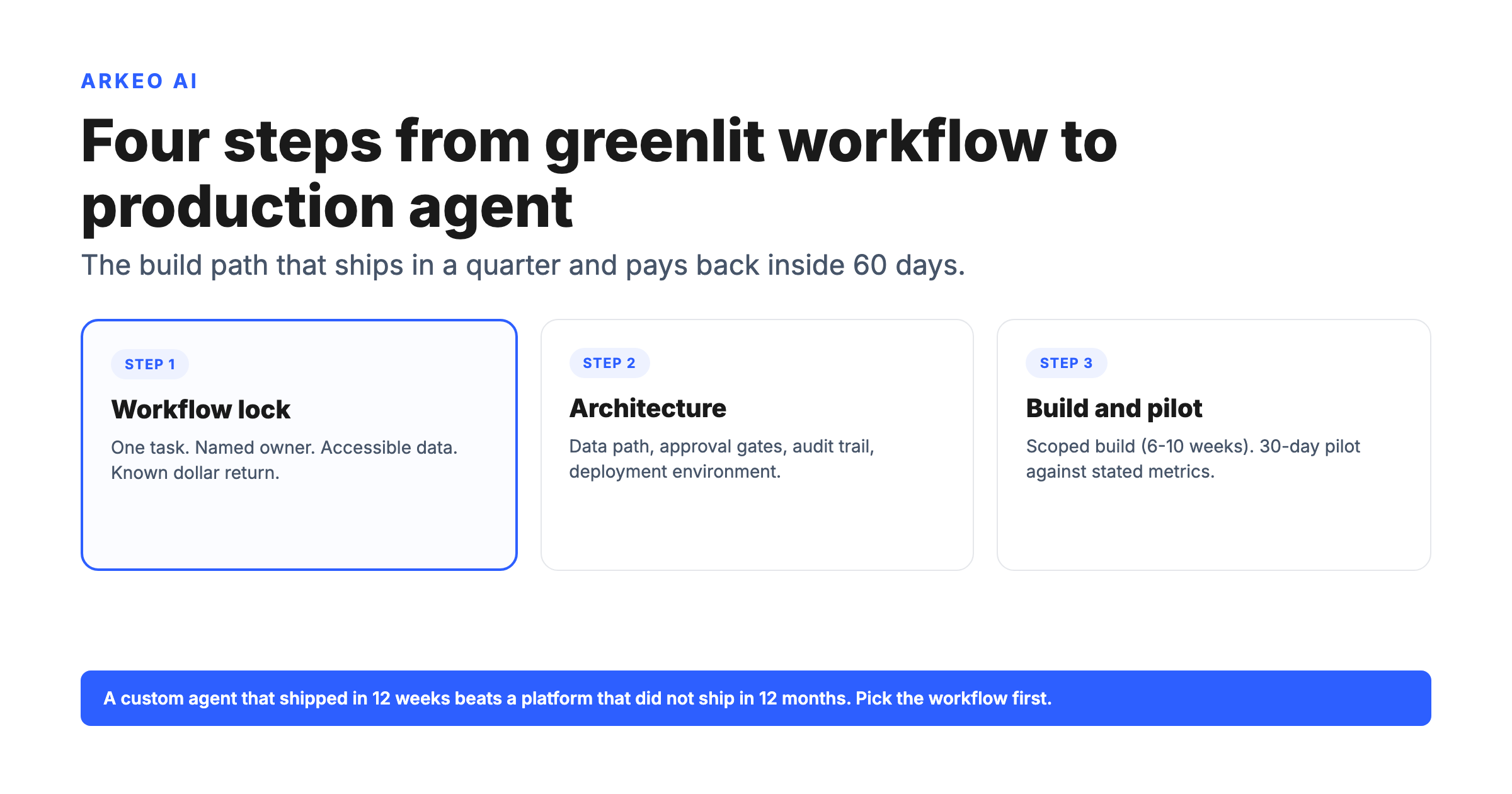
The second pile is the 90-day agent build path: the variable, cross-system, judgment-heavy workflows where an agent actually pays for itself. In Arkeo's own builds, a scoped single-workflow agent typically runs $15,000 to $40,000 and 6 to 10 weeks to production, depending on how many systems it touches and how much guardrail and review logic the workflow demands. That spread is not a quote; it is the honest range from those builds for a single well-scoped workflow agent.
Picture an operations lead at a mid-sized distributor drowning in supplier emails. Half of them are clean reorders that a rule could route in seconds. The other half are messy: a forwarded thread with three different quantities, a handwritten note scanned crooked, a price dispute buried in a reply chain. Splitting that pile is the whole game. The clean half becomes a 30-day rule. The messy half becomes a 90-day agent. In one build like this, the parsing held until a supplier quietly switched its order confirmations from a PDF attachment to an inline HTML email, which broke extraction overnight and pushed the timeline out by about three weeks while the agent learned the new format. That is the kind of friction the range above already accounts for, and why the messy half justifies an agent that reads the thread, reconciles the numbers, and escalates the price dispute to a human. Try to solve both with one agent and you overpay for the easy half while under-building the hard half.
| Workflow | Right layer | Why |
|---|---|---|
| Send templated payment reminders | Rules-based | One trigger, one templated action, no judgment |
| Sort inbound customer emails into orders, complaints, and questions | AI agent | Unstructured text that varies with every sender |
| Sync a closed deal from CRM to accounting | Rules-based | Structured fields map cleanly between two systems |
| Approve or hold an order using stock, credit, and history | AI agent | Cross-system context plus a decision and escalation path |
This sequencing is the core of how Arkeo works: capture the easy wins fast, then build the few agents that move real numbers. For the deeper hub on this topic, read the pillar on AI agents for business, and when you are ready to scope the build itself, see our guide to custom AI agents.
Turn the backlog into a plan
In one free session, Arkeo separates your 30-day automation wins from your 90-day agent opportunities, so the first dollar you spend goes to the right layer.
Book Your Free AI Assessment →