Category
AI Agent Use Cases for Business Operations
Last updated: May 2026
You do not have an AI ideas problem. You have a prioritization problem. Most operators can rattle off a dozen places an agent might help, then stall on which one to build first, which one will quietly fail, and which one is too risky to touch without controls. Arkeo AI was founded in 2023 by an operator with 25 years running businesses, and the same patterns show up in three years of deploying agents inside Arkeo's own operations. That gap is expensive. In a 2025 PwC survey of 308 US executives, 79% reported already adopting AI agents, and 66% of adopters said they were getting measurable value through productivity. The companies pulling away are not the ones with the most ideas. They are the ones choosing the right first workflows.
This guide skips the brainstorm. It gives you the four traits that make a workflow a strong fit for an AI agent, the high-value use cases by business function with their system connections and expected benefit, the categories to avoid as a first project, and a method for picking your first three.
Quick Answer
• What makes a use case strong: repeatability, a clear owner, system access, and built-in review checkpoints.
• Best functions to start in: sales operations, admin, finance, operations, and compliance support, where work is structured and rules-based.
• What to avoid first: ambiguous judgment work, anything with no owner, and high-risk tasks without controls.
• Cost and timeline: a first quick-win agent is typically live in 30 to 90 days, with a scoped custom build around $15,000 to $40,000.
• How to choose: score each candidate, then sequence three across quick wins, mid-term builds, and long-term architecture. A free Arkeo AI Assessment ranks your top three for you.
What Makes a Strong AI Agent Use Case?
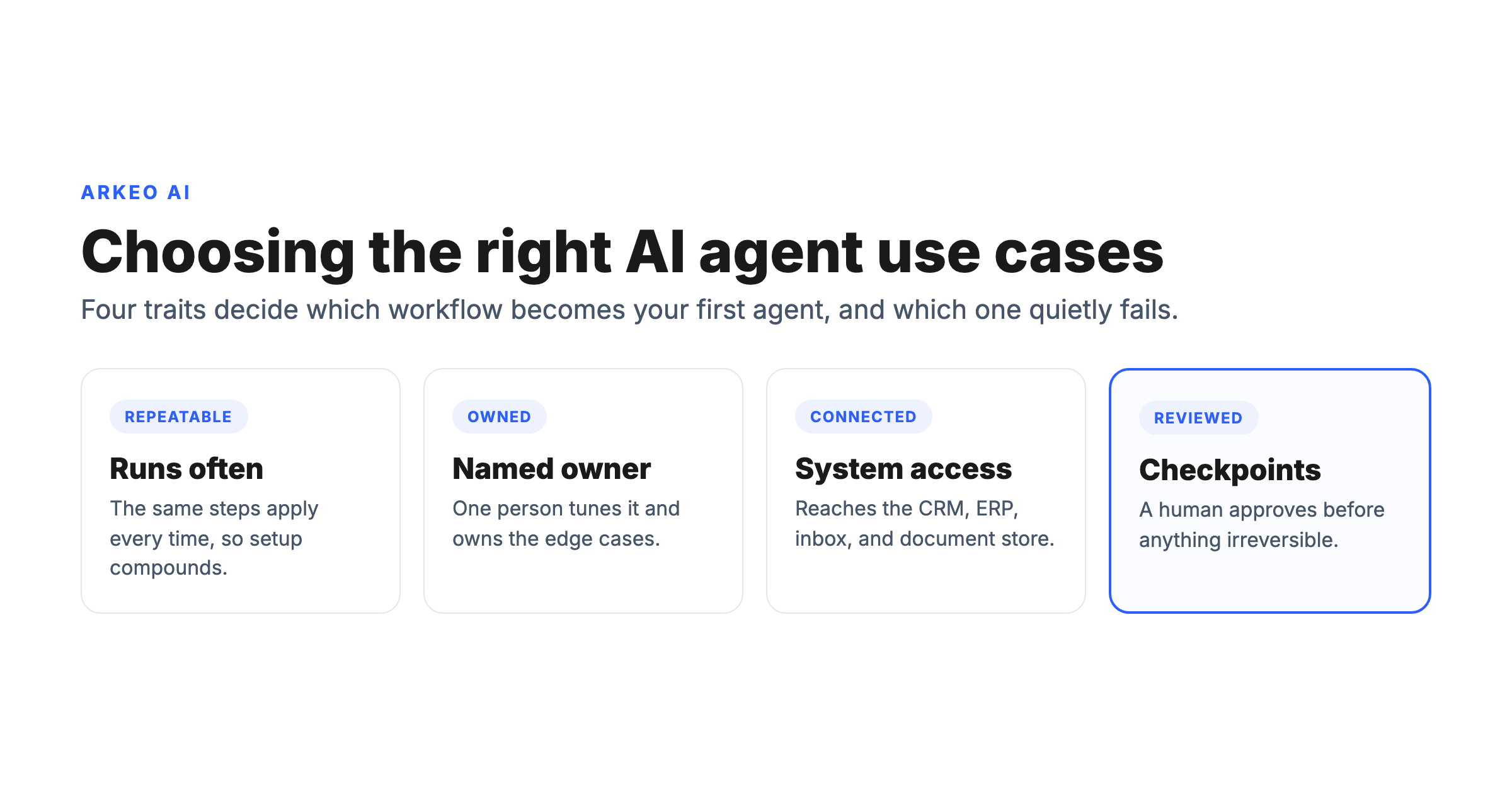
A strong AI agent use case is a repeatable, owned workflow where the agent can reach the systems it needs and a human can review its output at defined checkpoints. Miss any one of those four traits and the project tends to stall, drift, or create risk faster than it creates value. Use the traits as a filter before you fall in love with any single idea.
Repeatability. The workflow runs often enough and consistently enough that the same steps apply each time. Invoice coding, lead enrichment, and order status updates repeat hundreds of times a month. A one-off strategic decision does not. Repeatability is what turns a few hours of setup into a compounding return.
Clear owner. A named person owns the workflow today and will own the agent tomorrow. They define what good output looks like, catch edge cases, and decide when to expand the agent's scope. Workflows that belong to everyone and no one are where agents quietly rot.
System access. The agent needs to read from and write to the same systems a person would, such as the CRM, the ERP, the inbox, the ticketing tool, or the document store. If the data lives in a system nobody can connect to, that is an integration project first and an agent project second.
Review checkpoints. The workflow has natural points where a human approves before anything irreversible happens. A draft before it sends. A coded invoice before it posts. This is the difference between an agent that accelerates your team and one that compounds mistakes at machine speed. Here is the blunt truth most vendors leave out: AI agents make confident mistakes, and they make them quickly. Review checkpoints are not optional polish. They are the control that makes the rest safe.
The trait that surprises most operators is the second one. The hardest part of a successful agent is rarely the model. It is having a single owner who treats the agent like a new team member and tunes it. To see how these traits sit inside a broader operating model, the guide to AI agents for business covers the full picture.
The Use-Case Scoring Table
Score each candidate against the four traits before you commit a budget. Three or four green answers means a strong first-deploy fit. Two or fewer means fix the gaps first or pick a different workflow.
| Use case | Repeatable? | Clear owner? | System access? | Review point? | First-deploy fit |
|---|---|---|---|---|---|
| Lead enrichment and routing | Yes | Yes | CRM | Yes | Strong |
| Invoice coding and matching | Yes | Yes | ERP | Yes | Strong |
| Order and ticket status updates | Yes | Yes | ERP, helpdesk | Yes | Strong |
| Compliance evidence gathering | Yes | Yes | Doc store | Yes | Strong |
| Strategic vendor negotiation | No | Mixed | Varies | No | Avoid first |
See which workflows score highest in your operation
The free AI Assessment scores your candidate workflows against these four traits and hands you a ranked shortlist, so your first agent is the one most likely to pay off.
Book Your Free AI Assessment →
Four traits that separate a strong agent use case from a vanity demo
The use cases that ship and stay shipped share the same four traits. Every demo in the world satisfies one or two. The ones worth your budget satisfy all four.
Repeatable
Happens often enough that automating the loop pays back inside a quarter, not a year.
Clear owner
One named person accountable when an exception lands. Not a committee, not a job description.
System access
Agent can actually read the source and write the result back. Wired, not described.
Review checkpoint
Human catches confident wrong answers before they ship. Designed in from day one.
What Are the High-Value AI Agent Use Cases by Function?
The strongest first targets cluster in functions where work is structured, rules apply, and the systems are already connected. The use cases below are organized by function, each tied to its workflow conditions, the systems it touches, and the expected business benefit. Most businesses assume the flashiest use cases sit in customer-facing roles. In practice, the highest-return early wins are usually in the back office, where the work is repetitive, the rules are clear, and an hour saved is an hour the team gets back every single day.
Sales operations. AI agents enrich inbound leads, score them against your ideal-customer profile, route them to the right rep, and keep the CRM clean. Workflow conditions: high inbound volume, a defined scoring rubric. Systems: CRM, enrichment data, email. Expected benefit: faster lead response and fewer leads that fall through the cracks.
Admin and operations support. Agents draft routine correspondence, schedule across calendars, prepare meeting briefs from prior records, and update trackers. Workflow conditions: repetitive document and scheduling work. Systems: inbox, calendar, document store. Expected benefit: reclaimed hours for the people who hold the business together.
Finance. Agents code invoices to the right accounts, match purchase orders to receipts, flag anomalies for a human, and assemble first-draft reports. Workflow conditions: structured documents, clear coding rules, a mandatory approval step. Systems: ERP, accounts-payable tool, document store. Expected benefit: faster close cycles and fewer manual errors, with a controller signing off before anything posts.
Operations. Agents update order and ticket statuses, chase missing information, and keep service records current across systems. Workflow conditions: defined status transitions, frequent small updates. Systems: ERP, helpdesk, scheduling tools. The deeper look at AI agents for operations walks through these workflows in detail. Expected benefit: fewer dropped handoffs and a cleaner operational picture.
Compliance support. Agents gather evidence, assemble audit packets from source documents, and surface gaps against a checklist for a reviewer. Workflow conditions: documented requirements, a human reviewer, an audit trail. Systems: document store, compliance tool. Expected benefit: less scramble before an audit and a defensible record of what was checked.
How to pick your first three AI agent use cases without burning the budget
The order matters. Quick wins come first because they fund trust and learning. Mid-term builds compound on what the first wins taught you. The long-term architecture is earned, not bought.
Quick wins
Pick the workflow with the lowest risk and the cleanest measurable target. Ship it inside a quarter. Prove the loop.
Mid-term build
Add the workflows that compound on the first one. Same data, same operators, deeper judgment.
Long-term architecture
Cross-functional agent network. Private deployment. The moat your competitors cannot match.
Use Cases by Function and Complexity
The grid below maps the same use cases by function and by build complexity, so you can see at a glance which are quick wins and which need more integration work before they pay off.
Sales ops: lead enrichment and routing.
Admin: drafting routine correspondence.
Operations: status updates across systems.
Finance: invoice coding and PO matching.
Compliance: evidence gathering and gap checks.
Operations: chasing missing information.
Finance: automated reporting across sources.
Operations: multi-system workflow orchestration.
Compliance: continuous monitoring with controls.
If most of your strongest candidates land in the low and medium columns, that is a good sign. Quick wins fund the patience you will need for the harder builds. For the broader pattern of stitching these workflows together, the overview of AI agents for business automation shows how single-task agents grow into automated processes.
Four business functions where AI agents pay back fastest
These four show up in every mid-market deployment we have seen ship. Structured work, rules-based decisions, system-of-record data, and named exception owners. The right shape for the first three use cases.
Sales operations
Lead enrichment, follow-up drafting, deal hygiene, proposal assembly from past wins. CRM-native work.
Admin
Onboarding kits, document assembly, schedule coordination, signature chasing. Boring and load-bearing.
Finance
Invoice and PO matching, expense categorisation, vendor onboarding. Highest-volume, cleanest signal.
Operations and compliance
Intake triage, status rollups, compliance reporting, audit prep. Cross-system, recurring.
Which AI Agent Use Cases Should You Avoid First?
Avoiding the wrong first project matters as much as picking the right one. A failed first agent does not just waste money. It poisons the well, and the next proposal gets a harder room. Three categories are worth steering away from until you have a working track record.
Ambiguous work. Tasks that depend on judgment, taste, or context that lives only in someone's head are a poor fit for a first build. If two experienced people would handle the same input differently and both be right, an agent has no stable target to hit. Save these for later, once you have learned how your agents behave.
Work with no owner. If you cannot name the person who will tune the agent, define good output, and own the edge cases, do not start. Ownerless agents drift, accumulate quiet errors, and erode trust until someone unplugs them. The owner is the single biggest predictor of whether an agent survives its first quarter.
High-risk work without controls. Anything that moves money, touches regulated data, or takes an irreversible action needs review checkpoints, audit logging, and scoped access before an agent goes near it. The technology is ready. The temptation is to skip the controls to move faster. That is exactly how a promising pilot becomes a board-level incident. This is also why some businesses run these workflows on private, on-premise deployments rather than public tools, so the data and the audit trail stay inside their own walls. Arkeo builds agents this way for exactly these cases, keeping regulated data and the model inside the client's own environment instead of routing it through a public service.
How Do You Pick Your First Three AI Agent Use Cases?
The discipline is sequencing, not selection. Most agent programs fail not because the use cases were wrong, but because the company tried to do everything at once. The data backs this up. Capgemini found that only 2% of organizations have deployed AI agents at scale, with 12% partial, 23% piloting, and 61% still exploring, and fewer than one in five report high data and technology maturity. Deloitte expects the field to widen quickly: in its 2025 TMT predictions, 25% of enterprises using generative AI are expected to deploy AI agents in 2025, rising to 50% by 2027. The winners are not the ones chasing the most use cases. They are the ones who pick the right first few and earn the right to do more.
Sequence three candidates across three horizons. This mirrors the Arkeo methodology, refined over three years of deploying agents inside operating businesses.
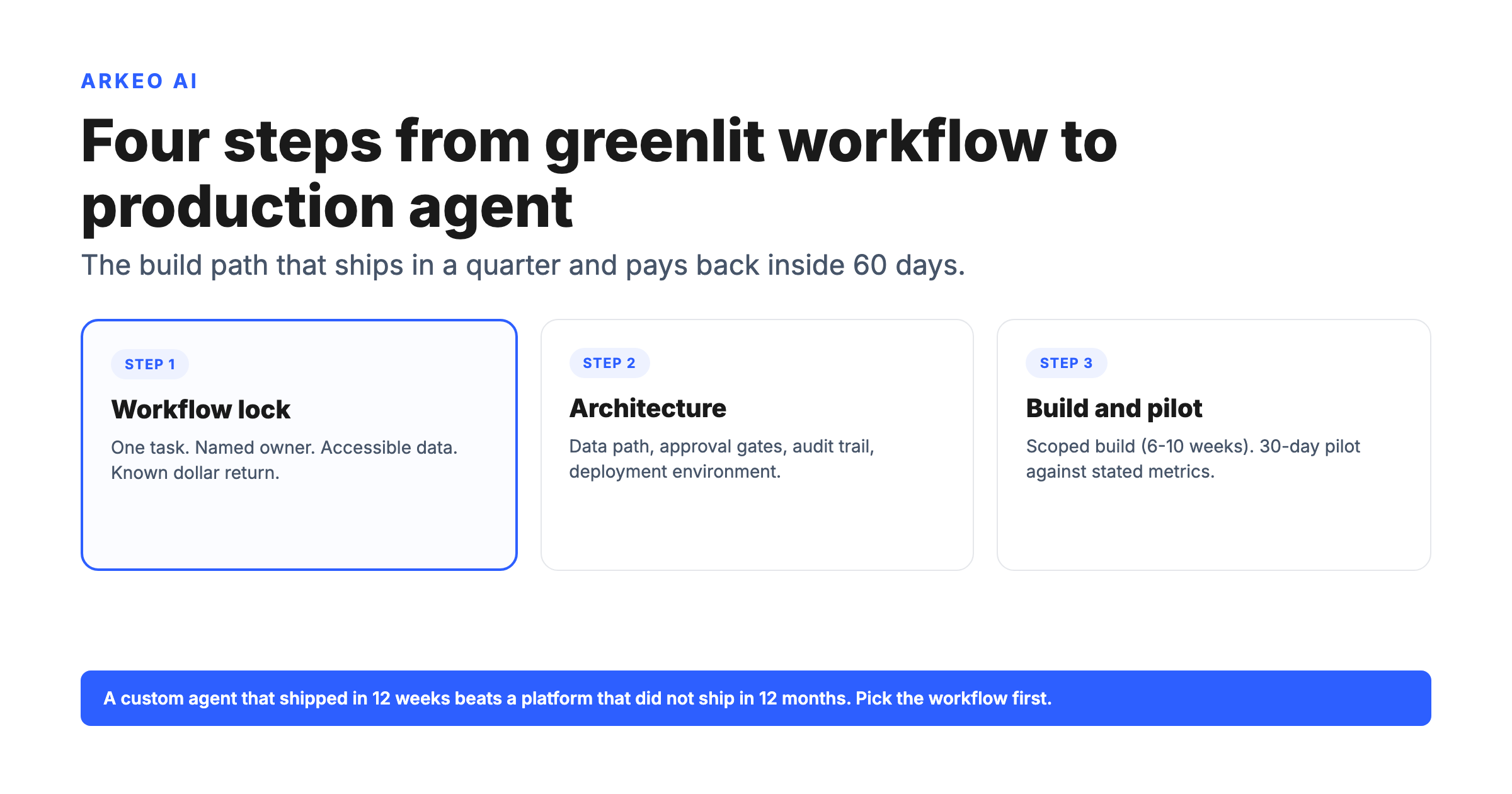
Quick wins (30 to 90 days). Pick one low-complexity, high-repeatability workflow that scored strong on all four traits, such as lead routing or status updates. The goal is a visible result fast, so the rest of the organization sees proof rather than promises. Picture a finance team that closes the books late every month because two people spend Fridays manually coding the same recurring vendor invoices, roughly six hours each per week between the spreadsheet, the inbox, and the ERP. A scoped invoice-coding agent that handles the routine matches and routes the odd ones to a human gives most of that time back, and the messy part is usually the first pass, where the agent miscodes a handful of new vendors until someone tightens the rules. In practice, a first quick-win agent like this is typically live in 30 to 90 days, and a scoped custom build runs about $15,000 to $40,000 depending on how clean the data and system access are.
Mid-term build (3 to 6 months). Choose one medium-complexity workflow that delivers real margin, such as invoice coding or compliance evidence gathering. This is the custom workflow agent that justifies the investment and connects to a system of record.
Long-term architecture (6 to 12 months). Identify the workflow that, once automated, changes how the business runs, such as cross-system reporting or process orchestration. You will not build this first. You name it now so the earlier two agents are built in a way that leads toward it.
Arkeo runs this sequencing for clients as a matter of method, not guesswork. We deploy the same agents we sell inside our own operation first, so the sequencing advice comes from running it, not theorizing about it. That is the difference between a vendor recommending a roadmap and a partner who has walked it.
Get your first three, prioritized and sequenced
The free AI Assessment maps your workflows, scores them against the four traits, and hands you a sequenced shortlist of quick win, mid-term, and long-term agents.
Book Your Free AI Assessment →