Category
Private AI Chat: A Secure Internal Assistant
Last updated: May 2026
Your team already uses chat-style AI. The only question is whether they are doing it on a public tool you cannot see, or on one you control. That gap is not theoretical. In Cisco's 2024 Data Privacy Benchmark Study, 48% of organizations admitted entering non-public company information into generative AI tools, and 45% entered employee information. Arkeo has spent three years deploying private AI agents on client infrastructure, and the pattern is consistent: people will paste sensitive data into a chat box if it saves them ten minutes, policy or no policy.
A private AI chat assistant is the practical answer. It gives your staff the same fast, conversational interface they like, while keeping every prompt and response inside your control boundary. Before you commit to one, it is worth knowing exactly where this interface earns its keep, where it quietly fails, and what it has to connect to so it does more than guess. If you want a structured read on whether chat is the right entry point for your operation, start with a free AI Assessment.
Quick Answer
• What it is: a ChatGPT-style assistant that runs on your own or a dedicated private instance, so prompts and answers never leave your firewall.
• What it is for: internal Q&A, document lookup, and team support over approved knowledge sources, with access scoped by role.
• Where it stops: chat is an interface, not a workflow engine. Multi-step approvals and system actions need purpose-built agents.
• Why it matters: it removes the reason employees reach for unmanaged public tools, which is where sensitive data leaks.
What Is Private AI Chat?
Private AI chat is a conversational AI assistant that runs inside your organization's control boundary, on your own infrastructure or a dedicated private instance, so the text of every prompt and response stays under your control and is never sent to a third-party provider's shared training pipeline. The interface looks and feels like the public chatbots your team already uses. The difference is everything that happens behind the box.
On a public, free-tier tool, the inputs may be used to improve the model unless a paid enterprise agreement explicitly opts out. Most employees use the default settings and never read that clause. A private deployment removes the ambiguity: there is no external provider reading your prompts, because the model and the data sit on your side of the firewall. You decide what it can see, who can use it, and how long anything is kept.
How Does Private AI Chat Differ From Public AI Chat?
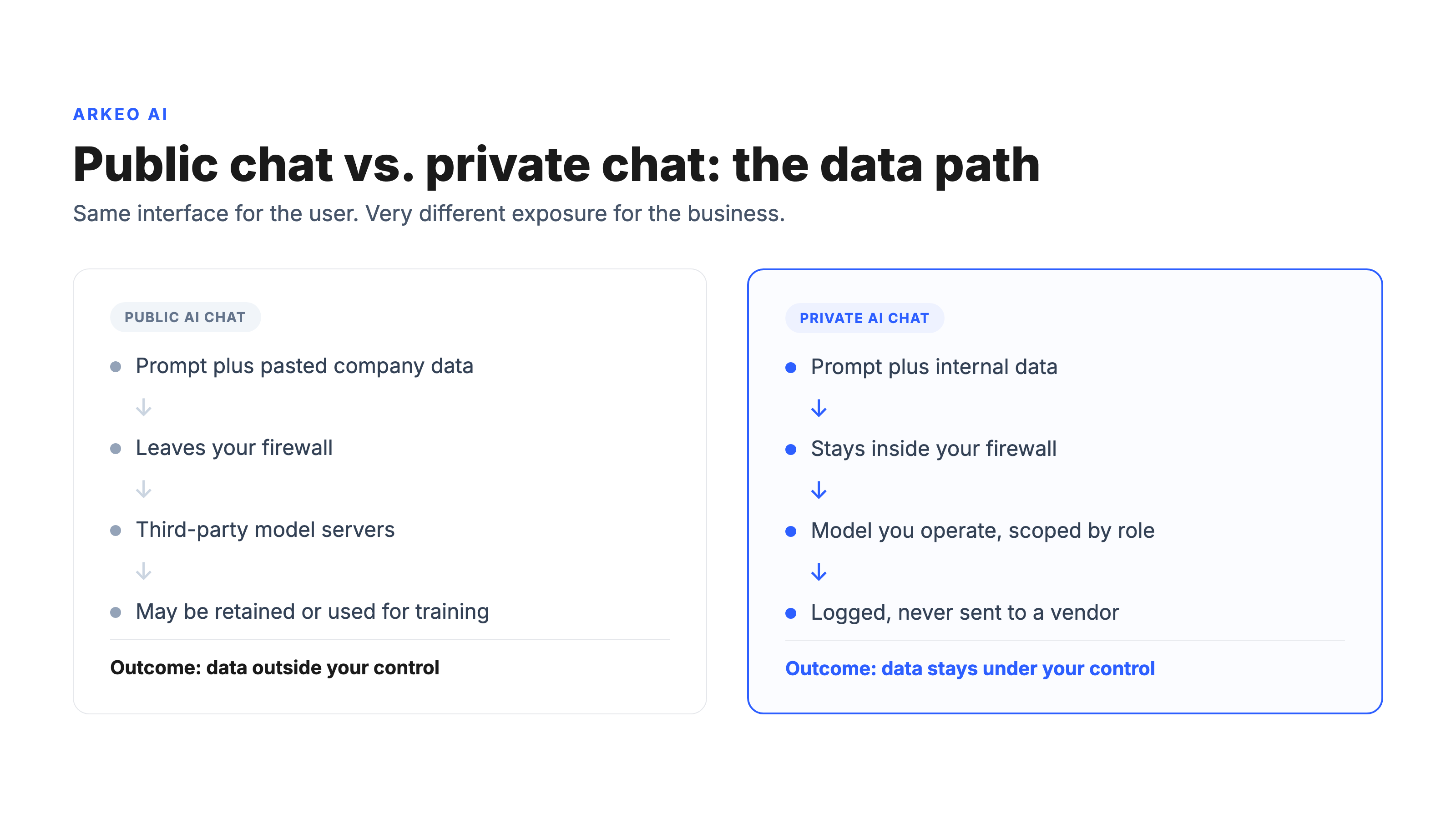
The interface is nearly identical. The data path is not. On a public tool, an employee's prompt plus whatever they paste into it leaves your boundary, lands on a vendor's servers, and may be retained or used for model improvement. On a private deployment, the same prompt stays inside your firewall and is answered by a model you operate. Same convenience for the user, completely different exposure for the business.
This is also where data residency becomes a real factor, not a checkbox. Gartner predicted in February 2025 that by 2027 more than 40% of AI-related data breaches will be caused by improper cross-border use of generative AI. When the model runs on private infrastructure inside a defined jurisdiction, that entire category of exposure shrinks, because the data was never crossing a border to begin with. This is one of the reasons Arkeo builds on-premise and private AI rather than reselling a public API with a logo on it.
When Is Private AI Chat Actually Useful?
Chat is at its best for open-ended, retrieval-heavy work where a human is in the loop and the job is to find or explain, not to execute. Three patterns earn their deployment cost quickly:
Internal Q&A. New hires and busy staff asking "what is the PTO carryover policy?" or "which form covers a vendor change?" get an instant, sourced answer instead of pinging three colleagues. Document lookup. A scoped assistant can read across handbooks, project wikis, and CRM exports and surface the relevant passage with a citation, instead of a person opening eleven tabs. Team support. Support and operations staff can draft replies, summarize a long thread, or reformat data, all against approved internal sources rather than a public model that knows nothing about your business.
The unlock in every case is scoping. Unlike a general-purpose public chatbot, a private assistant can be configured to retrieve only from approved internal document sets, with access restricted by role, so a contractor cannot query an executive's files. That is the feature that makes it safe to point at real company knowledge.
The shadow AI gap
78% of AI users bring their own AI tools to work, bypassing official channels, while only 39% have had any AI training from their employer. The convenience is already there. The control is not.
Source: Microsoft 2024 Work Trend Index.
Does Banning Public Chatbots Solve the Risk?
Most leaders assume the fix is a policy: ban the public tools, send a memo, problem closed. They are wrong. Banning public chatbots does not remove the demand for them, it just pushes the activity somewhere you cannot see. Employees move it to personal phones and home laptops, where you have zero visibility and zero audit trail. The Cisco 2024 study found that 27% of organizations had already banned generative AI applications, at least temporarily, and yet sensitive data was still flowing in. In Cisco's 2025 Data Privacy Benchmark Study, 64% of respondents said they worry about inadvertently sharing sensitive information through these tools, yet nearly half still admit to entering personal or non-public company data into them. Awareness is high. Behavior has not changed.
Here is the blunt truth a vendor brochure will not print: a ban without a sanctioned alternative makes your exposure worse, not better, because it moves the leak off your network entirely. Gartner found in a 2025 survey of cybersecurity leaders that 69% of organizations suspect or have confirmed that employees are using prohibited public generative AI tools. The only durable strategy is to give people a private alternative that is at least as fast and capable as the public one, then make it the path of least resistance.

The cost of getting this wrong is now measurable. IBM's 2025 Cost of a Data Breach Report found that 1 in 5 studied organizations experienced breaches linked to shadow AI, and those breaches cost $670,000 more on average than standard incidents. They were also more likely to compromise customer data and intellectual property. Consider the textbook case: in March 2023, Samsung engineers leaked proprietary source code and internal meeting notes into ChatGPT, which led Samsung to ban external generative AI tools company-wide. The data did not leak because the people were careless. It leaked because the convenient tool and the safe tool were not the same tool.
Your shadow AI exposure is already live
The free assessment shows exactly where staff are routing sensitive data into unmanaged public tools today, and what a sanctioned private alternative would have to match to pull that activity back inside your firewall.
Book Your Free AI Assessment →
Where Does Chat Alone Fall Short?
This is the part most "private ChatGPT" pitches skip. Chat is an interface layer, not a complete AI strategy. A private chat assistant handles open-ended questions and document lookup well. It is not built to execute multi-step workflows, run structured approvals, or trigger actions in your business systems. Ask it to "approve this purchase order, update the ledger, and notify the vendor," and a chat box will describe how to do that, not do it.
Those jobs require purpose-built AI agents wired into your systems, with permissions, error handling, and an audit trail for every action they take. The honest framing is that private chat is one interface pattern inside a larger private AI strategy, not the whole thing. Deploy it where open-ended Q&A adds value, and reach for agents where work has to be done, not just answered. The table below is the line to hold.
| Use a private chat assistant when | You need more than chat when |
|---|---|
| Answering open-ended questions over internal knowledge | Executing a multi-step workflow end to end |
| Looking up and summarizing documents with citations | Routing structured approvals through defined rules |
| Drafting replies and reformatting data with a human reviewing | Triggering actions inside your CRM, ERP, or ticketing system |
| Giving staff a safe alternative to public chatbots | Running unattended, with logging and rollback on every action |
How Do You Deploy Private AI Chat Safely?
A private assistant is only as safe as the controls wrapped around it. Four make the difference between a sanctioned tool and a faster way to leak.
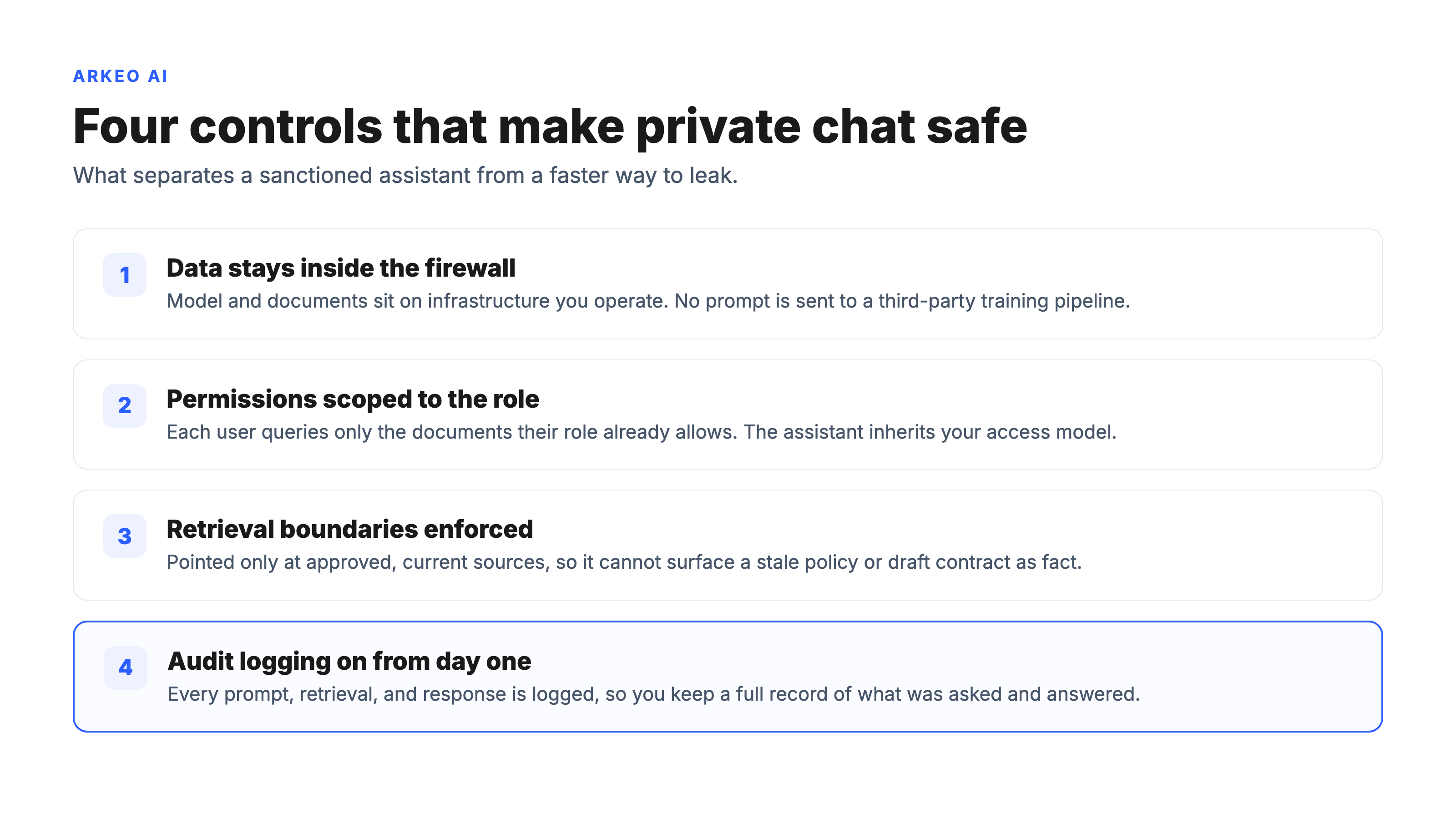
Data stays inside the firewall. The model and the documents it reads sit on infrastructure you operate, so no prompt or response is sent to a third-party provider's shared training pipeline.
Permissions are scoped to the role. Each user can query only the documents their role already allows, so the assistant inherits your existing access model rather than flattening it and letting a contractor read an executive's files.
Retrieval boundaries are enforced. Point the assistant only at approved, current internal sources, so it cannot surface a draft contract or a stale policy and present it as fact.
Auditing is on from day one. Log every prompt, retrieval, and response, because a private deployment without an audit trail is just a faster way to lose track of what was asked.
None of this is optional polish. In a July 2025 report, IBM found that 13% of organizations had already suffered breaches of AI models or applications, and 97% of those breached reported lacking proper AI access controls. That second number is the whole argument: the technology is not what fails first, the missing controls around it are.
The same lag shows up across the industry. The 2025 Thales Data Threat Report found that nearly 70% of organizations now name the fast-moving generative AI ecosystem as their top AI-related security risk, yet reported no clear improvement in data classification, encryption, or policy enforcement among AI-adopting organizations. Awareness keeps rising. Controls keep lagging.
A private chat deployment that skips permissions and auditing simply moves the same gap inside your firewall.
In practice, the controls list is also where the real work hides. Across Arkeo's private deployments, mapping permissions and retention against an existing access model consistently takes longer to get right than standing up the model itself, because it forces an honest inventory of who is actually allowed to see what. That mapping step is rarely glamorous, and it is the step most rushed pilots skip.
That is the kind of detail Arkeo brings to a build. The company was founded in 2023, pairs 25 years of business operating experience with three years of deploying private AI agents on client infrastructure, and runs its own operations on the agents it builds, which is the short version of "we use what we sell." That is why a real deployment starts by mapping your current state and data before any model is chosen.
A private chat assistant is often the right first step on the way to a private AI operating system, but it should be deployed with data isolation, permissions, retrieval boundaries, and auditing from day one, not bolted on after the first incident. For the broader infrastructure picture, see our guide to self-hosted AI, and if your goal is an assistant tied into real work rather than only Q&A, the pattern to study next is a private AI assistant.
Map the build before you scope the tools
The free assessment turns this into a plan: which sources a private assistant should connect to, the permissions and retention model it needs, and whether chat or a workflow agent is the right first build for your operation.
Book Your Free AI Assessment →