Category
What Private AI Means for Business
Last updated: May 2026
You want the leverage of AI inside your business, but you also want a straight answer to one question: where does your data actually go when a team member types it into an AI tool? Arkeo AI has spent three years deploying AI agents into live operations and building the Arkeo Operating System (AOS), and the same confusion shows up in nearly every engagement. Leaders know they want "private AI," but the term gets used to mean four different things at once, and the wrong assumption gets written straight into a vendor contract. Before you commit to a tool or a roadmap, you need to know what private AI really means, what it is not, and how to pick the version that fits your operation. Start by mapping your data paths with a free AI Assessment, or read on first to understand the landscape.
Quick Answer
• What it is: AI where inference and data stay inside your organization's control boundary, so prompts and outputs never flow to a shared public model or its provider.
• Not one model: It is a spectrum, from vendor-managed private tenancies through hybrid setups to fully self-hosted, on-premise deployments.
• Why businesses pursue it: Sensitive data protection, access control, auditability, compliance scoping, and workflow fit.
• How to choose: Match the model to your data sensitivity, team capability, and workflow needs, not to the loudest label.
What Does Private AI Mean for a Business?
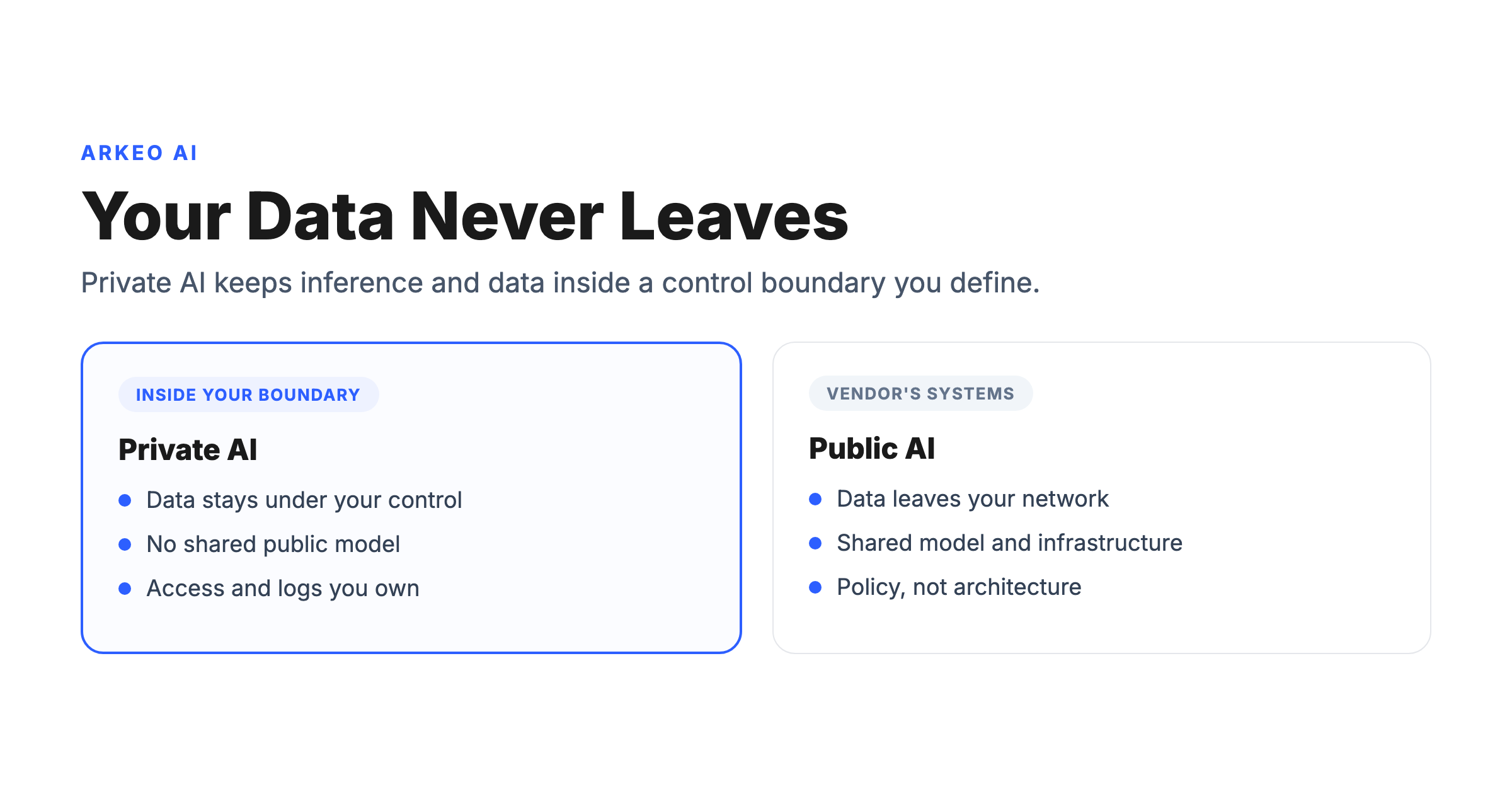
Private AI means AI inference and data storage stay within your organization's control boundary, so training data, prompts, and outputs do not flow to a shared public model or its provider's infrastructure. That control boundary can take several shapes: a private cloud tenancy, an on-premises server in your own building, or a vendor-managed isolated environment carved out for you alone. The defining property is not which building the hardware sits in. It is that your data never becomes part of a shared public system you cannot audit or control.
The business framing matters more than the technical one. Public hosted AI answers to a vendor's roadmap, retention policy, and terms of service. Private AI answers to you. The reason this is a live decision and not an academic one is that the tools are already inside your business, whether or not you sanctioned them. The only open question is where the data they touch ends up, and who can see it.
That gap is not theoretical. Cisco's 2024 Data Privacy Benchmark Study, a survey of 2,600 privacy and security professionals across 12 geographies, found that 27% of organizations had banned generative AI tools at least temporarily over privacy and data security risk. An additional 63% set limits on what data employees may enter, and 61% restricted which tools employees may use. Private AI is the structural answer to the problem those bans are trying to manage.
Is Private AI the Same Thing as Self-Hosted AI?
Here is a false belief worth correcting directly. Most businesses assume that "private AI" means "running an open-weight model on a server in our own basement." That is one version of private AI, but it is only the far end of the range. Treating the two as identical is how teams either rule private AI out as too heavy to operate, or sign up for far more infrastructure than their risk profile actually requires.
Private AI is a spectrum, not a single deployment model. Self-hosted, on-premise AI is the most controlled point on that spectrum, but it is not the only way to keep data inside your boundary. A vendor-managed private tenancy with isolated endpoints can keep your prompts out of a shared public model without you ever racking a server. The spectrum trades control for operational complexity at every step, and the right point depends on what you actually need to protect.

The cleanest way to see the difference is to follow the data. With public hosted AI, your prompt leaves your network, travels to a vendor's shared infrastructure, and may be logged, reviewed for safety, or used to improve the model, depending on the provider's data processing terms and your settings. With private AI, that round trip stays inside a boundary you define. The boundary is the whole point. Everything else is a question of how much of the stack you want to own.
What Are the Private AI Deployment Models?
Four deployment models sit along the private AI spectrum, ordered roughly from least to most control. Each one keeps data out of a shared public model; they differ in who runs the infrastructure and how much operational weight lands on your team.
Vendor-managed private gives you an isolated environment inside a provider's cloud, with private endpoints and contractual commitments that your data is not used to train shared models. It is the fastest to stand up and the lightest to operate, and for many mid-market teams it is enough. Hybrid splits the work: a public or vendor model handles low-risk tasks while your sensitive data and fine-tuning stay private. Self-hosted means you run open-weight models on infrastructure you control, with full ownership of the data path. On-premise is self-hosting taken all the way into your own facility, the strongest residency story and the heaviest to operate.
See which private AI model fits your operation
The free AI Assessment maps your data paths, risk, and workflows, then tells you whether vendor-managed, hybrid, self-hosted, or on-premise private AI is the right fit, before you commit a dollar of capital.
Book Your Free AI Assessment →
Why Do Businesses Pursue Private AI?
Four drivers push businesses toward private AI, and they usually arrive bundled.
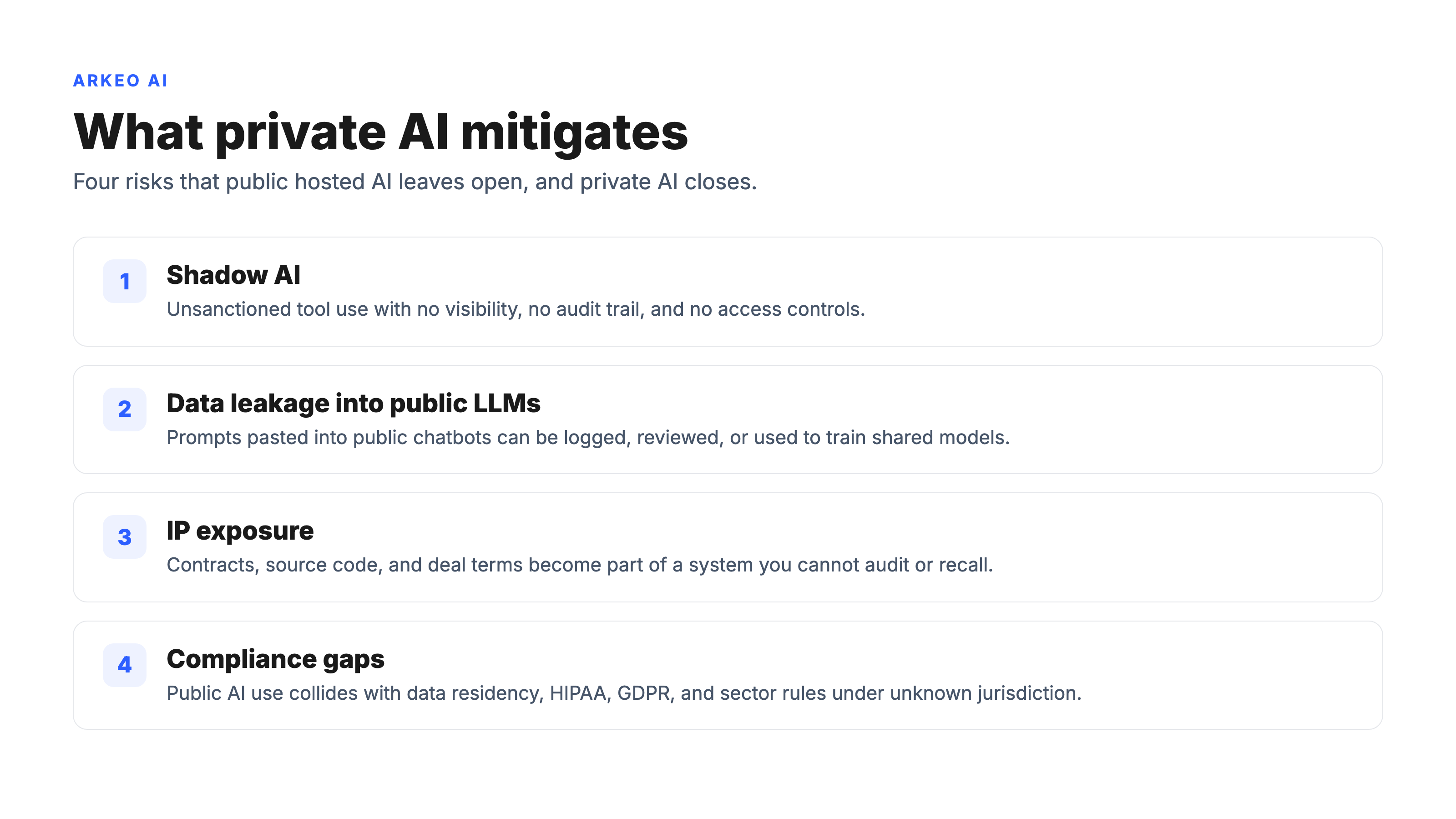
Sensitive data. The core risk with public hosted models is prompt ingestion: when an employee pastes a contract, a source-code snippet, or an HR record into a public chatbot, that content may be logged, reviewed, or used to improve the model. Cisco's benchmark study found that 48% of employees admitted entering non-public company information into generative AI tools and 45% entered employee information, even as 69% of organizations worried about threats to legal and intellectual property rights and 68% feared disclosure to competitors or the public. Private AI closes the leak at the source because there is no shared external system for the data to flow into.
Access control and auditability. A private deployment gives you direct control over who can use the system, what they can reach, and a log of what happened. That matters more than it sounds. IBM's 2025 Cost of a Data Breach Report, based on Ponemon Institute research across 600 organizations, found that 97% of organizations breached through AI lacked proper AI access controls, and 1 in 5 organizations reported a breach caused by shadow AI. Those breached with high shadow AI use paid on average 670,000 US dollars more per incident.
Compliance scoping. Enterprise procurement of public AI often collides with existing data processing agreements, GDPR data residency rules, HIPAA obligations, and sector rules like PCI-DSS for card data or ITAR for defense-related IP. Private AI makes compliance scoping tractable by keeping data under a known legal jurisdiction. Analysts have flagged the stakes: Gartner reported that generative AI ranked as the second-highest emerging risk for enterprises in a 2023 survey of senior risk executives, citing intellectual property, data privacy, and cybersecurity as the three risk dimensions.
Workflow fit. Internal assistants, document search across your own corpus, and agents that act inside your tools all work better where your data already lives, with no external dependency to negotiate. This is the layer where private AI stops being a defensive move and starts compounding into capability.
Here is the blunt truth a vendor brochure leaves out: private AI does not run itself. The most controlled models, self-hosted and on-premise, require real operational ownership. Models need patching, hardware fails, and capacity has to be planned. The system that runs flawlessly in a demo will, at some point, fall over in production, and someone on your side has to be ready to bring it back. That is exactly why Arkeo AI, founded in 2023 by an operator with 25 years of business experience, runs private and on-premise AI on its own systems first. The firm uses what it sells, so the deployments it recommends are the ones it operates daily.
How Do You Decide Which Private AI Model Fits?
The choice is not ideological. It is a fit assessment along three axes.
Business criteria. Start with what you are protecting and what you must prove. The more regulated or genuinely proprietary your data, and the stricter your residency rules, the further you move toward self-hosted or on-premise. If your concern is mostly keeping prompts out of a shared training set, a vendor-managed private tenancy may close the gap with far less weight.
Team capability. Be honest about who operates the system. A small team with no appetite to patch servers should not start at the on-premise end of the spectrum. Vendor-managed private exists precisely so that teams without infrastructure staff can still keep data inside a boundary. The right model is the most controlled one your team can actually run, not the most controlled one that exists.
Workflow needs. Match the deployment to how the AI will be used. High, steady internal volume and deep integration with private data favor self-hosting or on-premise. Sporadic, low-risk tasks rarely justify that weight. Many businesses land on hybrid, keeping sensitive workloads private while routing low-risk work to a vendor model.
Picture an operations lead at a 40-person professional services firm whose teams have quietly started using a public chatbot for client work. Usage is climbing, the data is sensitive, and a client audit lands six weeks out. The instinct is to ban the tools, which only pushes the activity onto personal devices and erases all visibility, or to do nothing. The durable answer is neither. It is to give people a private AI option that is at least as fast, sits inside the boundary, and produces the audit trail the business needs, then to match the deployment model to the team's real capacity rather than its ambitions. The Thales 2025 Data Threat Report, drawing on more than 3,100 IT and security professionals across 20 countries, found that nearly 70% of organizations name the fast pace of AI development as their leading GenAI security risk, and that GenAI security is now their second-highest security spending priority. The pressure to act is real; the trick is choosing the model that matches your reality.
This is the staged path Arkeo AI has used since 2023: map your current state and bottlenecks, ship 30-to-90-day easy wins, build the top custom workflow agents, then move toward a long-term private AI architecture coordinated through the Arkeo Operating System. The free AI Assessment is the lead magnet for that work; the paid Consult is the deeper diagnostic that follows if you want a costed roadmap. For the infrastructure end of the spectrum, this overview of choosing a deployment model you control goes deeper, and this guide to on-premise AI covers the in-your-building case.
Choose your private AI model with a clear head
The free AI Assessment is a 60-minute planning session that maps your data, risk, and usage, then recommends whether vendor-managed, hybrid, self-hosted, or on-premise private AI fits, with a phased roadmap and no obligation.
Book Your Free AI Assessment →