Category
Machine Learning Model Governance Explained
Last updated: May 2026
Your data science team can tell you, to three decimal places, how a credit model performed in validation. They probably cannot tell you who approved the new support chatbot to act on customer accounts, what it is allowed to do, or who reviews its decisions when it goes wrong. That gap is the live problem in 2026. Arkeo has spent three years deploying AI agents into production for mid-market operators, and the recurring pattern is that the controls built for statistical models do not stretch to cover systems that read open-ended language and take actions. The instinct is to fall back on the model-governance playbook, the one regulators have demanded since 2011. It is a good playbook. It is also incomplete for what you are actually shipping now. Before you decide whether your existing controls are enough, a structured review of where AI fits your operation, free through Arkeo's AI Assessment, will tell you faster than another internal audit.
Quick Answer
• What it is: the lifecycle discipline that controls how a machine learning model is validated, approved, monitored for drift, documented, and retired.
• What it covers: the model artifact itself, validation, ongoing monitoring, versioning, and review.
• Where it falls short: generative and agentic systems add open-ended inputs, unstructured outputs, and autonomous actions that classic controls were never designed for.
• Why it matters: model governance is necessary but not sufficient. It is one layer inside a broader AI governance operating model, not the whole thing.
What Does Machine Learning Model Governance Cover?
Machine learning model governance is the set of controls that determine how a model is validated, approved, monitored, documented, and retired across its full lifecycle. It answers four operational questions: does the model do what it claims, who is allowed to put it into production, how do you know it still works months later, and what is written down so a stranger could understand it. Get those four right and you have governance. Skip the monitoring and you have documentation theater, a binder that proves the model was fine on the day it shipped and says nothing about today.
None of this is new. The U.S. banking regulators codified it more than a decade ago. Federal Reserve Supervisory Letter SR 11-7 defines a model as a quantitative method that applies statistical, economic, or mathematical techniques to turn input data into quantitative estimates. That 2011 definition is still the cleanest description of the thing you are governing when the model is a classic predictor. Four controls do the work.
Validation. SR 11-7 breaks it into three parts: evaluating conceptual soundness, ongoing monitoring to confirm continued performance, and outcomes analysis that compares actual results against the model's forecasts. Validation is not a one-time gate. Two of its three pillars are continuous.
Monitoring and drift. A model that passed validation at launch degrades silently as data distributions shift, business rules change, and the population it scores evolves. Drift is the primary ongoing governance event, and monitoring the statistical behavior of inputs and outputs is what keeps governance live rather than archival.
Approval and effective challenge. Someone has to decide the model is fit for use and under what conditions. The OCC's Bulletin 2011-12, issued jointly with the Fed, defines "effective challenge" as critical analysis by objective, informed parties who can identify a model's limitations and force appropriate change. Approval without it is a rubber stamp.
Documentation. SR 11-7 requires documentation detailed enough for parties unfamiliar with a model to understand how it operates, its limitations, and its key assumptions. The industry later named the practice. Mitchell and colleagues at Google Research proposed model cards in 2018, short documents that report benchmarked performance across demographic groups, on the argument that models increasingly perform high-impact tasks in law enforcement, medicine, and employment, so their intended use must be made explicit. The governance-level documentation expectation predates the model-card label by seven years.
Underneath all four sits the model inventory. You cannot govern what you cannot enumerate. A registry of every model with its owner, version, purpose, risk tier, validation date, and monitoring cadence is the prerequisite for everything else, from audit to retirement policy.
Why Is Model Governance No Longer the Whole Story?
Here is the false belief worth challenging. Most teams assume that if their model governance is mature, their AI is governed. It is not. Classic model governance assumes a closed input/output contract: the model receives a defined set of features and returns a numeric estimate. You can validate that. You can back-test it. You can draw a clean boundary around it.
Generative and agentic AI breaks that contract on all three sides. The input is open-ended natural language, so there is no fixed feature set to validate. The output is unstructured text or, worse, an action taken in a real system, so there is no single number to back-test against. And the "model" may orchestrate external tools, call APIs, and chain decisions, so the thing you govern is no longer an artifact behind a clean interface. It is a behaving system.
The blunt truth a vendor will not put in a brochure: these systems break in ways your drift dashboards will never catch. A credit model degrades gradually and measurably. A language model can be perfectly stable on every benchmark and still be talked into doing something it should not, because the failure mode is the input itself, not statistical drift. Validation that only watches the numbers misses the entire category of risk that defines generative and agentic AI.
The standards bodies have already named the gap. NIST's Generative AI Profile (AI 600-1, July 2024), developed with roughly 2,500 participants, identifies thirteen risks unique to generative AI and more than 400 recommended actions, including output monitoring, content provenance, pre-deployment testing, and incident disclosure. Those controls have no equivalent in SR 11-7, because the systems it was written for did not generate open-ended content.
See where your AI controls actually stop
Arkeo's free AI Assessment maps your current models, deployment boundaries, and workflow risks in one 60-minute session, so you can see exactly where classic governance ends and modern controls have to begin.
Book Your Free AI Assessment →
How Does Model Governance Fit Inside Broader AI Governance?
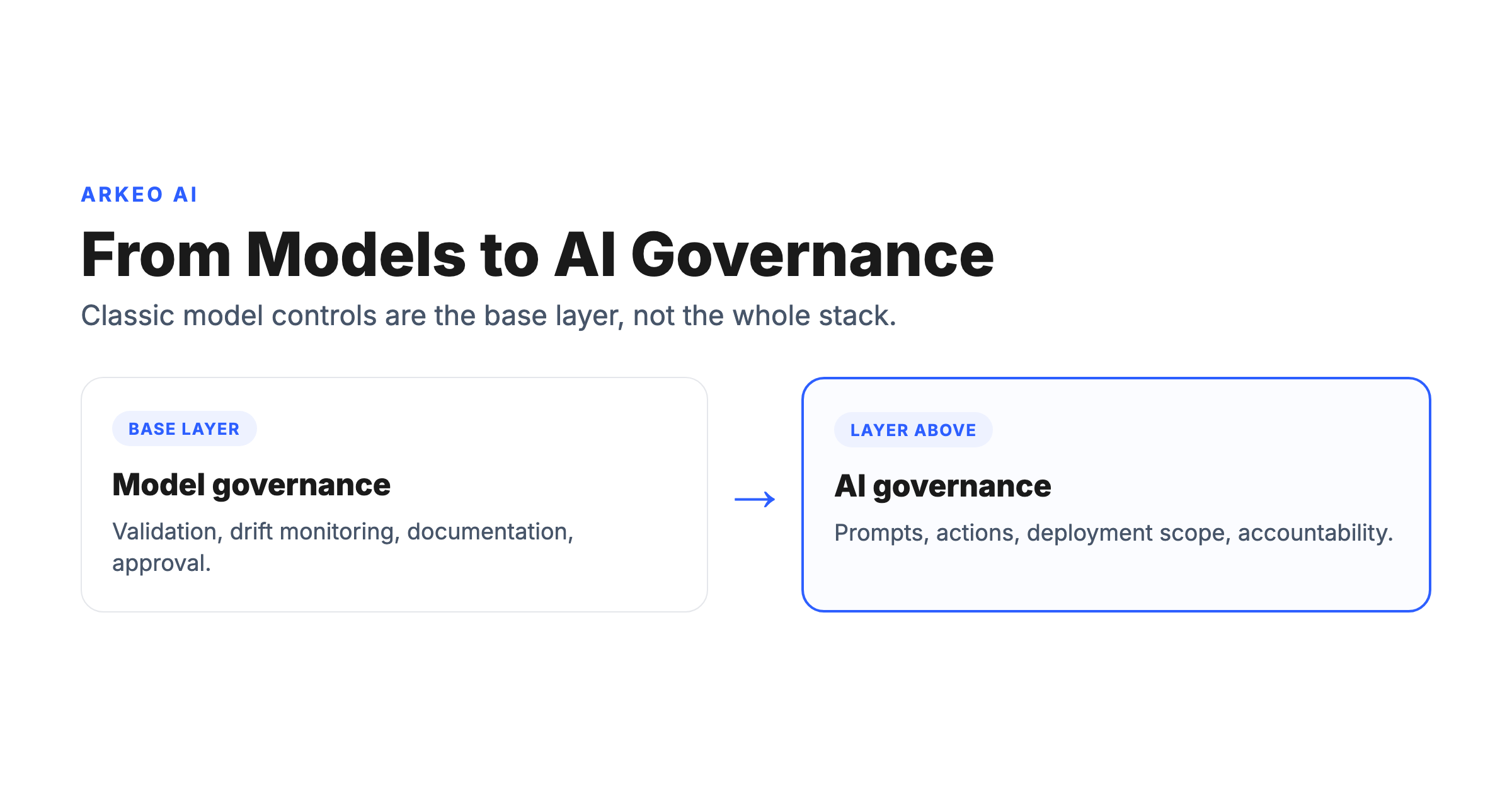
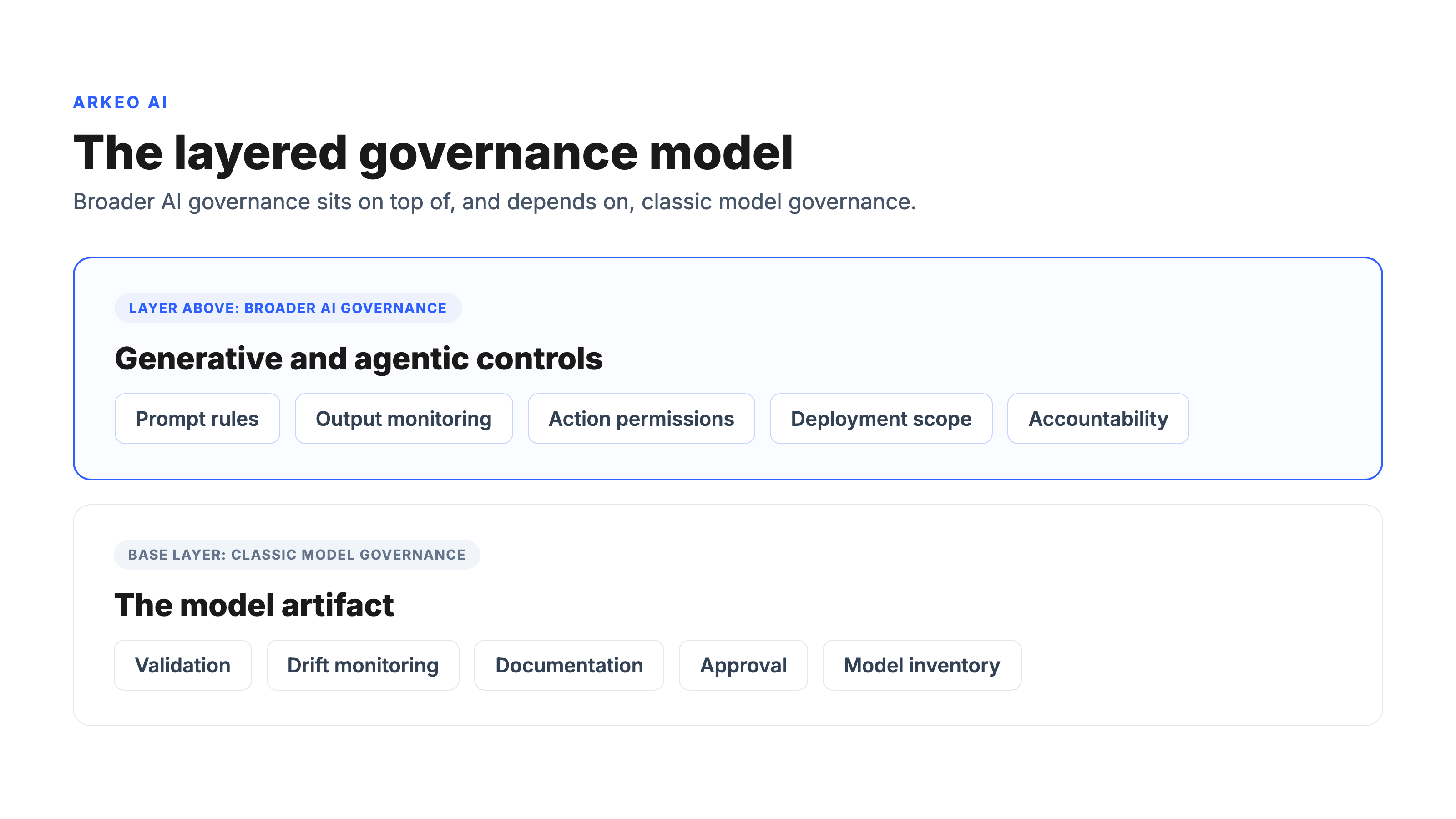
The right mental model is layers, not replacement. Model governance is the base layer, and it stays exactly as rigorous as it always was. Broader AI governance is the layer above it, covering what the model artifact never touched: deployment context, user interaction, the actions a system is permitted to take, and the accountability for all of it.
NIST gives you the scaffolding for the upper layer. The AI Risk Management Framework 1.0 (January 2023) organizes AI risk into four functions: GOVERN, MAP, MEASURE, and MANAGE. It is voluntary and sector-neutral. Classic model validation lives mostly inside MEASURE, while the governance, context-mapping, and management functions hold the broader controls, and they apply whether the system is a logistic regression or an autonomous agent.
For organizations operating in or selling into Europe, the layering is no longer optional. The EU AI Act (Regulation 2024/1689) entered into force on 1 August 2024 and sorts systems into four risk levels. High-risk systems must maintain detailed technical documentation, implement human oversight, and pass conformity assessment, and providers of general-purpose AI models must publish a summary of their training content. That documentation requirement maps directly onto both SR 11-7 and model cards. The layers reinforce each other. The law just made the upper layer mandatory.
The practical danger is treating these as two separate programs run by two separate teams. When model governance is owned by data science and "AI policy" is owned by legal, the seam between them is where systems ship ungoverned. The systems that scare experienced operators are not the ones with bad models. They are the ones where a competent model was wrapped in an agent that could take actions nobody scoped, approved by nobody in particular, because it fell in the gap between the two programs.
What Controls Should Teams Add for Modern AI Systems?
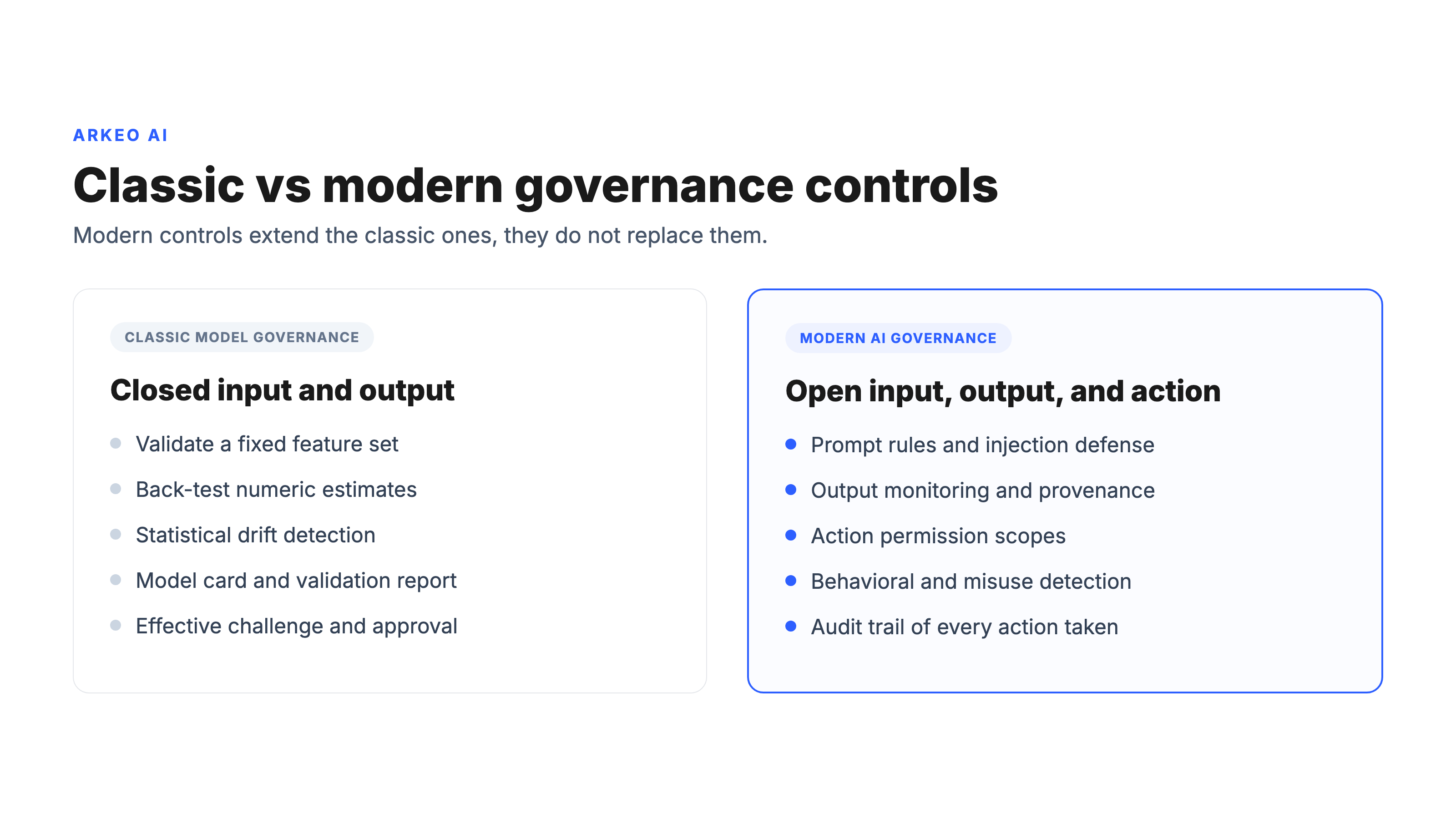
Keep every classic control, then add the ones that address open-ended input, generated output, and autonomous action. Consider a hypothetical mid-market lender that already governs its credit-scoring models well, then deploys a customer-service agent that can read account data and issue small refunds. The model behind the agent might be flawless. The risk lives entirely in the layer the credit-model controls never covered: what the agent is allowed to do, what it can read, and what gets logged when it acts. The table below pairs each classic control with the modern one it now needs.
The pattern is consistent. Each modern control is not a replacement but an extension that covers a surface area the closed input/output model never had: prompt governance because the input is now language, output monitoring because the output is now generated, action permission scopes because the system now does things. The fuller version of how these stack into a single framework lives in Arkeo's AI governance framework guide.
How Do You Avoid Governance Fragmentation?
The biggest risk is not a missing control. It is two governance programs that never connect. Fragmentation looks like this: data science runs a mature model-validation process, IT security runs a separate AI-usage policy, legal tracks the EU AI Act in a third silo, and an agentic workflow ships through the seams of all three without any single owner.
The fix is a single operating model with one inventory, one set of risk tiers, and one accountable owner per deployed system. Map your classic model controls and your modern AI controls onto the same NIST functions rather than running two parallel frameworks. The model inventory becomes a system inventory: it still records owner, version, and validation date, and now also records what each system is permitted to do, what data it can reach, and who reviews its actions. One register, expanded, not two fighting for jurisdiction.
This is the part Arkeo argues from its own deployments rather than from a slide. Founded in 2023 on 25 years of running real businesses, the company has spent three years putting AI agents into production and runs its own internal stack, the Arkeo Operating System, on the same principle it sells to clients: we use what we sell. When governance is built on-premise or as private AI inside your own infrastructure, the audit trail, the action logs, and the data boundaries are yours to enforce rather than terms you accept from a public vendor. Model governance, deployment controls, and workflow authorization belong in one operating model precisely because, in production, they fail at the seams. Where this extends into generative and agentic systems, the generative AI governance framework covers the controls those systems demand in detail.
Connect model controls to your whole AI operation
In one free 60-minute session, Arkeo maps your models, deployment boundaries, and workflow risks into a single governance plan you can act on, with no obligation to buy a build after.
Book Your Free AI Assessment →