Category
Claude Cowork for Teams: Private AI Deployment Guide
Last updated: May 2026
Your employees are pasting sensitive company data into public AI models right now. They aren't trying to be malicious, they are just trying to get their work done faster. Claude Cowork for Teams is a secure, centralized AI workspace designed to give your staff the automation tools they need while keeping your enterprise data completely private. After deploying private AI systems for mid-market operators since 2023, we have seen exactly how this platform moves companies from disjointed shadow AI to a managed AI workforce. That is exactly what we map during our free AI Assessment: which processes are costing you the most, and which ones a secure AI workforce can handle tomorrow.
- Target Audience: Mid-market teams of 5 to 150 members deploying a secure AI workforce.
- Context Window: 200,000 tokens per Team, up to 1 million on Enterprise.
- Core Security: Zero model training on Enterprise data, SSO, and SCIM provisioning.
- Base Cost: Starts at $20 per seat per month, plus variable API usage consumption.
Moving from Shadow AI to a Private AI Workforce
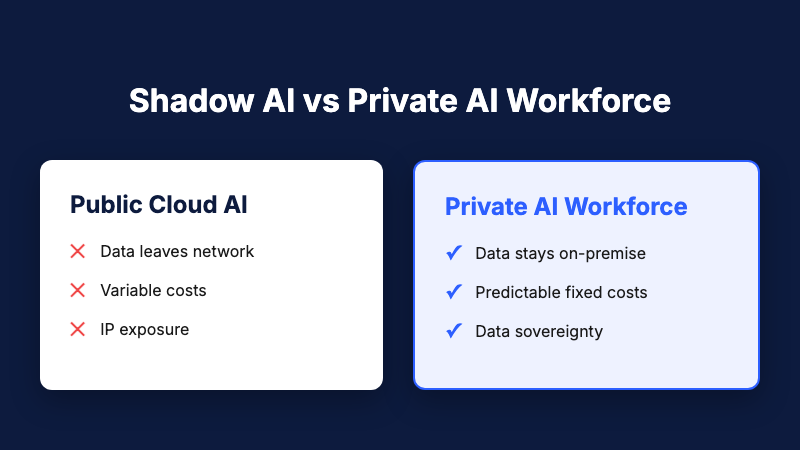
Most operators think letting employees expense ChatGPT Plus accounts is a valid AI strategy. They are wrong. It is actually a massive unmanaged data leak. When your team uses public cloud tools, you have zero visibility into what intellectual property is leaving the building. Every time an estimator asks a public model to check a bid, or an HR manager asks it to summarize an employee grievance, your operational truth becomes public training data.
Moving to a centralized system like Claude Cowork fundamentally changes this dynamic. It allows you to build a true private AI workforce. Anthropic explicitly guarantees zero model training on Enterprise plan data. This means your financial reports, HR policies, and preventing shadow AI become manageable realities. You stop playing defense against your own employees and start building an asset.
You control access through SSO and SCIM auto-provisioning. Instead of 50 rogue accounts managed on personal credit cards, you have a single, governed perimeter. This is the difference between experimenting with AI and deploying on-premise AI capabilities that protect your business.
Cowork serves business teams. Code serves engineering teams.
Anthropic ships both products on the same model class. The procurement decision is about the operating envelope, not the model. The fork below maps which team needs which product.
For business teams
For engineering teams
Claude Cowork vs. Claude Code: Understanding the Tools
Market confusion around AI tools is rampant. Vendors use the term "AI" to mean everything from basic chatbots to complex data pipelines. Let me clear up the difference between Claude Cowork and Claude Code, because they serve entirely different departments.
Claude Code is built for developers. It has a massive 1 million token context window, but it is not covered under Anthropic's Business Associate Agreement (BAA) for HIPAA readiness. It writes and debugs software. It lives in the terminal. If you are not an engineer, you will never touch it.
Claude Cowork is built for business operators, finance teams, and HR professionals. It uses the Sonnet 4.6 model with a 500,000 token context window on Enterprise, specifically designed to handle documents, spreadsheets, and daily administrative tasks. If you are comparing an AI workforce vs ChatGPT, Cowork is the interface your non-technical staff will actually use to get their jobs done. It is designed to be the central hub where human workers interact with digital agents.
The 3-Phase Deployment Model: Assess, Deploy, Manage
You do not just turn on Claude Cowork and expect transformation. Software does not fix broken processes. At Arkeo, we run three companies on our own AI systems, and we use a strict 3-phase model to deploy private AI workforces for mid-market clients.
Phase 1: Assess. We start by mapping your operational bottlenecks. We look at the tasks that consume the most manual hours—typically unstructured data entry, reporting, and policy lookups. We identify which of these tasks are ripe for automation and calculate the precise ROI.
Phase 2: Deploy. We configure Claude Enterprise with your SSO provider (like Okta), establish SCIM provisioning, and set up your initial Team Projects. We ring-fence your data so nothing leaks. Then, we build the exact prompts and workflows your team needs to execute those identified high-ROI tasks.
Phase 3: Manage. AI agents break. Regularly. APIs change, prompt drift occurs, and token costs can spike if unmonitored. We act as the managed service provider for your AI workforce, monitoring consumption, updating workflows, and ensuring your digital employees show up to work every day, just like your human ones.
Crawl, walk, run — the Arkeo deployment model for Cowork teams
Three phases. Each one ships a working capability before the next one starts. The teams that succeed at Cowork treat the assessment as a real piece of work, not a vendor demo.
Assess
Map shadow AI use, sensitive data flows, the three highest-payback workflows. Set the perimeter and governance.
Deploy
Stand up Cowork on private hardware or VPC. Ship the first workflow to a single team. Measure baseline.
Manage
Add workflows two and three. Continuous monitoring, audit review, regulatory updates.
Deploying Claude Cowork: 4 Enterprise Use Cases
It is easy to talk about AI transforming business. It is much harder to see what that looks like on a Tuesday morning. Here is how we see mid-market companies actually using Claude Cowork to eliminate administrative overhead.
Operations: The Scheduled Task Workforce
Claude Cowork handles recurring administrative friction perfectly. Consider the daily reporting burden in construction operations. Project managers spend hours compiling updates from disparate sources.
Instead of an operations manager spending an hour reading scattered updates, Cowork connects directly to your Slack workspace and Google Drive. You can schedule a recurring task: "Every morning at 7 AM, read the daily field reports from the 'Site Updates' Slack channel and the 'Daily Incident Logs' spreadsheet. Generate a 3-bullet summary of delays and email it to the leadership team." The AI agent executes this perfectly, every single day, without needing to be re-prompted. This is not a chat interface; this is a scheduled digital worker operating autonomously.
Finance: Unstructured Data Parsing
I routinely see finance coordinators manually matching 50 scattered, blurry text receipts and random PDFs into Excel every month because their ERP system cannot read unstructured data. It is a terrible use of human capital. It burns out good employees on low-value data entry.
With Cowork, that coordinator simply drops those 50 messy files into a specific local directory. The system scans the folder, extracts the vendor name, date, total amount, and tax from every single document, and outputs a perfectly formatted spreadsheet ready for import. It turns hours of data entry into a three-minute review process. The finance team stops acting as data typists and starts acting as financial analysts.
See Where AI Fits in Your Business
Book a free 30-minute AI Assessment. We'll map your highest-value automation opportunities, estimate ROI, and build a 90-day deployment roadmap. No obligation, no pitch deck.
HR and Onboarding: Living Policy Projects
Claude Team Projects allow you to upload the equivalent of 15 full financial reports or 100,000 lines of code to serve as persistent, secure context for a chat. This fundamentally changes how internal knowledge is accessed.
HR teams use this to create a living policy assistant. They upload the entire employee handbook, benefits packages, and provincial labour laws into a shared Team Project. When a manager asks, "What is our exact policy for an employee requesting three weeks of continuous paternity leave in BC?", they get an instant, cited answer based strictly on private company data. There are no hallucinations, because the model is only referencing your specific documents. It reduces HR bottlenecks and ensures managers get consistent, compliant guidance immediately.
IT and Security: Securing the AI Perimeter
For the CTO, Claude Enterprise is about governance. It provides the controls needed for securing your enterprise IP against internal leaks and external threats.
You deploy the system using SCIM to auto-provision accounts via Okta. All data is strictly ring-fenced. More importantly, the CTO gets detailed audit logs and API usage monitoring. They can see exactly which departments are adopting the tools and where token consumption is spiking, maintaining complete control over the technical perimeter. You cannot manage what you cannot measure, and Claude Enterprise finally gives IT the measurement tools required for secure AI adoption.
Four enterprise workflows where Cowork teams deliver fastest
These four show up in every Cowork deployment we have shipped. High-volume, document-heavy, and currently consumed by senior hours the firm would rather spend on growth.
Operations
Status rollups, exception flagging, cross-system reconciliation. Boring, load-bearing, recurring.
HR
Onboarding kits, document assembly, compliance attestations, knowledge base maintenance.
Finance
Invoice and PO matching, expense categorisation, vendor onboarding. Highest-signal workflow.
Sales operations
Lead enrichment, follow-up drafting, proposal assembly from past wins. Pipeline lift.
What Are the Hidden Costs of Claude Enterprise Pricing?
Deploying an AI workforce is not a flat-rate software subscription. This is where unmanaged deployments fail. Operators are used to SaaS pricing where a seat costs a fixed amount per month, regardless of how heavily the user relies on the software. AI does not work that way.
Claude Enterprise pricing starts at a $20 per seat monthly base, but that is just the access fee. The real cost comes from API usage consumption. Every time your team processes a massive document, runs a complex scheduled task, or queries a deep Team Project, you pay for the tokens used. The compute cost is variable.
If you just hand out licenses without an architecture plan, you will end up with runaway token costs. We have seen companies accidentally burn thousands of dollars in a weekend because a poorly optimized scheduled task got stuck in a loop. This is why mid-market companies need a managed deployment. We built what we sell, and we know that monitoring token consumption and optimizing workflows is just as important as the initial setup. A managed service partner ensures your digital workforce stays within budget.
Ready to Deploy AI on Your Infrastructure?
Arkeo builds private AI systems for mid-market companies. No cloud dependencies, no data leaving your building, no per-token pricing. Start with a free 30-minute assessment.
Frequently Asked Questions
Does Claude Cowork use our data for model training?
No. Anthropic explicitly guarantees that they do not train their models on data submitted through the Claude Enterprise or Team plans. Your intellectual property remains completely private and secured within your environment.
How much does Claude Enterprise cost for a mid-market team?
Claude Enterprise starts with a minimum requirement of 20 seats at a $20 per seat monthly base rate. In addition to this base fee, companies pay for variable API token consumption based on actual usage.
What integrations does Claude Cowork support natively?
Claude Cowork natively integrates with common enterprise platforms including Google Drive, Microsoft 365, Slack, and GitHub. These connectors allow the AI workforce to securely interact with your existing operational files.
Can we deploy Claude Cowork on private infrastructure?
Yes. Claude Enterprise provides strict data sovereignty controls, API billing, and SCIM provisioning. This allows mid-market companies to deploy managed AI workflows that act as a private system without exposing data to public models.