Category
Claude Cowork Data Privacy: Securing Your Enterprise IP
Claude Cowork Data Privacy: Securing Your Enterprise IP
The reality of enterprise artificial intelligence is no longer about whether your team will use it. They already are. If you are operating a mid-market company with 50 to 500 employees, the operational truth is that your staff is uploading data to cloud-based language models right now. They are pasting client contracts, financial projections, and proprietary code into browser windows. They are doing this because the tools make them faster, and operators cannot afford to move slowly.
The problem is not the technology itself. The problem is the architecture of the deployment. When an employee uses consumer-grade tools like Claude or ChatGPT to summarize a sensitive internal document, that enterprise intellectual property leaves your controlled environment. It enters a public cloud ecosystem where data retention policies, training data usage, and access controls are entirely dictated by the vendor.
For a business owner or operations executive, this is a massive unmanaged risk. The conversation around Claude cowork data privacy is not just an IT concern. It is a fundamental question of data sovereignty and corporate governance.
This guide breaks down exactly what happens to your data when it interacts with external AI models, the true cost of the shadow AI crisis in the mid-market, and why deploying a private AI workforce on your own infrastructure is the only sustainable path forward for data-conscious operators.
The Reality of Claude Cowork Data Privacy
When discussing Claude cowork data privacy, we must separate the consumer applications from enterprise agreements. Anthropic, the company behind Claude, has made significant strides in defining commercial data privacy boundaries. Their default stance for enterprise API users is that customer data is not used to train their foundational models. However, there is a massive difference between a vendor promise and true data sovereignty.
If your employees are using the free or standard pro versions of these tools, the default terms of service often allow the provider to use inputs for model improvement. This means that a proprietary internal process documented and pasted into a chat window could theoretically inform the weights of a model that your competitors also use.
Even under enterprise agreements where training on your data is explicitly prohibited, the architecture still requires your data to leave your building. It is transmitted over the internet, processed on third-party servers, and stored in external logs for abuse monitoring. For industries dealing with sensitive financial data, healthcare records, or critical infrastructure intellectual property, relying on a vendor's promise of zero retention is often insufficient.
The operational truth is that as long as you rely on a shared public cloud AI model, you do not possess absolute control over your enterprise IP. You are renting access to intelligence and paying for it with data exposure.
Three honest questions about Claude Cowork data privacy
Anthropic publishes solid data handling commitments for Cowork. The questions below are not about whether Anthropic is trustworthy — they are about whether the architecture is acceptable for your specific data, your specific compliance posture, and your specific risk tolerance.
Inference path
Where do prompts and outputs physically run? Anthropic's cloud, your VPC, or your hardware? The disk location decides the audit story.
Training boundary
Are your prompts and outputs used to train future foundation models? Default settings, contract terms, and override paths.
Audit attestation
What concrete attestations can the vendor provide for your auditor? SOC 2, HIPAA BAA, regional residency.
The Shadow AI Crisis in the Mid-Market
We have been building and deploying AI agent systems since 2023. Over the last three years, the most consistent pattern we see during an initial technical audit is the volume of shadow AI. Shadow AI occurs when employees bypass approved IT channels to use generative AI tools to accomplish their daily tasks.
They do not do this maliciously. A project manager facing a four-hour task to synthesize meeting notes into a project brief will use an AI tool that does it in four seconds. A junior developer will use a coding assistant to debug a script. The efficiency gains are too massive to ignore.
But this behaviour creates an invisible pipeline draining your enterprise IP. You cannot secure what you cannot see. When employees use unvetted personal accounts to process company data, you lose auditability. If a client asks for proof that their data has not been compromised, you have no logs to show them. You cannot verify what was uploaded, who uploaded it, or where it went.
Attempting to solve this by simply blocking access to AI domains on the corporate network is a failed strategy. Employees will use personal devices or find workarounds. The only effective strategy is to provide a superior, secure, internal alternative. You must give them the tools they need to operate efficiently, but architected in a way that protects the business.
Employees using ChatGPT with company data?
You cannot secure what you cannot see. Stop the invisible leak of your enterprise IP and take control of your AI strategy. We map exactly where your data is going and build a secure infrastructure for your business.
Book Your AI Assessment →Data Sovereignty: The Cost of an IP Leak
To understand the urgency of this issue, operators need to quantify the value of the data leaving their building. Mid-market companies in construction, oil and gas, professional services, and manufacturing run on proprietary processes. Your competitive advantage is often codified in your estimating spreadsheets, your standard operating procedures, and your internal playbooks.
If an estimator pastes a complex pricing model into a public AI tool to generate a summary, that logic is now residing on a third-party server. If a legal associate uploads a draft contract for grammar checking, client confidentiality is breached. The consequences extend beyond theoretical competitive disadvantage. They cross into regulatory violations, breach of contract, and loss of client trust.
Data sovereignty is the principle that an organization has total control over its data, including where it resides, who has access to it, and how it is processed. True data sovereignty is incompatible with public cloud AI models. Achieving sovereignty requires infrastructure that you control. It requires an architecture where the compute happens within your environment and the data never crosses an external firewall.
The unbudgeted cost of a single shadow-AI IP leak
Most mid-market firms have never budgeted for a shadow-AI incident. The two figures below are the honest range from disclosed incidents — direct response cost, plus indirect competitive cost from leaked strategy or pricing.
Forensics, legal review, breach notifications, customer communications. The 90-day post-incident cost shows up before any litigation.
Competitive cost when pricing strategy or product roadmap reaches a competitor through a leaked prompt. Hard to quantify, easy to feel.
Public Cloud AI vs. Private AI Workforces
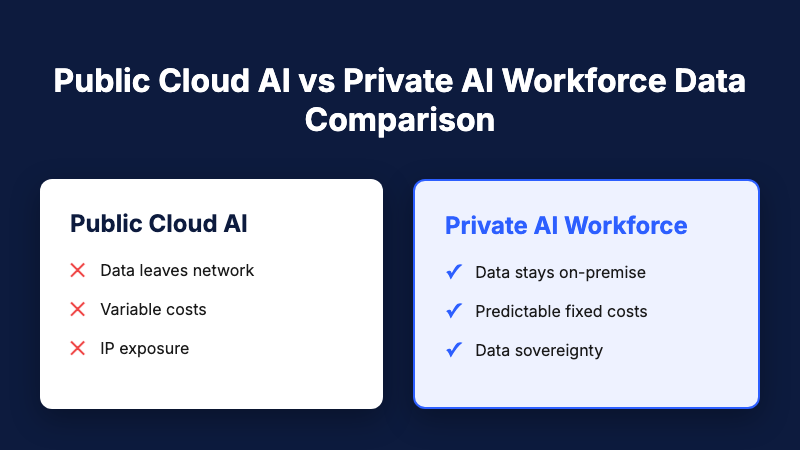
The marketplace currently presents business owners with a false dichotomy. The narrative suggests that to gain the operational efficiencies of AI, you must sacrifice data control to massive cloud providers. This is incorrect. The alternative is deploying a private AI workforce on your own infrastructure.
Public cloud AI models are generalized tools designed to be mildly useful to billions of users. They require constant internet connectivity and operate on a per-token pricing model. Every query you run costs money, and the financial predictability of your operations degrades as adoption scales. More importantly, they represent an unacceptable security posture for sensitive enterprise data.
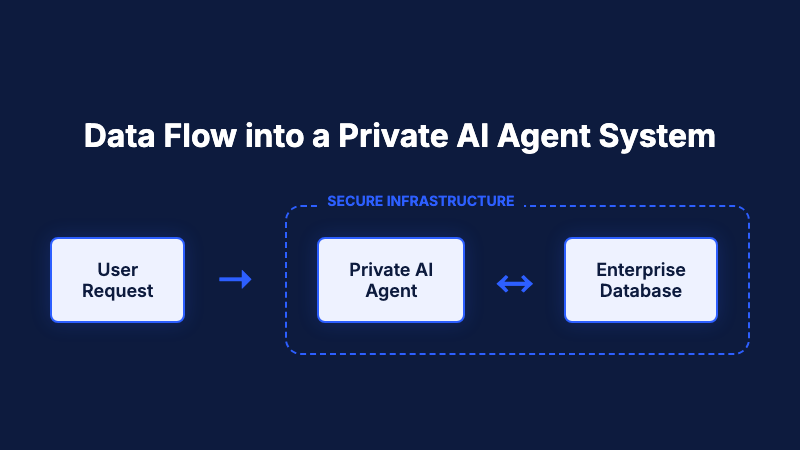
A private AI workforce, by contrast, is a system of specialized AI agents deployed within your controlled environment. These agents run on local or dedicated private cloud infrastructure. They do not require a connection to external model providers to function. They are trained specifically on your operational data, your standard operating procedures, and your business logic.
Because the models and the data reside together under your control, the privacy risk drops to zero. You maintain absolute authority over the entire system. This is the difference between renting a generic tool and owning a proprietary asset.
Same Claude model class, very different data privacy posture
The procurement decision is not about which is "better Claude". It is about where the data lives during inference. For regulated mid-market work, that single boundary is everything.
Vendor cloud, vendor controls
Your hardware, your controls
The Arkeo AI Methodology: Assess, Deploy, Manage
At Arkeo AI, our core positioning is clear. We deploy a custom AI workforce for your business. We do not resell access to public models. We build Agent Operating Systems that run securely on your infrastructure. Three of our own companies run entirely on these systems. We use what we sell, and we understand the operational realities of mid-market business.
Deploying a secure AI workforce is not a simple software installation. It is a strategic operational shift that requires a rigorous methodology. We break this process into three distinct phases.
Phase 1: Assess
The assessment phase is where we identify the operational bottlenecks and map the data architecture. We analyze where shadow AI is currently occurring in your organization. We quantify the manual hours spent on repetitive administrative tasks, reporting, and data entry. We do not look for places to forcefully insert AI. We look for operational drag and determine if a private agent can execute the task faster and more securely. This phase culminates in a clear deployment roadmap with fixed costs and defined ROI.
Phase 2: Deploy
The deployment phase is where we build the AI workforce. We configure the hardware, whether that is on-premise servers or a secure private cloud environment. We deploy the specialized open-source foundational models and configure the agent systems. We integrate the agents securely with your existing databases, ERP systems, and communication platforms. During this phase, data security is paramount. Role-based access controls are established, ensuring that an agent operating in HR cannot access financial data from the accounting department.
Phase 3: Manage
AI agents are powerful, but they break. Data schemas change, API endpoints update, and business processes evolve. A deployed AI system requires ongoing management. This is a critical differentiator. We do not hand you a complex system and walk away. The management phase involves continuous monitoring of agent performance, updating the underlying models, and refining the agent instructions as your business grows. We manage the AI workforce so your executive team can focus on operations.
Establishing a Governance Framework for Mid-Market Operators
Technology alone does not solve the privacy problem. A secure AI deployment requires a robust governance framework. Business leaders must establish clear policies regarding how AI is utilized within the organization. This framework must address access, auditability, and data classification.
First, access must be strictly controlled through role-based permissions. If a human employee does not have clearance to view specific payroll data, the AI agent assisting that employee must be similarly restricted. The Agent Operating System must inherit the security posture of the broader organization.
Second, every action taken by an AI agent must be auditable. In a private AI environment, every query, every data retrieval, and every output is logged locally. If an error occurs or a decision is questioned, operations managers can trace the exact logic path the agent followed. This level of transparency is impossible when using public cloud interfaces.
Third, operators must enforce strict data classification rules. Not all data requires the same level of security. Public marketing copy can be drafted using general models. However, anything classified as enterprise IP, client personally identifiable information, or financial data must be restricted exclusively to the private AI infrastructure.
The ROI of Private AI Workforces vs Cloud LLMs
When evaluating AI deployment options, operators must look beyond the initial setup costs and analyze the long-term cost curve. Public cloud AI platforms appear inexpensive initially. You pay a low monthly subscription fee per user or a fraction of a cent per token. However, as adoption increases and your agents process massive volumes of internal data daily, those token costs compound rapidly.
Cloud AI pricing is fundamentally a variable cost that scales with your operational velocity. The more efficient you become, the more you pay.
A private AI workforce operates on a fixed-cost model. You invest in the infrastructure and the deployment upfront. Once the system is running, whether your agents process ten documents a day or ten thousand, your compute costs remain largely static. For mid-market companies scaling their operations, the financial predictability of a fixed-cost asset is vastly superior to a variable-cost cloud dependency.
Furthermore, the true ROI of a private AI workforce is measured in enterprise valuation. A company that relies entirely on rented cloud models has not built proprietary intellectual property. A company that owns a highly specialized, secure AI workforce trained on its own data has created a massive competitive moat and a highly valued corporate asset.
Ready to secure your enterprise IP?
Stop renting generic intelligence and start building a secure, proprietary AI workforce on your own infrastructure. Discover the financial and operational impact of private AI for your specific business.
Book Your AI Assessment →The Path Forward for Data-Conscious Leaders
The conversation around Claude cowork data privacy highlights a much larger structural issue in enterprise technology. The rush to adopt AI has caused many organizations to compromise their data security standards. Mid-market operators cannot afford to make this mistake. The risks of IP leakage, regulatory non-compliance, and loss of competitive advantage are too severe.
We built Arkeo AI because we recognized this gap in the market. We saw businesses struggling with shadow AI and frustrated by the lack of secure, enterprise-grade solutions that didn't require a massive data science team. We solve this by delivering fully managed, private AI workforces.
The transition from cloud dependency to data sovereignty requires a decisive operational shift. It requires operators to demand control over their infrastructure and their data. By deploying private AI agent systems, you ensure that your proprietary processes remain proprietary. You empower your workforce with cutting-edge efficiency tools without exposing your business to the massive risks of public cloud ecosystems.
Frequently Asked Questions
Does using Claude for enterprise work put my data at risk?
If employees use consumer-grade accounts, your data may be used to train future public models, placing your IP at high risk. While enterprise API agreements offer zero-retention policies, your data still leaves your controlled network to be processed on external servers. For absolute security, sensitive enterprise IP should only be processed on private, on-premise infrastructure.
What is shadow AI in the workplace?
Shadow AI refers to the unauthorized use of generative AI tools by employees to complete their work. Because these tools bypass official IT security channels, operations leaders lose all visibility into what corporate data is being uploaded to external servers, creating massive audit and security vulnerabilities.
How is a private AI workforce different from cloud AI?
Cloud AI processes your data on third-party servers and charges per query, creating security risks and variable costs. A private AI workforce consists of specialized models running entirely on your own secure infrastructure. Your data never leaves the building, ensuring total data sovereignty and predictable fixed costs.
Can we just ban AI tools to protect our data?
Banning AI tools is an ineffective strategy. The efficiency gains are so significant that employees will inevitably find workarounds, using personal devices or hidden accounts. The only effective security strategy is providing a superior, private AI system that gives employees the tools they need while keeping the data secured on your infrastructure.
The future of mid-market operations relies on efficiency, but it must not come at the cost of your intellectual property. Take control of your AI infrastructure today.