Category
Claude Cowork for Construction Operations: A Deployment Guide
The Unstructured Data Problem in Construction
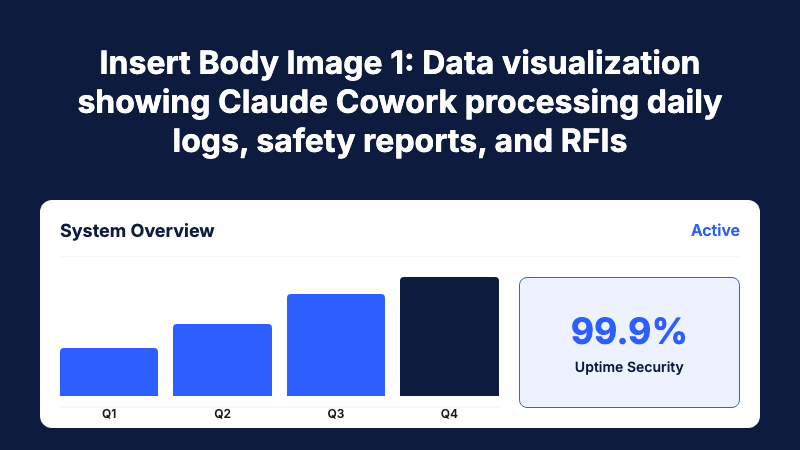
Walk onto any mid-market construction site, and you’ll find a paradox: we build highly precise physical structures, yet the operational data supporting them is chaos. Daily logs, safety reports, RFIs, submittals, change orders, and schedule updates are scattered across Procore, email threads, PDFs, and hand-written notes.
The construction industry runs on unstructured data. For decades, operations managers and project executives have thrown more administrative headcount at this problem. When a project scales, the admin overhead scales linearly. The result? Project managers spend 40% of their time chasing data instead of managing the build, and executives lack the operational truth required to protect margins.
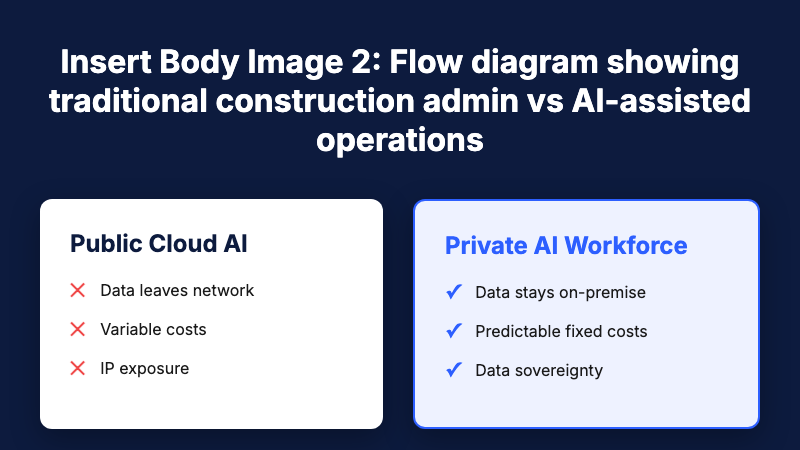
Over the last three years, we’ve watched construction firms try to solve this with cloud AI tools like ChatGPT. They upload project specs and ask for summaries. It works in isolated instances, but it fails at the organizational level for two reasons:
- Context isolation: A generic cloud LLM doesn’t understand the specific site history, the vendor relationships, or the company’s internal safety manual.
- Data leakage: Uploading sensitive RFIs or proprietary bid data to public cloud models is a massive IP risk. Shadow AI is already happening in your firm, whether you know it or not.
The solution isn’t another cloud app. It’s deploying a custom AI workforce—specifically, utilizing frameworks like Claude Cowork—on your infrastructure. This is a deployment guide for construction operations leaders ready to stop experimenting and start building private AI agent systems.
Stop Guessing About Your AI Readiness
Are your competitors already using private AI to reduce their admin overhead? Probably. Stop losing margin to data chaos.
Book Your AI Assessment →What is Claude Cowork for Construction?
Claude Cowork is a framework that allows you to deploy Anthropic’s Claude models (like Claude 3.5 Sonnet) as active participants in your operational workflows, rather than passive chat interfaces. When tailored for construction, Claude Cowork operates as a team of specialized AI agents that ingest, process, and route project data.
At Arkeo AI, we don’t view AI as a tool; we view it as a workforce. A Claude Cowork deployment in a construction firm typically involves setting up specific "roles" for the AI:
- The RFI Analyst: Cross-references incoming RFIs against the master spec book and historical project data.
- The Safety Auditor: Reviews daily safety logs and flags leading indicators of risk based on your specific safety manual.
- The Daily Log Summarizer: Aggregates superintendent notes, weather data, and sub-trade updates into a single executive briefing.
The Business Case for Private AI in Construction
Why deploy this privately instead of just buying enterprise licenses for cloud AI?
1. Data Sovereignty and Security
Construction firms handle highly sensitive data: proprietary estimating formulas, subcontractor pricing, and legal correspondence regarding delays. When you deploy a private AI workforce on your own infrastructure (or single-tenant virtual private cloud), the operational truth never leaves your building. Your data is not used to train the provider’s future models.
2. Deep Contextual Integration
A generic AI doesn't know that "Phase 2 concrete" was delayed by weather last Tuesday, affecting the rebar schedule for Thursday. A private agent system, continuously ingesting your Procore data and daily logs, does. It connects the dots across your specific operational silos.
3. Fixed-Cost Scalability
Cloud AI charges per token (per word read or written). If you have an AI agent reading every RFI and daily log across 15 active job sites, the token costs will spiral out of control. Deploying a private agent ecosystem shifts this to a predictable, fixed-cost model. You pay for the compute infrastructure, not per-query, allowing you to run continuous operations without budget anxiety.
Four high-impact agent deployments for mid-market contractors
These are the four workflows we have seen mid-market construction firms actually ship into production. Each one is high-volume, document-heavy, and currently consumed by senior engineering or PM time the firm would rather spend on production.
RFI processing
Parse inbound RFIs, draft responses from spec books and historical projects, route exceptions to senior reviewers.
Safety log analysis
Read daily safety logs, flag patterns, draft compliance reports, surface near-miss trends before they become incidents.
Submittal review
Triage submittals against spec, route to the right reviewer with context attached, track approval cycle time.
Estimating support
Read drawings, pull quantities, draft baseline estimates for senior estimator review. 40 to 60 percent cycle cut.
Deep Dive: High-Impact Use Cases for Claude Cowork in Construction
When operations leaders ask what a private AI workforce actually does day-to-day, the answer lies in specific, repeatable workflows that currently consume hours of human capital.
1. Automated Submittal Review
The submittal process is notorious for bottlenecking construction schedules. A project engineer typically spends hours reviewing a 300-page PDF from a manufacturer, verifying that the product data matches the architect's specifications. It is tedious, error-prone work.
A Claude Cowork agent trained on your specific project parameters can instantly ingest the submittal document, cross-reference it against the vector database containing the master specifications, and generate a compliance report. It highlights deviations—such as a substitution in material grade—and flags them for human review. This turns a four-hour task into a 15-minute verification.
2. Safety Leading Indicator Analysis
Most construction firms collect massive amounts of safety data, but they only use it reactively (after an incident occurs). The data is too vast for a safety manager to analyze comprehensively on a daily basis.
By deploying a Safety Auditor agent, you can ingest daily site logs, weather conditions, and near-miss reports in real-time. The AI identifies patterns that humans miss. For example, it might recognize that over the last three weeks, near-misses related to scaffolding have increased by 15% on days following heavy rain. The agent then alerts the site superintendent to conduct a targeted toolbox talk the next morning. This is the shift from reactive safety to predictive operations.
3. Change Order Documentation and Pricing Validation
Change orders are where margins are either made or lost. When a change is requested, validating the scope against the original contract and ensuring the pricing is accurate requires pulling data from multiple silos.
An AI agent integrated with your estimating software and contract database can immediately draft the narrative for the change order, pull the historical unit costs for the required materials, and generate a preliminary pricing sheet. The human project manager simply reviews the output, applies their strategic judgment, and signs off. This accelerates the approval process, improving cash flow and reducing disputes with subcontractors.
The Technical Architecture of a Private Construction AI
To move beyond experimentation, you need a robust technical foundation. The architecture of a private AI deployment using Claude Cowork involves several distinct layers.
The Data Fabric (Storage and Vectorization)
Your raw data—PDFs, emails, Procore exports, legacy database dumps—must be organized. We utilize automated ingestion pipelines that clean and structure this data. The critical component here is the Vector Database. This allows the AI to perform semantic searches. When an agent looks for "concrete pouring procedures in freezing weather," the vector database retrieves the exact paragraphs from your historical projects and safety manuals, regardless of the specific keywords used.
The Orchestration Layer (LangChain / LlamaIndex)
Agents don't just "know" what to do; they must be orchestrated. We use frameworks to define the logic of the agents. If Agent A (Intake) receives a document, it knows to pass it to Agent B (Analysis) if it's an RFI, or Agent C (Safety) if it's a hazard report. This orchestration layer is the brain of your AI workforce, ensuring tasks are routed and executed logically without constant human prompting.
The LLM Engine (Claude Models)
This is where Anthropic’s Claude shines. Claude 3.5 Sonnet, for example, is exceptionally proficient at complex reasoning and understanding massive context windows (up to 200,000 tokens). This means it can hold an entire project's specification book in its "memory" while analyzing a single RFI. By running this within a secure environment, we leverage this reasoning capability without exposing the data to the public internet.
Public AI tools versus a private Claude Cowork deployment for construction
Construction data is sensitive on multiple axes: competitive bid intelligence, ITAR-adjacent project work, and client-confidential drawings. Public AI tools fail on all of these. Private deployment fails on none.
Bid IP exits the firewall
Same model, owned boundary
Phase 1: Assessing Your Operational Readiness
You cannot deploy an AI workforce into broken processes. Before writing any code or deploying any agents, you must standardize the inputs.
Standardize the Daily Log: If your superintendents are submitting daily logs via voice notes, text messages, and crumpled paper, Claude Cowork will struggle. You need a unified ingestion point. It doesn't mean changing the tool (they can still use voice), but the routing must be centralized—usually into an S3 bucket or a secure database that the agent can read.
Audit the Data Silos: Identify exactly where the operational truth lives. Is it in Procore? SharePoint? A legacy ERP? The AI agents need read-access to these systems. At Arkeo AI, our first step is always mapping these data pipelines. We've seen projects stall because the necessary safety documents were locked in a proprietary system without an API.
Where Are Your Data Bottlenecks?
You don't need to hire a $200K data scientist to figure out your AI strategy. We built what we sell, and we know exactly where construction firms get stuck.
Get a Custom AI Readiness Assessment →Crawl, walk, run — the Arkeo deployment model for mid-market contractors
No big-bang transformations. Each phase ships a working capability into the operation before the next one starts. Trust earned in the first 30 days is what funds the architecture work later.
Assess
Map shadow AI use, sensitive data flows, and the top three workflow candidates. Set the perimeter and governance.
Deploy
Stand up Cowork on private hardware. Ship the first workflow with one team. Measure against baseline.
Manage
Add workflows two and three. Continuous monitoring, audit log review, regulatory and standards updates.
Phase 2: Deploying the Agent Operating System (AOS)
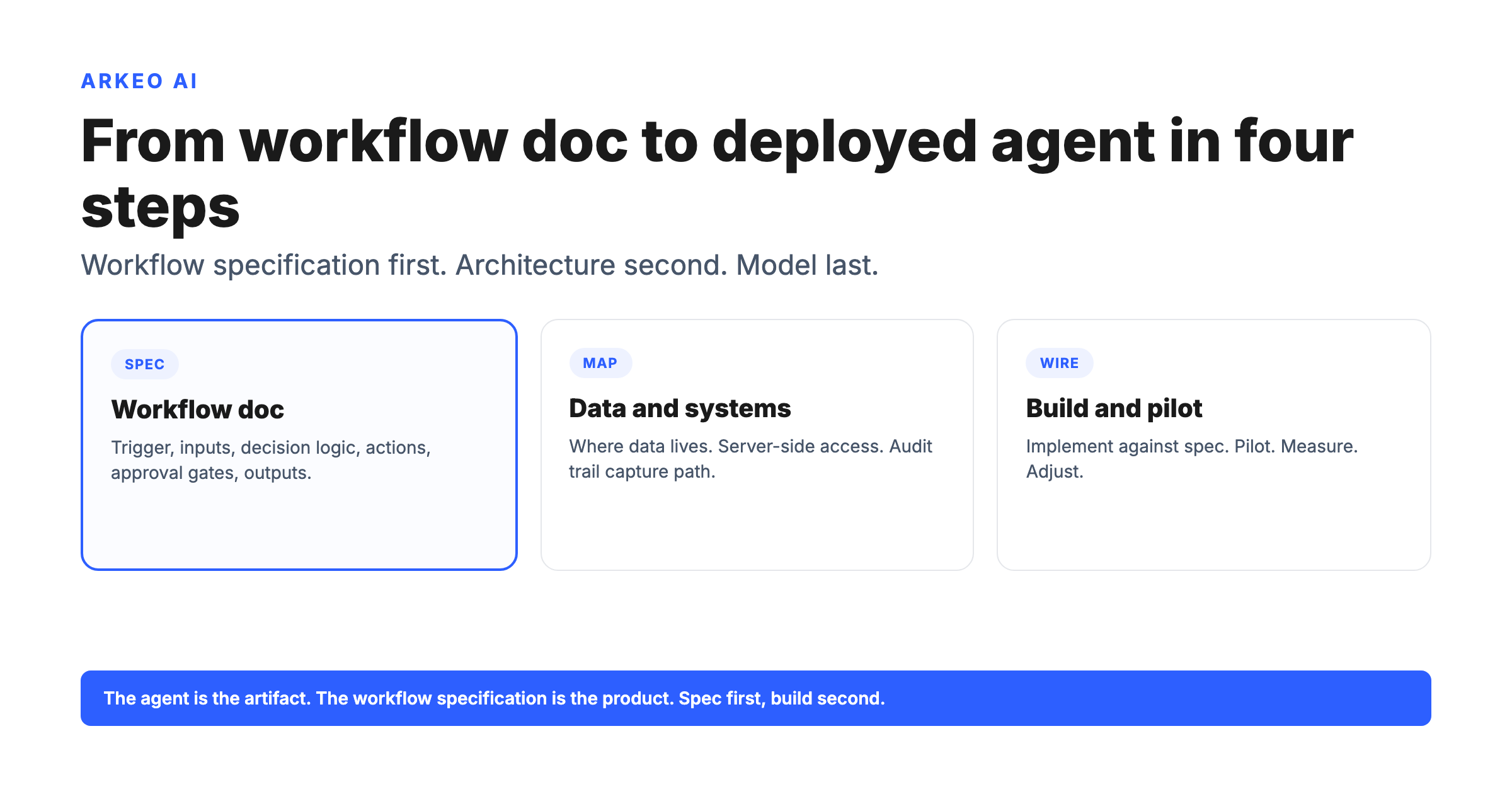
Deploying Claude Cowork for construction requires an underlying architecture to manage the agents. We call this the Agent Operating System (AOS).
Step 1: The Ingestion Layer
This is where unstructured data enters the system. Using tools like OCR (Optical Character Recognition) and transcription models, the AOS converts daily logs, voice notes, and scanned PDFs into machine-readable text. This data is then vectorized and stored in a private vector database.
Step 2: The Agentic Workflow
Instead of a single AI trying to do everything, you deploy specialized agents. Let's look at the RFI workflow:
- The Intake Agent receives the RFI via email or Procore.
- The Context Agent searches the vector database for the relevant architectural drawings and previous RFIs on the same topic.
- The Drafting Agent uses Claude Cowork to generate a proposed response, citing the exact page in the spec book.
- The Human-in-the-Loop (your project engineer) reviews the draft, approves it, or modifies it.
Step 3: The Output Layer
The AI must push the approved data back into your core systems. If the AI agent identifies a safety leading indicator, it shouldn't just send an email; it should automatically create an action item in your safety management software and flag the site superintendent.
Phase 3: Managing the AI Workforce
Deploying AI agents is not a one-time project; it is the integration of a new workforce. And like any workforce, it requires management, governance, and performance reviews.
Monitoring for Hallucinations: AI models, including Claude, can hallucinate. In construction, a hallucinated spec can result in a $50,000 rework. This is why the Human-in-the-Loop architecture is non-negotiable for critical workflows. However, as the system learns your specific operational data, the accuracy increases significantly.
Ongoing Managed Operations: The APIs will change. The models will update. Your internal processes will evolve. The "Manage" phase is where most mid-market construction firms fail because they treat AI like traditional SaaS software. It is not. It requires continuous tuning of the prompts, updates to the vector database, and monitoring of the agent interactions. This is the core of Arkeo AI’s managed service model.
Measuring ROI: Don't measure AI success by "time saved." Time saved is often reabsorbed by other inefficiencies. Measure it by throughput and margin protection. Are you processing RFIs 40% faster, preventing schedule delays? Is your PM managing three projects instead of two without burning out? That is the operational truth.
Overcoming the Change Management Hurdle
The technology is only half the battle; the other half is human adoption. The construction industry is notoriously resistant to new software, largely because historically, new software just meant more data entry for the superintendents and foremen.
The beauty of a well-deployed AI workforce is that it requires less from the field, not more. If a superintendent can simply dictate their daily log into a voice memo on their phone, and the AI agent structures it, categorizes it, and files it appropriately, adoption happens organically.
At Arkeo AI, our deployment methodology focuses heavily on "invisible AI." The end-user (the person on the job site) shouldn't feel like they are learning a new, complex software platform. They should just feel like their administrative burden has magically disappeared. We achieve this by integrating the agents directly into the communication channels they already use, like email, SMS, or Microsoft Teams.
Stop Relying on Shadow AI
Right now, your junior estimators and project engineers are copying and pasting sensitive project data into public cloud instances of ChatGPT or Claude. They are doing it because they are drowning in administrative overhead and trying to survive.
You can't ban AI; you have to govern it. By deploying a private AI workforce using frameworks like Claude Cowork, you give your team the tools they need to operate efficiently, while retaining complete control over your data and intellectual property.
Since 2023, Arkeo AI has been building and managing private AI agent systems. We use what we sell to run our own businesses, and we know how to deploy it securely for yours.
Take Control of Your Data and Operations
Stop letting your team risk IP with public cloud tools. Deploy a private, managed AI workforce that understands your specific construction operations.
Book Your AI Assessment →Frequently Asked Questions
What is Claude Cowork?
Claude Cowork is a conceptual framework and set of tools for integrating Anthropic’s Claude AI models into active, agentic workflows rather than passive chat interfaces. It allows businesses to build custom AI teams that process data automatically.
Is on-premise AI more expensive than cloud AI?
Initially, the setup cost for private/on-premise AI is higher due to infrastructure requirements. However, at scale (processing thousands of documents daily), the fixed-cost model of private AI becomes significantly cheaper than the per-token pricing of cloud providers.
Do we need a massive IT team to run this?
No. This is why Arkeo AI focuses on the "Manage" phase. We deploy the systems and act as the ongoing operators for your AI workforce, allowing your team to focus on construction, not infrastructure.
How long does deployment take?
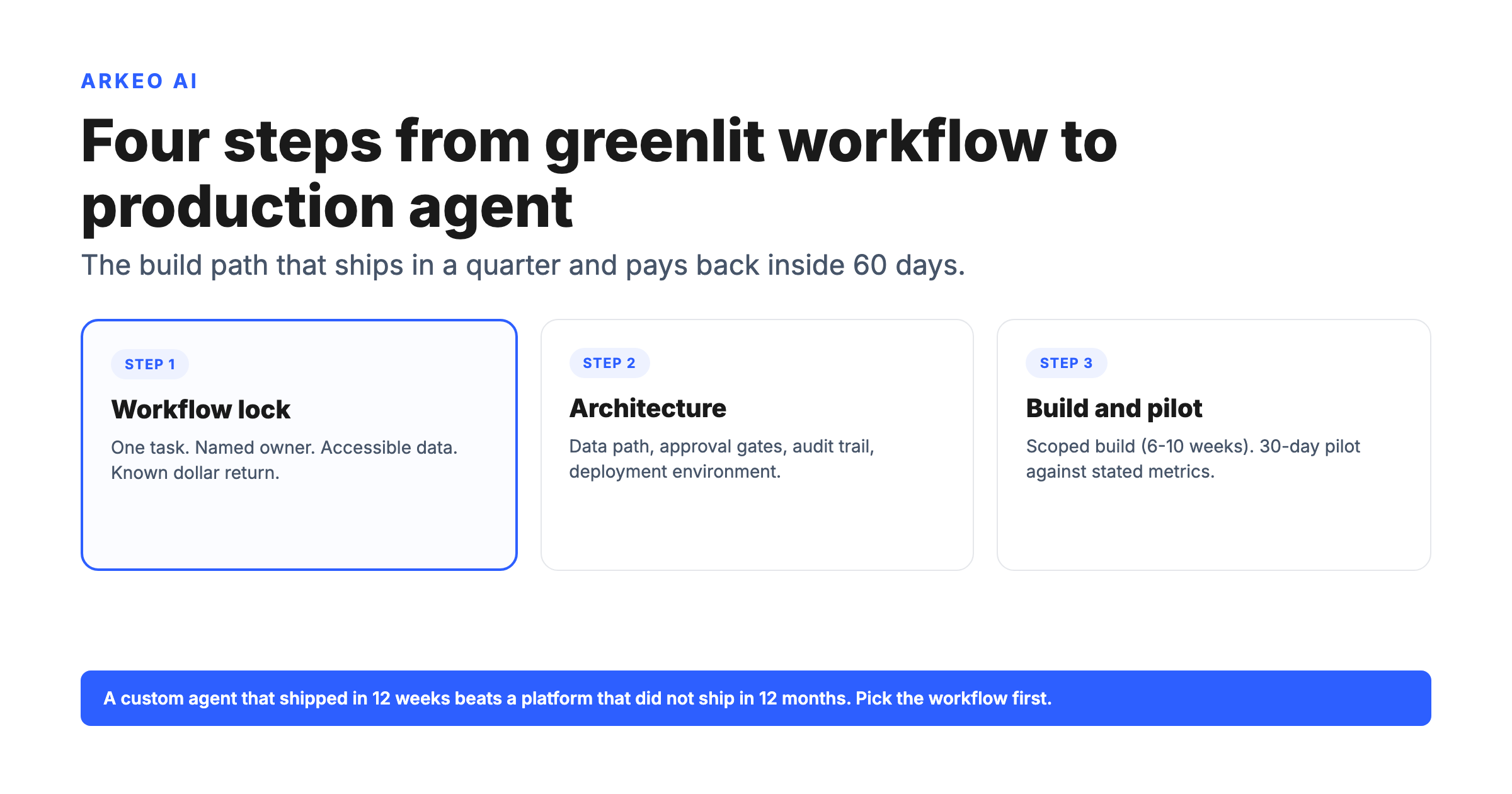
A standard deployment, from the initial AI Assessment to the first active agent workflow (e.g., RFI processing), typically takes 6 to 8 weeks, assuming clean data access.
Can the AI agents replace our project managers?
No. AI agents replace the administrative burden (data routing, summarization, initial drafting) that consumes a project manager's time. The goal is to elevate your PMs to focus on strategy, relationships, and problem-solving, not data entry.