Category
The ROI of AI Implementation Consulting
Last updated: June 4, 2026
By David Brennan · Arkeo AI · Building and Deploying Custom AI agents since 2023
If you are the operator selling a $50K-to-$200K AI implementation consulting fee to a CFO who has already seen one vendor promise a three-month payback that never landed, this is the math that survives the meeting. The question on the table is not whether AI works; it is whether this particular engagement fee earns itself back inside a window the CFO can defend, when one vendor's optimistic deck has already burned the credibility budget for the year. In this guide, you'll get the four ROI levers, the three-scenario sensitivity model (conservative, base, optimistic), a realistic 12-to-18 month payback window, and the kill criteria that prove the engagement is real.
A scoped single-workflow agent reaches production in 6 to 10 weeks of build, or 8 to 12 weeks when private; that operating range is the unit the ROI math has to clear, not a vendor's three-month payback claim. Before you sign the SOW, a free AI Assessment names the one workflow with an ROI shape worth paying a consultant to deliver.
Quick Answer
• What it measures: Whether the consulting fee itself is earned back by what the consultant enables, not the ROI of the AI workflow in the abstract.
• The four levers: Time saved, error cost avoided, headcount avoided, revenue accelerated.
• Realistic payback: 12 to 18 months for a mid-market first engagement; anything shorter is a sales claim.
• The defensible case: Three scenarios (conservative, base, optimistic), one named owner, and a conservative line a CFO can sign.
One scoping note before the math. If the question on the table is what the consultant charges, the pricing detail lives in the dedicated piece on what an AI consultant costs. The work here is the other side of the same conversation: not what you pay, but whether the fee is earned back by what the consultant enables.
Why do most AI consulting ROI claims fall apart at CFO review?
Most ROI claims collapse because they count every lever at the optimistic end, attribute the entire workflow's value to the consultant, and skip the conservative scenario that proves the case is real. A CFO reads the deck and asks three questions; the model breaks on one of them.
The first question is which lever you are actually counting. The PwC AI Agent Survey of 300 senior US executives found 66 percent of agent adopters report measurable productivity gains. Productivity gains are real, but a productivity number is not a dollar number. The CFO wants to know which hours, on which workflow, at which loaded rate, with evidence the hours were freed and not absorbed back into other work.
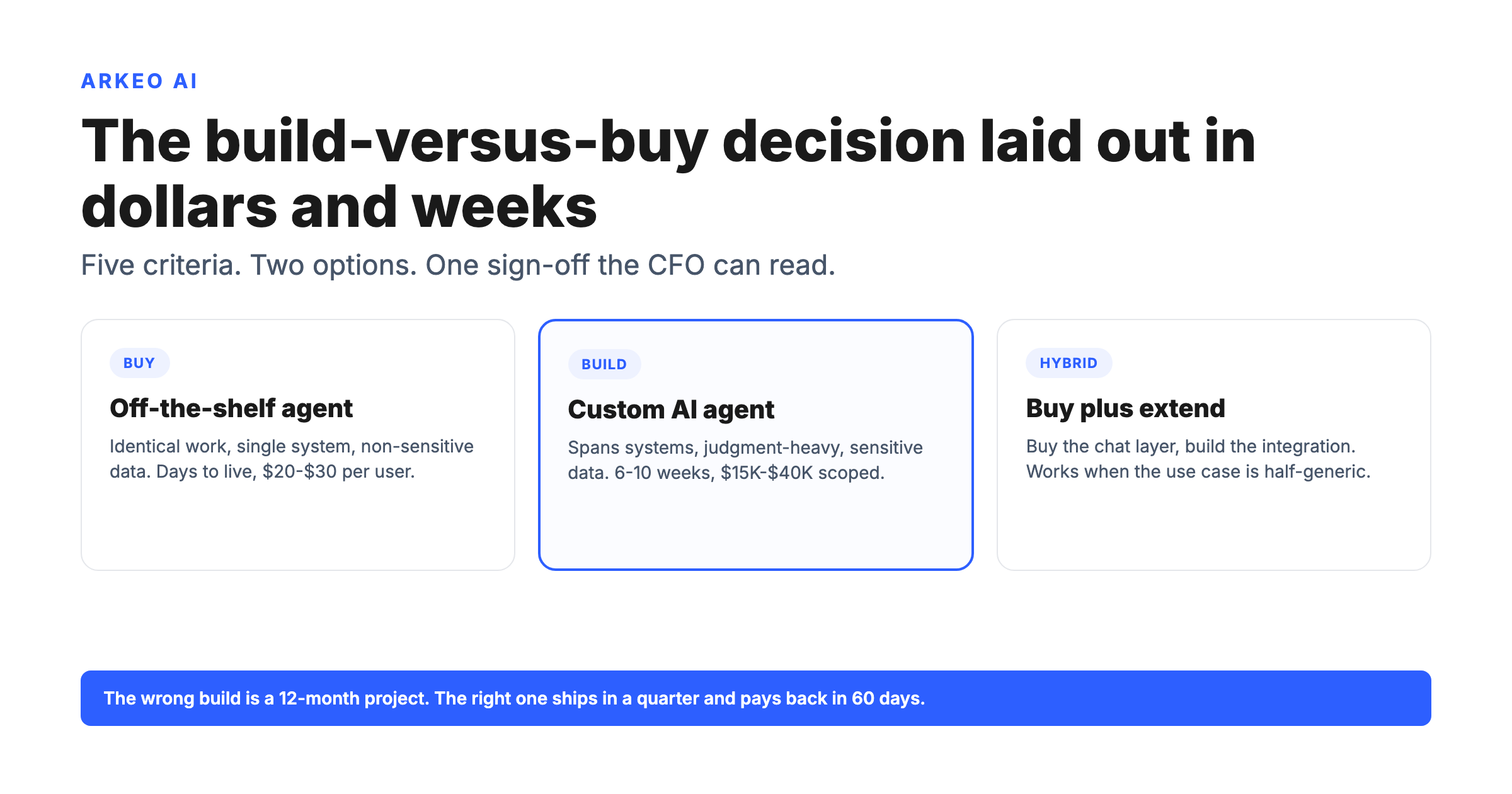
The second question is what the consultant did versus what the platform did. An off-the-shelf copilot at $20 to $30 per user per month can deliver a real time-saved lever on its own. The consultant earns the fee by selecting the right workflow and turning a pilot into a deployed system that does not stall. The Deloitte State of Generative AI Wave 4 study of 2,773 C-suite respondents found more than two-thirds expect 30 percent or fewer of their experiments to scale within three to six months. BCG's Where's the Value in AI? report from October 2024 found 74 percent of companies struggling to capture value from AI. The consultant has to be the difference between the 30 percent that scale and the 70 percent that do not.
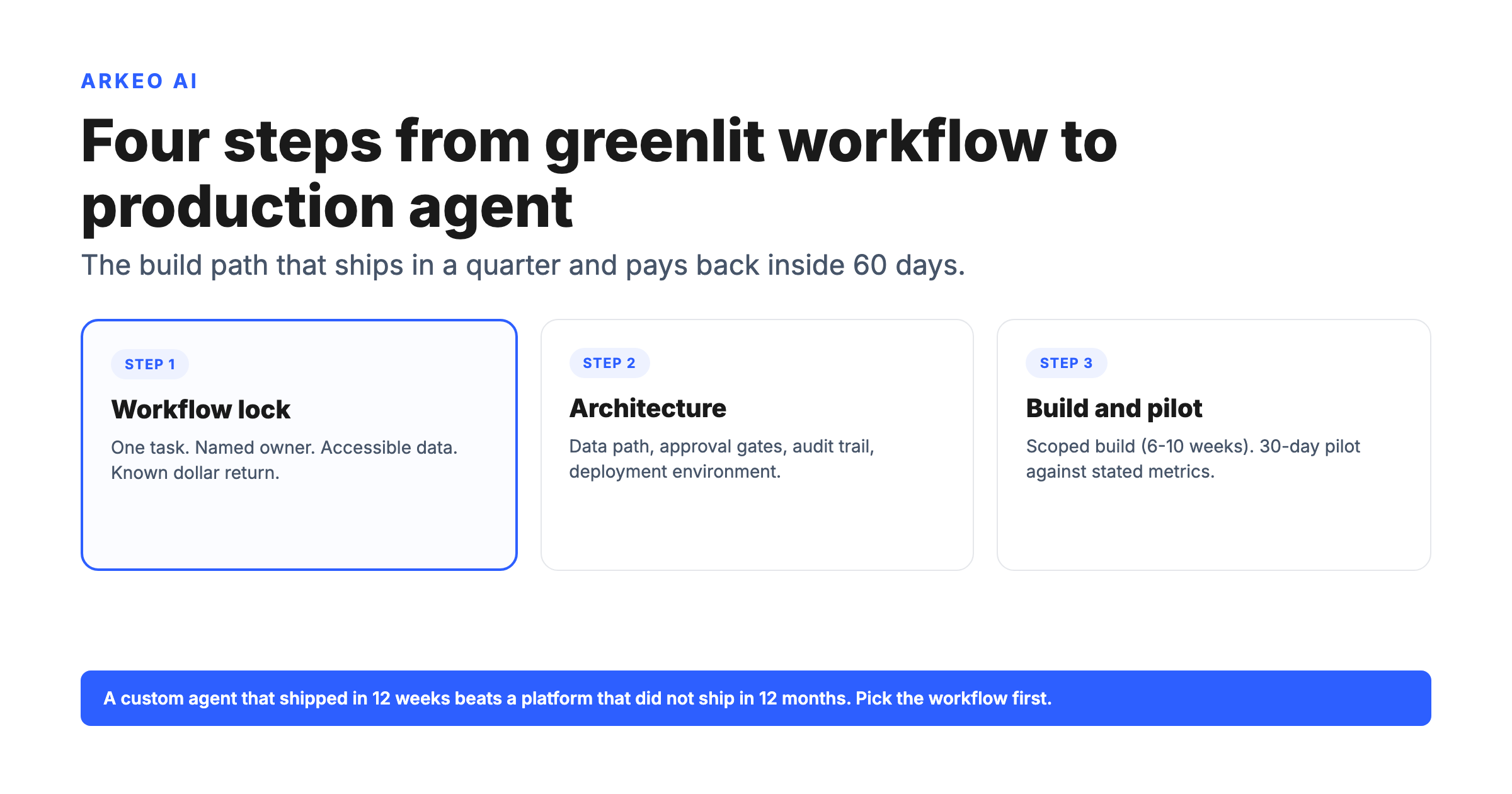
The third question is the payback window. In Arkeo's build experience, a scoped single-workflow agent runs about $15,000 to $40,000 and 6 to 10 weeks to production, or 8 to 12 weeks when private or enterprise-grade. The first quick win typically lands in 30 to 90 days. Layered with the consulting fee and the platform cost, the realistic payback window for a mid-market first engagement is 12 to 18 months.
What are the four levers that prove an AI consulting fee earns its keep?
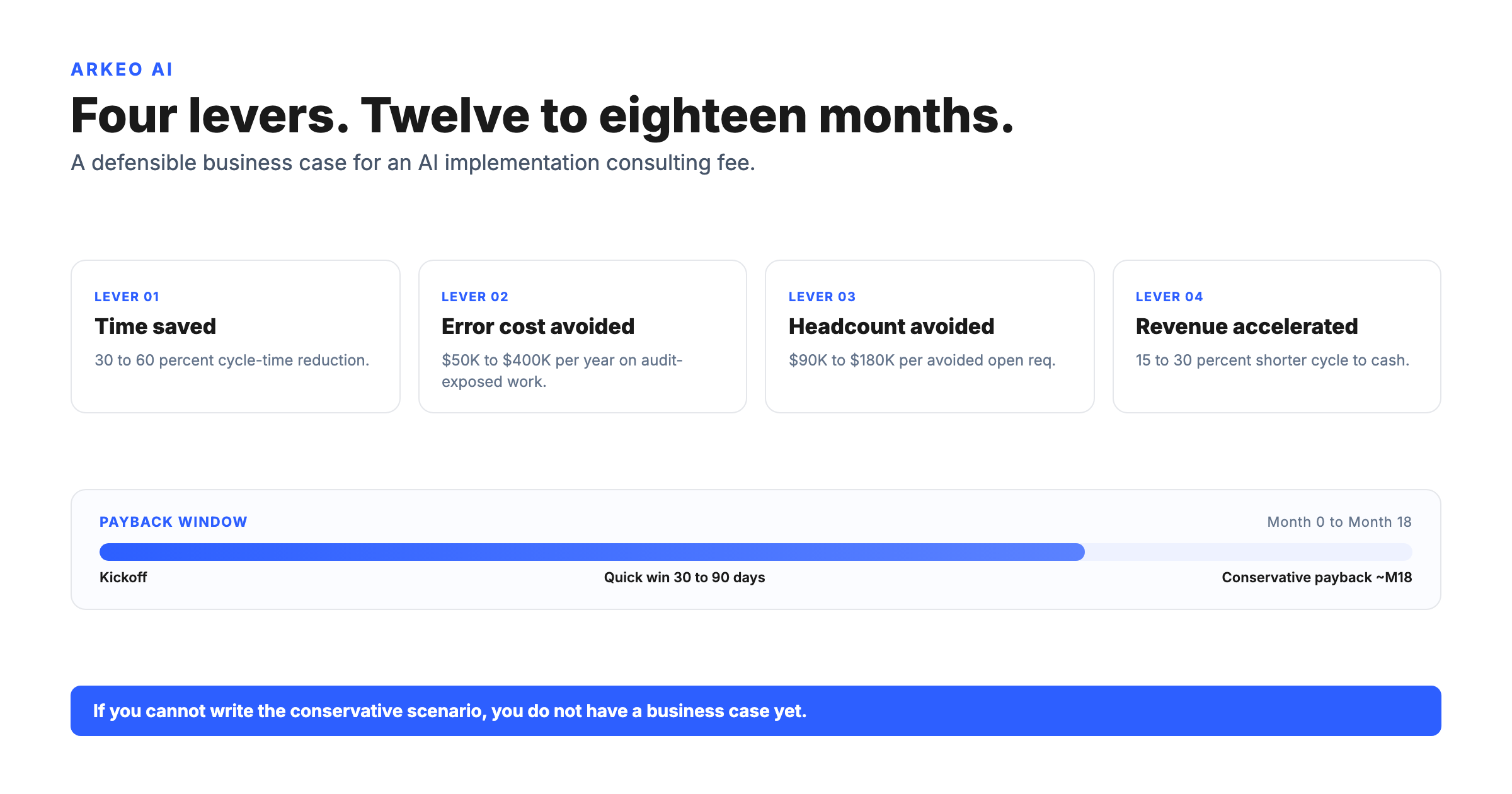
A defensible business case names which levers it counts and refuses the rest. Mid-market engagements rarely touch all four; two or three is the honest range. Each lever has a measurement method that holds up under audit and a typical range that does not get laughed out of the boardroom.
THE FOUR LEVERS
What the consultant's fee has to earn against
Count the ones you can measure. Refuse the rest.
LEVER 01
Time saved
Hours freed on a specific workflow that the deployed agent now handles end to end, multiplied by the loaded hourly cost of the role doing the work today.
MEASUREMENT
Baseline cycle time over four weeks before deployment, then four weeks after, on the same workflow with the same operator.
TYPICAL RANGE
30 to 60 percent of cycle time on a well-scoped workflow.
LEVER 02
Error cost avoided
Compliance penalties, rework hours, and breach exposure the workflow was generating before the consultant rebuilt it on a controlled deployment.
MEASUREMENT
Three-year incident history times unit cost of the incident, discounted to a defensible expected value.
TYPICAL RANGE
$50,000 to $400,000 a year on a workflow with audit exposure.
LEVER 03
Headcount avoided
An open requisition the deployed agent now covers, so the role does not get filled this fiscal year. Never current-headcount savings; that is a different conversation.
MEASUREMENT
Fully loaded annual cost of the open req signed off by HR before deployment.
TYPICAL RANGE
$90,000 to $180,000 a year per avoided mid-market hire.
LEVER 04
Revenue accelerated
Quote-to-cash, proposal turnaround, or sales-cycle days shortened, valued at the gross margin on the accelerated revenue, not the headline contract value.
MEASUREMENT
Days shaved off the cycle times the present value of the cash pulled forward, at the company's hurdle rate.
TYPICAL RANGE
15 to 30 percent shorter cycle on a clearly scoped revenue workflow.
A defensible business case names which levers and refuses the rest.
Picture a 280-person specialty distributor with a $120,000 consulting fee on the table to deploy an agent across quote-to-cash. The honest model counts two levers: time saved on quote generation (the operations team spends roughly 14 hours a week assembling quotes today, dropping to about 5 after deployment) and revenue accelerated (average quote turnaround of 4.5 days falling to 1.5). It refuses headcount avoided because no req was open. It refuses error cost avoided because incident history on this workflow is thin. Two levers, both measurable, both defensible.
A 60-minute free AI Assessment names the one workflow with an ROI shape worth paying a consultant to deliver, and surfaces the levers a CFO will defend.
Book Your Free AI Assessment →The error-cost lever carries the highest dollar magnitude when it applies. The IBM Cost of a Data Breach 2025 report found 97 percent of AI-model breaches involved organizations lacking proper AI access controls, with shadow AI usage adding $670,000 per incident. A consultant who replaces an uncontrolled public-AI workflow with a private deployment is removing a real expected-value loss from the books. Arkeo deploys a private AI workforce on your own infrastructure where data never leaves the building, operated under the Assess, Deploy, Manage model. We use what we sell. The headcount lever is the one a CFO probes hardest; the IBM IBV CEO Study of 2,000 CEOs across 33 countries found 65 percent plan to use automation to address skills gaps, which only counts as avoided cost when the req was already open and signed off before deployment.
What does a realistic 12 to 18 month payback actually look like?
The sensitivity analysis is what turns a business case into a defensible business case. Three scenarios, written down at kickoff, each a different combination of levers and lever ranges. The CFO signs the conservative scenario. The board hears the base scenario. The optimistic scenario is the upside.
THE SENSITIVITY ANALYSIS
Three scenarios for a $120K engagement
Same workflow, three different lever combinations. Numbers shown for illustration on a hypothetical 280-person mid-market business.
SCENARIO 01
Conservative
One lever (time saved) counted at the low end. 30 percent cycle-time reduction on quote generation. Nothing else credited.
12-MONTH ROI
Roughly 0.6x on a $120K fee plus $25K platform. Net positive in year two.
PAYBACK MONTH
Approximately month 18.
SCENARIO 02
Base
Two levers counted at midrange. Time saved at 45 percent plus revenue accelerated through faster quote turnaround. No headcount or error claims.
12-MONTH ROI
Roughly 1.4x on the same $145K total.
PAYBACK MONTH
Approximately month 11.
SCENARIO 03
Optimistic
Three levers, including a second workflow accelerated off the same platform. Time saved at the high end, revenue accelerated, plus one avoided open req in year two.
12-MONTH ROI
Roughly 2.2x in year one, climbing to 3.5x by month 18.
PAYBACK MONTH
Approximately month 7.
If you cannot write the conservative scenario, you do not have a business case yet.
The conservative line is the scenario that gets signed. One lever, low end of the range, paying back in the second half of the 12 to 18 month window. If the conservative scenario is still net negative at month 18, the engagement is not justified on the math; it is justified on a different argument, such as strategic optionality, and the CFO has the right to refuse it.
The operator test: Pull out your last vendor proposal. Does it include three scenarios (conservative, base, optimistic) with named lever ranges and written kill criteria? If the conservative scenario is missing or nets out negative at month 18, you do not have a business case yet. You have an aspiration.
Picture a hypothetical regulated services firm with the same $120,000 fee but a different lever profile: no headcount avoided and no revenue acceleration, but a documented compliance-rework cost of roughly $180,000 a year on the workflow the consultant is replacing. The conservative scenario counts one lever (error cost avoided at the low end) and pays back inside month 12. The optimistic scenario adds time saved and clears month 8. The same engagement fee tells two completely different stories on two different operations; the levers decide which story is true.
What does a defensible business case actually contain?
The honest format is short. A business case the CFO will defend has six parts: the workflow being deployed, the levers being counted with their measurement methods, the three-scenario sensitivity model, a named operating owner, the fully loaded cost line (consulting fee, platform, internal labor, ongoing operations), and the written kill criteria. Everything else is decoration.
The kill criteria are the part operators skip and CFOs probe. "What measurable outcome, by what date, would cause us to halt the deployment?" is a question the consultant should be able to answer in writing at week one. If the answer is vague, the engagement does not have a business case; it has an aspiration. The pillar guide on enterprise AI strategy covers the sequenced operating plan the consultant has to walk you through to earn the fee. The detail on which consultant profile executes well is in the dedicated post on AI implementation consultant vetting, and the upstream selection criteria are in how to hire an AI consultant.
The free AI Assessment delivers the four levers, the three scenarios, and the kill criteria for one priority workflow, in a format the CFO can sign.
Book Your Free AI Assessment →