Category
Shadow AI Governance: Control Unmanaged AI Use
Last updated: May 2026
Your IT department probably thinks they have artificial intelligence under control because they blocked OpenAI on the corporate firewall. They are wrong. Employees are simply using their personal phones, hotspotting their laptops, or finding proxy sites to summarize your confidential PDF contracts. The reality of modern business operations is that if a tool exists that can turn a four-hour manual task into a four-minute automated process, your employees will find a way to use it.
When productivity tools advance this quickly, friction-based IT policies fail completely. Employees will always choose efficiency over compliance if the approved tools are perceived as inferior or non-existent. The result is a massive, invisible attack surface that operates entirely outside of your control, processing your most sensitive corporate data without any oversight or auditability.
To protect the business and maintain a competitive edge, operators must shift from futile blocking strategies to establishing strict shadow AI governance. You cannot eliminate the demand for automation, but you can control the supply by providing a superior, secure alternative.
- What is Shadow AI? Shadow AI refers to the unapproved and unmanaged use of artificial intelligence tools by employees, which inadvertently exposes proprietary corporate data to external systems.
- The Governance Framework: To establish true Shadow AI Governance, companies must follow a three-step process:
- 1. Audit: Identify current unauthorized AI usage and workflows across the organization.
- 2. Policy: Draft clear, enforceable AI acceptable use guidelines that define data classification.
- 3. Deploy Alternative: Implement a secure, Private AI Workforce that provides necessary capabilities without ever exposing corporate data to public clouds.
What is Shadow AI and Why is it Dangerous?
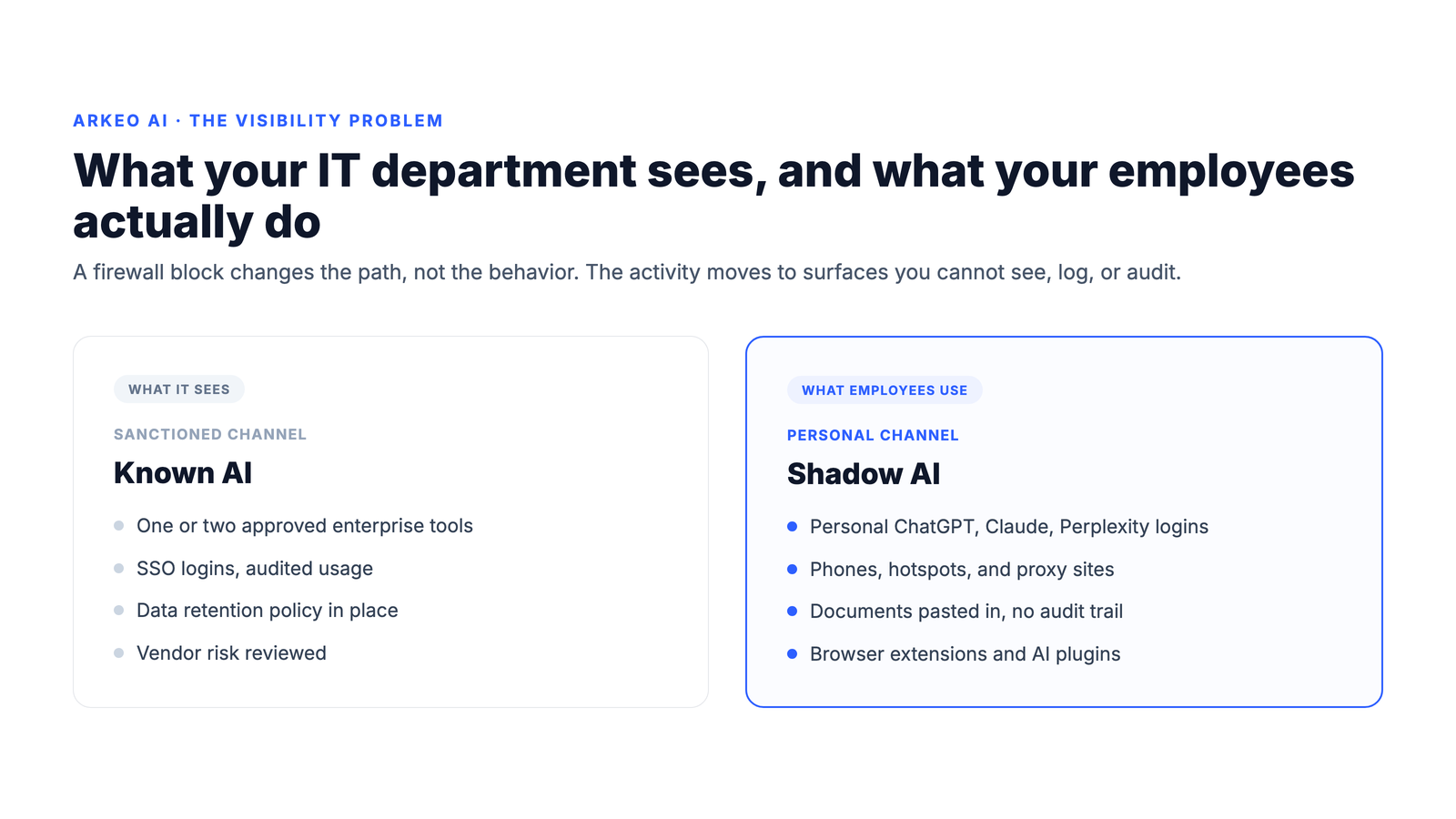
Shadow AI encompasses any use of generative artificial intelligence tools that has not been explicitly vetted, approved, and managed by your IT and operations teams. This includes utilizing public chatbots, employing document summarizers, using code assistants running in web browsers, or integrating unapproved APIs into internal scripts.
The primary danger is not the artificial intelligence itself. The danger is the complete and total lack of AI data sovereignty. When an employee pastes a client spreadsheet into a public tool to generate a pivot table, that client data leaves your secure perimeter immediately. It is ingested by third-party servers where you have zero visibility into how it is stored, how it is processed, or how it is used to train future iterations of those public models.
The scale of this problem is staggering. According to Gartner, 69% of organizations suspect or have evidence that employees are using prohibited public GenAI tools. The risks compound daily. Furthermore, Gartner warns that by 2030, more than 40% of enterprises may experience security or compliance incidents directly linked to unauthorized shadow AI usage.
The risk extends significantly beyond simple data leakage. Without an operating framework, employees make critical business decisions based on outputs from unvetted systems. These public models are prone to hallucinating facts, inventing citations out of thin air, and producing confident but entirely incorrect analytical conclusions. If your operations team relies on these outputs for client deliverables, structural engineering assessments, or financial projections, the legal and financial liability rests entirely on your business, not the software vendor.
Operating a mid-market business in 2026 requires acknowledging that these tools are already functioning inside your network. If you are not actively managing a Private AI Workforce, you are passively accepting the immense risks of an unmanaged public one.
Industry Examples: When Shadow AI Costs the Business
To understand the severity of unmanaged artificial intelligence, you have to look at how it manifests in daily operations across different sectors. The risks are rarely malicious. They are born out of highly motivated employees trying to do their jobs faster and clear administrative backlogs.
Oil & Gas Operations
In the oil and gas sector, operational efficiency and speed are critical. We consistently see field supervisors using public chatbots to quickly summarize daily drilling reports, equipment maintenance logs, and complex safety incident narratives. They take raw, unstructured data containing proprietary well locations, production yields, and identifiable employee details, and paste it directly into an unmanaged browser window. They get a clean, formatted summary for the morning meeting, but the company permanently loses control of highly sensitive operational data that competitors would pay heavily to access.
Construction Estimating
Construction firms run on tight margins and complex, high-stakes bids. Estimators are under constant pressure to turn around proposals faster than the competition. A common shadow AI workaround involves uploading confidential site plans, proprietary material pricing sheets, and subcontractor bids into public PDF summarizers to extract material quantities quickly. The estimator saves three hours of grueling manual takeoff work, but the firm's competitive pricing strategy and vendor relationships are now sitting on a public cloud server, completely outside the protection of their master service agreements.
Professional Services and Legal
Law firms, accounting practices, and financial consultancies handle the most sensitive data in the market. Yet, junior analysts frequently use unapproved artificial intelligence to draft initial legal briefs, summarize dense discovery documents, or format complex financial audits. Even if they attempt to anonymize the data before uploading it, the specific patterns, dates, and financial structures often remain highly identifiable. This directly violates strict client confidentiality agreements and permanently breaches the core trust required to operate in professional services.
Manufacturing and Supply Chain
Supply chain managers dealing with thousands of SKUs and fluctuating vendor pricing often turn to public AI to optimize their inventory models. By uploading vendor price lists and historical demand data to unvetted platforms, they attempt to forecast shortages. However, exposing the exact volume and pricing tiers negotiated with suppliers instantly compromises the manufacturer's leverage in future negotiations. A single uploaded spreadsheet can unravel years of strategic procurement work.
Specific Security Protocols Broken by Shadow AI
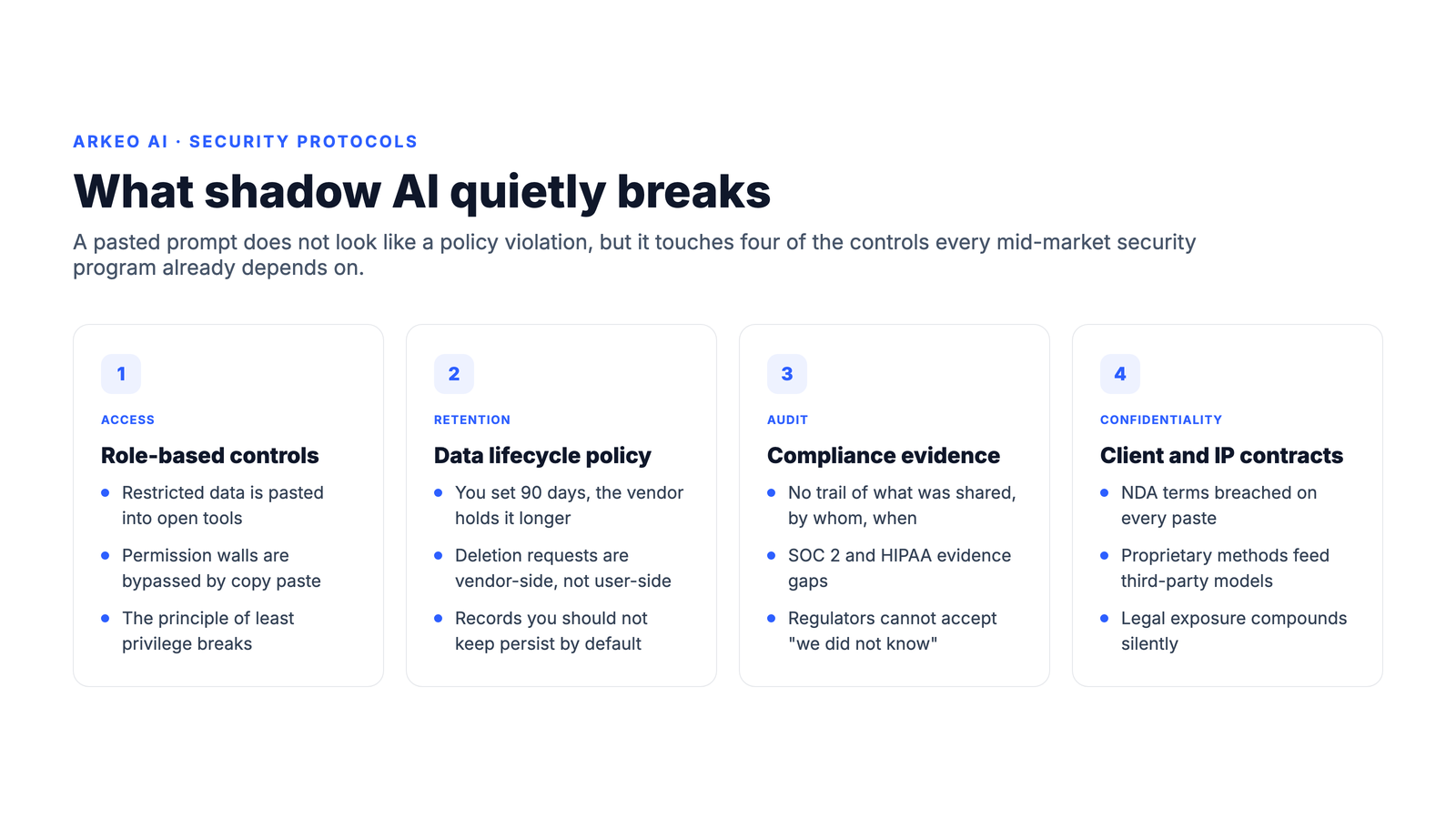
When employees bypass approved channels to use public models, they are not just breaking a generalized corporate rule. They are systematically overriding the core security protocols that keep your business compliant, secure, and insurable.
Identity and Access Management (IAM): Corporate systems rely on strict, role-based access controls. Shadow AI tools operate entirely on personal, unmanaged accounts. When an employee leaves the company, their access to corporate software is immediately revoked by IT. However, any company data they fed into a personal AI account remains with them permanently. You cannot revoke access to a system you do not govern, manage, or even know exists.
Data Loss Prevention (DLP): Most mid-market companies have invested heavily in DLP systems configured to prevent sensitive files from being emailed externally or uploaded to unauthorized file-sharing sites. Shadow AI often circumvents these expensive controls completely because the data is copy-pasted as plain text directly into a browser window, bypassing network-level file security checks and rendering DLP investments useless.
Compliance and Audit Trails: Regulated industries require a clear, unbreakable chain of custody for decision-making. When a public model generates an insight that leads to a business action, there is zero audit trail. You cannot demonstrate to an auditor or regulator how a conclusion was reached, what specific data was considered, or who authorized the automated process. This destroys compliance standing.
Vendor Risk Management (VRM): Before adopting new software, companies execute a VRM process to ensure the vendor meets security standards (SOC 2, ISO 27001). Shadow AI bypasses this entirely. Employees are effectively signing zero-dollar contracts with unknown entities, granting them broad rights to process corporate data without legal review or risk assessment.
Where do you stand?
You almost certainly have shadow AI in your operation right now.
An anonymous internal survey and a one-week network audit usually reveal more AI surface area than executives expect. Arkeo's 60-minute AI Assessment runs that audit for you and produces a verdict in the same session.
Why Blocking AI Tools Fails
Traditional IT governance relies heavily on the firewall. The standard historical response to a new digital threat is to block the domain, update the blacklist, and move on. This approach fails entirely when applied to artificial intelligence.
Blocking these tools throttles organizational productivity and actively encourages dangerous, covert workarounds. If your top-performing team knows a system can save them four hours of manual data entry every single day, they will find a way to use it. If you block the secure, corporate-managed route, they will use an unsecured, personal route. They will email proprietary data to their personal devices, use cellular hotspots to bypass the corporate network entirely, or find lesser-known, potentially malicious proxy sites that the corporate firewall has not flagged yet.
Friction-based security only works when the alternative is acceptable. In this case, the alternative is returning to slow, manual processes while your competitors move significantly faster. The only effective governance strategy is providing a better, authorized alternative that runs exclusively on your infrastructure.
Spending money on IT security but employees bypass the firewall?
Take our Shadow AI Risk Audit to see where your employees are leaking data, and learn how to deploy secure agent systems instead.
Take the Audit3 Steps to Establish Shadow AI Governance
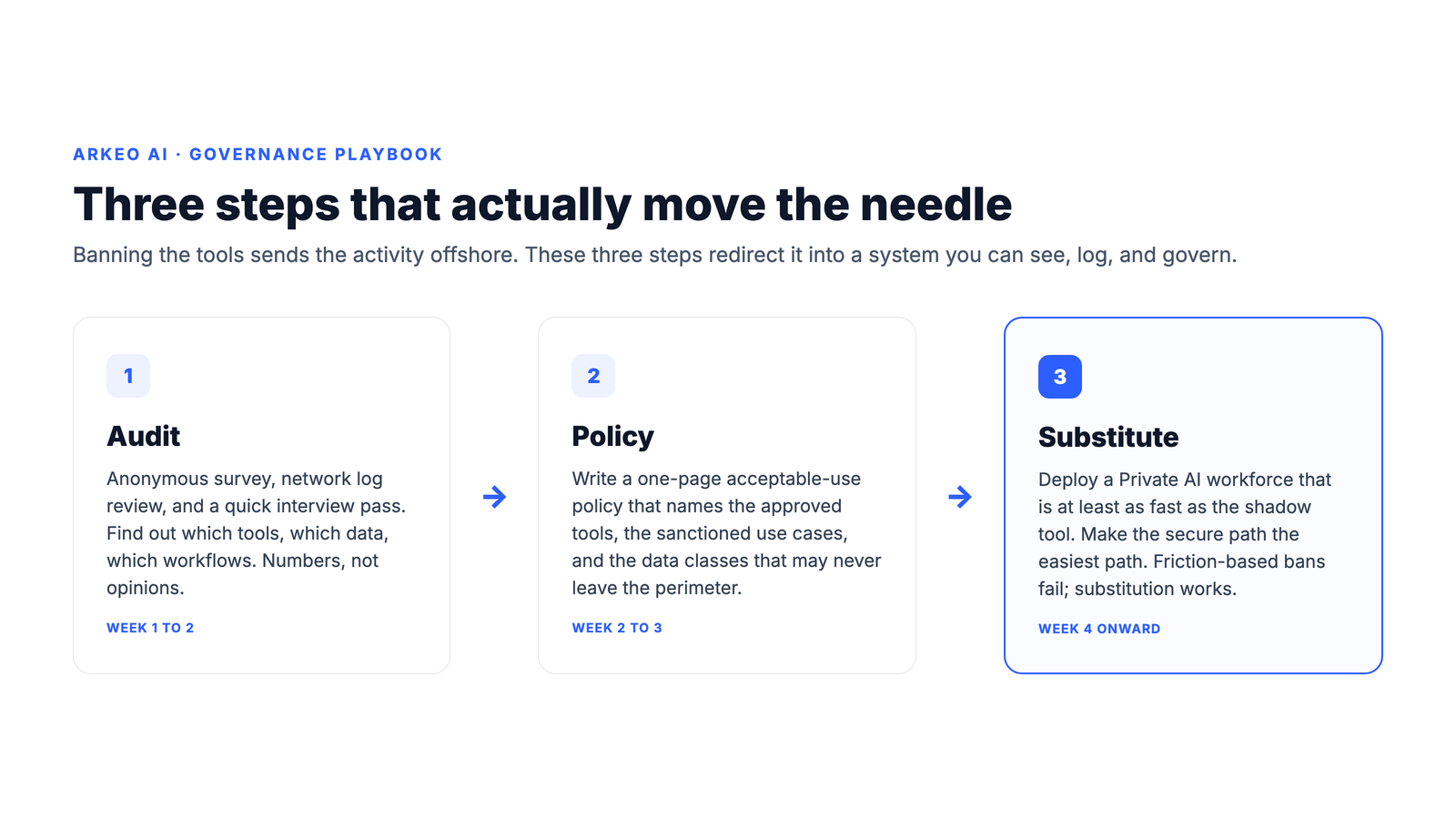
Effective governance balances the need for operational efficiency with the absolute requirement for strict data security. You cannot simply tell your highest performers no. You must understand what they need, set the boundaries clearly, and deliver the capability securely. Follow these three steps to regain control.
1. Audit Existing AI Usage and Workflows
You cannot govern what you cannot see. The first critical step is acknowledging that shadow usage is already happening across your organization. You need to definitively identify what tools are currently being used, who is using them, and what specific administrative or analytical tasks they are automating.
Start with network traffic analysis to identify connections to known public models, but do not stop there. Survey your team anonymously to understand their daily workflows. Ask specific, targeted questions about where they experience the most manual friction and what workarounds they have built. The goal is not punishment or reprimand. The goal is operational discovery. You need to know what capabilities your workforce genuinely requires to do their jobs efficiently so you can build the secure replacement.
If fifty percent of your operations team is using a public tool to format daily reports or extract data from PDFs, that is not a behavioral problem. That is a clear, undeniable signal of an operational requirement that your current software stack is failing to meet. Auditing gives you the blueprint for what your secure system must be able to execute.
2. Draft a Comprehensive AI Acceptable Use Policy
Once you understand the operational landscape, you must establish firm structural controls. A strong governance policy leaves no room for interpretation or ambiguity. It must explicitly state what is allowed, what is completely forbidden, and the specific disciplinary consequences for violations.
Your policy must include strict data classification rules. Define exactly what constitutes public data, internal data, and confidential client data. Make it explicitly clear that pasting proprietary code, client deliverables, financial records, or personally identifiable information into unapproved public models is a severe policy violation that fundamentally compromises the business.
Furthermore, the policy should define a clear approval process for new tools. If a department head wants to test a specialized application, there must be a documented, rapid path to evaluate its data handling practices. If you make the approval process a black box of immediate, unexplained rejections, shadow IT will continue to thrive in the dark. Create a transparent path to yes, provided the requested tool meets your stringent data sovereignty and security standards. Detail exactly how incident response will be handled if an employee accidentally leaks data, ensuring a culture of rapid reporting rather than concealment.
3. Deploy a Secure, Private AI Alternative
The policy only works if you provide a safe, superior alternative. You cannot demand that employees stop using tools that save them hours of tedious work unless you hand them something vastly better. By deploying a Private AI Workforce, you give your employees the same powerful, generative capabilities found in public models, but housed entirely within your tightly controlled infrastructure.
When you provide a private, managed environment, the core incentive to use unapproved, unsecure tools disappears entirely. Employees get the speed, automation, and assistance they want, and leadership gets the security, auditability, and control they demand. The corporate data stays perfectly safe, it never trains external or competitor models, and operational productivity increases exponentially without expanding your organizational risk profile.
The Arkeo AI Framework: Assess, Deploy, Manage
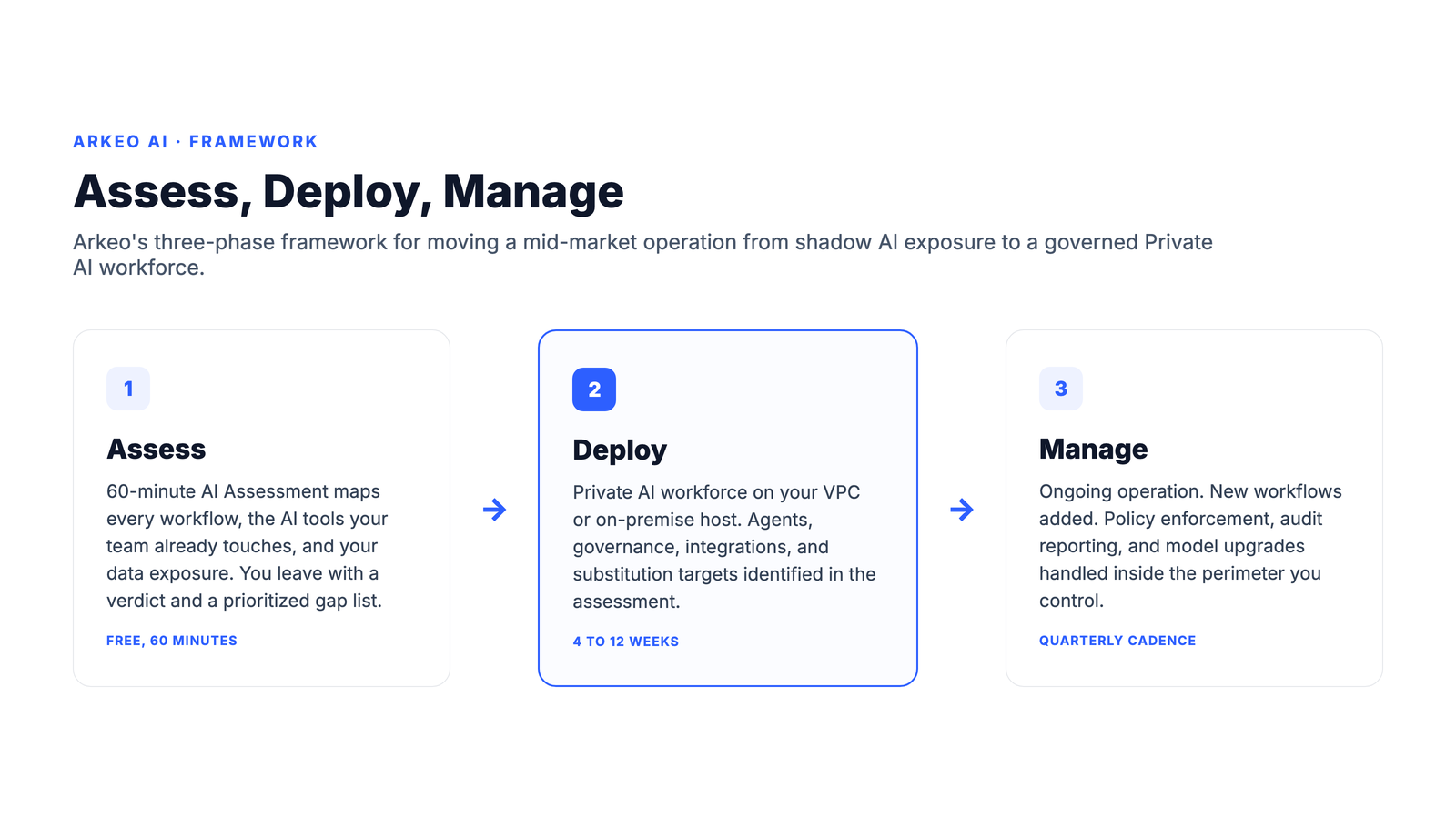
Solving the shadow AI problem permanently requires more than just buying another software license or drafting a PDF policy. It requires a fundamental shift in how you operate your business. At Arkeo AI, we have been building and deploying agent systems since 2023, and our approach is built on reality, not industry hype. We use what we sell to run three different companies daily. Our proven framework ensures you transition smoothly from unmanaged risk to a secure, high-performing Private AI Workforce.
Phase 1: Assess
We do not start by writing code or selling licenses. We start by mapping the ground-level operational truth of your business. During the rigorous assessment phase, we identify exactly where your team is currently experiencing friction and where shadow tools are likely being used to compensate for process failures. We map your critical data flows, evaluate your existing technical infrastructure, and identify the highest-impact areas for secure, immediate automation. This gives us the exact blueprint for what your business actually needs, rather than what a software vendor wants to sell you.
Phase 2: Deploy
With the operational assessment complete and validated, we build and deploy your Private AI Workforce directly on your infrastructure. This is not a multi-tenant cloud service where your proprietary data is pooled with thousands of other companies. Your models run entirely in your secure environment. They access only the specific internal data you permit, and they rigidly follow the strict governance policies we help you establish. This deployment phase systematically replaces the fragmented, unsecure tools your employees were using with a unified, secure system that integrates directly with your existing operations and workflows.
Phase 3: Manage
Deploying the system is only the beginning of the journey. Artificial intelligence is not static, set-and-forget software. It requires ongoing, vigilant oversight to ensure it continues to operate within the strictly defined parameters. The Manage phase is where we provide ongoing operational support and Governance as a Service. We continuously monitor the agents, refine their system instructions based on operational feedback, update the underlying models to the latest secure versions, and ensure that your governance policies are actively enforced at the system level. We manage the immense technical complexity of the models so your leadership team can focus entirely on running and growing the business.
This comprehensive, end-to-end approach ensures that you never return to the chaos of unmanaged tools. You establish a rock-solid baseline of security and build a robust foundation for long-term operational scale.
Replace Shadow AI with Secure Private AI
Stop worrying about where your data is going. We deploy and manage secure agent systems on your infrastructure, protecting your IP.
Book Your AI AssessmentReady to govern shadow AI
Stop chasing your employees. Substitute the path of least resistance.
Arkeo runs a 60-minute AI Assessment that maps your shadow AI surface, scores your exposure, and produces a 12-month substitution plan tailored to your operation.