Category
What Is Self-Hosted AI? A Business Owner's Guide to Private AI Deployment
Most business owners who hear "self-hosted AI" picture a data center full of servers and a team of engineers to run it. That image belongs to 2020. In 2026, a 40-person company can run a private AI system on infrastructure that fits in a server room — or in a cloud environment the business controls — without a single in-house AI engineer. The technology has changed. What has not changed is how most of the content about it reads: written for developers, not operators.
This guide is written for operators. It explains what self-hosted AI actually is, who it makes sense for, what it costs, and what deployment looks like for a company that has no interest in becoming an AI lab.
Quick Answer
- Self-hosted AI: AI models that run on your own infrastructure, not on OpenAI's or Google's servers. Your data stays in your environment.
- Who it's for: Companies with sensitive data, compliance requirements, or proprietary processes they are not comfortable processing through a third-party system.
- What it takes: A managed deployment partner, 90 days, and a budget starting around $6,500 to go live.
- What Arkeo does: Installs working AI systems on your infrastructure. Done-for-you. No data scientists required.
What Is Self-Hosted AI?
Self-hosted AI means running AI models on infrastructure you control rather than sending your data to a cloud provider. When your team uses ChatGPT, Copilot, or Gemini, their prompts and your company data travel to servers owned by Microsoft, Google, or OpenAI. With self-hosted AI, the model runs inside your environment. Nothing leaves without your approval.
The terminology can be confusing because several phrases describe the same concept: self-hosted AI, on-premise AI, private AI, and local AI are used interchangeably in most business contexts. They all mean the same thing for practical purposes: the AI model is running on infrastructure you own or control, and the data you feed it does not reach a third party.
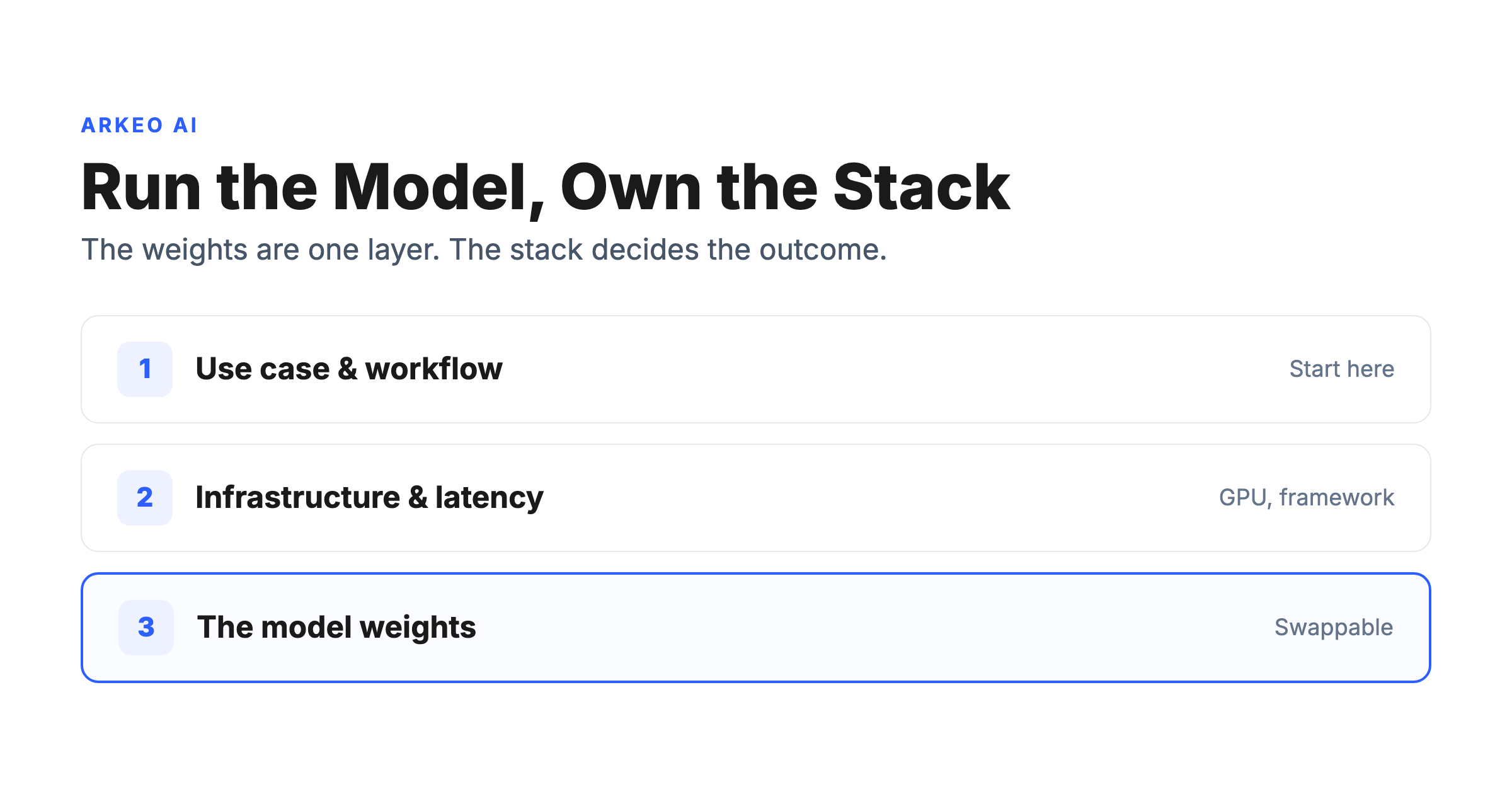
A self-hosted AI system for a mid-market business has four components:
- A language model. An open-source model (such as Llama, Mistral, or similar) that has been trained to read and generate text. In 2026, the quality of open-source models rivals commercial APIs for most business tasks.
- A serving layer. Software that runs the model efficiently, manages requests from your team, and handles the processing. This is infrastructure, not something your employees interact with directly.
- Your business data. Documents, SOPs, CRM records, emails, contracts, historical reports. This is what makes the AI useful to your specific business rather than generic.
- An interface. What your team actually uses. A chat-style interface for queries, an agent that drafts or summarises automatically, or a workflow integration that pushes outputs into your existing tools.
Most of the complexity sits in layers 1 and 2. A managed deployment provider like Arkeo handles those. Your team interacts with layer 4.
Why Businesses Move to Self-Hosted AI
The question is not whether AI is useful. Most business owners already know it is. The question is whether the way they are currently using it is sustainable — or safe.
Your data is more valuable than you realise
When an employee pastes a proposal into ChatGPT, several things happen. The prompt is sent to OpenAI's servers. Depending on the account settings, it may be used to improve the model. The response comes back, the employee pastes it into their document, and no one thinks much about what just traveled over that connection.
Now consider what is inside that proposal. Subcontractor pricing. Job-cost margins. A client's operational details. Scope-of-work language that took years to develop. Every one of those details just moved through a third-party system, under terms written by that third party.
For most businesses, this is not a theoretical concern. It is happening right now, with or without a policy about it. The 2026 NTT DATA Enterprise AI study found that 95% of enterprises say private and sovereign AI are important to their business, yet only 29% have a concrete plan for it. The gap between recognition and action is where the risk lives.
Shadow AI is already in your business
76% of AI experiments never reach production. That statistic, cited regularly by Gartner and McKinsey researchers, describes the formal experiments. It does not count the informal ones: the employee who started using Claude for meeting summaries, the sales rep pasting CRM data into a chatbot to draft follow-ups, the ops manager running variance reports through an AI tool no one officially approved.
This is shadow AI. It produces real productivity gains, which is why people keep doing it. It also creates a governance gap: no approval logic, no audit trail, no visibility into what data is leaving the business or how it is being processed.
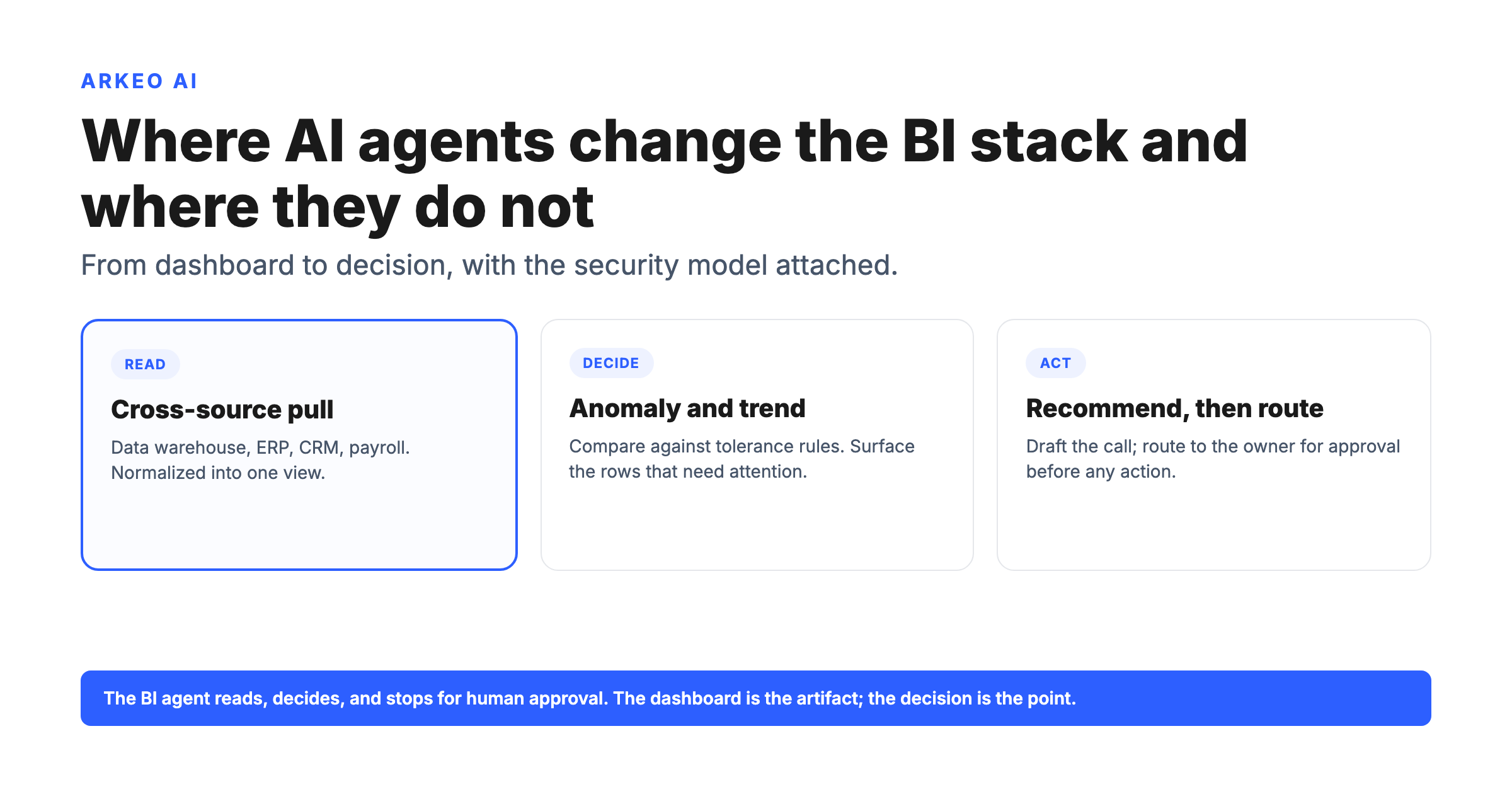
Self-hosted AI does not eliminate AI use. It governs it. When the model runs in your environment, you see what goes in and what comes out. You control who has access. You build approval logic that keeps humans in the loop on decisions that matter.
Long-term cost predictability
Cloud AI tools charge by usage. Per token, per API call, per seat. Costs scale with adoption, which creates an uncomfortable dynamic: the more useful the tool becomes, the more it costs, and the pricing is entirely at the vendor's discretion.
On-premise and private AI infrastructure has a different cost structure. There is a higher upfront investment, and then the marginal cost of usage is close to zero. Dell's Enterprise Strategy Group research found that enterprises running on-premise AI infrastructure at scale achieved a four-year ROI of 1,225%. The crossover point for mid-market companies is lower usage volume than most assume.
This is not an argument that cloud AI is always wrong. For some workflows, cloud tools are the right answer. The point is that the cost model is different, and for businesses with high-volume, ongoing AI use, the economics of private deployment improve significantly over a two-to-three-year horizon.
Keep Your Data in Your Environment
Book a free AI Capacity Assessment. Find out if private AI fits your business and get a 90-day deployment roadmap. No obligation.
Self-Hosted AI vs Cloud AI: The Five Differences That Matter
The comparison between self-hosted and cloud AI comes down to five factors. How each one weighs for your business depends on your industry, your data, and your growth trajectory.
| Factor | Self-Hosted AI | Cloud AI |
|---|---|---|
| Data location | Your servers or controlled environment | Vendor's servers (OpenAI, Google, Microsoft) |
| Cost model | Fixed infrastructure + managed operations | Per-token or per-seat pricing, vendor-controlled |
| Compliance | You own the security perimeter and audit trail | Shared responsibility model; vendor holds data |
| Customisation | Model trained on your specific data and processes | Generic model; limited fine-tuning options |
| Setup | Managed deployment, 30-90 days with Arkeo | API key in minutes; governance is your problem |
None of these factors is automatically disqualifying for cloud AI. For a business with no sensitive data, straightforward processes, and low AI usage volume, cloud tools are often the right starting point. For a business with proprietary workflows, compliance exposure, or a team that has already started using AI in ungoverned ways, self-hosted AI is the more defensible foundation.
What Self-Hosted AI Actually Looks Like at a 50-Person Company
The mental model most business owners have of on-premise AI is wrong. It is not a raised floor, climate-controlled server room, and a team of engineers in rotation. For a 50-person company running Arkeo's Core or Connected tier, the physical infrastructure is often a single rack-mounted server, or a controlled cloud environment such as an Azure private instance or AWS VPC. The model runs there. Employees access it through a browser-based interface or through integrations with the tools they already use.
What your team interacts with is not the infrastructure. It is the output: a drafted report, a summarised meeting, a research brief on a prospective client, a set of follow-up emails queued for review. The AI does the work. Your team reviews, approves, and ships.
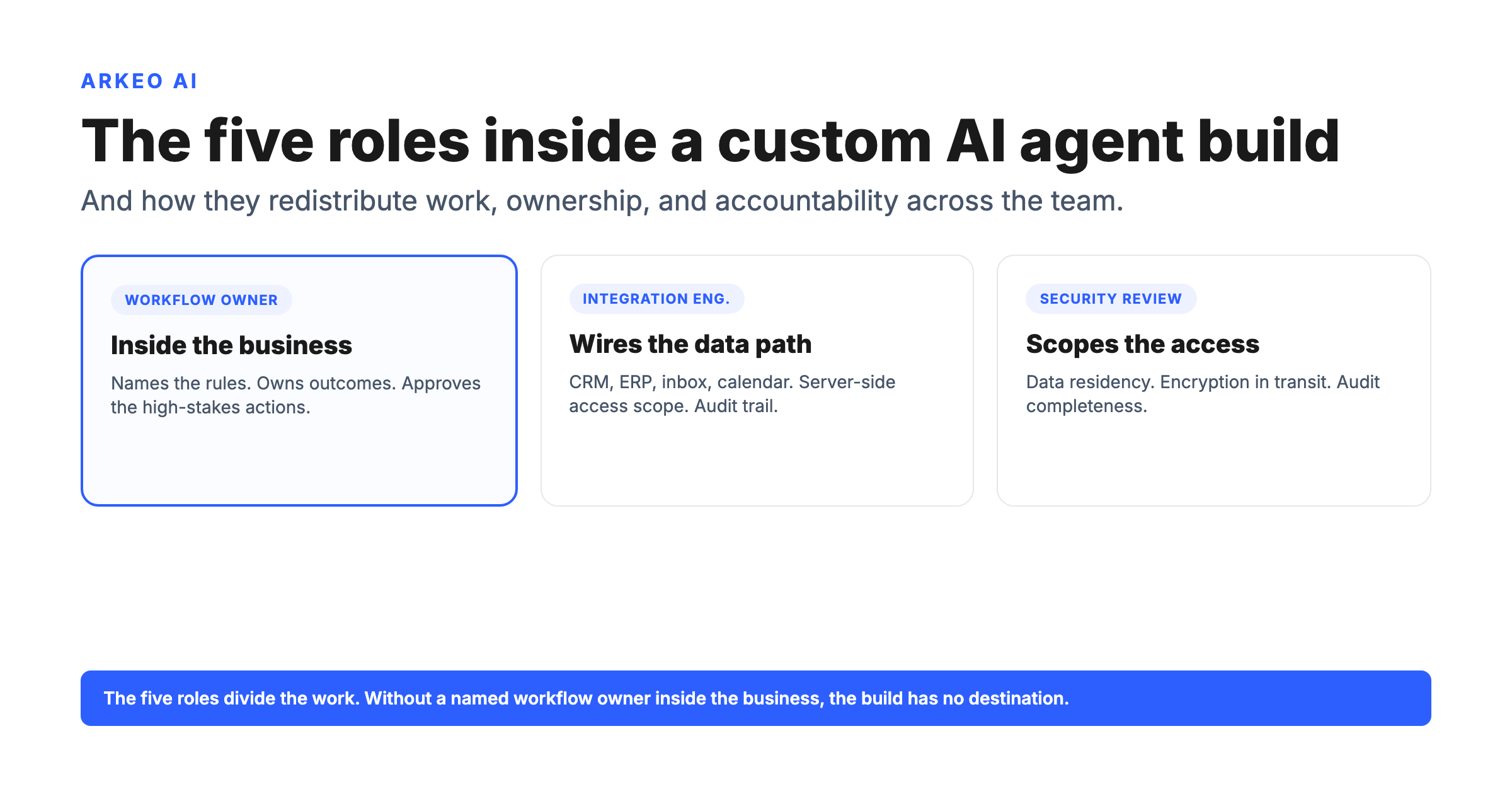
Arkeo structures this around four departments, each with its own agents doing specific work:
- Sales: Prospect research, qualification, outreach drafts, follow-up sequences, deal summaries
- Marketing: Content briefs, draft blog posts, SEO analysis, social copy, newsletter drafts
- Operations: KPI briefings, status reports, exception alerts, meeting summaries, scheduling
- Finance: Invoice processing, expense categorisation, budget tracking, variance reports
None of these workflows require a data scientist. They require a deployment partner who understands both the AI and the business well enough to configure the agents correctly, integrate them with existing systems, and keep them running. That is what Arkeo manages.
The Oil and Gas case study is a useful illustration. An O&G services company came to Arkeo with a documentation problem: safety compliance records, COR audit preparation, and cross-client reports were consuming a disproportionate amount of highly skilled staff time. The concern was data: these documents contained client-specific operational details that could not be processed through a cloud AI system. Arkeo deployed a private AI system on the client's own infrastructure. The result was an 80% reduction in documentation time, automated COR audit preparation, and zero cross-client data contamination. The AI ran on their servers. Their data stayed there.
Which Arkeo Tier Fits Your Business
Arkeo's deployment model has three tiers. The right starting point depends on how complex your workflows are, how many systems need to talk to each other, and how many people need to use the AI.
| Tier | Activation | Monthly | First-Year Total | Best For |
|---|---|---|---|---|
| Core | $6,500 | $1,500/mo | $24,500 | Private AI assistant trained on your documents, SOPs, and policies. No integrations required. Live in under a week. |
| Connected | $12,500 | $3,000/mo | $48,500 | Everything in Core plus 1-3 API integrations (CRM, email, calendar, accounting). Drafts, researches, and routes within your existing systems. |
| Orchestrated | $30,000 | $7,500/mo | $120,000 | Multi-agent system across departments. Orchestrator plus 2-5 specialist agents. Governance, audit logging, role-based access, up to 50 users. |
Most mid-market operators start with Connected. It delivers the full workflow integration that makes AI genuinely useful across a team, not just as a personal productivity tool. Construction and oil and gas clients often start with Core for compliance documentation, where the priority is keeping data on private infrastructure quickly, then expand to Connected once the team is comfortable with how the system works.
Pricing is published because transparency matters. The conversation about whether Arkeo is right for your business should happen before a proposal, not after.
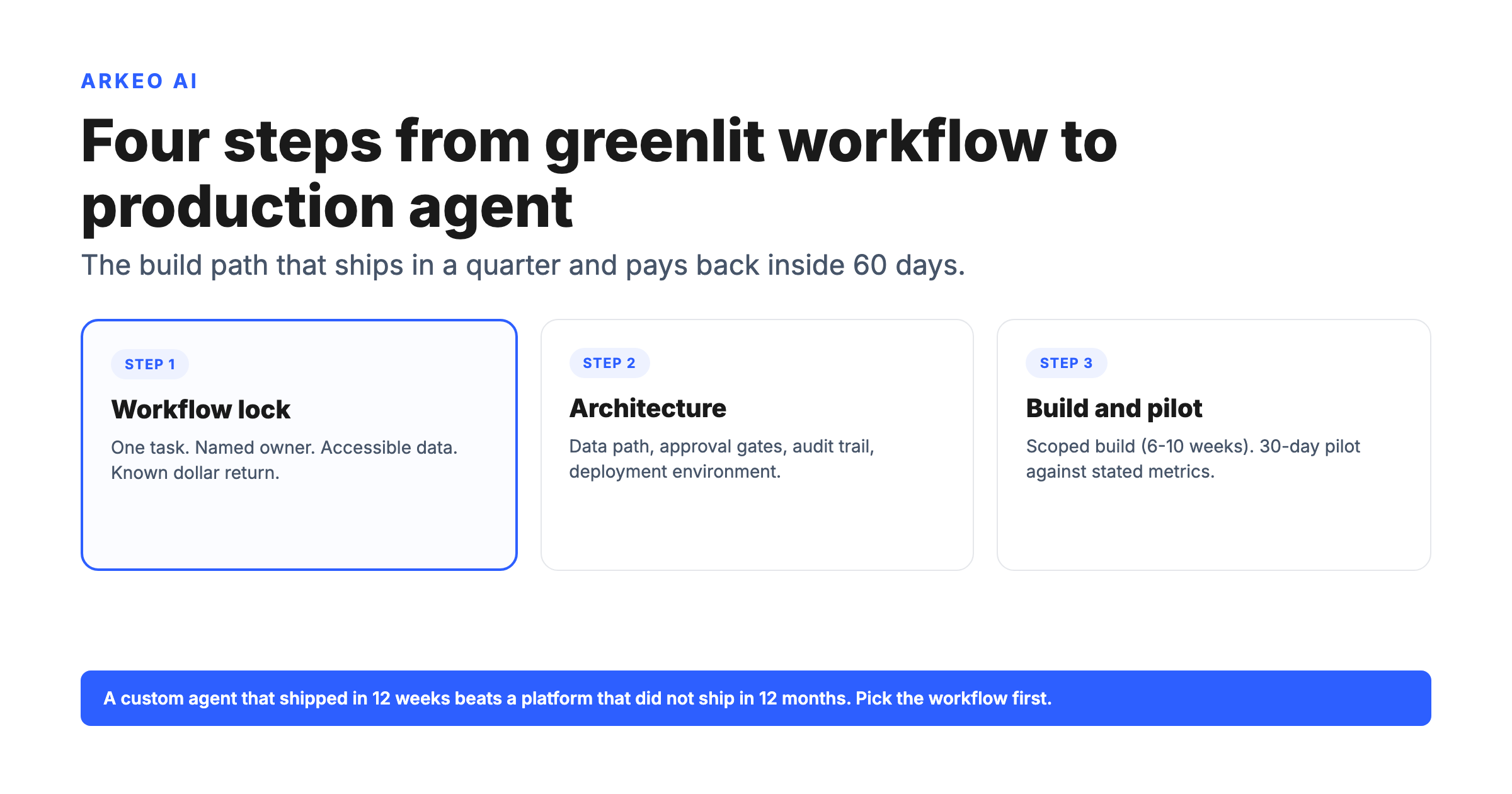
How Long Does It Take to Deploy Self-Hosted AI?
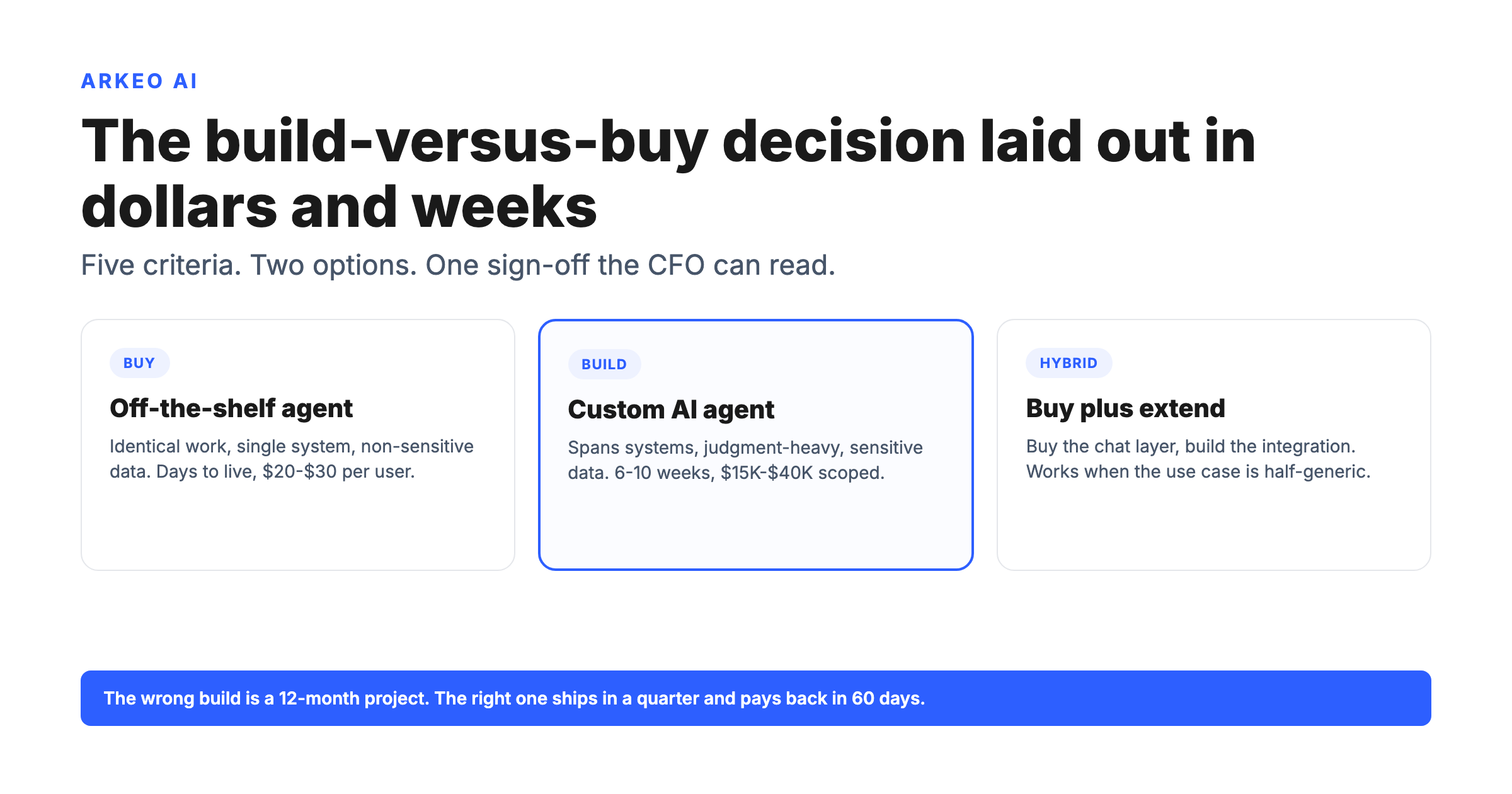
The most common objection to private AI deployment is timeline. The assumption is that it takes a year, requires a large IT project, and will consume significant internal resources.
That assumption is wrong for a managed deployment.
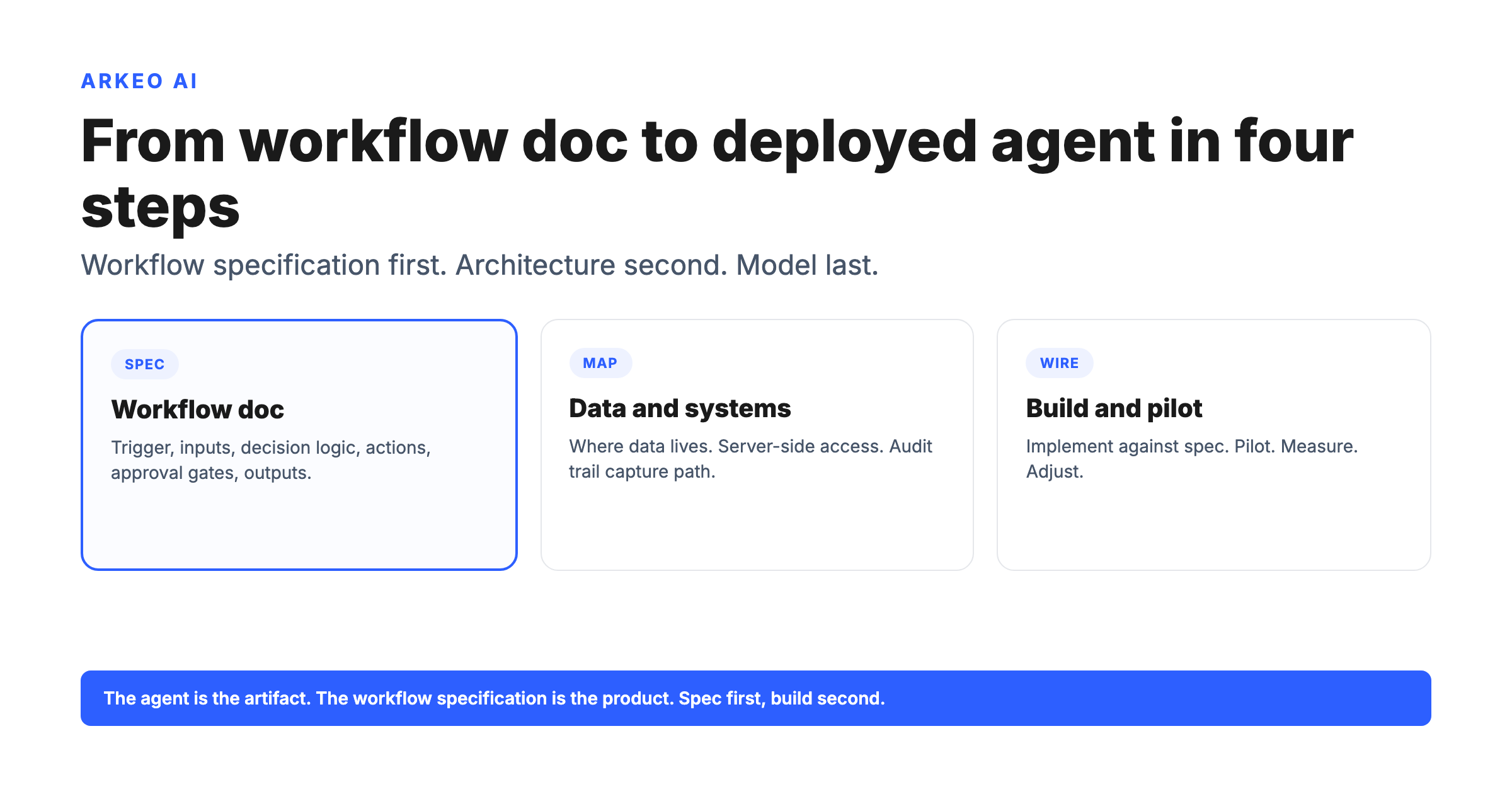
Core is live in under one week. No integrations, no data migration, no lengthy configuration. Arkeo configures the model on your infrastructure, trains it on your existing documents and SOPs, and hands you a working system. Under a week, start to finish.
Connected takes 30 to 45 days. The additional time covers integration with your CRM, email client, calendar, and any other systems in scope. Arkeo handles the technical integration. You provide access and sign off on the agent behaviours before anything goes live.
Orchestrated takes 60 to 90 days. Multiple agents, cross-department workflows, governance configuration, and team onboarding all require more time. 90 days is the outer bound, not the average.
What you provide: access to your systems, a designated internal contact, and time to review and approve agent behaviours before go-live. What Arkeo handles: infrastructure setup, model configuration, integration development, testing, documentation, and ongoing managed operations.
After go-live, Arkeo manages the system on a monthly retainer. This covers monitoring, updates, performance tuning, and team upskilling as your use of the system expands. The AI does not run itself. It runs better when it is actively managed by people who built it.
Ready to Deploy AI on Your Infrastructure?
Arkeo deploys private AI systems for businesses that are done experimenting with DIY tools. Core is live in under a week. Connected integrates with your CRM, email, and calendar. Start with a free 30-minute AI Capacity Assessment.
Frequently Asked Questions
What is the difference between self-hosted AI and cloud AI?
Self-hosted AI runs on infrastructure you control. Cloud AI runs on a vendor's servers (OpenAI, Google, Microsoft). With self-hosted AI, your data does not leave your environment. With cloud AI, your prompts and data travel to the vendor's systems and are subject to their terms of service.
Is self-hosted AI suitable for small and mid-sized businesses?
Yes. In 2026, managed deployment providers like Arkeo make self-hosted AI accessible to companies with 15 to 500 employees. You do not need an in-house engineering team. The deployment provider handles the technical complexity. Core is live in under a week at $6,500 activation.
Do I need a data scientist to run self-hosted AI?
No. With a managed deployment, you do not manage the model yourself. Arkeo handles infrastructure, configuration, and ongoing operations. Your team interacts with the outputs: drafts, summaries, reports, and alerts. The technical layer is invisible to day-to-day users.
How much does self-hosted AI cost?
Arkeo's Core tier starts at $6,500 activation plus $1,500 per month. For a full breakdown of what each deployment tier includes and what it costs across year one, see Private AI for Business: What It Actually Costs, or book an AI Capacity Assessment for a cost model specific to your workflows and systems.
What hardware do I need for on-premise AI?
The hardware depends on the deployment model and the size of the AI model being run. For Arkeo's Core and Connected tiers, a single server with an appropriate GPU typically suffices. For businesses that prefer not to manage hardware, Arkeo can deploy on a cloud environment you control (Azure private instance, AWS VPC) rather than physical on-premise hardware.
Can self-hosted AI integrate with my CRM and ERP?
Yes. Arkeo's Connected and Orchestrated tiers include API integrations with your CRM, email, calendar, accounting software, and other systems. The AI reads from and writes to your existing tools rather than creating a separate workflow layer.
Is self-hosted AI more secure than cloud AI?
It offers a different security model, not automatically a better one. The advantage of self-hosted AI is that you own the security perimeter. Data does not leave your environment. Cloud AI relies on the vendor's security controls and terms of service. For businesses with regulated data, sensitive client information, or proprietary processes, owning the security perimeter is generally the stronger position.
What open-source AI models are used in self-hosted deployments?
Arkeo uses open-source models including variants of Llama, Mistral, and similar foundation models, selected based on the specific use case and performance requirements. The choice of model is part of the deployment configuration, not a decision you need to make before engaging.
Why has Arkeo been building AI agents since 2023?
Arkeo's founder David Brennan began building AI agents in production in 2023, before the current wave of commercial AI tools existed. That three-year track record means the systems Arkeo deploys have been tested in real business environments, not just described in demos. The construction case study (75% admin reduction, three companies, zero cloud data exposure) and the O&G case study (80% documentation reduction, automated COR audit preparation) reflect real deployments that have been running for extended periods.
Self-hosted AI is not a niche enterprise project. It is what happens when a company decides to stop sending its processes to someone else's system and starts building on its own infrastructure. The technology has matured, the deployment model is manageable, and the business case is clear for companies that handle sensitive data or proprietary workflows.
If you want to know whether this makes sense for your specific situation, the AI Capacity Assessment provides a straight answer: what workflows are worth automating, which deployment model fits your constraints, and what a working system actually costs. No obligation, and no sales pitch before you have useful information.