Category
OpenClaw vs OpenCode: Evaluating AI Agent Frameworks
Last updated: May 2026
Mid-market operators are rushing to deploy AI agents, but they often choose the wrong foundation. When a leadership team decides to automate their workflows, they frequently confuse coding assistants with operational agents. The result is a stalled deployment where engineers try to force a software development tool to process invoices or screen resumes.
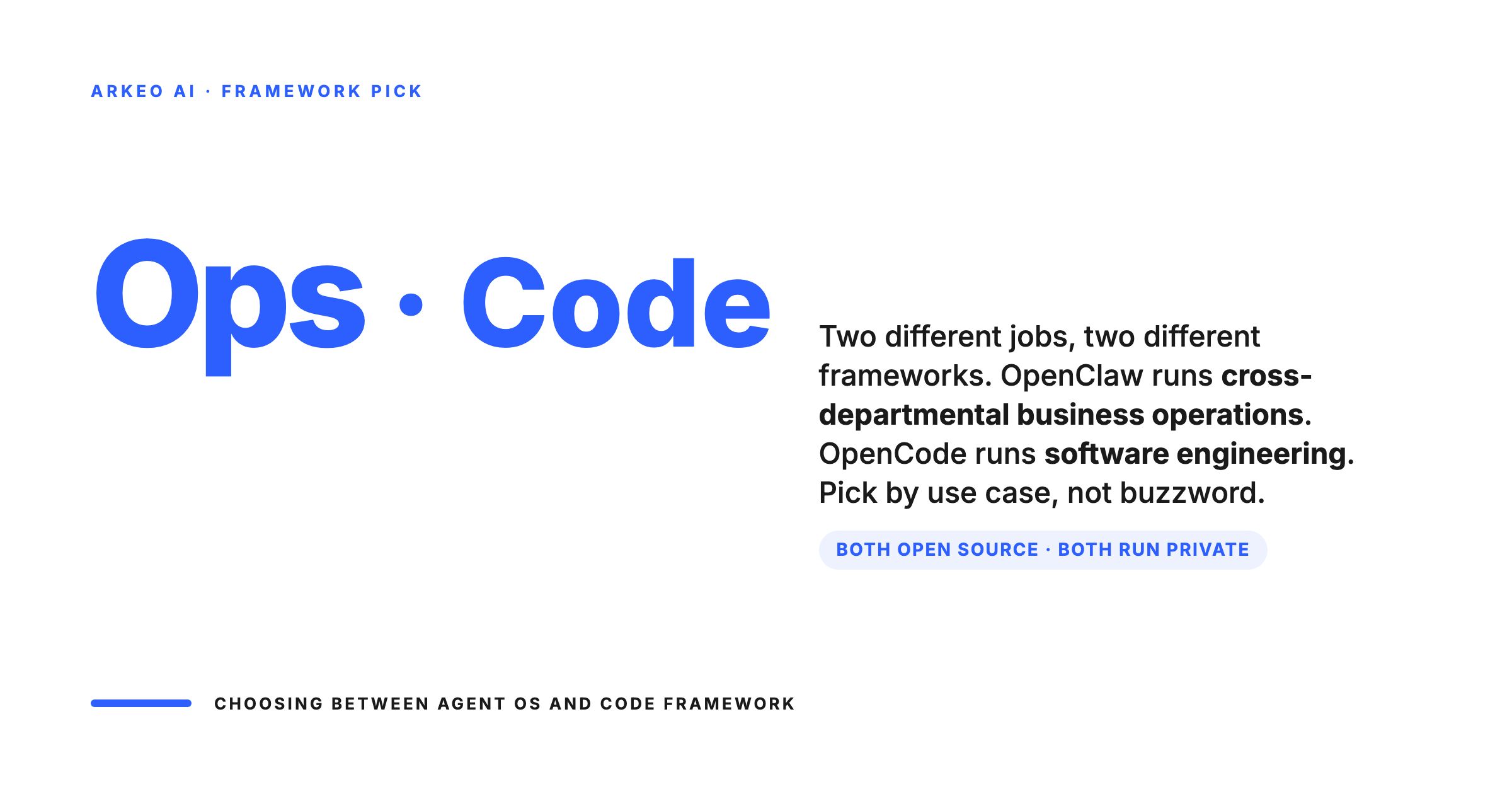
Choosing the right framework dictates whether your AI initiative scales or fails. Two of the most common systems evaluated today are OpenClaw and OpenCode. While both are powerful open-source agent frameworks, they solve entirely different business problems. One is built to write software. The other is built to run your company.
- OpenClaw: A private Agent Operating System (AOS) built for cross-departmental business operations like finance, HR, and project management.
- OpenCode: A specialized framework designed strictly for software engineering, repository management, and code generation.
- The Verdict: If you are building a custom software product, use OpenCode. If you are trying to automate your internal workflows securely across legacy SaaS platforms, deploy OpenClaw.
The Core Difference: Operations vs Engineering
To understand the distinction between these two frameworks, you must define the end goal. A tool is only as good as the bottleneck it is designed to eliminate.
OpenCode is a developer's engine. It interacts natively with integrated development environments, code repositories, and continuous integration pipelines. Its primary function is to increase the velocity of a software engineering team. It excels at refactoring legacy codebases, generating boilerplate scripts, and conducting automated peer reviews.
OpenClaw is an operational engine. It is designed to navigate the messy reality of mid-market business operations. Most companies do not run on perfectly documented APIs. They run on a mix of modern SaaS tools, legacy ERP systems, and web portals. OpenClaw uses Browser Control Relays to interact with these systems exactly like a human would. It clicks buttons, extracts text from screens, and submits forms.
Deep Dive into OpenCode: The Developer Framework
For a Chief Technology Officer managing a large engineering team, OpenCode is a highly effective lever. It allows senior developers to offload routine tasks and focus on complex system architecture.
The framework is exceptional at parsing complex logic and suggesting optimizations. When an engineer submits a pull request, OpenCode can automatically review the changes against company styling guidelines, flag potential security vulnerabilities, and even write the corresponding unit tests. It integrates tightly with the terminal and the command line.
However, its strength is also its limitation. OpenCode requires a highly technical operator. It does not possess native capabilities to navigate an external vendor portal to download a PDF invoice. It is not designed to parse applicant tracking systems or update customer relationship management records. Using OpenCode for administrative business tasks requires massive custom engineering, which defeats the purpose of an out-of-the-box framework.
Deep Dive into OpenClaw: The Private AI Workforce
If your bottleneck is administrative overhead, OpenClaw is the correct architecture. Arkeo focuses on deploying a Private AI Workforce because mid-market operators need digital employees that can execute multi-step workflows without constant supervision.
OpenClaw achieves this through isolated Workspaces and native browser automation. When an operations manager needs to reconcile daily field logs against a project schedule, an OpenClaw agent logs into the project management software, reads the data, cross-references it with the master schedule, and drafts a status report. That is exactly what we map during our free AI Assessment; we find which processes are costing you the most, and identify which ones an agent can handle tomorrow.
Crucially, deploying OpenClaw on your infrastructure ensures that your operational truth remains secure. Because the agents run on your private node, you establish strict data boundaries. The finance agent cannot access HR files, and the HR agent cannot access client contracts. This level of internal governance is missing from purely code-focused frameworks.
Bring Your AI In-House.
Your employees are already using AI; you just don't control the data. Book a Free AI Assessment to map your shadow AI exposure and get a step-by-step plan to deploy a secure, private AI workforce on your own infrastructure.
Security and Data Sovereignty
Data security is the primary reason mid-market companies abandon cloud AI experiments. When an employee pastes a proprietary contract into a public chat interface, the company loses control of that intellectual property.
OpenClaw is built specifically for data sovereignty. It is designed to be deployed on-premise or within a secure Virtual Private Cloud. The models process your data locally. A vendor invoice or a sensitive employee performance review never leaves your building. The system logs every action, providing a complete audit trail for compliance and management review.
While OpenCode can also be run locally with smaller models, its default behaviour in many environments relies on calling advanced public models to solve complex coding problems. If a developer uses a cloud-connected coding assistant, proprietary source code is transmitted externally. For strict enterprise environments, locking down an operational AOS like OpenClaw is structurally simpler than restricting a developer tool that constantly needs external documentation.
Which Framework Should You Deploy?
The decision between OpenClaw and OpenCode is not about which technology is superior. It is about aligning the tool with the business objective.
You should choose OpenCode if your primary product is software. If your competitive advantage relies on shipping code faster, reducing technical debt, and augmenting a team of software engineers, OpenCode provides the specialized tooling required for development environments.
You should choose OpenClaw if your company sells services, manufacturing, or physical products. If you are drowning in manual data entry, disconnected SaaS platforms, and administrative reporting, you need an operational framework. OpenClaw provides the secure, private AI workforce necessary to automate the back office so your human team can focus on growth.
Bring Your AI In-House.
Your employees are already using AI; you just don't control the data. Book a Free AI Assessment to map your shadow AI exposure and get a step-by-step plan to deploy a secure, private AI workforce on your own infrastructure.