Category
OpenClaw vs Moltbot: Which Agent OS is Best?
Last updated: May 2026
Mid-market technical leaders evaluating AI agent frameworks often hit a wall before they even write their first prompt: they can't figure out whether to install OpenClaw or Moltbot. They spend hours reading comparisons, trying to map feature sets, and trying to decipher which open-source project will win out. The truth is much simpler, and much more frustrating: they are the exact same project.
The problem isn't that you are choosing between two competing agent operating systems. The problem is that the viral rebranding of this project in early 2026 created a massive vulnerability. While you are wasting time comparing names, scammers are actively using the legacy "Moltbot" name to distribute malicious forks designed to compromise your internal infrastructure. In the enterprise AI space, downloading the wrong repository isn't just a mistake; it's a critical security breach.
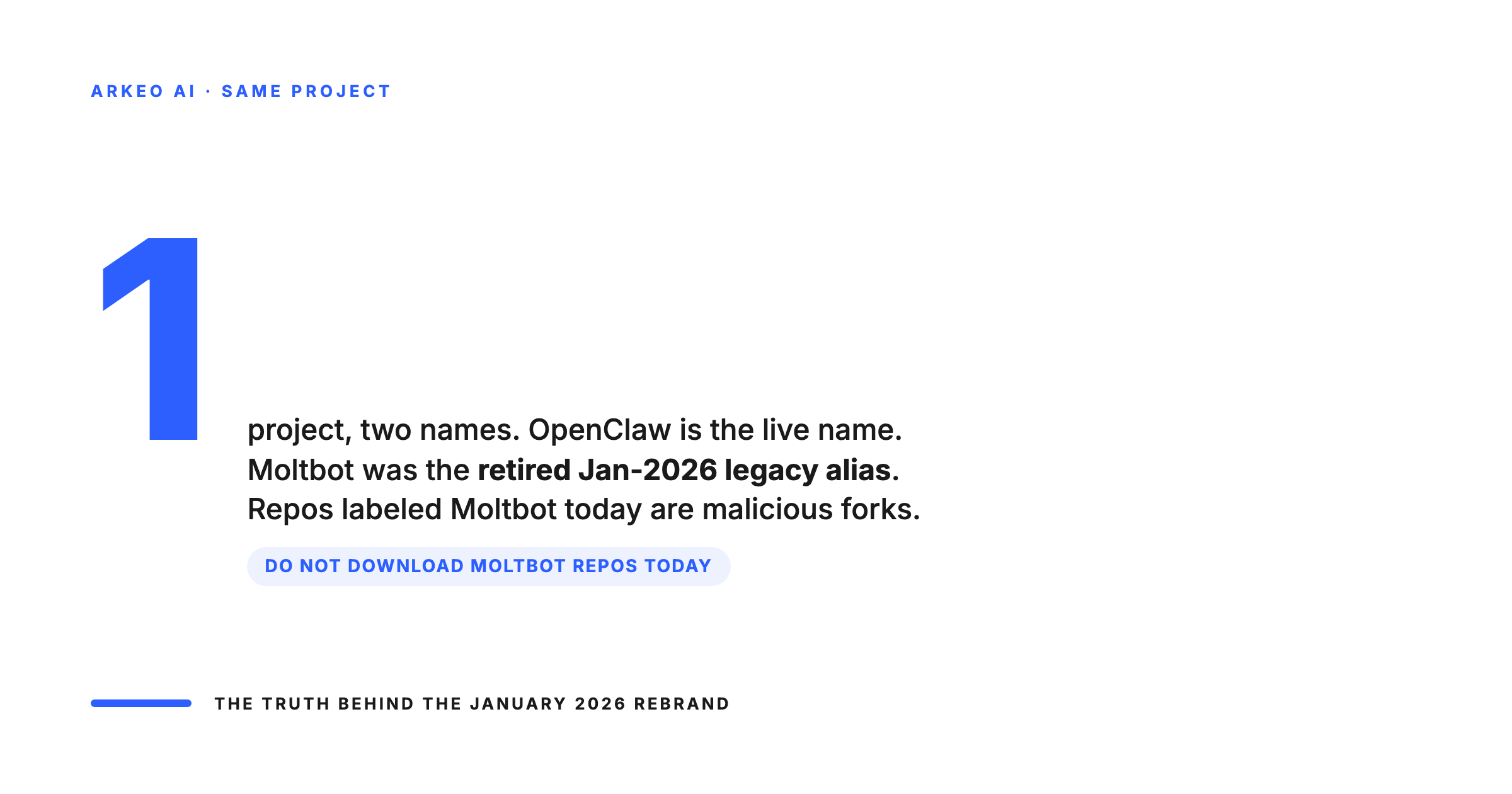
OpenClaw is the current, official name for the open-source agent operating system formerly known as Moltbot. There is no competition between the two—only a dangerous naming history you need to navigate to protect your data.
- The Short Answer: OpenClaw and Moltbot are identical. OpenClaw is the official project; Moltbot is its retired legacy name.
- The Rebrand: The core team changed the name from Clawdbot to Moltbot to OpenClaw in rapid succession in January 2026.
- Security Warning: Do not download repositories labeled "Moltbot" today. Malicious actors use the retired name to distribute compromised code.
- The Real Focus: Stop worrying about repository names. Focus on deploying OpenClaw securely on private infrastructure to protect your business data.
The Short Answer: They Are the Same Project
If you are trying to map the feature differences between Moltbot and OpenClaw, you can stop right now. There are none. Clawdbot, Moltbot, and OpenClaw are all the same technology created by the exact same development team.
The core architecture—utilizing Nodes to manage logic, isolated Workspaces to secure data, and Browser Relays to navigate web interfaces—was built under the original name and remains completely unchanged today. The underlying code executing tasks via large language models is identical. When comparing them, you aren't comparing a Macbook to a PC; you are comparing an application before and after it received a mandatory app store rename.
The January 2026 Rebrand Timeline
To understand why this confusion exists, you have to look at one of the wildest technology rebranding cycles in recent history. The agent framework didn't just change its name once; it changed it multiple times within a matter of days.
In late 2025, the project gained massive traction under the name Clawdbot. However, as enterprise adoption scaled, the team faced imminent trademark concerns with existing "bot" platforms. To avoid litigation, the developers rushed a rebrand to Moltbot (and occasionally referred to it internally as Molty) in early January 2026.
The name Moltbot survived for less than a month. According to coverage by Forbes and major developer networks, the team realized that appending "bot" to the name fundamentally misrepresented the project. They weren't building a chatbot; they were building an autonomous agent capable of grasping and manipulating digital tools. Furthermore, they needed to definitively signal their commitment to the open-source community.
By January 30, 2026, the project was officially and permanently rebranded to OpenClaw.
Bring Your AI In-House.
Your employees are already using AI; you just don't control the data. Book a Free AI Assessment to map your shadow AI exposure and get a step-by-step plan to deploy a secure, private AI workforce on your own infrastructure.
The Security Risks of the "Moltbot" Name Today
Most people think that finding an old GitHub repository under a legacy name just means you are downloading an outdated version of the software. They're wrong. In the fast-moving AI agent space, downloading legacy forks is actively dangerous. This is one of the hidden risks of shadow AI that most operators miss.
Because the project went viral during the exact window it was changing names, a massive vacuum was created. The official development team abandoned the Moltbot name, but thousands of blog posts, YouTube tutorials, and Reddit threads still pointed to it. Scammers and grifters immediately stepped into that void.
Today, if you search for a "Moltbot" repository, you are highly likely to find a malicious fork. These compromised versions are designed to look identical to the official open-source code but contain hidden payloads. When you run them, they establish a backdoor, granting external actors access to the very internal databases and APIs you connected to the agent. You must exclusively download and deploy the official OpenClaw releases to ensure your infrastructure remains secure.
Beyond the Name: Deploying OpenClaw for Business
The debate over names is a distraction from the actual challenge of enterprise AI. Once you have the correct, official OpenClaw repository, the hard part is just beginning. Downloading a verified open-source package does not magically create an automated workforce.
Deploying OpenClaw requires rigorous business architecture. You must map your specific workflow bottlenecks, define strict Role-Based Access Control (RBAC), and isolate agent tasks into secure Workspaces. If an agent hallucinates or makes a mistake, it must be contained.
More importantly, running a secure agent means physically separating your data from the public internet. This is what we build at Arkeo AI. A true Private AI Workforce runs OpenClaw entirely on your own dedicated hardware or a secure Virtual Private Cloud (VPC). The data never leaves your building. You maintain total data sovereignty while automating your most expensive administrative burdens.
Stop guessing which open-source fork is safe. That's exactly what we map during our free AI Assessment — which processes are costing you the most, and how to deploy a secure, private OpenClaw architecture to handle them tomorrow.
Bring Your AI In-House.
Your employees are already using AI; you just don't control the data. Book a Free AI Assessment to map your shadow AI exposure and get a step-by-step plan to deploy a secure, private AI workforce on your own infrastructure.