Category
OpenClaw Mission Control: Managing Your AI Workforce
Last updated: May 2026
Mid-market operators often think that standing up a local AI model solves their security problems. They spin up an open-source model, point their employees to a new chat interface, and assume the data is safe. That is a dangerous assumption. Without a governance layer, you haven't eliminated shadow AI; you have just moved it to a different server where you still have zero visibility into what your digital workforce is actually doing.
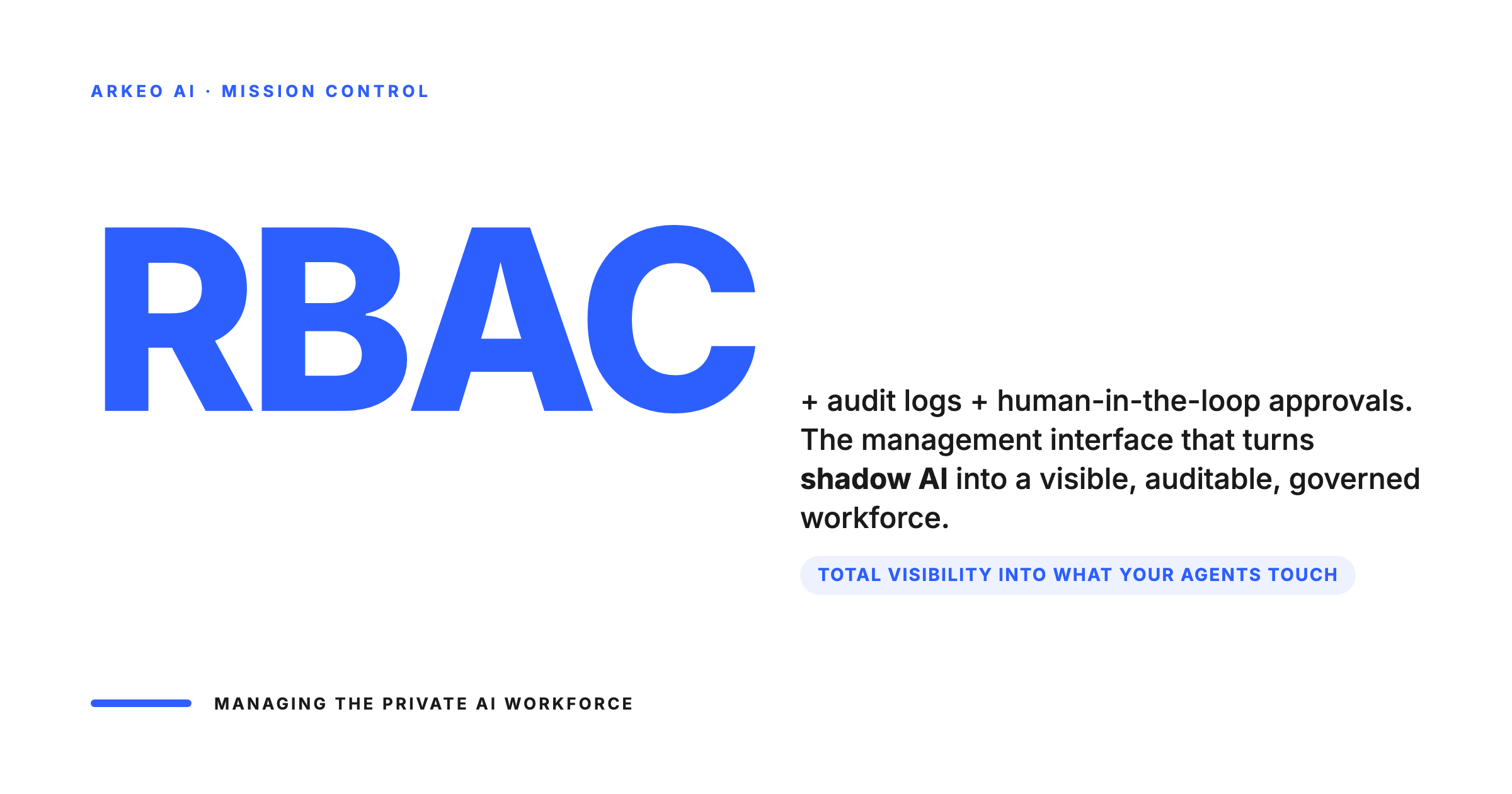
This is where OpenClaw Mission Control becomes non-negotiable. Mission Control is the central governance and management interface for your private AI operations. It transforms a scattered set of local scripts into a manageable, auditable workforce. When an agent touches your financial database, drafts a client email, or parses an employee record, Mission Control logs the action, enforces the permissions, and demands human approval before the work is finalized.
- What it is: The management interface for governing a Private AI Workforce on your infrastructure.
- Core Function: Replaces shadow AI with visible, auditable, and secure agent operations.
- Key Features: Role-Based Access Control (RBAC), full audit logging, and human-in-the-loop approval gates.
- The Value: Gives leadership total visibility into what data AI agents touch and ensures zero IP leakage.
The Shift From Chatbots to a Governed AI Workforce
Most companies start their AI journey with unstructured chatbots. An employee pastes a messy spreadsheet into a prompt and asks for a summary. The problem is that chatbots are unpredictable and ungoverned. If a junior estimator feeds highly confidential bid margins into an agent, and that agent later uses that context to answer a question for a competitor's project manager, you have a massive data breach on your hands.
When deploying OpenClaw as a structured operational tool, you are not building a better chatbot. You are building a digital employee. And just like a human employee, an AI agent requires boundaries, supervision, and an escalation path when it gets confused. Mission Control provides the dashboard to see exactly which agents are active, what tasks they are executing, and where they are encountering errors in real-time.
We see companies abandon AI pilot projects all the time because they lack this visibility. When a script breaks silently, operations grind to a halt. Mission Control prevents this by turning silent failures into visible alerts, allowing your human managers to step in and correct the workflow.
Role-Based Access Control (RBAC) for AI Agents
You would never give an entry-level marketing coordinator full administrative access to your company's payroll database. Yet, companies routinely deploy internal AI models with blanket access to their entire SharePoint or Google Drive architecture. This is a catastrophic security failure waiting to happen.
Mission Control treats AI agents exactly like human employees through strict Role-Based Access Control (RBAC). It utilizes isolated Workspaces to create hard data boundaries. An agent assigned to process accounts payable invoices is placed in a Finance Workspace. It has permission to read the AP inbox, access the vendor master list, and draft entries in your ERP. It is physically blocked from accessing HR records, legal contracts, or executive communications.
If an agent attempts to access a file path outside its designated Workspace, Mission Control denies the request and logs the violation. This principle of least privilege ensures that even if an agent hallucinates or receives a malicious prompt, the blast radius is entirely contained within its specific silo.
Bring Your AI In-House.
Your employees are already using AI; you just don't control the data. Book a Free AI Assessment to map your shadow AI exposure and get a step-by-step plan to deploy a secure, private AI workforce on your own infrastructure.
Total Visibility: Audit Logging Every Prompt and Action
Compliance and security in the mid-market require a paper trail. If a vendor is paid the wrong amount, or a client receives an incorrect proposal, "the AI did it" is not a legally defensible excuse. You must be able to prove exactly how and why a decision was made.
Mission Control provides comprehensive audit logging for your Private AI Workforce. It records every single action an agent takes. This includes the initial prompt that triggered the workflow, the specific database queries it executed, the files it opened, and the API calls it made. If an agent utilizes a browser relay to navigate a legacy SaaS portal, Mission Control logs every click and form submission.
This level of traceability is the blunt truth of enterprise AI: if you cannot audit it, you cannot trust it. When you rely on public cloud AI tools, you have zero access to the backend decision logs. With Mission Control running on your private infrastructure, you own the complete operational truth, allowing your IT team to quickly debug errors and prove compliance during security audits.
Human-in-the-Loop: Establishing Approval Gates
The biggest fear operations leaders have is that an AI agent will run wild, hallucinate a number, and send a disastrous email to their best client. It is a valid fear. AI models are probabilistic; they guess the next best word. They do not possess judgment.
Mission Control mitigates this risk through mandatory human-in-the-loop approval gates. You define the rules for high-risk actions. If an operations agent drafts a delay notification for a major construction project, Mission Control prevents the agent from hitting "send." Instead, it routes the drafted email, along with the source data it used to make the decision, to the project manager's Slack channel.
The human manager reviews the work, verifies the logic, and clicks a single "Approve" button. The agent does 99 percent of the heavy lifting, gathering the data, formatting the document, and writing the copy, but a human retains absolute control over the final 1 percent. This is the only way to build trust in an automated system.
Building Your AI Governance Blueprint
Deploying software is cheap; deploying poorly planned automation is incredibly expensive. Before you touch a single setting in Mission Control, you must map your operational workflows. You need to identify which data is sensitive, who owns the approval process for each task, and what the escalation path looks like when an agent encounters an edge case.
That is exactly what we map during our free AI Assessment, which processes require strict RBAC, where your data vulnerabilities lie, and how to structure your workspaces before you write any code. Build the governance blueprint first, then configure the software to enforce it.
Bring Your AI In-House.
Your employees are already using AI; you just don't control the data. Book a Free AI Assessment to map your shadow AI exposure and get a step-by-step plan to deploy a secure, private AI workforce on your own infrastructure.