Category
Claude Cowork for Manufacturing: Mid-Market Playbook
Last updated: May 2026
Integrating AI into manufacturing operations requires balancing aggressive automation with strict data security. Public models expose proprietary schematics, compliance records, and supply chain logistics to unacceptable risks. Claude Cowork eliminates this vulnerability by providing an isolated, enterprise-grade environment. It enables mid-market manufacturers to deploy a private AI workforce that systematically executes complex back-office workflows while maintaining absolute data sovereignty.
Quick Answer
• Core Objective: Deploy AI automation across manufacturing operations without exposing proprietary IP to public models.
• The Solution: Claude Cowork establishes a secure, private AI workforce for engineering, compliance, and supply chain tasks.
• Operational Impact: Scales back-office efficiency through dedicated agentic systems while guaranteeing strict data sovereignty.
What is a Private AI Workforce?
When most people think of AI, they imagine a chat box. You type a question, and it gives you an answer. That’s a tool, not a workforce.
A private AI workforce is an interconnected system of AI agents that operate autonomously within your company’s secure environment. These agents are given specific roles, permissions, and access to your internal data, and nothing else.
Claude Cowork, built on Anthropic's advanced Claude architecture, is designed specifically for complex, multi-step enterprise reasoning. When deployed privately on your infrastructure, Claude Cowork acts as the cognitive engine for your AI workforce.
The critical differentiator is data sovereignty. When you deploy a private AI workforce, your data never leaves the building. The models process your proprietary CAD files, quality control reports, and vendor contracts entirely within your secure firewall. Your data is not used to train future public models. You retain absolute control.
The Shadow AI Crisis on the Manufacturing Floor
Before discussing deployment, we need to address the reality of what is likely already happening in your facilities.
"Shadow AI" refers to employees using unauthorized, consumer-grade AI tools for company work. A recent industry survey found that over 68% of employees use AI at work, yet the majority of mid-market companies have no formal AI governance policy.
In manufacturing, this looks like:
- A junior engineer pasting a proprietary component schematic into ChatGPT to write a testing protocol.
- A procurement manager uploading a supplier contract to a free cloud AI to summarize the liability clauses.
- A maintenance supervisor feeding a week’s worth of machine downtime logs into a public model to look for patterns.
Every time this happens, your intellectual property leaves your control. For manufacturing companies, where IP and operational efficiency are the primary competitive advantages, this is unacceptable. The solution isn’t to ban AI. Employees will just hide it better. The solution is to provide a superior, secure, internal alternative.
Is Your IP Leaking Through Shadow AI?
If your team is using public AI tools, your proprietary data is at risk. Stop the leak and give them a secure, private AI workforce.
Book Your Free AI Assessment →
When per-token cloud pricing starts to cost more than owning the hardware
The crossover comes faster than vendor calculators want you to know. For a mid-market manufacturer running steady operational AI across engineering, compliance, and supply chain, the math usually tips inside the first eighteen months.
Cost climbs linearly with usage. Engineering and compliance scale, the bill scales with them. No leverage.
Hardware cost is set. Usage can quadruple over five years without changing the bill. Crossover usually well inside 18 months.
Core Manufacturing Use Cases for Claude Cowork
A private AI workforce powered by Claude Cowork isn't about replacing your team; it's about removing the operational drag that prevents them from doing high-value work. Here is what an AI workforce actually does in a manufacturing environment.
1. Instant SOP and Training Material Generation
Standard Operating Procedures (SOPs) are the backbone of manufacturing quality control, but keeping them updated is a massive administrative burden.
With a private AI agent, a senior technician can record a video of themselves performing a complex machine changeover. The AI agent processes the video, transcribes the audio, extracts the step-by-step actions, and generates a formatted, ISO-compliant SOP document. It can then instantly translate that document into five different languages for your diverse workforce. What used to take an engineer three days now takes twenty minutes.
2. Automated Compliance and Quality Control Reporting
Manufacturing is heavily regulated. Whether you are dealing with ISO 9001, aerospace AS9100, or automotive IATF 16949, the documentation requirements are relentless.
An AI workforce can monitor your digital quality control logs, cross-reference them against the specific requirements of your compliance frameworks, and automatically draft the necessary audit reports. If a parameter falls out of tolerance, the agent flags it, drafts the non-conformance report, and routes it to the quality manager for review before the end of the shift.
3. Supply Chain and Inventory Analysis
Supply chain resilience requires constant monitoring. A dedicated procurement AI agent can ingest daily supplier updates, global pricing index changes, and your current inventory levels.
Claude Cowork excels at processing massive amounts of unstructured text. It can read through 50 different supplier email updates, extract the relevant lead-time changes, compare them against your production schedule, and highlight exactly which production runs are at risk next month. It delivers the operational truth, allowing your human team to negotiate solutions rather than dig for data.
4. Predictive Maintenance and Machine Telemetry Parsing
Modern manufacturing machines output gigabytes of telemetry data: temperatures, vibration frequencies, cycle times. However, making sense of that raw data usually requires a dedicated data science team, leaving most mid-market operators reacting to breakdowns rather than preventing them.
A private AI workforce can ingest this continuous stream of machine data. Claude Cowork, with its massive context window, can cross-reference real-time vibration data against historical maintenance logs and the manufacturer's original equipment manuals (OEMs). The agent can identify the subtle patterns that precede a bearing failure, alert the maintenance supervisor, and automatically draft the work order along with the required parts list, all before the machine actually goes down.
5. Legacy System Integration
Most mid-market manufacturers run on a mix of modern ERPs and legacy systems that don't talk to each other. An AI workforce can act as the intelligent bridge. Agents can be trained to read the outputs of a legacy inventory system, format the data correctly, and input it into your modern financial software, eliminating hours of manual data entry and reducing human error to zero.
Four agent deployments that pay back inside a quarter for mid-market manufacturers
These are the four workflows we see ship and stay shipped in mid-market plants. Each one is high-volume, document-heavy, and currently consumed by senior engineering or compliance time.
SOP generation
Parse technician videos and floor walkthroughs into draft Standard Operating Procedures. Senior engineers approve, not author.
Compliance and QC
Draft compliance and quality control reports against current standards. Audits compressed from weeks to days.
Supply chain analysis
Parse vendor performance, inventory, and lead-time data. Flag supplier risk before procurement does.
Predictive maintenance
Read machine telemetry and inspection logs. Predict failure patterns ahead of unplanned downtime.
Deploying Your Private AI Workforce: The 3-Phase Model
Deploying an AI workforce is an operational transformation, not an IT project. After years of building agent systems, we've formalized a 3-phase deployment model that mitigates risk and ensures measurable ROI.
Phase 1: Assess
You cannot deploy AI into a broken process. The first step is a rigorous assessment of your current operations. We identify the bottlenecks, map the data flows, and determine exactly where an AI agent will provide the highest immediate return. We don't guess; we look at the data. This phase results in a clear deployment roadmap and a defined ROI target.
Phase 2: Deploy
This is where we build your private infrastructure. We establish the secure, on-premise or private-cloud environment where your instance of Claude Cowork will live. We configure the Agent Operating System (AOS), build the specific agents defined in the assessment phase, connect them to your data sources, and establish the strict governance and permission protocols.
For a mid-market manufacturer, this often means setting up secure data pipelines that pull from your ERP, your shop floor PLCs (Programmable Logic Controllers), and your historical quality assurance databases. We ensure that the AI agents have read-only access where appropriate, and strictly controlled write access only when executing approved workflows. Every agent action is logged and auditable.
Phase 3: Manage
This is the differentiator. AI agents are powerful, but they break. Data schemas change, APIs update, and business rules evolve. A deployment without ongoing management is guaranteed to fail within six months.
In the Manage phase, Arkeo AI provides ongoing operational oversight. We monitor agent performance, ensure data security compliance, handle updates, and continuously refine the agents' instructions based on their output. If your primary supplier changes their invoice formatting, an unmanaged AI agent will fail to process it. Under the Manage phase, our team detects the error, updates the agent's parsing instructions, and returns it to production before it causes a backlog. We manage the AI workforce so you can manage your business.
Crawl, walk, run — proven Arkeo deployment model for mid-market manufacturing
No big-bang rollouts. Each phase ships a working capability into the plant, with the next phase starting only after the previous one has paid back.
Assess
Map current AI use, sensitive operational data, and the top three workflow candidates. Set the perimeter and the governance.
Deploy
Stand up the secure infrastructure with Agent OS integration. Ship the first workflow into the plant.
Manage
Add workflows two and three. Continuous agent performance review, model updates, and audit handling.
The Cost Crossover: Why Cloud AI Pricing is a Trap
When companies first explore AI, they look at cloud pricing models, which are almost universally based on "per-token" usage. A token is roughly equivalent to a word or part of a word. You pay for every prompt you send and every response you receive.
For a small marketing team generating a few blog posts, per-token pricing is negligible. But for a manufacturing company using AI to process hundreds of daily quality reports, analyze massive CAD files, and run continuous supply chain monitoring, per-token costs scale exponentially.
Worse, it creates a perverse incentive: the more you use the AI to improve your business, the more you are penalized financially. You start telling employees to "use the AI less" to save money, completely defeating the purpose of the technology.
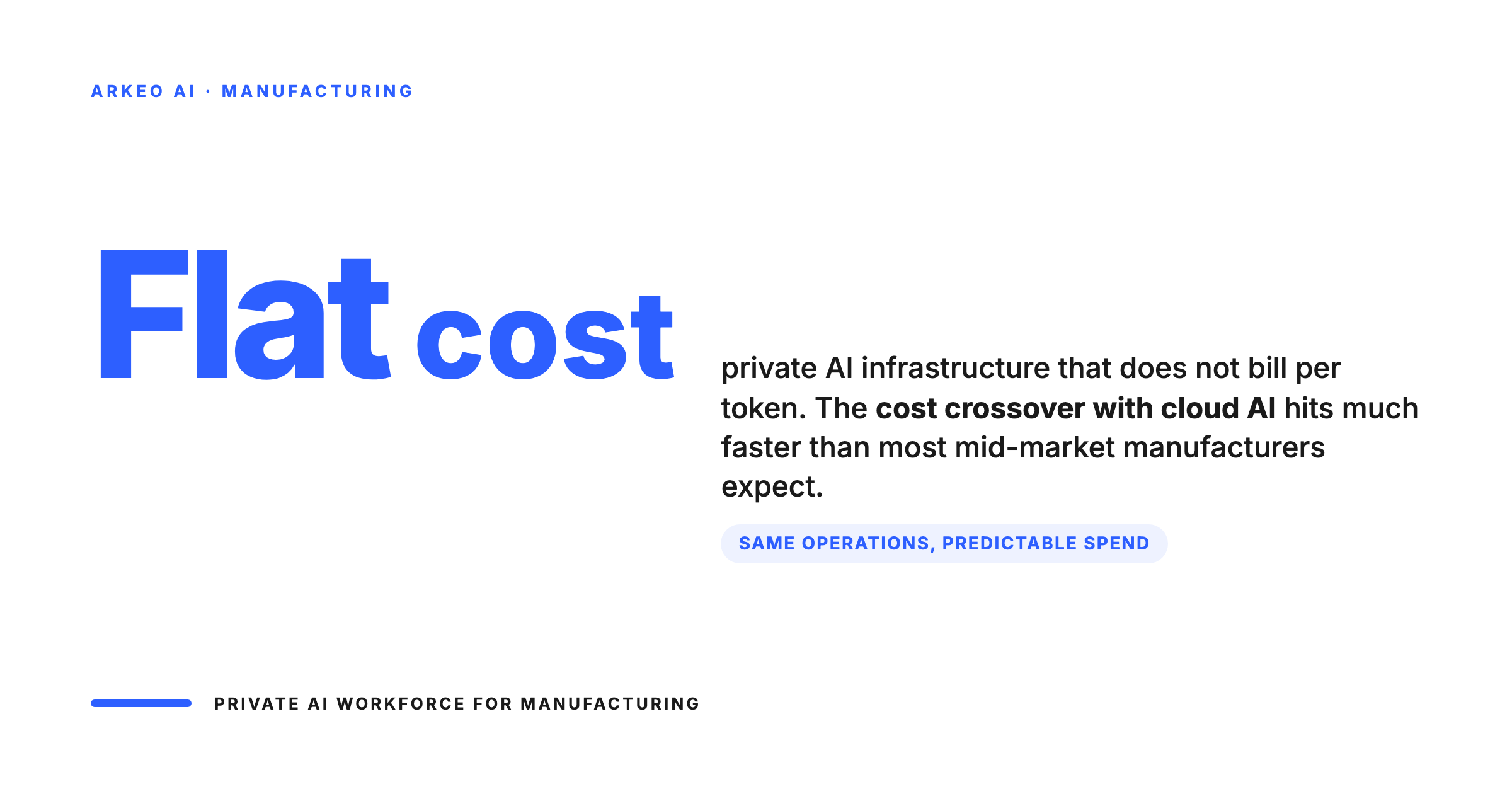
A private AI workforce operates on a fixed-cost model. Because you control the infrastructure, your processing costs are flat, regardless of how much data the agents process. There is a capital expenditure for the initial deployment (or a fixed operational expenditure for a private cloud instance), but the marginal cost of running an additional query or processing an extra hundred reports is essentially zero.
At a certain scale (usually hit much faster than mid-market operators expect) the fixed cost of a private deployment becomes significantly cheaper than the unpredictable, exponentially growing cost of cloud API usage.
Ready to Take Control of Your Data and Operations?
Stop guessing with generic AI tools. Let us map exactly how a private AI workforce can secure your IP and eliminate operational bottlenecks in your manufacturing facility.
Book Your Free AI Assessment →
What five years of operations cost on each model
The crossover does not happen because hardware is cheap. It happens because steady-state operational AI is high-usage, and cloud per-token pricing punishes that usage. The longer the runway, the wider the gap.
Per-token billing accumulates across every engineer, every compliance review, every supplier analysis. The bill compounds with success.
One-time hardware investment plus operating power. Usage doubles or triples, total cost barely moves. Compounding savings.
Securing the Future of Manufacturing Operations
The competitive landscape in manufacturing is no longer just about who has the best machines or the cheapest materials. It is about who can process operational data the fastest and most securely.
Deploying Claude Cowork as a private AI workforce allows you to leverage the most advanced reasoning models available without compromising the intellectual property that forms the foundation of your business. It transforms AI from an unpredictable cloud experiment into a secure, managed, and highly productive extension of your team.