Category
How to Use Claude Cowork: Building an AI Workforce
Last updated: May 2026
Claude Cowork represents a fundamental shift from individual AI assistants to team-based agentic workflows. For mid-market leaders, the goal isn't just giving employees a chat interface; it's about building a persistent, shared environment where AI agents and human teams collaborate on complex, multi-stage projects. By centralizing context and shared knowledge, Claude Cowork allows companies to move from simple task completion to full-scale operational transformation.
This guide provides the technical and strategic framework for deploying Claude Cowork as a centralized hub for your custom AI workforce. We move past the "single-player" AI model to show you how to structure shared Project spaces, integrate proprietary data, and deploy custom instructions that drive measurable increases in team output across high-stakes industries like construction, manufacturing, and financial services.
Quick Answer
• Core Function: A collaborative AI environment designed for team-based projects and shared agentic workflows.
• Operational Value: Eliminates "single-player" AI silos by centralizing context, allowing teams to scale complex operations like RFP responses or compliance audits.
• Deployment Strategy: Create dedicated Project spaces, upload institutional knowledge bases, and define custom instructions to automate multi-step professional tasks.
Introduction: The AI Illusion in the Mid-Market
Companies are buying AI licenses and getting zero operational leverage. I see it every single day. You sign the check for ChatGPT Enterprise or Microsoft Copilot. You distribute the seats to your team. You expect a revolution in productivity. Six months later, your operational costs are exactly the same. Your output has not increased. The only difference is your team is now using expensive software to write polite emails or summarize meeting notes. This is a massive failure in execution.
The problem is not the technology. The underlying foundation models are incredibly powerful. The problem is the deployment model. You are treating AI like a calculator. You are giving individual employees a tool to speed up individual tasks. This is single-player AI. It is inefficient. It does not scale. It does not fundamentally change how your business operates.
If you run a $50 million construction firm or a mid-market oil and gas services company, polite emails do not move the needle. You need operational transformation. You need a system that reads a 400-page Request for Proposal, extracts the compliance requirements, cross-references your past successful bids, and drafts a technical response in minutes. You need an automated process that reviews site safety logs against OSHA regulations in real-time. You cannot achieve this with single-player AI.
You need a custom AI workforce. This is where Claude Cowork enters the conversation. Claude Cowork is the bridge between a fascinating tool and a deployable operational asset. It is the management layer that allows you to transition from individual software licenses to an Agent Operating System. In this guide, I will show you exactly how to build and deploy a private AI workforce using Claude Cowork. We will focus on data sovereignty, role definition, and measuring true operational ROI.
The Problem with Single-Player AI
Before we build the solution, we must dissect the failure of the current model. Most mid-market companies are currently trapped in the single-player AI paradigm. This creates three massive operational liabilities.
First, you have the Shadow AI risk. Your employees are smart. They know AI can save them time. If you do not provide a secure, company-managed system, they will use public tools. They will upload proprietary blueprints, confidential client data, and internal financial models to public web interfaces. You have completely lost control of your intellectual property. In industries like defense manufacturing or energy, this is not just a leak. It is a catastrophic compliance violation.
Second, single-player AI guarantees inconsistent outputs. If you have five project managers using AI to write weekly status reports, you will get five completely different formats. One will be a bulleted list. One will be a narrative. The AI is reacting to the individual prompt skills of the user. There is no standardization. Your business relies on standardized processes to maintain quality and predictability. Single-player AI destroys standardization.
Third, single-player AI suffers from isolated knowledge. The AI only knows what the individual user pastes into the chat box. It does not have access to your company archives. It does not know the specific engineering tolerances you established on a project three years ago. It operates in a vacuum. A tool that operates in a vacuum cannot make complex, context-aware decisions.
This isolated approach is costing you money. You are paying for software that creates security risks and delivers inconsistent results. You need to move the AI out of the individual chat box and integrate it directly into your operational workflow.
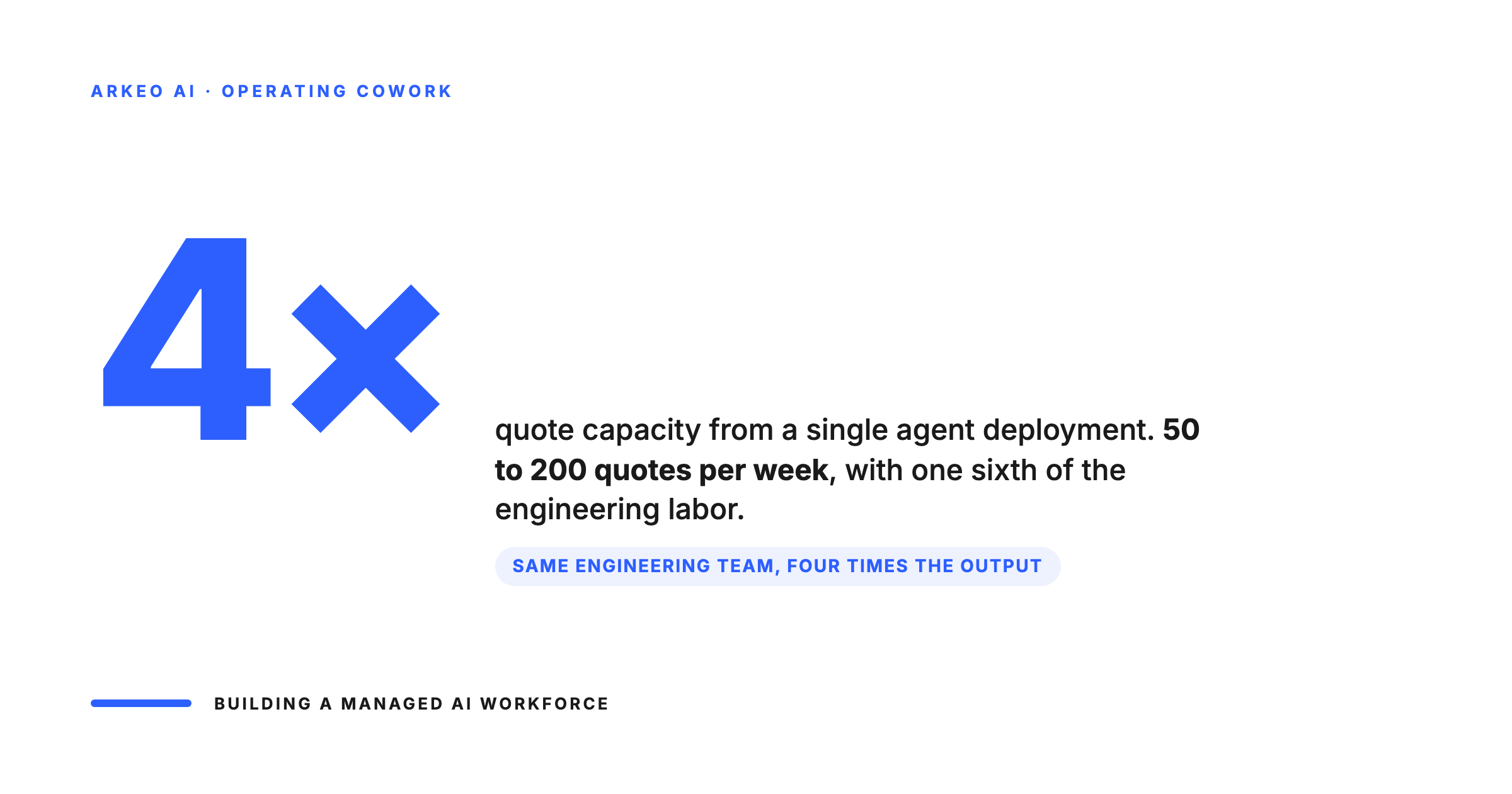
What 4× capacity actually means inside an engineering team
This is the live deployment, not a vendor projection. A quoting workflow that previously consumed 200 engineer-hours a week now consumes 33 hours, with four times the throughput.
quotes per week. Each one took 4 engineer-hours. Win rate held steady around 20 percent.
quotes per week. Each one takes about 10 minutes of engineer review. Win rate held, throughput quadrupled.
What is Claude Cowork in an Enterprise Context?
Claude Cowork represents a fundamental shift in AI architecture. It moves the technology from an individual utility to a shared workspace. However, in an enterprise context, it is much more than a shared chat interface. It is the foundation of your Agent Operating System.
Think of your company as a machine. Currently, human employees perform every function within that machine. Claude Cowork allows you to build digital workers, or AI agents, to execute specific, repetitive functions within that machine. You are no longer giving a human a tool. You are giving a human an AI assistant that handles the heavy lifting.
This requires a strict boundary. At Arkeo AI, we build private AI ecosystems. We use tools like Claude within a secure, managed perimeter. The enterprise context means your data never leaves your environment to train public models. Your proprietary knowledge becomes the exclusive fuel for your private AI workforce.
Industry Deep Dive: Transforming Heavy Operations
Let us look at a manufacturing company doing $75 million in revenue. They receive dozens of custom fabrication requests every week. Currently, an engineer spends four hours manually reviewing the CAD files, checking material costs, and estimating labor. With Claude Cowork deployed in a private enterprise environment, we can build a Quoting Agent. The human engineer uploads the request to the shared workspace. The Quoting Agent automatically accesses current material pricing databases, reviews the company rules for margin requirements, and generates a draft quote in 45 seconds. The human engineer reviews the quote, makes minor adjustments, and sends it to the client.
We just reduced a four-hour task to ten minutes. We increased quote velocity. We standardized the quoting process. This is the power of a private AI workforce. It is not about writing better emails. It is about fundamentally rewiring how the business processes information.
Stop Paying for AI Hype. Start Building AI Leverage.
If your team is using ChatGPT to write emails while your core operations remain manual, you are losing the AI race. Mid-market leaders need private, secure AI agents that actually do the work. The Arkeo AI Assessment maps your exact workflows to deployable AI agents, eliminating Shadow AI and driving measurable ROI.
Three building blocks inside a secure perimeter
The architectural unit is the Project workspace, not the prompt. Each agent lives in its own workspace, with shared institutional context wired in, all behind a perimeter that keeps data out of public model training.
Project workspaces
Shared context across the team. Documents, briefs, and standards live in the Project, not in a person's chat history.
Role-specific agents
One agent per role (engineering, marketing, sales). Each one has its own system prompt, scope, and rules.
Secure perimeter
Private deployment keeps data inside the firewall and out of the public training pool. Audit-ready by default.
Step 1: The AI Assessment (Define the Roles)
The biggest mistake executives make is turning on the software and telling the team to figure it out. That is a recipe for low adoption and zero ROI. You do not hire a new employee, point them to an empty desk, and tell them to find something useful to do. You give them a job description. You give them specific responsibilities. You must treat your AI workforce exactly the same way.
The first step in using Claude Cowork is the AI Assessment. This is a rigorous operational audit. You must identify the specific bottlenecks in your business that are ripe for automation. You are looking for tasks that are text-heavy, repetitive, rule-based, and time-consuming.
Once you identify the bottlenecks, you define the roles for your AI agents. You are not building a general intelligence. You are building highly specialized digital workers.
Consider a commercial construction firm. A major bottleneck is the submittal review process. The general contractor must review hundreds of submittals from subcontractors to ensure they match the architectural specifications. This is tedious, error-prone work. It takes days.
We define a role: The Submittal Review Agent.
We document exactly what this agent must do. It must read the subcontractor document. It must read the master architectural specification. It must compare the two documents. It must flag any deviations in materials, dimensions, or performance standards. It must format these deviations into a standardized PDF report.
We are not asking the AI to manage the project. We are asking it to perform one specific, highly valuable task with perfect consistency.
In an oil and gas services company, the role might be The Safety Compliance Auditor. This agent reviews daily field reports. It cross-references the reported activities against the latest OSHA regulations and internal company safety manuals. It instantly highlights potential violations or missing documentation.
By defining these roles clearly, you set the foundation for a successful deployment. You give the AI a clear target. You give your human employees a clear understanding of what the AI is supposed to do.
Step 2: Data Sovereignty & Context Integration
An AI agent is only as intelligent as the data it can access. If you give a brilliant human engineer zero background information on a project, they will fail. The same applies to Claude Cowork. You must integrate your company context into the system. However, for mid-market companies, this must be done with absolute security.
Data sovereignty is non-negotiable. You cannot feed your proprietary bid models, client lists, or technical schematics into a public AI that might use your data to train future models for your competitors.
This is the private AI advantage. When setting up Claude Cowork for enterprise use, you establish a secure perimeter. The data stays inside your walls. We utilize techniques like Retrieval-Augmented Generation. This allows the AI to search through your internal databases, document repositories, and historical archives without ever exposing that data to the public internet.
Let us look at a professional services firm, like a large regional accounting practice. They have twenty years of tax memos, legal opinions, and client strategy documents. This archive is their most valuable asset.
To make Claude Cowork useful, we connect it to this archive securely. When a junior accountant needs to research a complex tax credit for a real estate client, they do not just ask a generic AI model. They ask their internal Research Agent. The agent searches the secure, private archive. It finds three similar cases the firm handled in 2022. It synthesizes the strategies used in those cases and presents a draft memo based entirely on the firm's historical intellectual property.
The integration of context turns a generic language model into a custom-built expert on your specific business. It ensures the AI speaks your language, follows your precedents, and respects your unique operational constraints.
How the agent reads your institutional knowledge without leaking it back to public models
Retrieval-Augmented Generation pulls answers from your internal sources at query time, instead of training the model on them. The result: live answers from current data, and a hard guarantee that nothing was uploaded to a public training set.
Internal sources
Databases, document repositories, ticket systems, shared drives. All inside your firewall.
Retrieval layer
Indexes and pulls relevant chunks at query time. The agent reads from this, not from public training data.
Generation
Claude answers using only retrieved context. Proprietary data never leaves the perimeter or trains the model.
Step 3: Deploying the Workforce
With the roles defined and the secure data integrated, you move to deployment. This is where you configure the specific environments within Claude Cowork.
You organize the work into Projects. A Project in this context is a dedicated workspace for a specific AI agent or a specific workflow. You do not mix the Marketing Agent with the Engineering Agent. You keep their environments separate to maintain focus and prevent context contamination.
The most critical part of deployment is writing the system prompts. A system prompt is the foundational instruction set for the AI agent. It is the digital equivalent of a standard operating procedure manual. It dictates the agent's persona, its rules, its constraints, and its output format.
A weak system prompt produces weak results. Instructing the system to "Review this contract for errors" is a terrible prompt. The AI will guess what you consider an error.
A strong, operator-level system prompt looks like this: "You are the Senior Contract Analyst for a heavy civil construction firm. Your sole responsibility is to review vendor agreements. You must identify any clauses related to liquidated damages, indemnification, and payment terms exceeding net-45 days. You must flag these clauses. You must calculate the maximum financial exposure based on the project value provided. You must format your findings in a strict JSON structure, categorizing risks as High, Medium, or Low based on the attached company risk matrix. Do not provide legal advice. Only highlight deviations from our standard terms."
This level of detail forces the AI to behave predictably.
You must also establish guardrails. Guardrails are absolute rules the AI cannot break. In our contract example, a guardrail might be a hard stop preventing the AI from ever suggesting modifications to the limitation of liability clause without explicit human authorization. Guardrails protect your business from AI hallucinations and ensure compliance with internal governance.
One Project workspace per role, with the rules of that role baked in
The mistake is treating Cowork like one big shared chatbot. The pattern that works is to define each role explicitly: persona, rules, constraints, output format. The agent stops drifting because the workspace tells it what it is.
Marketing agent
Brand voice, campaign briefs, channel templates. Outputs draft copy in the team's house style.
Engineering agent
Code standards, architecture docs, ticket templates. Drafts PRs and triages incoming bugs.
Sales agent
ICP definition, qualification rules, past-wins library. Drafts proposals and follow-ups.
Step 4: Managing the Workforce
Deploying the AI agents is only half the battle. The other half is managing the human transition. You are fundamentally changing the nature of work for your employees.
Historically, your team members were the doers. They wrote the code. They drafted the proposals. They reviewed the spreadsheets line by line.
With a custom AI workforce, your team members must transition from doers to reviewers. They become editors. They become managers of digital output. This requires a completely different skill set.
You must train your staff to manage AI agents effectively. They need to understand how to write effective task-level prompts. They need to understand how to spot AI hallucinations. They need to know how to provide feedback to the system to improve its performance over time.
Consider the proposal writing process. In the past, a team of three people might spend two weeks writing a comprehensive response to a government RFP. They divided the sections, wrote the content manually, and merged the documents.
Now, the Proposal Agent generates the first draft of the entire document in thirty minutes based on the RFP requirements and the company's historical data.
The human team does not sit idle. Their job is now to review the AI draft. They check the technical accuracy. They refine the strategic messaging. They ensure the tone matches the client's expectations. They elevate the quality of the final product from acceptable to exceptional.
If you fail to train your humans to manage the AI, they will reject the system. They will view it as a threat or a nuisance. You must actively manage this change. You must demonstrate how the AI removes the tedious, repetitive parts of their jobs, allowing them to focus on high-value, strategic work that actually drives revenue.
Four steps from kickoff to a managed Cowork workforce
This is the order that works. The teams that fail at this skip the first step. The teams that succeed treat the AI Assessment as a real piece of work, not a vendor demo.
AI Assessment
Define the agent roles you actually need. Map workflows, sensitive data, and the order to roll them out.
Data sovereignty
Decide where the data lives. Wire context integration to internal sources, set the perimeter, lock down RBAC.
Deploy workforce
Stand up Project workspaces, write per-agent system prompts, ship the first role to a pilot team.
Manage workforce
Measure output, tune the prompts, expand to the next role, govern at workspace granularity.
Measuring ROI: Output Capacity and Error Reduction
The software industry wants you to measure ROI based on seat licenses and feature adoption. This is a distraction. The only metrics that matter to a CEO or VP of Operations are output capacity, cost reduction, and error rate mitigation.
When you deploy a custom AI workforce using Claude Cowork, you must measure its impact on your unit economics.
Let us return to the manufacturing company processing custom quotes. Before AI, they processed 50 quotes per week. Each quote required four hours of engineering time. That is 200 hours of expensive engineering labor dedicated to a pre-sales activity with a 20 percent win rate.
After deploying the Quoting Agent, the engineering time per quote drops to ten minutes. The company can now process 200 quotes per week using only 33 hours of engineering time.
The ROI is not the thousands of dollars you saved on legacy software licenses. The ROI is the massive increase in quoting capacity. The ROI is the hundreds of hours of engineering time freed up to work on billable, margin-producing projects. The ROI is the potential revenue generated by responding to four times as many market opportunities.
You must also measure error reduction. Human beings get tired. They get distracted. They miss critical details in massive contracts. AI agents do not get tired. They apply the exact same level of scrutiny to page 400 as they do to page one.
If your Compliance Agent catches one missed regulatory requirement that would have resulted in a significant fine, the system has paid for itself for the entire year.
You must track these operational metrics obsessively. Build dashboards that show the volume of tasks handled by AI agents versus humans. Track the processing time for core workflows before and after deployment. Document the specific errors caught by the AI that humans historically missed.
This data proves the value of the Agent Operating System. It justifies further investment. It shifts the conversation from IT spending to operational strategy.
Expanding Capabilities with Deep Integrations
Once the core agents are functioning reliably, you can push the boundaries of Claude Cowork further. A true private AI workforce does not just read and write text. It interacts with your other software systems.
This requires custom API integrations. You can connect your Claude Cowork environment directly to your ERP system, your CRM, or your project management software.
Imagine a mid-market logistics company. They manage hundreds of freight shipments daily. We can build a Logistics Agent that monitors incoming email traffic from port authorities. When the agent detects a notification about a delayed container, it does not just summarize the email.
Through API integrations, the agent automatically checks the ERP system to identify which customer orders are impacted by the delayed container. It then drafts a customized update email for each affected customer. Finally, it creates a high-priority task in the CRM system for the account manager to follow up by phone.
This is end-to-end operational automation. The AI is no longer just assisting a human. It is independently executing a multi-step business process across multiple software platforms.
This level of integration requires careful planning and robust security protocols. You must ensure the AI has the correct permissions to read and write data in your core systems. However, the operational leverage generated by this approach is massive. It allows mid-market companies to achieve the operational efficiency of enterprise giants without the corresponding headcount.
Engineering hours required to hit the same revenue target
The headline 4× capacity reads well. The underlying labour math is the part procurement actually cares about: the same revenue covered by a fraction of the engineering payroll.
of engineering time to produce 50 quotes per week. 20 percent win rate. The team is the bottleneck.
of engineering review for 200 quotes per week. Same 20 percent win rate. Four times the at-bats, one sixth the hours.
Scaling and Securing the AI Workforce
Building an AI workforce is an iterative process. You do not deploy twenty agents on day one. You deploy one. You test it. You refine the system prompt. You train the human managers. You measure the ROI.
Once the first agent is generating undeniable value, you deploy the second.
As you scale, you will begin to see emergent benefits. The agents will start to interact with each other. The outputs of one agent will become the inputs for another.
Consider the proposal process again. The Submittal Review Agent finishes its analysis of a subcontractor document. The output of that analysis is automatically fed into the Proposal Generation Agent, which updates the final client proposal to reflect the specific materials the subcontractor will use.
This creates an automated operational pipeline. The human employees sit above this pipeline, monitoring the flow of information, handling complex exceptions, and focusing on high-level strategy.
This is the ultimate goal of deploying Claude Cowork in an enterprise setting. You are building an asynchronous, highly scalable workforce that operates around the clock, executing your standard operating procedures with perfect consistency.
However, we must revisit the topic of security. It is the primary barrier for executive adoption in the mid-market. When implementing this architecture, the configuration of your security perimeter dictates your success.
Public AI models train on user inputs. If an employee pastes a proprietary algorithm into a public chat interface, that algorithm becomes part of the training data. This is an unacceptable risk.
To utilize Claude Cowork effectively, you must utilize enterprise-grade agreements that explicitly prohibit the use of your data for model training. This is step one.
Step two involves access control. Not every employee needs access to every AI agent. The intern should not have access to the Financial Forecasting Agent that is tied directly to the ERP system. You must implement strict Role-Based Access Control within your AI environment.
Step three is auditability. You must have a complete log of every interaction between your human employees and your AI agents. If an AI agent generates a piece of code that causes a system failure, you must be able to trace exactly who prompted the agent, what the prompt was, and what context was provided.