Category
Claude Code: The Executive's Guide to an AI Workforce
Last updated: May 2026
If your development team is still manually copying code into a browser window, you are paying for an outdated workflow. The hype cycle of "AI coding assistants" has trained operators to accept tools that merely type faster. This is a fundamental misunderstanding of what modern AI can do.
Claude Code is an agentic coding tool that reads entire codebases, edits files autonomously, runs terminal commands, and integrates directly with your development tools. It is the shift from a digital autocomplete feature to an autonomous digital worker.
The problem is not adoption; developers will find a way to use the fastest tools available. The problem is governance. If you deploy an autonomous tool without a managed architecture, you risk exposing proprietary intellectual property to cloud endpoints. We see this daily: companies blindly buy enterprise licenses, only to realize their codebase is now a black box of shadow AI.
Quick Answer
• What it is: An agentic CLI tool that autonomously reads codebases, edits files, and manages pull requests.
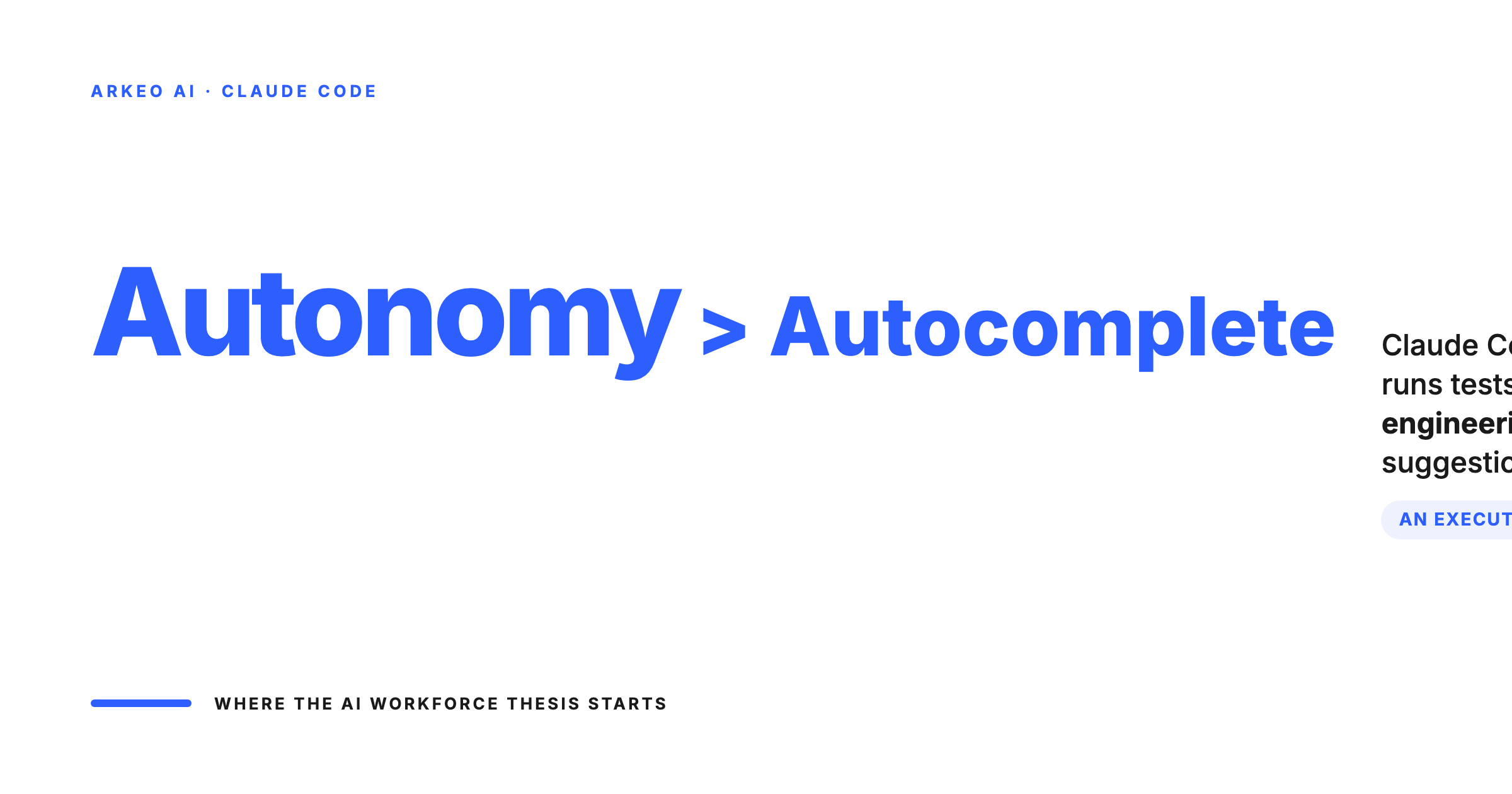
• Autonomy vs Autocomplete: Copilots type code for a human operator; Claude Code executes multi-step engineering tickets (tests, linting, commits).
• The Security Risk: Using cloud-based agents without oversight leaks proprietary codebase IP to third-party endpoints.
• The Solution: Deploy Model Context Protocol (MCP) servers and strict governance policies (CLAUDE.md) to secure enterprise data boundaries.
The Difference Between Autocomplete and Autonomy
Most engineering leaders think deploying AI means giving employees a smarter search bar or a better autocomplete. They are wrong. True operational leverage does not come from typing speed; it comes from autonomous execution.
When an engineer uses GitHub Copilot, the human is still driving the workflow. The developer must identify the bug, run the local server, test the changes, format the file, and commit the code. The AI simply suggests the syntax for line 42.
Claude Code flips this dynamic. It acts as an autonomous digital worker. You can assign it a raw directive: "Write tests for the authentication module, run them, fix any failures, and commit the changes with a descriptive message." The agent plans the approach, writes the code across multiple files, executes the terminal commands to run the test suite, reads the failure logs, rewrites the broken logic, and stages the commit.
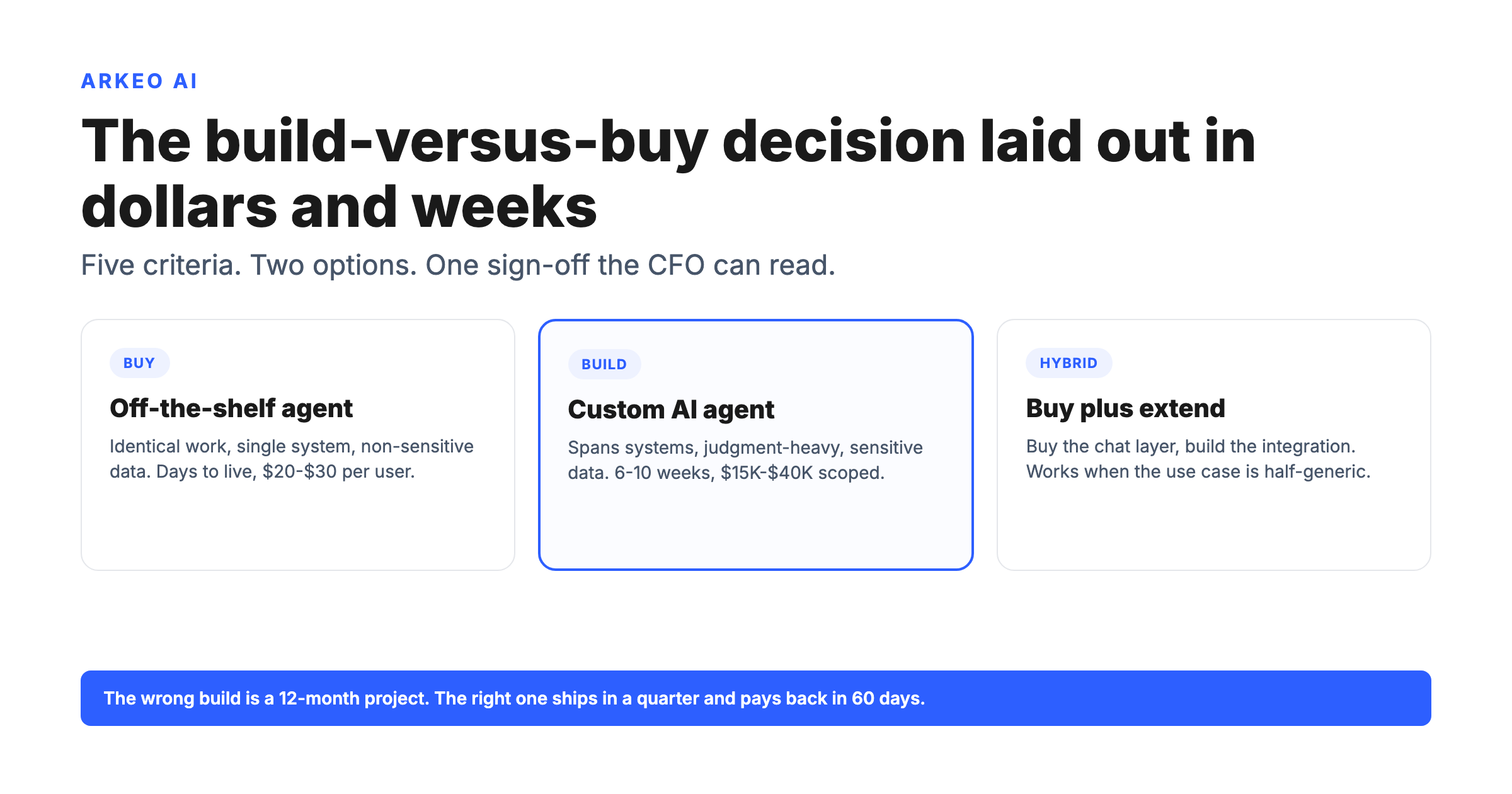
This is where mid-market companies miscalculate their ROI. If you measure AI success by lines of code written per hour, you are measuring the wrong metric. Just as we discovered when we built a custom AI coding agent, you should measure how many complete tickets an agent can close without human intervention.
Two different operating models that look similar from the outside
Both produce code. Only one of them does the work. The difference shows up the moment you stop being the bottleneck and start being the reviewer.
Human drives every step
Agent runs the loop
Agent Teams: The New Architecture of Engineering
The concept of a single AI assistant is already obsolete. Complex enterprise software requires parallel processing, and Claude Code achieves this by spawning subagents.
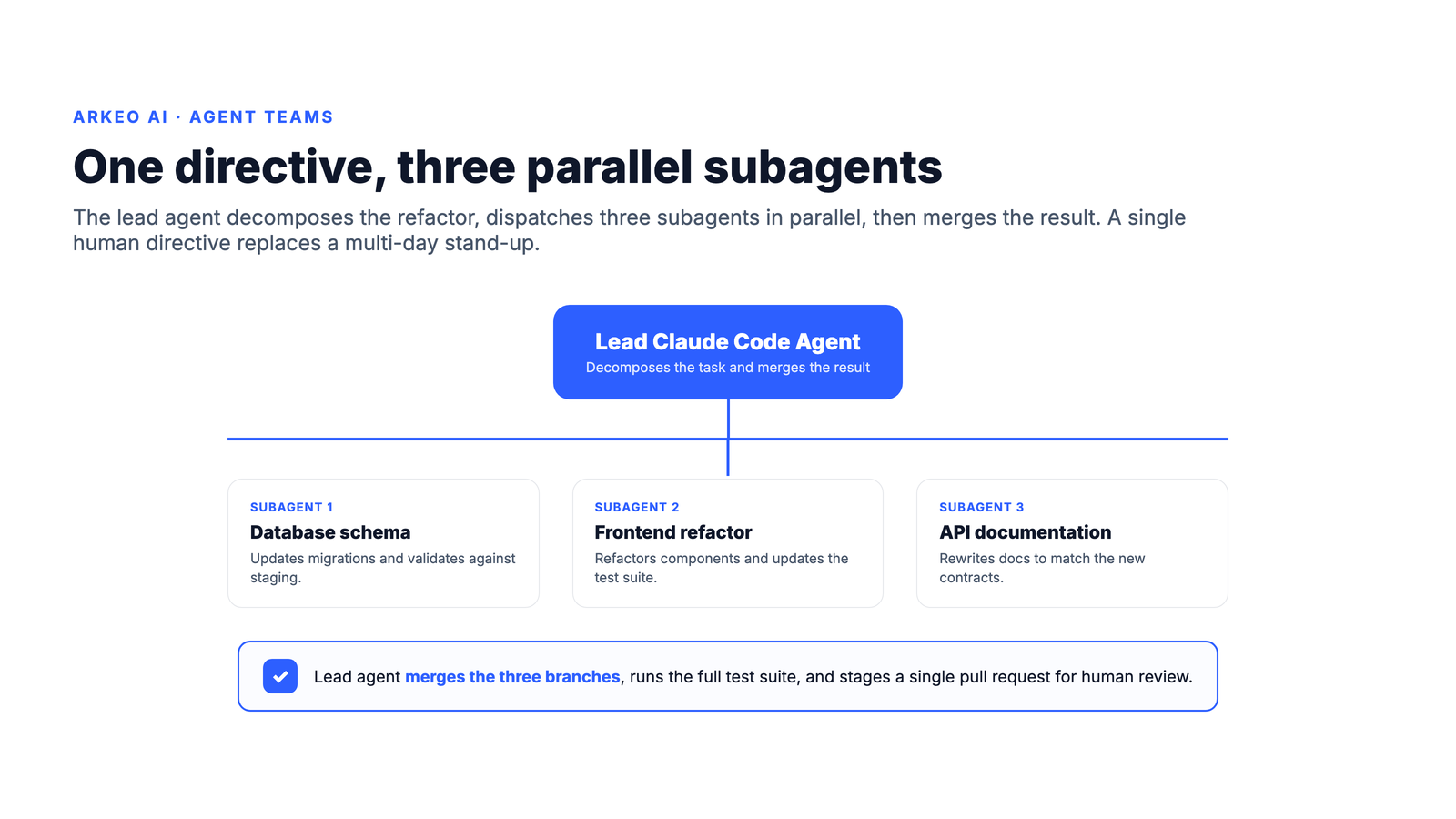
When faced with a massive refactor, a lead Claude Code agent can break the task into discrete pieces and dispatch multiple subagents. One agent updates the database schema, a second agent refactors the frontend components, and a third agent rewrites the API documentation. The lead agent coordinates the work, reviews the outputs, and merges the final result.
For an operations leader, this introduces a radical new management challenge. You are no longer just managing 50 human developers; you are managing a hybrid workforce. You must establish new approval gates, monitor the output of digital workers, and design CI/CD pipelines that can handle code generated at machine speed. Without intentional architecture, agent teams will generate technical debt faster than any human team ever could.
Three governance layers, one config file at the root of every repo
The pattern that works at scale is to encode the rules of engagement inside the repository itself. A single CLAUDE.md file scopes every agent that touches the codebase: who it is, what it is allowed to do, what shipping looks like.
Identity
The agent's role, voice, and decision-making scope. What it can sign off, what it must escalate.
Boundaries
Folders, services, and credentials it can read and write. Hard limits, not soft conventions.
Shipping standards
Test coverage, lint rules, PR templates, review SLAs. The agent meets the same bar as a human engineer.
See Where AI Fits in Your Business
Book a free 30-minute AI Assessment. We'll map your highest-value automation opportunities, estimate ROI, and build a 90-day deployment roadmap. No obligation, no pitch deck.
Governance at Scale: Enforcing Standards with CLAUDE.md
A major fear for any CTO is that AI agents will write inconsistent, unmaintainable code. If five different subagents solve five different problems, they often use five different architectural patterns.
Claude Code solves this through deterministic governance mechanisms. By placing a CLAUDE.md file in the root of your project, you define the operational rulebook for the AI workforce. This file acts as the ultimate authority on coding standards, approved libraries, architectural decisions, and review checklists. Before an agent writes a single line of code, it parses this document.
Furthermore, the system builds "auto memory." As Claude Code works through your codebase, it learns your build commands, recognizes recurring debugging insights, and applies them to future sessions. For a development team, this means the AI workforce gets faster and more accurate over time, automatically documenting the tribal knowledge that usually lives only in senior engineers' heads.
That is exactly what we map during our free AI Assessment: which processes are costing you the most, and how to govern AI agents so they follow your strict architectural standards.
The Shadow AI Risk and the MCP Solution
Here is the blunt truth: developers will pipe your proprietary code into public cloud models if you do not give them a secure alternative. We have seen mid-market companies where entire client databases were uploaded to consumer chatbots just to generate SQL queries, leading to massive shadow AI risk.
Claude Code operates via Anthropic's cloud APIs, similar to ChatGPT Enterprise. While enterprise agreements exist, your data is still leaving your network. To build a truly secure AI workforce, you must isolate the agent from your sensitive infrastructure. This is where the Model Context Protocol (MCP) becomes mandatory.
MCP is an open standard that acts as a secure bridge between AI tools and external data sources. Instead of giving an agent raw access to your Jira tickets, Google Drive, or production databases, you deploy an MCP server. The MCP server sits inside your secure boundary and acts as a strict API gateway. The agent can request data, but the MCP server dictates exactly what is exposed, enforcing read-only permissions and logging every query.
If you fail to deploy MCP correctly, you are actively leaking data. Deploying Claude Code is not an IT installation task; it is a security architecture project. You must define the boundaries of your digital workers before you turn them loose in your codebase.
An MCP server is the gateway between an autonomous agent and your systems of record
Direct access from an agent to production systems is a recipe for the wrong outcome. The MCP server pattern interposes an authenticated, allow-listed, audit-logged boundary that lets the agent work without giving it root.
Agent talks directly to systems
MCP server enforces the contract
Ready to Deploy AI on Your Infrastructure?
Arkeo builds private AI systems for mid-market companies. No cloud dependencies, no data leaving your building, no per-token pricing. Start with a free 30-minute assessment.