Category
Claude Cowork vs ChatGPT Enterprise: 2026 Comparison Guide
Last updated: May 2026
Your team is already using AI, whether you gave them permission or not. The frustration isn't about adoption anymore. It's about control. Leaders are watching employees manually copy and paste sensitive company data into consumer-grade chatbots, risking IP leakage while barely scratching the surface of true automation. You know you need an enterprise-grade solution, but the choice between the major platforms is muddy.
We hear this from COOs and founders constantly: "Should we buy ChatGPT Enterprise seats, or is Claude better for our document workflows?" At Arkeo AI, we architect and deploy autonomous AI systems for mid-market companies every day. We have seen firsthand what happens when a company blindly buys 100 cloud AI seats without an operational strategy. Adoption stalls, and shadow AI persists.
An AI workforce is fundamentally different from a chatbot. It is a system of parallel sub-agents capable of accessing files, executing multi-step workflows, and integrating into your existing infrastructure.
Quick Answer
• Best for document-heavy work: Claude Cowork. Near-perfect retrieval on needle-in-haystack benchmarks across context windows up to 1 million tokens.
• Best for broad integration and research: ChatGPT Enterprise. Deep Research mode and 60+ business app integrations.
• Pricing: Both start around $20 to $30 per seat for teams, scaling up to $200/month for heavy power users.
• The catch: Both are cloud-based. For strict data sovereignty, deploy a Private AI Workforce on infrastructure you control.
The Shift from Chatbots to Autonomous Workforces
Most people think deploying AI just means giving employees a smarter search bar. They are wrong. True operational leverage does not come from faster typing. It comes from autonomous execution.
Claude Cowork operates as a file-native agent. It reads directly from your local file system and dispatches parallel sub-agents to handle complex, multi-step document analysis. ChatGPT Enterprise acts more like an AI operating system. It connects deeply into your existing tech stack, bringing multimodal capabilities and broad ecosystem integration to the table.
The choice is not about which model is "smarter." It is about how your team actually works. Do you need deep, focused analysis on massive local datasets, or do you need a highly connected assistant that pulls from 60+ external applications?
Feature Showdown: File-Native vs Ecosystem Integration
Claude Cowork and ChatGPT Enterprise operate on radically different core models. Claude's distinct advantage is its file-native autonomy. It interacts directly with local files and system folders. If your team handles dense legal discovery, complex technical manuals, or massive bid packages, Claude acts like a dedicated analyst that never loses its place.
ChatGPT Enterprise shines through its ecosystem integration. With native connections to Slack, Google Drive, Microsoft 365, and over 60 other applications, it acts as a central hub. Its Deep Research mode allows it to scour the web, synthesize external data, and switch seamlessly between text, voice, and vision modalities. It is built for breadth and speed across diverse tasks.
Two different operating philosophies, two different sweet spots
Both products work. The right choice depends on whether your team mostly does document-native autonomous work or mostly does broad research and integration across business apps.
File-native autonomy
Ecosystem integration
Here is the blunt truth: neither of these platforms will magically fix a broken operational process. If your data governance is a mess, plugging an AI into it will just generate bad answers faster.
Struggling to Choose the Right AI Platform?
Don't guess which AI fits your operations. Book a free 30-minute AI Assessment and we will identify your top 2 or 3 high-impact use cases and map a secure deployment plan.
Book Your Free AI Assessment →
Context Windows and Complex Document Analysis
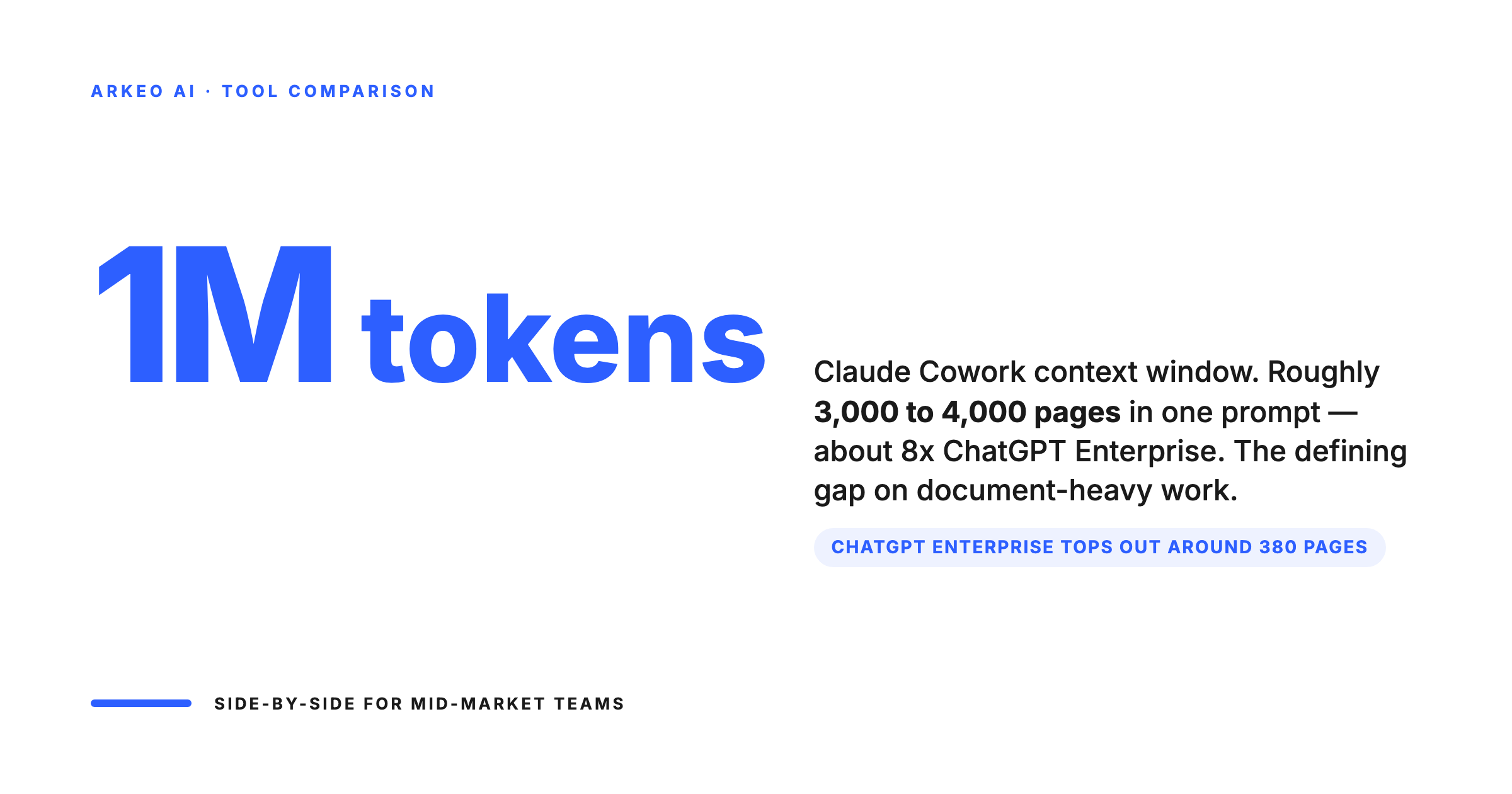
At their top tiers, both Claude Cowork and ChatGPT Enterprise offer context windows up to 1 million tokens. To put that in perspective, 1 million tokens is roughly equivalent to 3,000 to 4,000 pages of dense text. You can feed an entire codebase or a year's worth of financial reports into a single prompt.
How much you can hand the model in a single prompt
Token counts only matter when your work involves reading long documents. For RFP responses, contract review, and complex audits, the difference between 380 pages and 4,000 pages is the difference between summarising and actually answering.
Roughly 380 pages of plain text in one prompt. Long-document work has to be chunked and re-stitched.
Roughly 3,000 to 4,000 pages in one prompt. Full RFPs, whole contract libraries, multi-quarter financials in one shot.
Capacity is not the same as accuracy. Anthropic reports near-perfect retrieval on Claude's needle-in-haystack benchmarks, meaning Claude can reliably find a specific clause buried hundreds of pages deep in a long document. ChatGPT Enterprise's strength is different. It is built for modality switching across text, voice, and image, and for high-volume work across diverse tasks rather than flawless deep-document recall.
For firms heavily reliant on document-heavy analysis in legal, compliance, due diligence, or technical specifications, the retrieval gap often dictates the buying decision.
Pricing Breakdown (Early 2026 Tiers)
Budgeting for an AI workforce requires looking beyond the basic individual subscription. As of early 2026, both platforms offer competitive base pricing, but they scale differently based on compute requirements.
Claude Cowork starts at $20/month for Pro users. The Team tier runs $25 to $30 per seat. For heavy operational reliance, Anthropic offers maximum compute tiers ranging from $100/month (Max 5x) up to $200/month (Max 20x) for power users running complex parallel workflows.
ChatGPT Enterprise follows a similar baseline: Plus is $20/month, and Business tiers run $20 to $25 per seat. They also offer a Pro tier at $200/month for extreme usage, while full Enterprise deployment averages around $60 per seat (minimum 150 seats) with dedicated support and analytics.
Before locking into an annual enterprise contract, compute the real cost: total seats times monthly rate times your team's actual usage tier, plus the cost of switching if the platform turns out to be the wrong fit. Many companies overbuy at the maximum compute tier and pay for capacity they never touch.
The Hidden Risk: Data Sovereignty and Cloud AI
Here is the critical flaw in both solutions. They are cloud-hosted. Even with stringent enterprise privacy promises (including claims that they will not train models on your data), your company's intellectual property still leaves your secure network infrastructure to be processed on third-party servers.
Two architectures, two very different compliance postures
Both Claude Cowork and ChatGPT Enterprise are cloud-hosted by default. For HIPAA, GDPR, ITAR, or any regulated data, the real choice is between vendor cloud and a private deployment that keeps the data on your hardware.
Data leaves the network
Data stays inside the firewall
For highly regulated sectors like legal, healthcare, manufacturing, or defense, AI data security is non-negotiable. Sending proprietary code or client data to Anthropic or OpenAI creates compliance exposure under HIPAA, GDPR, ITAR, and most regulated-industry frameworks. Cloud BAAs and DPAs help, but they shift liability rather than eliminate the exposure.
This is where on-premise AI deployment becomes the path that holds up to audit. A Private AI Workforce runs entirely on your own infrastructure. Your data never leaves the building.
At Arkeo AI, we believe operators should not have to trade security for capability. We build secure, private agent systems that give you the power of modern LLMs without the cloud exposure risk.
Ready to Deploy AI Agents That You Control?
Arkeo builds private AI agent systems for mid-market companies and founders running regulated or sensitive workflows. Your data stays on your infrastructure. Start with a free 30-minute assessment to identify your highest-impact use case.
Book Your Free AI Assessment →