Category
AI Strategy vs AI Readiness: The Difference
Last updated: June 2026
By David Brennan · Arkeo AI · Building and Deploying Custom AI agents since 2023
If you are the CEO, COO, or technical leader of a 50-to-500 person company being told to "get serious about AI" this quarter, you are about to be pitched two very different consulting engagements that sound almost identical. One sells you an AI strategy. The other sells you an AI readiness assessment. Both promise a deck, both quote real money, and both will cost you a quarter if you buy the wrong one first. Pick wrong and you fund a polished roadmap that the underlying data and systems cannot support, or you audit yourself into a thick binder with no future direction attached. This guide gives you the precise, operator-grade definition of each term, the cluster boundary between them, and the order to run them in so the next dollar you spend on AI actually moves a workflow.
Arkeo deploys these systems for a living, including on its own operations, and the line between strategy and readiness is the most consequential distinction a mid-market leader makes before signing the first AI engagement. Get it backwards and the program produces motion without progress.
Quick Answer
• AI strategy: the future-state plan. Where AI fits in the business 12 to 36 months out, what gets built when, and the sequence of bets that compound. Roadmaps, timelines, capability targets.
• AI readiness: the current-state diagnostic. Whether your data, infrastructure, governance, and culture can actually support what the strategy proposes, and what to fix before deployment.
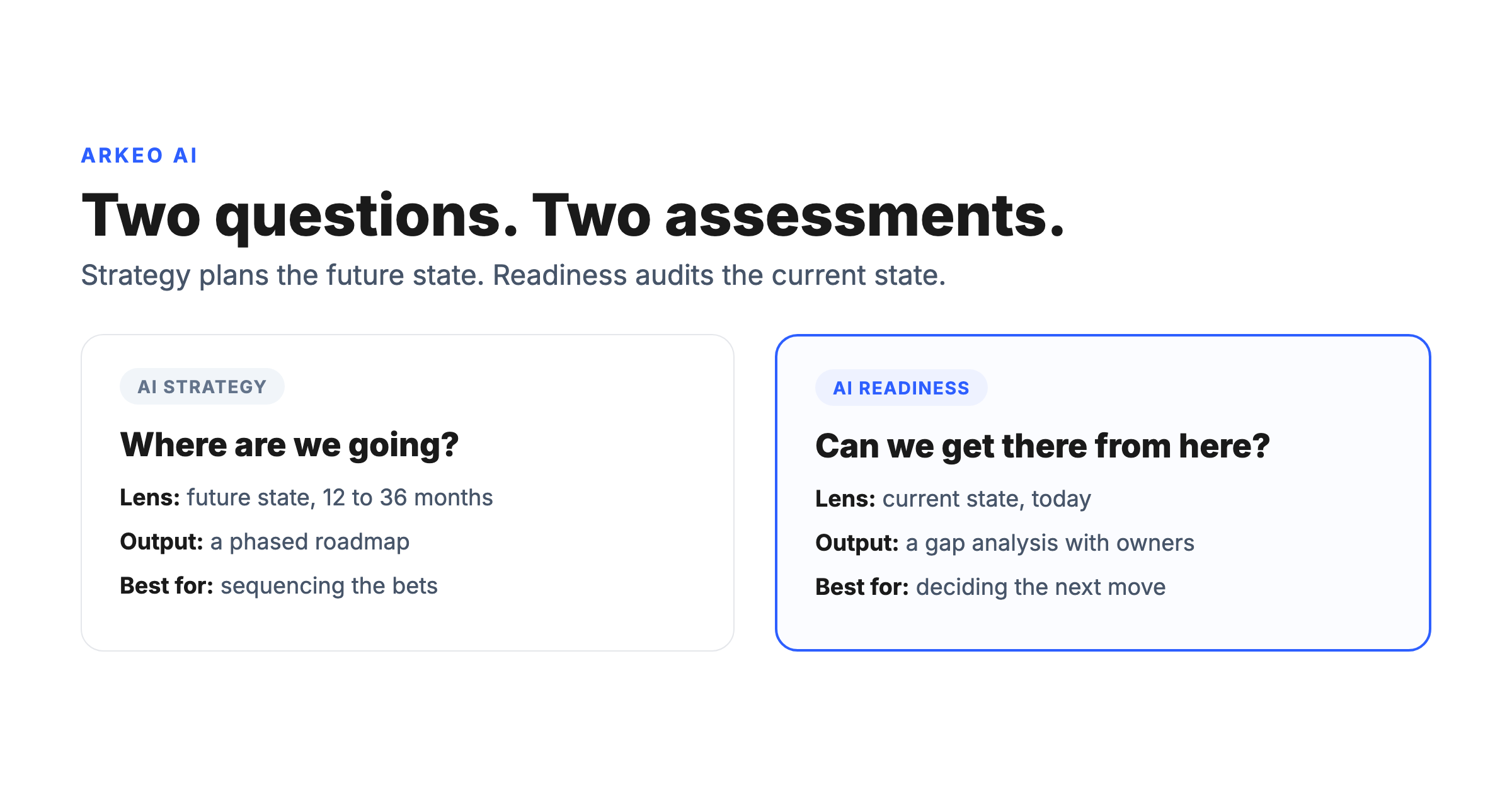
• The difference in one line: strategy answers "where are we going?" Readiness answers "can we get there from here?"
• Which first: for most mid-market operators, readiness, because it surfaces the gaps a strategy assumes away.
• Cost of getting it wrong: a roadmap that cannot ship, or a maturity report that never turns into a plan.
The short version, then the detail. A focused free AI Assessment from Arkeo runs both lenses in a single 60-minute working session and ends with a prioritized next move, not a slide. AI strategy is the future-state plan for where AI fits in the business and in what order; AI readiness is the present-state audit of whether the data, systems, and people can support that plan today. Strategy is forward-looking. Readiness is diagnostic. Treating them as the same exercise is why so many AI programs read well on paper and ship nothing.
What Is AI Strategy?
An AI strategy is the future-state plan that defines where AI will create value in the business, which workflows get automated in what order, and what capabilities the company has to build to support that path over the next 12 to 36 months. It is the document that turns "we need to do something with AI" into a defensible sequence of bets, with a thesis on why this order, this budget envelope, and these workflows.
A real enterprise AI strategy answers four questions. Where will AI move margin or capacity, and by how much. Which workflows get touched first, and which deliberately wait. What the build-versus-buy split looks like for off-the-shelf copilots, custom agents, and platform contracts. How the operating model evolves once the agents are in production. The output is a roadmap with phases, dependencies, and an honest read on the hardest call: what to not do this year.
Strategy lives in the future tense. Its job is to give the leadership team a shared picture of where the business is heading with AI and the sequence to get there. Done well, it shortens the conversation at every budget cycle for the next three years. Done poorly, it is a slide deck that assumes a level of data, infrastructure, and capability that the business does not actually have.
What Is AI Readiness?
AI readiness is the current-state diagnostic that measures whether a business can support AI deployment today, evaluated across four axes: data, systems, governance, and people. It is the assessment that decides whether the strategy's first move is shippable in the next 90 days, or whether the prerequisites have to be built first.
An ai readiness assessment goes narrow and deep on the things that decide whether AI projects survive contact with reality. Is the data clean, accessible, and governed, or is it locked in three systems that do not talk. Can the existing tech stack integrate an agent, or does the agent have to live in a sandbox forever. Are there acceptable-use policies, audit trails, and human-in-the-loop checkpoints, or is governance a blank page. Does any human own the workflow after launch, or will the agent become an orphan the first time something breaks.
Readiness lives in the present tense. The deliverable is not a roadmap. It is a gap analysis with owners attached: what is ready now, what has to be built before the first agent goes live, and what risks have to be contained. A readiness pass ends in a deployment decision for a specific workflow, not a vision for the program.
How Are AI Strategy and AI Readiness Different?
Here is the cluster boundary stated cleanly, because the market keeps blurring it. Strategy owns the future state: timelines, roadmaps, capability targets, sequencing, the 12-to-36-month picture. Readiness owns the current state: data audits, infrastructure checks, governance maturity, cultural fit, the right-now picture. They are different units of analysis, different time horizons, and different outputs.
01
Core question
Strategy: Where are we going with AI?
Readiness: Can we get there from here?
02
Time horizon
Strategy: 12 to 36 months forward.
Readiness: today and the next 90 days.
03
Output
Strategy: a phased roadmap with sequencing.
Readiness: a gap analysis with owners.
04
Unit of analysis
Strategy: the whole business and its capability arc.
Readiness: specific workflows, data, and systems.
05
Primary risk
Strategy: a roadmap that assumes a foundation that does not exist.
Readiness: a thorough audit with no future direction attached.
06
Decision it drives
Strategy: where to bet over the next 3 years.
Readiness: whether this workflow ships in the next quarter.
Read the first row twice. "Where are we going?" and "Can we get there from here?" are not the same sentence. The first is answered by a corporate AI strategy. The second is answered by an ai maturity model applied to your current operation. The most common failure mode in mid-market AI programs is buying one and assuming it does the other's job.
Plan the future state or audit the current state?
The leadership team needs a 12-to-36-month roadmap that sequences workflows, capabilities, and infrastructure bets. Output: a phased roadmap that names where to bet, what to build, and what to deliberately not do this year.
The next call is whether a specific workflow ships in 90 days. Output: a gap analysis with owners across data, systems, governance, and people that names what is ready now, what has to be built first, and who runs the workflow after launch.
Why Does the Order Matter So Much?
Most companies start with strategy. They hire a firm, get a 60-page slide deck, and then discover six weeks in that the data the strategy depends on lives in a system nobody has integrated, owned by a vendor whose API is on the deprecation list. The strategy was not wrong. It was unbuildable on the current foundation, and nobody checked.
The numbers around that failure pattern are blunt. A Deloitte survey of more than 2,700 senior leaders across 14 countries found that more than two-thirds of enterprises expect 30 percent or fewer of their generative AI experiments to be fully scaled within the next three to six months. BCG research published in October 2024 found that 74 percent of companies struggle to scale value from AI despite widespread adoption, and only 4 percent have built consistently leading AI capability. Almost none of those projects die because the model failed. They die because the underlying readiness was never honestly assessed, and the strategy assumed it.
That is the false belief at the heart of most mid-market AI programs. The assumption is that strategy comes first because it is the bigger, more important document. The reality is that strategy assumes a level of data quality, system integration, and governance maturity that the business has to actually have. If readiness is not assessed first, the strategy is a fiction. A 12-month roadmap built on data that takes six months to clean is a 24-month roadmap with the first 12 months hidden.
The operator test: Pick your top AI initiative. Write one sentence that describes the data it depends on and who governs it today. If that sentence takes more than a minute to draft, the strategy is built on an assumption the readiness pass has not tested yet.
The free AI Assessment audits your top workflows against the four readiness axes, then maps them onto a 30-to-90-day plan you can actually fund.
Book Your Free AI Assessment →The blunt truth a strategy consultant rarely puts in the proposal is this. A roadmap on top of unready data does not survive contact with operations. Want to talk about this against your specific situation? Book a free assessment, 30 minutes, working session, no deck. The conversation alone will tell you whether your top three workflows belong on a strategy slide or on the readiness backlog first.
What Does AI Readiness Actually Measure?
The strongest readiness assessments score the same four axes, and every one of them maps to a failure mode Arkeo sees recur in mid-market deployments. The US National Institute of Standards and Technology codified a sector-agnostic version in the NIST AI Risk Management Framework, organized around four core functions, Govern, Map, Measure, and Manage. The operator version reads like this.
Data readiness. Is the data the workflow depends on accessible, structured, current, and governed. If three systems hold pieces of the truth and the joins are broken, no agent can save you. IBM's 2025 research found that 97 percent of organizations that suffered an AI model or application breach lacked proper AI access controls, and shadow-AI usage added an average of $670,000 to breach cost. Readiness catches the access-control gap before the agent goes near the data, not after.
Systems readiness. Can the agent read from and write to the systems where decisions actually get made, your ERP, your CRM, your ticketing system. If it can only chat in a sidebar, it is a copilot, not an operational agent. Most projects get stuck here.
Governance readiness. Is there an acceptable-use policy, an approval workflow, and an audit log. Without these, you cannot put an agent into a regulated workflow, and you cannot defend the program at the board level when something inevitably misfires.
People readiness. Does someone own the workflow after launch, and has the team been trained to operate alongside the agent rather than around it. The IBM IBV CEO Study found that 31 percent of the workforce will require retraining or reskilling over the next three years, and that "lack of expertise and knowledge" is the top barrier CEOs cite to AI innovation. Readiness names the owner. Strategy assumes one exists.
The operator test: Name the operational owner for each of your top three candidate workflows right now. If any name is blank, or if the person named does not yet know they own it, the people-readiness axis is a gap that belongs on the remediation list before the agent goes live.
What Does AI Strategy Actually Decide?
Once readiness has been honestly assessed, strategy gets to do real work. A useful strategy makes four decisions and defends them. The sequence of workflow targets over 12 to 36 months, in order of expected value and feasibility. The build-versus-buy split for off-the-shelf copilots, custom agents, and platform contracts. The infrastructure path between public cloud, private cloud, and on-premise deployment for sensitive workloads. The operating model that runs the agent fleet once it exists, including who owns model updates, who handles incidents, and how the business measures whether the program is paying for itself.
The right strategy is shaped by what readiness exposed. If the data layer needs six months of cleanup, the first wave of the strategy is off-the-shelf copilots and pilot-grade agents while the foundation is built. If governance is mature and data is clean, the first wave can be production agents inside revenue-bearing workflows. Strategy without readiness picks the wrong wave. Readiness without strategy never picks one.
How Should a Mid-Market Operator Use Both?
The order that works for a 50-to-500 person, $10M-to-$200M business is consistent. Run a focused readiness pass first, narrowed to the top three candidate workflows the leadership team already suspects. Use that pass to surface the data, systems, governance, and people gaps. Then write the strategy with those gaps either fixed or sequenced into the early phases.
This is the order Arkeo runs in its free AI Assessment. The session maps the current state and your data, identifies the 30-to-90-day easy wins on off-the-shelf tools, names the top three custom-agent opportunities, and sketches the long-term architecture toward a private AI operating system. Arkeo, founded in 2023 with 25 years of operating-company experience behind it, has spent the last three years deploying these agents inside real businesses including its own operations. The model is Assess, Deploy, Manage: the assessment runs the readiness lens, the deployment phase builds the strategy's first wave, and the manage phase keeps the agents alive in production. Scoped single-workflow agents typically reach production in 6 to 10 weeks, or 8 to 12 weeks when the deployment is private and on-premise. None of that sequencing is possible if the readiness work has not been done.
None of this means strategy is optional or that readiness alone is enough. Both are required. Run readiness first so you know what is true. Write strategy second so you know where you are going. Then deploy.
A free AI Assessment runs the readiness lens across your operation and hands you the next move, so the strategy you fund is buildable on the foundation you actually have.
Book Your Free AI Assessment →