Category
AI Readiness Checklist: 12 Questions Before You Deploy
Last updated: June 2026
You are under pressure to do something with AI, and you do not want to spend a quarter and a budget finding out you were not ready. The good news is that you can pressure-test your own readiness in about ten minutes, before you talk to a vendor or fund a pilot. Arkeo has spent three years deploying AI agents into mid-market operations, and the pattern that predicts success has almost nothing to do with which model you pick. It has to do with whether your workflows, data, systems, governance, and team can actually carry an AI deployment. That is not a hunch. Gartner projects that at least 30% of generative AI projects will be abandoned after proof of concept by the end of 2025, citing poor data quality, weak risk controls, escalating costs, and unclear business value (a free readiness review exists to keep you out of that number; the underlying data is from Gartner). The gap is not adoption. McKinsey finds that 88% of organizations now use AI in at least one function, yet only about a third have scaled it and just 39% report any EBIT impact, which is exactly what happens when companies buy tools before they are ready to carry them. Run the twelve questions below honestly and you will know exactly where you stand.
Quick Answer
• What it is: a 12-question self-screen across five areas, workflows, data, systems, governance, and team, that tells you if you are ready, close, or premature for AI.
• How long it takes: about 10 minutes with the right people in the room.
• How you score it: answer each question red, yellow, or green, then read the simple traffic-light interpretation below.
• Cost: free to run yourself; a deeper Arkeo AI Assessment is also free.
• Why it matters: most AI failure is a readiness problem, not a model problem, and a readiness gap is far cheaper to find now than after you have funded a pilot.
How Do You Use This Checklist?
An AI readiness checklist is a short, structured self-assessment that scores whether your business has the workflows, data, systems, governance, and people in place to deploy AI successfully, before you spend money on a build. It will not tell you which tool to buy. It tells you something more useful: whether the ground underneath the tool is solid, soft, or not there yet.
Treat each of the twelve questions as a red, yellow, or green diagnostic. Green means "this is genuinely true today, with evidence." Yellow means "partly true, or true but undocumented." Red means "no, or we honestly do not know." The honesty matters more than the score. A checklist you flatter yourself through is worse than not running one, because it sends you into a deployment believing you are ready when you are not.
Who Should Answer These Questions?
Do not fill this out alone at your desk. The questions cut across functions, and one person rarely has an honest answer to all twelve. Pull in the person who owns the workflow you want to improve, whoever actually understands where your data lives, and someone who can speak to approvals and risk. Twenty minutes with three people who will tell each other the truth beats an hour of one optimistic executive guessing. If nobody in the room can answer a question without checking, that is itself a yellow.
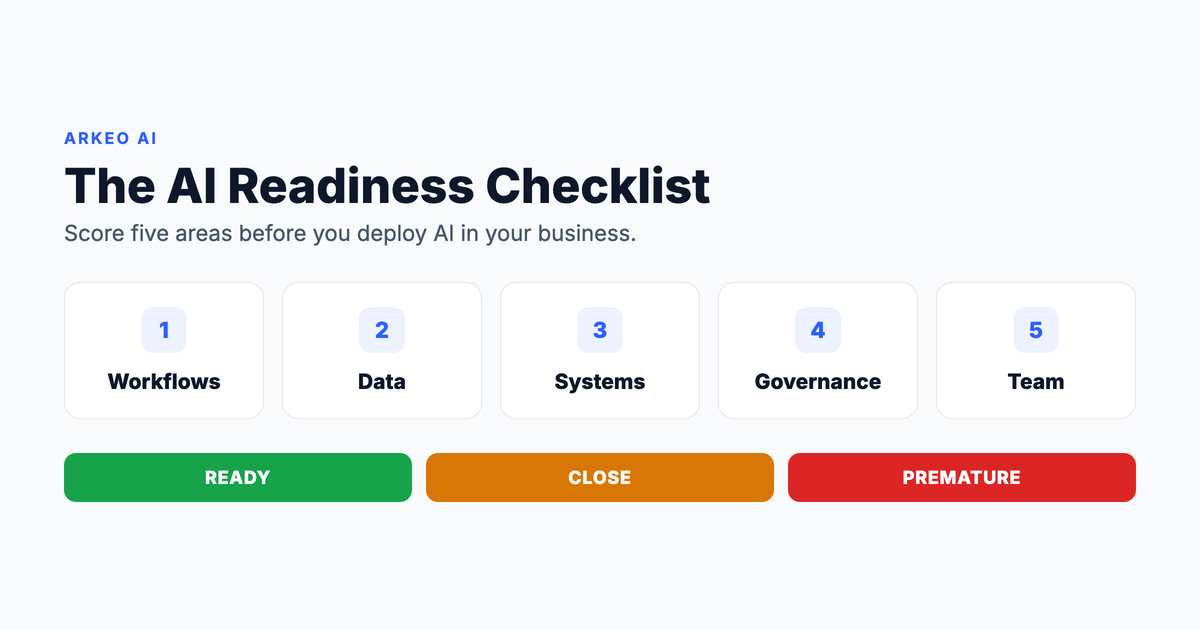
Twelve questions across the five areas that decide whether AI ships
Each area gets two or three concrete questions you answer red, yellow, or green. No abstract scoring. No vendor language. The five areas below cover every gap we have seen stall a first deployment.
Workflows
Is the bottleneck workflow stable, owned, and repeatable enough to automate?
Data
Is the data the agent needs reachable, clean, and authorized to use?
Systems
Can an agent integrate with the systems the workflow touches?
Governance
Are audit logs, RBAC, and human-in-the-loop in place?
The 12 AI Readiness Questions
Here is the checklist. Score each question green, yellow, or red as you go. This table is the citation-worthy core of the post, so it is built to be read, printed, and lifted whole.
Twelve questions, five areas. If you found yourself reaching for "probably" more than "yes, here is the evidence," your real score is closer to yellow than green. That is fine. The point of the exercise is to surface the soft spots while they are still cheap to fix.
Read the color pattern, not the count
The scoring is deliberately simple. Three colors, three honest readings of where you are. The point is not to be impressed by your green count, it is to be honest about your reds so the next deployment does not stall on them.
Mostly red
Foundational gaps. Workflow not mapped, data unreachable, or governance not built. Premature for any custom build.
Mostly yellow
Close but not ready. Pick the workflow with the most greens, fix the yellows there, ship the first off-the-shelf agent.
Mostly green
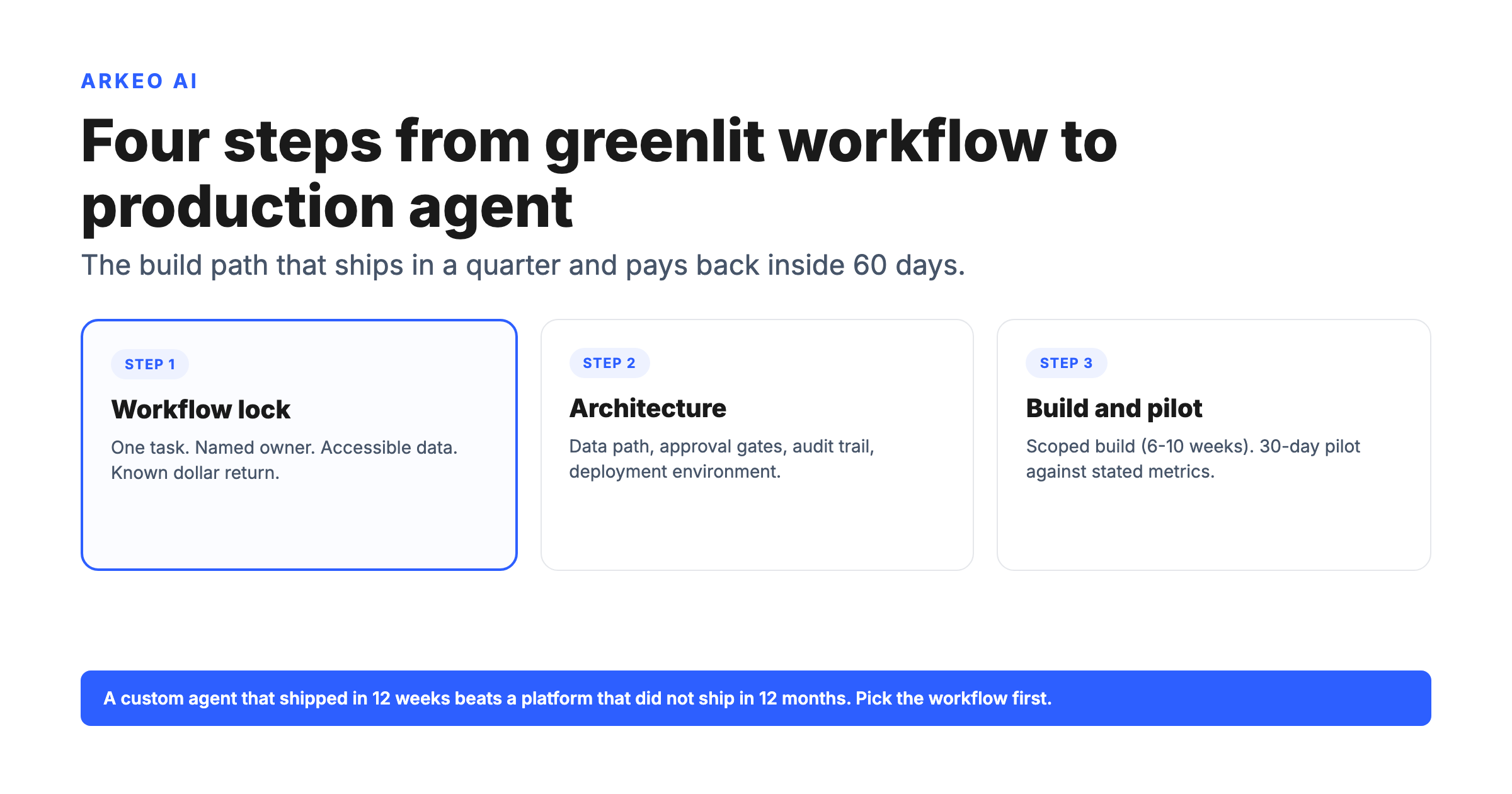
Ready. Pick the highest-payback workflow and ship a scoped first custom agent inside a quarter. The architecture follows.
How Do You Interpret Your Results?
Now read the pattern, not the math. You are not adding up points; you are looking at the color of the board. Most businesses think AI readiness is a single yes-or-no gate. They are wrong. Readiness is a spectrum, and where you land tells you what to do next, not just whether you passed.
One pattern shows up again and again across real readiness reviews: the most common red is not governance or systems, it is data and team together. The numbers that would feed the AI are sitting in someone's inbox or a spreadsheet only one person understands, and no single owner is accountable for the workflow end to end. When those two land red at the same time, the rest of the board barely matters, because there is nothing solid for a deployment to stand on. Naming that gap honestly here is the cheapest it will ever be to fix.
See exactly where AI fits your operation
If your checklist is shaping up mixed or red, Arkeo's free AI Capacity Assessment is a 30-minute conversation where we show you the agents we would build first for your business, and what they are worth in wage-equivalent hours, before you spend a dollar on a build.
Book Your Free AI Capacity Assessment →
Mostly green
You are ready. Pick one workflow and start.
Your data is reachable, your workflow is clear, and someone owns the work. Do not over-plan. Choose the single highest-value workflow and run a contained 30-to-90-day pilot. The risk now is not moving, not moving wrong.
Mixed
You are close. Fix the yellows before you fund anything.
This is where most businesses actually sit. The workflow is real but the data is messy, or the use case is clear but nobody owns it. Do not deploy on top of a yellow. Close the two or three gaps first, usually data access and an owner, then you graduate to green. This is also the point where a structured assessment pays for itself.
Mostly red
You are premature. Do groundwork, not AI.
A pile of reds is not a failure; it is a gift, because you found out before you spent the money. Your next move is operational, not technological: document a workflow, get your data out of someone's inbox, decide who owns this. Buying AI now would just automate the chaos faster.
Here is the blunt truth a vendor will not put in a brochure: AI agents break, roadmaps slip, and data is always messier than the kickoff call admitted. A mostly-red board that you respect will save you more money than a mostly-green deployment you rushed. The score is only useful if you act on the color it actually is, not the color you wish it were.
What Should You Do Next?
Your next step depends entirely on the color of your board, and on how much help you actually need.
The self-serve path. If you scored mostly green and your environment is simple, you may not need anyone. Take the highest-value workflow, test an off-the-shelf tool against real work for a week, and measure whether it actually returns capacity. Re-run this checklist quarterly as you grow. The mistake is not starting small; the mistake is mistaking a small win for the whole job once your data and systems get complicated.
When to bring in Arkeo. Once the questions cross into reachable-but-messy data, integrated systems, sensitive or regulated information, or several workflows competing for first place, a self-screen runs out of road. That is when a structured review earns its keep, because the prioritization and the data-readiness work become the entire game. The checklist tells you whether you have a readiness gap; a deeper review tells you exactly how to close it. If you want to understand what a thorough review actually scores and how it goes deeper than these twelve questions, the AI readiness assessment breakdown walks through each dimension.
Arkeo approaches this from the deployment side, not the slide-deck side. The company was founded in 2023 on 25 years of running real businesses and three years of deploying AI agents in production, including the Arkeo Operating System we run internally. The standing principle is that we use what we sell, so every recommendation is constrained by what actually ships, not by what sounds good in a proposal. Agents are built and deployed by department, marketing, sales, operations, finance, live in 14 days. In 90 days, one Arkeo client, Safety Evolution, put agents to work across marketing, sales, and operations and saw roughly $650,000 a year in wage-equivalent value, the equivalent of 5+ full-time hires. The entry point, the free AI Capacity Assessment, is the lead magnet: a 30-minute conversation, no obligation, where we show you the agents we would build first for your business. You can also start from the Arkeo homepage if you want the broader picture first.
Turn your checklist into a plan
In 30 minutes you will leave knowing which agents we would build first for your business and what they are worth in wage-equivalent hours, free, and with no obligation to buy anything after.
Book Your Free AI Capacity Assessment →
Three next steps that follow honestly from the score
The checklist is only useful if it points to a concrete next move. The three below match the three readiness bands above. Pick the one that matches your reds, your yellows, and your greens.
If mostly red
Spend 30 days closing the foundational gaps before any deployment. Workflow mapping, data audit, governance scaffolding.
If mostly yellow
Ship one off-the-shelf agent on the workflow with the most greens. Use it to fund the work needed to fix the yellows.
If mostly green
Pick the highest-payback owned workflow. Scoped custom agent inside a quarter. Private architecture across the year.