Category
AI Readiness Assessment: The 5-Area Scorecard Before You Build
Last updated: July 2026
By David Brennan · Arkeo AI · Building and Deploying Custom AI Agents since 2023
Most operators who land here have already tried something. A ChatGPT pilot. A Copilot rollout. An automation someone on the team built over a weekend. The results were fine. Nothing broke. But six months later, nothing changed either.
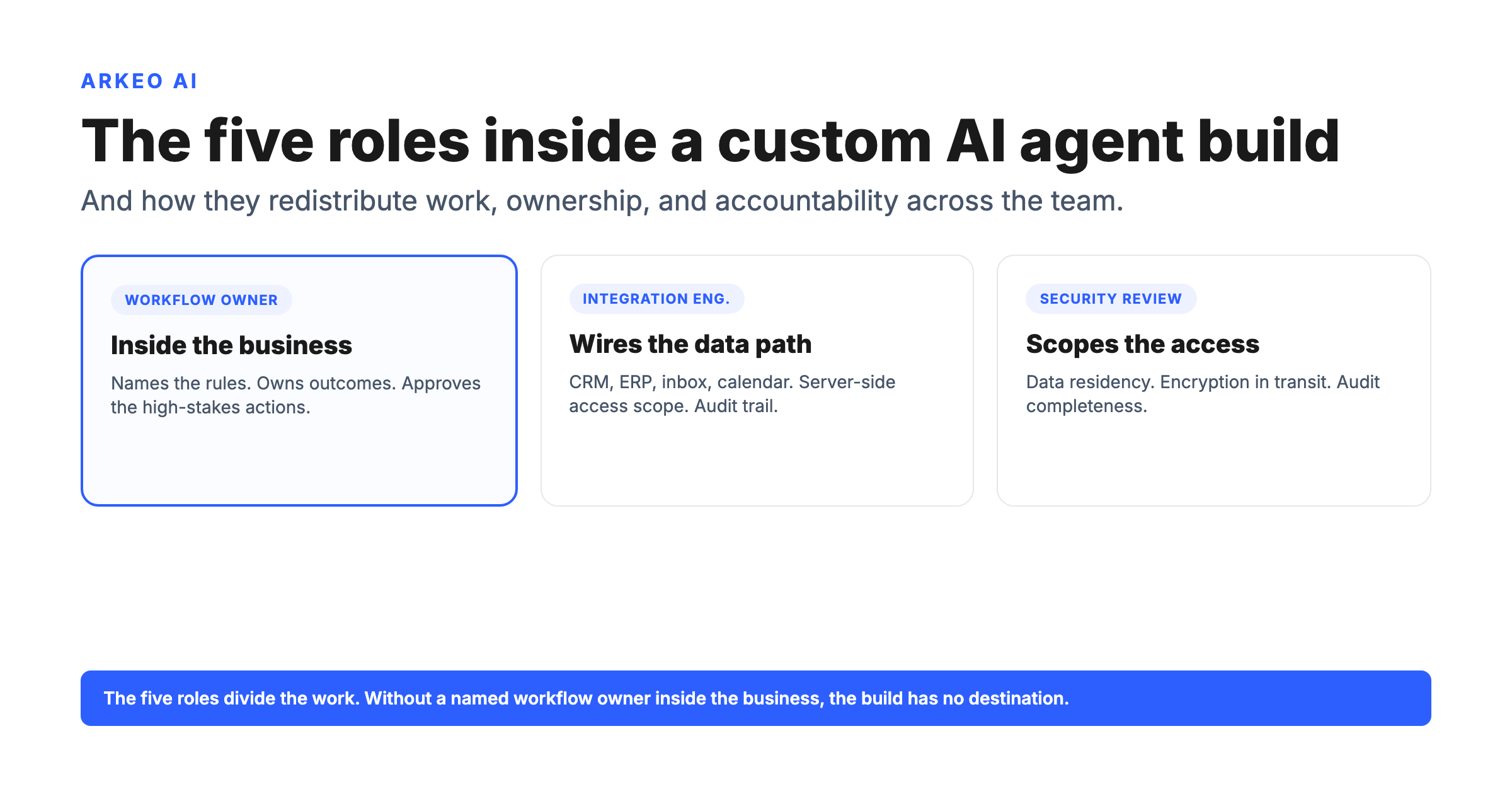
The problem is almost never the technology. It is that nobody checked whether the business was actually ready to deploy before the build started. The workflow was not documented. Nobody decided where the data could and could not go. The person supposed to own it in production had three other jobs.
An AI readiness assessment answers those questions before they become expensive surprises. Here is how to run one, and how to score where you stand right now.
Quick Answer
What it is: An AI readiness assessment measures five things before you spend money on a build: your data, your workflows, who controls what AI does with company information, whether AI can connect to your systems, and who owns the agent when it goes live. A real assessment takes a day to run. It saves months of wasted engineering.
What it is not: A vendor quiz that tells you you are ready before trying to sell you a subscription. Any assessment that skips the data question and the ownership question is a marketing exercise.
The most common finding: The workflow exists. The data exists. The gap is that neither is documented, and nobody has been named to own the agent in production. Both are fixable in weeks.
Next step: Once you have your score, the free AI Capacity Assessment shows you the agents we would build first for your business, and what they would be worth in hours and dollars given back to your team.
Run this scorecard first. Then bring your score to a free, 30-minute AI Capacity Assessment. We will show you the agents we would build first for your business, and what they are worth in wage-equivalent hours. No vendor pitch.
Book Your Free AI Capacity Assessment →What AI readiness actually means
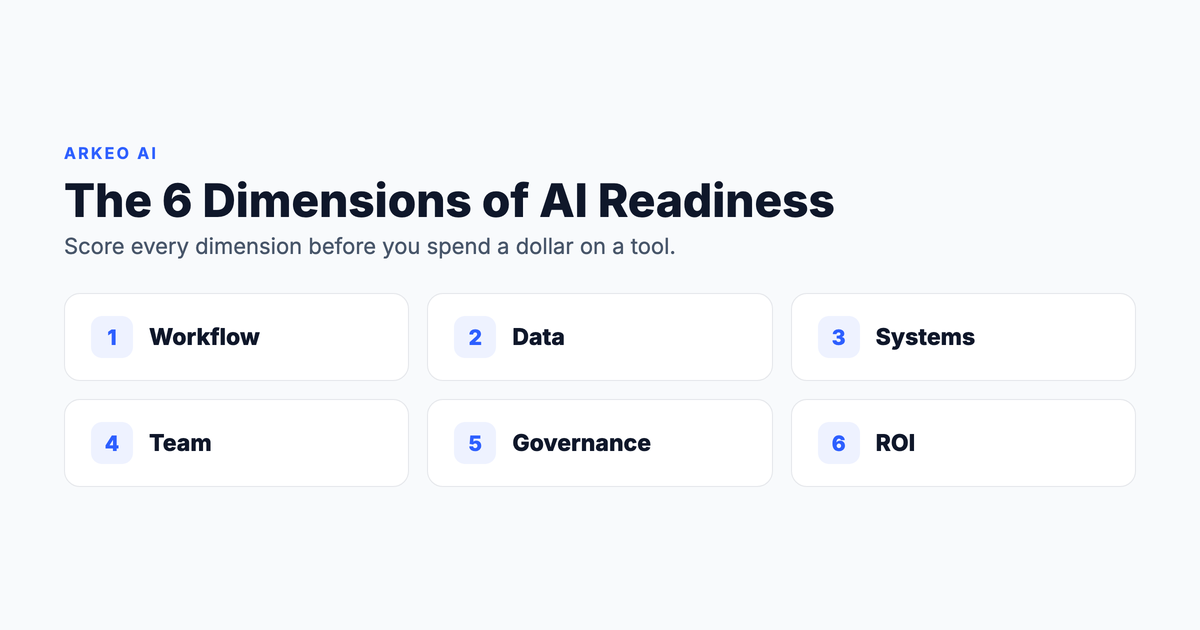
AI readiness is not about whether your team is excited about AI. It is not about whether you have budget. It is not even about whether you have data; almost every company at 50 employees or more has enough data to run agents. The question is whether five operational conditions are in place to deploy something that works and stays working.
Readiness is a systems question, not an attitude question. A company with a skeptical leadership team and clean, documented workflows is more ready to build than a company with an enthusiastic board and four years of unstructured spreadsheets. Enthusiasm does not run agents. Documented inputs and named owners do.
It is also worth being clear on what a readiness assessment is not the same as. An AI strategy tells you what you are going to build and in what order. A readiness assessment tells you what conditions need to be true before that strategy can succeed. Do the assessment first. Build the strategy from what it finds.
The operator test: Can you name the one workflow you would automate first, the person who would own it in production, and where the data lives? If any of those three is a committee or a placeholder, you are not ready to build yet. You are ready to assess.
What Arkeo finds in almost every assessment
Before the scorecard, it is worth knowing what the common patterns actually look like. These come up regardless of industry, and none of them are rare.
The founder is the bottleneck. This is the single most common pattern in any assessment involving a founder-led business. Sales, client communication, and every fire route through one person, because their personal touch is what wins deals or keeps clients. That same person is also the ceiling on growth. The fix is rarely to remove the founder from the relationship; it is to name the one workflow around them, follow-up emails, meeting recaps, CRM notes, that is pure administrative drag, and hand that piece to an agent while the founder keeps the parts that actually require them.
Employees are already using AI with company data and nobody knows. In almost every assessment Arkeo runs, some portion of the team is already using a personal AI account with company information: client records, financial data, sometimes regulated data. Leadership usually knows about a handful of approved accounts and has no visibility into the rest. This is not a willingness problem, it is a governance gap, and it is one of the cheapest gaps on this list to close.
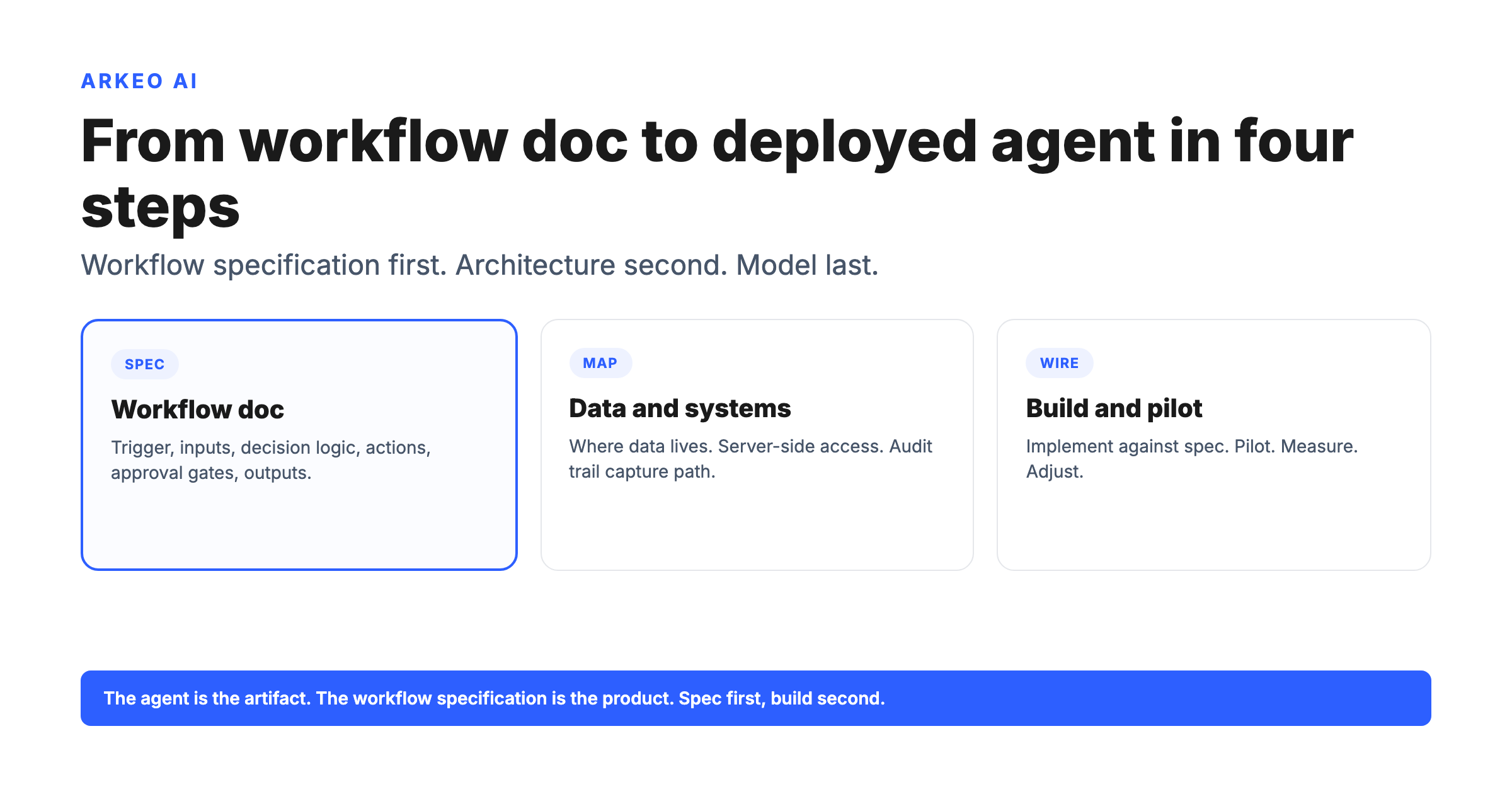
The workflow exists but nobody wrote it down. This is the most common finding across every sector. The workflow is real, consistent, and repeatable. The team runs it the same way every time. But it lives in someone's head because it always has. A two-hour working session with the person who runs the workflow produces a documented process an agent can follow. The build can start the following week.
The data question gets discovered mid-build. A clear candidate workflow gets chosen, the build looks straightforward, and then partway through, someone discovers that a piece of the data has a contractual or regulatory restriction on third-party cloud processing. The assessment would have caught that in twenty minutes. Finding it mid-build costs weeks.
The One Result Worth Knowing
In 90 days, one Arkeo client, Safety Evolution, put agents to work across marketing, sales, and operations. The agents replaced a $5,000-a-month SEO agency and doubled organic traffic; cut sales rep admin from 60% of the workweek to 10%, with lead response under five minutes; and ran daily briefs and triaged over 2,000 customer emails, avoiding an Operations Coordinator hire entirely. Total wage-equivalent value: roughly $650,000 a year, the equivalent of 5+ full-time hires, without adding headcount. That is what "ready" gets you. This scorecard is how you find out if you are.
The five-area scorecard
Score each area 1, 2, or 3. Add them up at the end. The total tells you your next move.
1. Do you have the data?
Agents read data and act on it. If the data your target workflow depends on is scattered across disconnected spreadsheets, locked in a system nobody controls, or simply does not exist in a structured form, the agent has nothing to work with.
You do not need a data warehouse or a specialist team. You need access to the right data, in a form a system can read, with permission to use it.
Score 1: This will stop your build. Data lives in systems you do not control, cannot be read by external tools, or does not exist in structured form.
Score 2: This will slow your build. Data exists and is accessible, but requires manual extraction or cleanup before an agent can use it reliably.
Score 3: Clear. Data is in a system you can connect to, it is reasonably clean, and you have permission to use it in an automated context.
The operator test: If someone asked you to pull last month's data for the target workflow right now: how long would it take, and would a person need to clean it first?
2. Is the workflow actually written down?
Agents automate workflows. If the workflow is not documented, if it varies by who runs it, or lives entirely in someone's head, the agent will automate the inconsistency, not the result you want.
The most common finding here is that the workflow does exist and is repeatable. It just has never been written down. That is not a failure. That is a two-week fix.
Score 1: This will stop your build. The workflow is ad hoc. Different people run it differently. There is no consistent input and no agreed output.
Score 2: This will slow your build. The workflow is consistent in practice but not on paper. The right person could map it in a working session. It has not been done yet.
Score 3: Clear. The workflow is documented with a clear input, a clear output, and it runs the same way regardless of who does it.
The operator test: Could you hand the description of this workflow to a new employee today and have them run it correctly? If not, an agent cannot run it either.
3. Do you know what your team is already doing with AI?
This is the area most operators underestimate. It covers two things: who is allowed to approve AI actions in your environment, and which company information can and cannot go to an outside service.
The question is more urgent than it sounds. In almost every assessment Arkeo runs, employees are already using personal AI tools with company data. Client records, financial information, contracts, patient data. It is happening right now, without approval, without any record of what was shared. That is a liability, not a preference. The fix is not to block AI use. It is to build a controlled system so the same work gets done safely.
Score 1: This will stop your build. No policy exists. Employees use whatever AI tools they want with whatever data they have access to. Nobody knows what is going to outside services.
Score 2: This will slow your build. A policy exists on paper but is not enforced, or covers some teams but not others. The question of which data can go to a public AI service has not been formally decided.
Score 3: Clear. You have a written policy covering AI tool use and data classification. You know which workflows are safe for public AI services and which need to stay on private infrastructure. Someone owns enforcement.
The operator test: Right now, without asking anyone: do you know which employees are using public AI tools with client or operational data? If the honest answer is no, this needs to be addressed before or alongside the first build.
4. Can AI actually connect to the systems that run your business?
This comes down to two questions. First: can an agent connect to your CRM, your project management tool, your shared inbox, your ERP? Most modern business software can be connected to. Getting the permissions and security review sorted takes time, but the path is usually clear.
Second: does your data need to stay on your own infrastructure, or is it safe to process through a third-party AI service? This is where builds get derailed mid-sprint. A business handling regulated or contractually restricted data, safety records, financial data, patient information, may not be able to send that data to a public AI service. Finding this out six weeks into a build costs months. Finding it in the assessment costs an afternoon.
Score 1: This will stop your build. Your key systems cannot be connected to, or you have identified a data restriction but have no path to private deployment.
Score 2: This will slow your build. Connectivity exists but has not been tested for the target workflow. Or the data question has not been formally decided; someone suspects it needs to stay private but nobody has confirmed it in writing.
Score 3: Clear. Your target systems can be connected to, you have confirmed who has permission to do so, and the data residency question is decided and written down.
The operator test: Is the data your first agent will process safe to send to a third-party AI service? Has that been confirmed in writing, or is it still someone's assumption?
5. Is there a named person who owns this when it goes wrong?
The most common reason agents fail in production is not technical. It is that no named person owns what happens when the agent drifts, produces an unexpected output, or breaks. Deploy-and-walk-away does not work. Agents need someone watching them, someone accountable when they misbehave, and someone with the authority to pause them if something goes wrong.
This does not require a specialist team. It requires one named person with a few hours a week and the authority to act. Most companies have that person. They just have not assigned the role.
Score 1: This will stop your build. Nobody has been named to own the agent in production. Leadership wants AI but has not assigned accountability for what happens after it ships.
Score 2: This will slow your build. The right person exists and has been informally identified but the role is not formally assigned and the accountability is not in writing.
Score 3: Clear. A named person with a specific role owns the agent in production, has the authority to pause or escalate, and knows it.
The operator test: If the first agent went live tomorrow and produced a wrong output that reached a customer, who would find it, who would fix it, and who would be accountable? If any of those is a committee or unclear, you have a gap here.
What your score means
AI READINESS SCORECARD
Score each of the five areas 1, 2, or 3. Add them up.
5 to 8: Stop before you build. At least one area has a gap that will break the build before it reaches production. Money spent on engineering before fixing it is wasted. Most of what is blocking you is fixable in 4 to 8 weeks; fix it first, then build.
9 to 11: Ready to start, not ready to ship. You have enough in place to begin, but the partial gaps will create problems in production if you ignore them. Start the documentation and data decision work in parallel with the build, not after it.
12 to 15: Ready to build. The conditions are in place. The question is which agent to build first, not whether to build.
What to do based on your score
If you scored 5 to 8: Do not book the assessment yet, and do not start the build. Use the next 4 to 8 weeks to close the gaps. The two highest-leverage fixes are almost always workflow documentation (area 2) and the data residency decision (area 4). Both can be done without any engineering involvement. Once those move to a 3, reassess. Book the assessment when you are at 9 or above.
If you scored 9 to 11: You are ready to start. The free AI Capacity Assessment is the right next move. It shows you the agents we would build first for your business, and what they would be worth in hours and dollars given back to your team. Close the remaining partial gaps in parallel with the build, not after it.
If you scored 12 to 15: The conditions are fully in place. The free AI Capacity Assessment takes you straight to which agent to build first and what it is worth. Book it this week.
One Arkeo client's agents delivered roughly $650,000 a year in wage-equivalent work, the equivalent of 5+ full-time hires, in 90 days. The free AI Capacity Assessment finds your number. 30 minutes. You leave with a plan, not a slide deck.
Book Your Free AI Capacity Assessment →Notes by industry
The five areas apply across all industries, but the gaps that show up most often shift by sector.
Construction. Workflow documentation and system connectivity are the most common gaps. Project data is often split across entities, estimates live in disconnected spreadsheets, and multi-company structures complicate the data question. The upside: construction work is highly repetitive and document-heavy, exactly the conditions where agents deliver the fastest return once the foundation is in place.
Oil and Gas. The data question and AI oversight policy are the consistent blockers. Contractor safety records, operational data, and regulatory reporting often carry restrictions that rule out third-party AI services entirely. On-premise deployment is frequently a contractual and regulatory requirement in this sector, not a preference. The assessment has to start with the data question, not end with it.
Manufacturing. Data access is the most common gap, not because the data does not exist, but because it lives in production and operations systems that were not built for external connections. Getting clean reads out of these systems requires more integration work than a typical CRM. The readiness conversation in manufacturing is largely a data access conversation.
Professional Services. The AI oversight and data question is where the conversation starts. Client confidentiality obligations, engagement-specific data restrictions, and the personal nature of the work mean those decisions have to be made before any workflow is selected. The upside: once that is in place, professional services workflows, client prep, document review, reporting, are among the highest-return candidates in any sector.