Category
The Cost of Ignoring an AI Readiness Audit
Last updated: June 2026
If you run a $10M to $200M company and your team is pushing to build an AI agent before anyone has audited the data, the systems, or the workflows it will touch, the cost of skipping the audit is going to surface twelve months from now as a written-off pilot, an extra line on a breach report, and a board conversation about why next year's AI budget should be smaller, not bigger. The temptation to skip is rational: an audit looks like a delay, a vendor demo looks like progress, and the team that wants the agent is already drafting the requirements doc. In this guide, you will get the concrete cost columns of skipping the AI readiness audit, the specific failure modes behind each one, the sourced numbers behind shadow AI breach exposure, and the decision rule for when an audit pays back inside the first quarter, so you can answer the team pushing to build with a number, not an opinion.
Arkeo has been operating a business for 25 years and deploying AI agents on its own operations and on mid-market client engagements for three years. The failure mode that repeats across those engagements is not model quality and it is not vendor choice. It is the audit that did not happen. Deloitte's State of Generative AI Wave 4 survey of 2,773 C-suite and director-level leaders across 14 countries found that more than two-thirds of enterprise respondents expect 30% or fewer of their GenAI experiments to be fully scaled within the next three to six months. That two-thirds figure is the audit gap measured at scale. The companies in that two-thirds are not failing because the technology stopped working. They are failing because the audit was skipped, and the gaps the audit would have surfaced surfaced as a stalled production cutover instead.
Quick Answer
• What it is: An AI readiness audit is a structured diagnosis of data, infrastructure, workflows, and culture against the operating requirements of a specific AI workload before any agent is built.
• Cost of skipping it: Stalled pilots that absorb 6-figure spend without shipping, an extra $670,000 in breach exposure per IBM's 2025 data, and budget cuts on next year's AI line after one bad quarter.
• Cost of running it: A free AI Assessment from Arkeo on one workflow; mid-market audit fees commonly land between $15K and $50K for a single-workflow scope when run by an outside firm.
• Why it matters: The companies that audit first reach production in 6 to 10 weeks and avoid the seven-figure write-offs that scare boards off AI for a year.
• Next step: Book a free AI Assessment. Arkeo will audit one of your workflows to see if you are ready for custom agents.

What does skipping the AI readiness audit actually cost?
The cost of ignoring an AI readiness audit is the sum of a stalled pilot's sunk cost, the elevated breach exposure from ungoverned AI usage that the audit would have caught, the cost of the rework cycle when the agent has to be rebuilt against integration the team did not map, and the cost of the budget cut that follows the first bad quarter. Each column is concrete, and each one shows up before the agent ever earns a dollar of return.
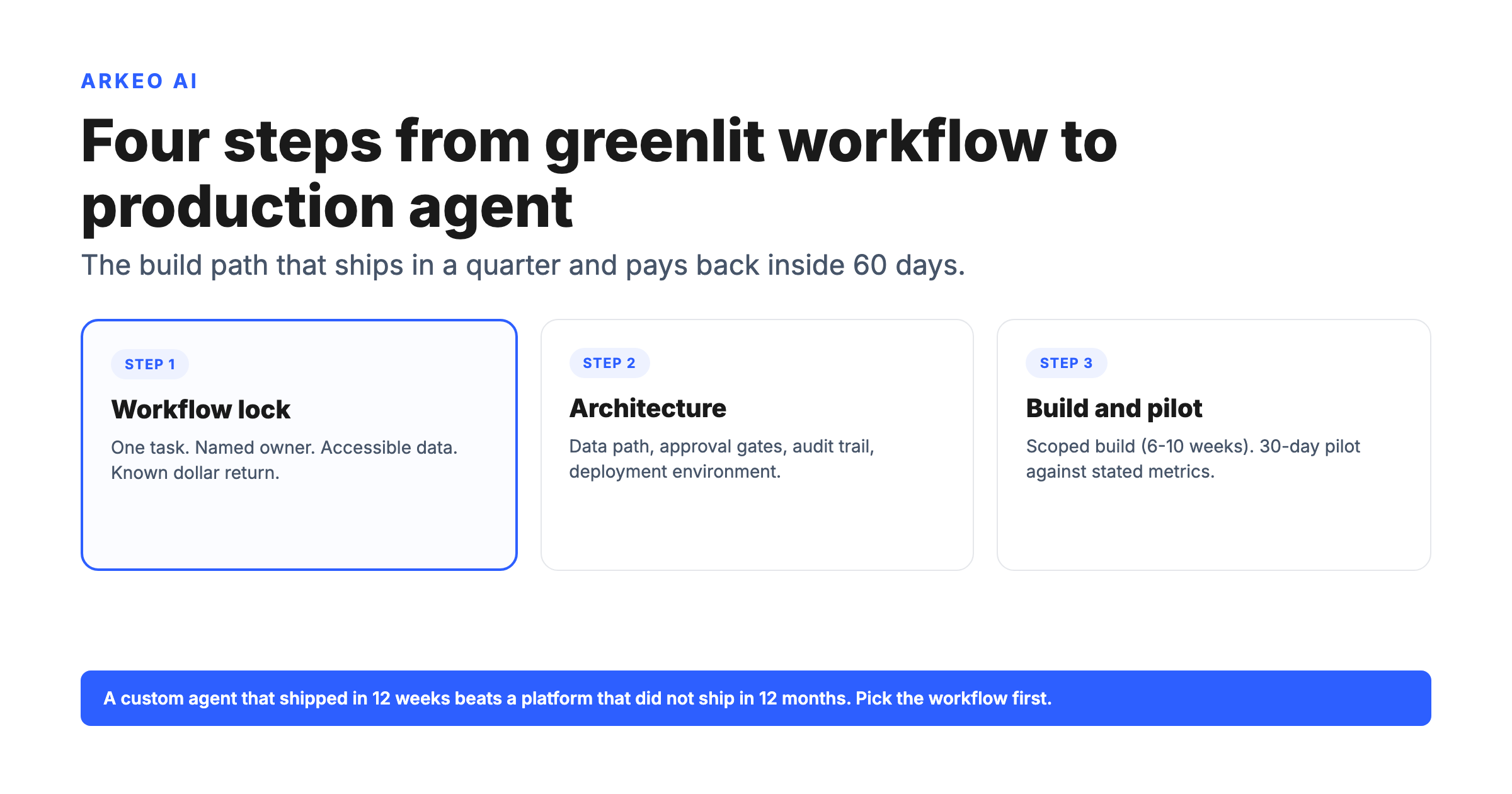
Start with the pilot cost. A mid-market AI pilot typically lands in the $40K to $120K range for the first attempt, counting vendor fees, internal time, and integration scoping. When the pilot stalls at the integration layer because the data the agent needs lives in three systems no one had mapped, that money is not recovered. The vendor is paid, the contract has run its term, and the agent does not ship. Arkeo's own build experience puts a scoped single-workflow agent at roughly $15K to $40K and 6 to 10 weeks to production, 8 to 12 weeks when the deployment is private or on-premise. Those ranges assume the audit has been done. Skip the audit and the same scope routinely doubles in time and cost because the work the audit was supposed to surface gets discovered in the middle of the build.
What is the shadow AI breach premium?
Then add the breach exposure. The IBM Cost of a Data Breach 2025 report puts the global average breach at $4.44 million and the US average at an all-time high of $10.22 million. Organizations with high shadow-AI usage pay $670,000 more per breach. 97% of organizations that suffered a breach of an AI model or application lacked proper AI access controls, and 13% of breached organizations reported a breach of an AI model or application directly. Read those four numbers together: shadow AI is not a hypothetical policy concern. It is a measured cost premium, and the readiness audit is where the inventory that catches it gets built.
added to the average data breach cost when shadow AI usage is high.
Source: IBM Cost of a Data Breach 2025
Most mid-market operators believe their data is locked down because the firewall is. The shadow-AI premium says it is not. The data is leaving the building one prompt at a time through personal ChatGPT accounts, browser extensions, and unsanctioned coding copilots, and the audit is the only mechanism that turns that into a list a CISO can act on. Stanford HAI's 2025 AI Index reports 78% of organizations used AI in 2024, up from 55% in 2023, the largest year-over-year jump in the Index's history. The shadow part of that 78% is what the audit measures.
What are the cost columns of skipping the audit?
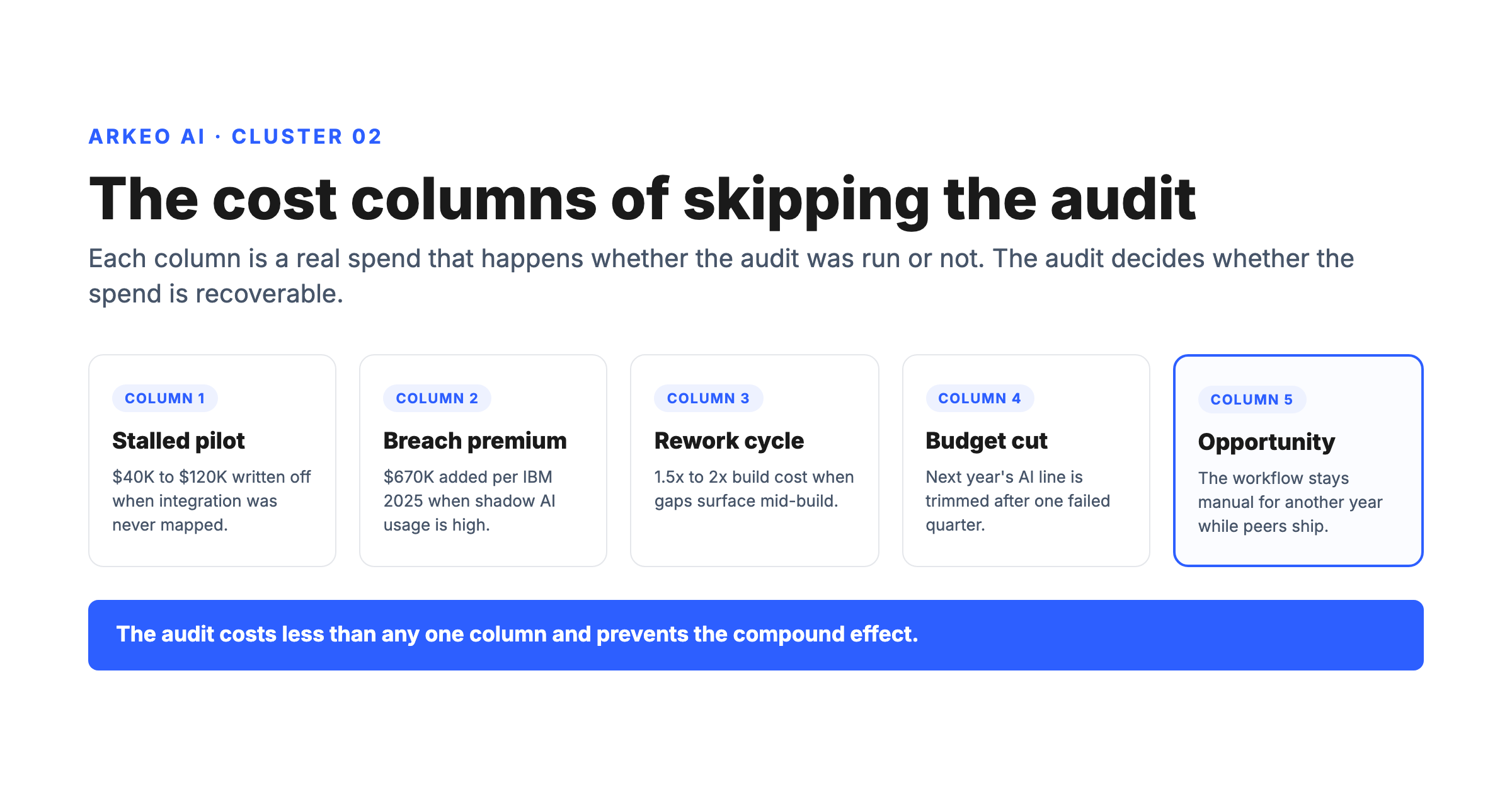
A useful way to brief a CFO is to set the costs out as columns. Each column is a real spend that happens regardless of whether the audit was done. The difference is whether the spend is recoverable.
COST COLUMNS
Five columns of skipping the audit
Each one is a real spend that lands whether the audit was run or not. The audit decides whether the spend is recoverable.
COST COLUMN 01
Stalled pilot spend
$40K to $120K written off when a pilot dies at the integration layer because the data sources, APIs, and approval routes were never mapped before the contract was signed.
COST COLUMN 02
Shadow AI breach premium
$670,000 added to the average breach cost per IBM 2025 when shadow AI usage is high. The audit is what turns the shadow inventory into an access-control list.
COST COLUMN 03
Rework cycle
A build cycle that doubles in time and cost when integrations, data quality, and approvals get discovered mid-build instead of mid-audit. Operator estimate: 1.5x to 2x the scoped budget.
COST COLUMN 04
Budget cut
Next year's AI budget is trimmed after a single failed pilot. The team that wanted the agent loses the trust of the board. Reset takes two to three quarters.
COST COLUMN 05
Opportunity cost
The workflow that would have been ready for an agent stays manual for another year. Industry adoption pulls ahead. The PwC 79% adoption figure is the trailing indicator of the gap that grew during that lost year.
The audit costs less than any one column and prevents the compound effect.
The columns compound. A stalled pilot does not just absorb its own dollars. It tightens the budget for the next agent that would have shipped, and it gives the security team a reason to lock down AI usage in a way that pushes more activity into the shadows, which raises the breach premium. The audit costs less than any one of these columns and prevents the compound effect.
See if your operation is ready for custom agentsArkeo's free AI Assessment audits one of your workflows end-to-end, scores it against the six readiness dimensions, and tells you whether to build, fix first, or hold. No pitch deck.
Book Your Free AI Assessment →
What is an AI audit, and what does it actually catch?
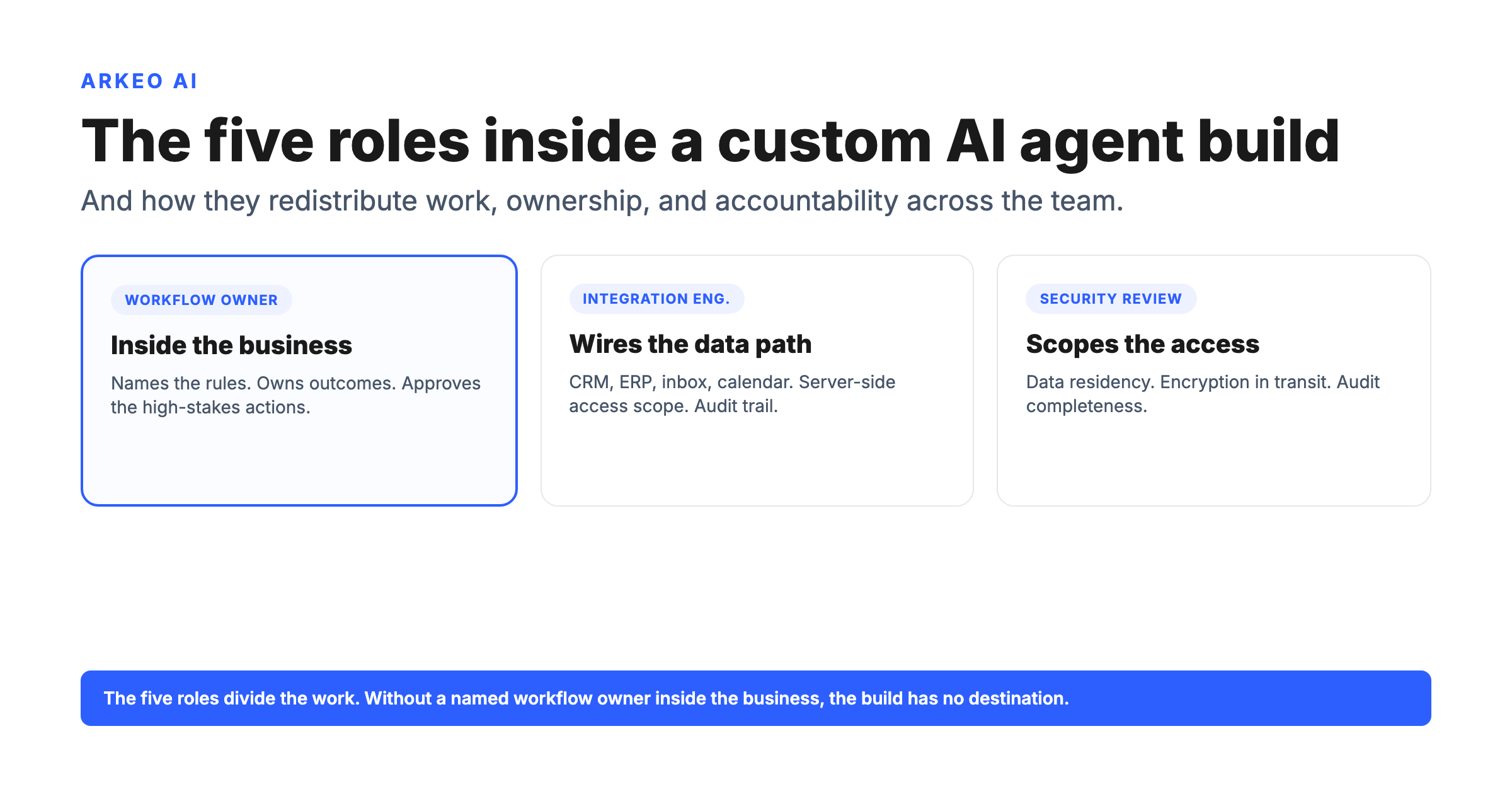
An AI audit is a structured inventory of every data source, system integration, workflow, and risk control that a candidate AI workload depends on, concluded with a go, fix-first, or no-go recommendation for the workload. It catches the four things that kill production cutovers. First, data the agent needs that is not actually captured anywhere digital, such as inspection notes still living in a tradesperson's notebook or pricing exceptions agreed over the phone and never reconciled. Second, integration gaps where the agent cannot reach the ERP, CRM, ticketing system, or approval queue where decisions actually get made. Third, approval design that was never written down, leaving the agent unable to route a $5,000 invoice or a customer refund to the right human. Fourth, ownership gaps where no named operator is signed up to run the agent the day after it ships.
None of these are technology problems. They are operating-discipline problems wearing AI costumes. Arkeo has been in business for 25 years operating real companies before deploying AI agents on top of them, which is why the audit looks like operations work. Process maps. Data sources. Approval routing. Owner names. On-call schedules. The deliverable is a one-page diagnosis the CFO and the COO can both read and act on, plus a workload-level scorecard against the readiness dimensions described in the Cluster 02 ai readiness pillar.
What is an AI audit trail, and why does it matter for readiness?
An AI audit trail is the running record of every prompt sent to a model, every model response, every action the agent took on a downstream system, and every approval the human-in-the-loop layer signed off on. It is the production-time analog of the readiness audit's pre-build diagnosis. The readiness audit decides whether the agent should ship. The audit trail proves what the agent did after it shipped.
The reason it matters now: 97% of organizations that suffered a breach of an AI model or application in IBM's 2025 data lacked proper AI access controls. The audit trail is where access controls become legible. Without it, an internal investigation has nothing to reconstruct, an external auditor has nothing to verify, and a regulator has nothing to read. The NIST AI Risk Management Framework 1.0 places this work inside its Manage function, which is one of the four core functions, alongside Govern, Map, and Measure. Most mid-market operators do not need to implement NIST line by line, but they do need to know it exists, because regulators, insurers, and enterprise customers will be asking about it inside the next two budget cycles.
How do you sell an AI audit internally?
The honest sell to a skeptical executive is not about AI. It is about avoided cost. Reframe the audit as the unit of due diligence between the request to build and the contract to build. Three things make the case land.
First, anchor the audit cost against the cost columns above. A scoped single-workflow audit costs less than 10% of a stalled pilot in the worst case and is free when run through Arkeo's AI Assessment. Second, anchor the timeline. A focused single-workflow audit completes in days to weeks, not quarters. The team that wants the agent does not lose its momentum, it gains a sequenced plan. Third, anchor the deliverable. The audit produces a one-page diagnosis with a go, fix-first, or no-go decision per workload. That deliverable is the artifact a CFO can take to a budget conversation and a CIO can take to a board update. No deck. Just a decision.
The IBM IBV CEO Study of 2,000 CEOs across 33 countries reports that lack of expertise is the top barrier to AI innovation, 31% of the workforce will require retraining or reskilling over the next three years, and 65% of CEOs say their organizations will use automation to address skills gaps. The audit is also where the people side of the readiness picture gets named. Which workflows are ready for an agent. Which roles are about to change. Which managers are about to need a new operating cadence. That picture is what gets the audit funded inside an organization, not the technology pitch.
Want this case built for your CFO?Book a free AI Assessment and Arkeo will bring the numbers, not a sales deck.
What kills the payback on an AI build?
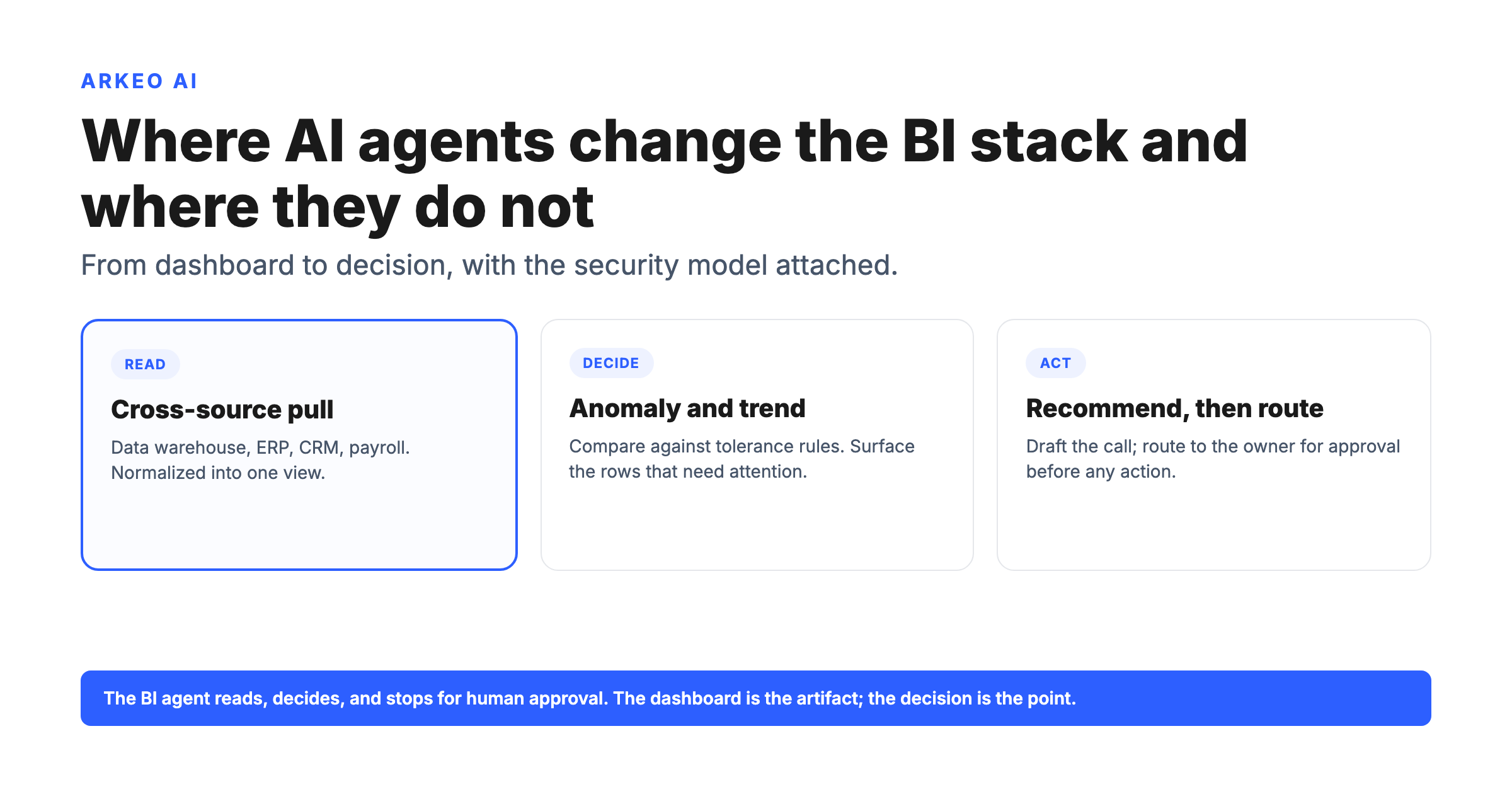
One blunt truth before you sign any build contract: most pilots do not fail because the model could not do the task. They fail because the operating environment was not ready to consume the output. The pattern repeats across mid-market deployments. The agent drafts a quote. There is no integration to push the quote back into the CRM. The agent flags a risk. There is no approval queue to route it through. The agent reads a document. There is no schema for it to write the structured fields into. The output exists. The workflow has nowhere to put it.
Picture a 200-person specialty manufacturer that committed to a quoting agent without an audit. The vendor's demo ran on a clean sample. The production data lived in a legacy ERP with no REST API, a shared drive of customer PDFs that had never been parsed, and a sales-engineer approval step that lived only in two senior staff members' heads. The pilot shipped on time. It produced quotes. None of them flowed back into the CRM, none of them carried a confidence score the sales engineers could act on, and the senior staff approvals stayed in inboxes. The agent was correct. The business was not ready. The audit would have caught all three gaps in week one, before the contract was signed. That is the audit's job: surface the gaps when they are still cheap to fix.
BCG research published in October 2024 put a wider number on the same gap: 74% of companies struggle to achieve and scale value from AI, and only 4% have built cutting-edge AI capabilities that consistently generate significant value. The default outcome for an unready company is not failure, it is purgatory, and purgatory is the most expensive cost column of all because it stays open quarter after quarter.
When does the audit pay back inside the first quarter?
The audit pays back inside the first quarter when one of three conditions is true. First, when the workload candidate the team was about to build has a hidden integration gap that would have stalled the pilot. The audit surfaces the gap before the contract is signed, and the avoided pilot cost is the payback. Second, when the company has high shadow AI usage that the audit converts into a written policy, a tool inventory, and an access-control list. The avoided breach premium is the payback. Third, when the audit reranks the candidate workloads against a six-dimension scorecard and surfaces a different first workflow than the team had picked. The faster route to a deployed agent is the payback.
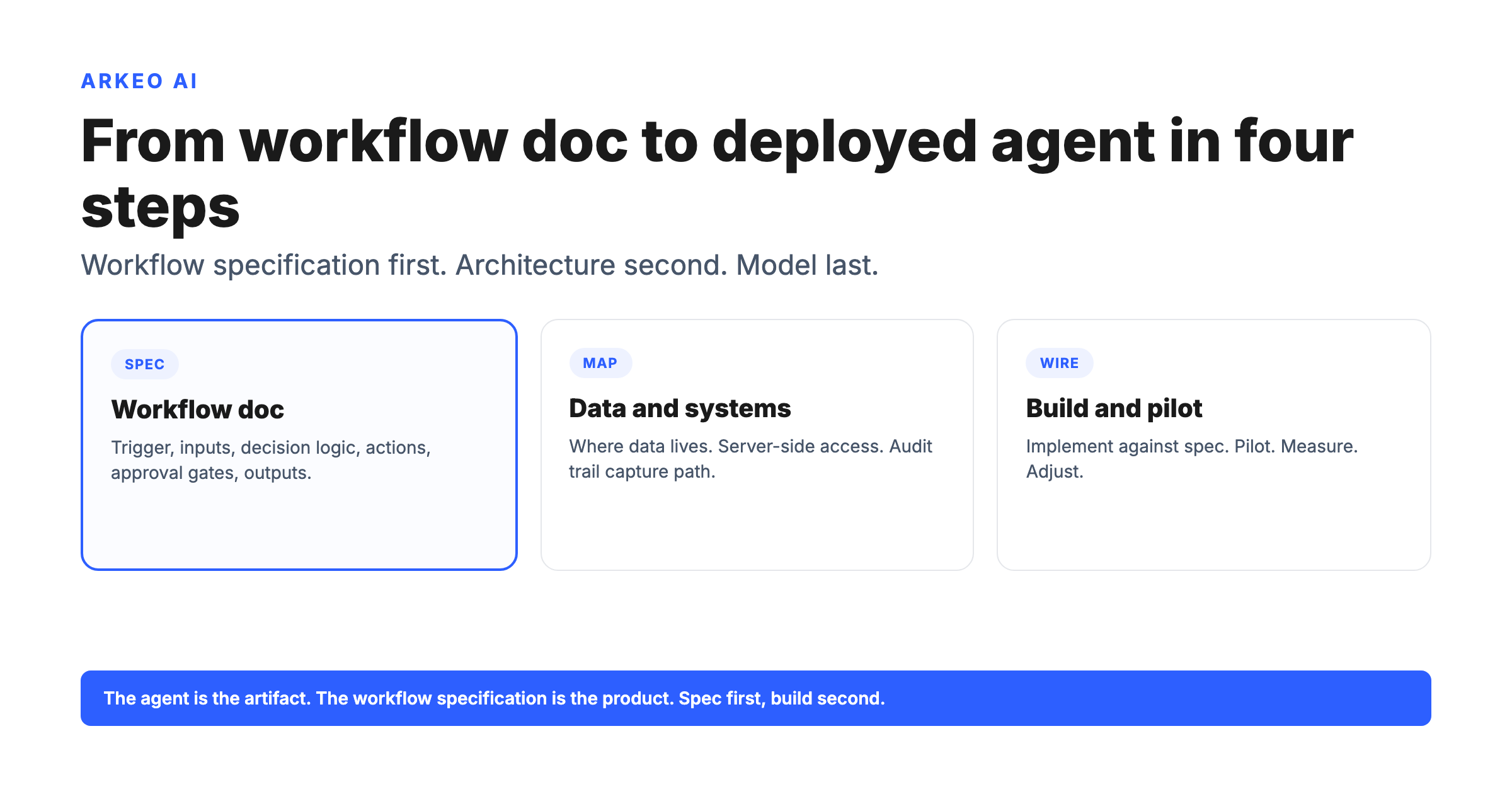
In all three cases, the audit is the cheapest insurance the operating budget can buy against the cost columns above. Arkeo runs the Assessment phase as the first step of an Assess, Deploy, Manage methodology so the audit's output is a deployable plan, not a stand-alone consulting deliverable. We use what we sell: the same audit pattern runs against Arkeo's own operations every quarter, and the agents that run Arkeo's marketing, sales pipeline, and back-office work were sequenced from those audits.
The reading order for cluster 02 is the same one Arkeo runs on engagements. First, the ai readiness pillar to frame the maturity model and the six dimensions. Second, the ai readiness assessment spoke for the diagnostic process. Third, this article for the cost of skipping the audit. Together they give the operator the language, the tool, and the business case.
Audit one workflow in 60 minutesArkeo's free AI Assessment audits one of your workflows against the six readiness dimensions and gives you a go, fix-first, or no-go decision you can take to the board.
Book Your Free AI Assessment →