Category
What a Good AI Readiness Assessment Tool Measures
Last updated: May 2026
You want a fast, honest read on whether your business is ready to put AI to work, so you go looking for an AI readiness assessment tool. A ten-question quiz, a downloadable scorecard, a calculator that spits out a maturity score. The problem is that most of these tools are built to capture your email, not to tell you the truth about your operation. A green light on a generic scorecard feels like progress, but it can send you straight into the projects that quietly fail.
The numbers back up the caution. Gartner predicts at least 30% of generative AI projects will be abandoned after proof of concept by the end of 2025, citing poor data quality, weak risk controls, escalating cost, and unclear value. A scorecard that never asks about those four things cannot warn you about the most common way AI initiatives die. After three years deploying AI agents inside real operations, Arkeo has seen the gap between a tidy readiness score and a workflow that is actually ready to automate, and it is wide.
Quick Answer
• What it is: A self-service quiz, scorecard, or calculator that gives you a quick read on AI readiness, usually free.
• What it is good for: A first-pass screen and a shared vocabulary, before any money is committed.
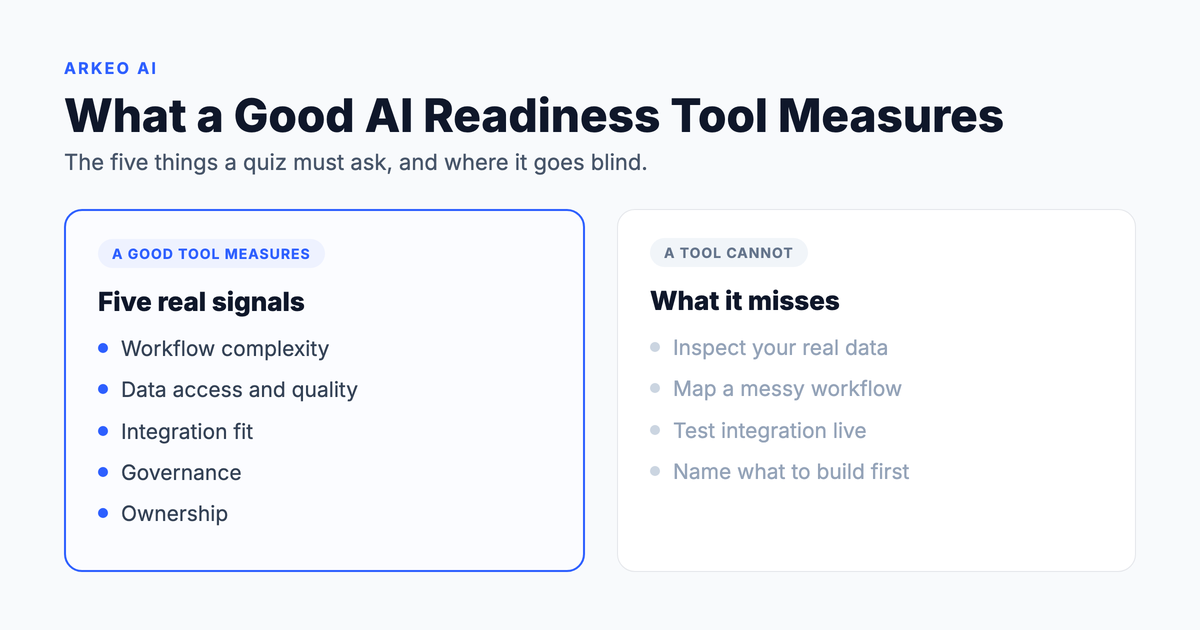
• Where it falls short: It cannot inspect your data, test integration fit, or name the workflow worth automating first.
• Why it matters: A green score on a generic tool is not a plan. The moment money, sensitive data, or multiple teams are involved, you need a workflow-specific review.
What Can An AI Readiness Assessment Tool Actually Do?
An AI readiness assessment tool is a self-service questionnaire that scores how prepared your business is to adopt AI, based on the answers you type in. It is a mirror, not a microscope. It can only reflect back a structured version of what you already believe about your own data, systems, and goals. That is genuinely useful for a few jobs, and useless for several others.
Used well, a good tool earns its place at the very start of the journey. It gives a busy operator a fast read before any budget is on the line. It creates a shared vocabulary, so your operations lead and your finance lead are arguing about the same thing. It surfaces obvious gaps, the data sitting in three disconnected systems, the process nobody has documented, the absence of anyone who owns AI internally. And it lowers the cost of the first conversation, because you walk in already knowing roughly where you stand.
Here is the false belief worth killing early. Most businesses think a high readiness score means they are ready to build. They are wrong. A score measures your answers, not your reality. A tool cannot open your CRM and check whether the customer records are clean enough to feed an agent. It cannot read your contracts to see where the regulated data lives. It cannot watch your team work for a day and notice that the bottleneck everyone complains about is not the one a model would actually fix. The tool depends entirely on the quality of your self-knowledge, and self-knowledge is exactly what most teams lack at the start.
So treat the result the way you would treat an at-home blood pressure cuff. A reading is informative. It is not a diagnosis, and it is certainly not a treatment plan. Where a self-service read ends, a tailored review begins, which is exactly what a free AI Assessment with Arkeo is built to add.
What Should A Good AI Readiness Assessment Tool Measure?
The difference between a useful tool and a lead-capture gimmick is what it asks about. A vanity tool asks how excited leadership is about AI and how many tools you already use. A serious tool digs into the five things that actually determine whether an AI project survives contact with reality. Score a tool by whether it covers all five.
| Measurement category | What a good tool asks | Why it predicts success |
|---|---|---|
| Workflow complexity | Is the target process repeatable and well-defined, or messy and exception-heavy? | Clean, repeatable workflows automate; tangled ones swallow budget. |
| Data access | Where does the data live, who can reach it, and is it clean enough to trust? | Poor data quality is the top reason projects are abandoned. |
| Integration fit | Will AI connect to the systems you already run, or sit on an island? | A tool nobody can plug in is a tool nobody uses. |
| Governance | Who reviews risk, where does sensitive data go, and what is the approval path? | Weak risk controls stall projects before they scale. |
| Ownership | Is there a named internal owner accountable for results, not just a champion? | Unowned initiatives drift, then quietly die after the pilot. |
If a tool only returns a single number, treat that as a red flag. A maturity score with no breakdown across these five categories tells you nothing actionable. The value is in the dimensions, because that is where you see which part of your readiness is weak and what to fix first.
See where AI actually fits your operation
A free AI Assessment goes past the quiz: a 60-minute planning session where Arkeo reviews your real workflows, data, and bottlenecks and tells you honestly where to start.
Book Your Free AI Assessment →
The blunt truth a vendor will not print in a brochure: most AI projects do not fail on the model. They fail on data nobody cleaned, an owner nobody appointed, and a workflow nobody mapped. A good tool forces those questions into the open early, while changing the answer is still cheap. That is also why a generic score and a tailored review are not the same product.
How Do You Evaluate Whether A Tool Is Any Good?
Once you know what a tool should measure, judging the tools themselves gets easy. Run any AI readiness assessment tool, free or paid, through the same short list of questions and watch how fast the weak ones reveal themselves.
The red flags are the mirror image of those questions. Be wary of a tool that returns a flattering score in under a minute, one that demands your email before it shows you anything, one whose result is identical no matter what you answer, and one that ends every assessment with the same product recommendation. A tool built to qualify you as a lead optimizes for a high score and a captured contact, not for telling you the workflow you should automate first. There is nothing wrong with a free tool capturing your email, that is a fair trade, as long as the read you get back is honest. The problem is when the score is the product.
This is also where a generic tool and a tailored review part ways. Arkeo runs on the principle of using what we sell, deploying AI agents inside our own operation before recommending anything, so a readiness review is grounded in what actually shipped rather than what scores well on a quiz. For a deeper, structured walkthrough of how readiness is scored end to end, see our guide to the AI readiness assessment and the categories that matter most.
When Is A Tool Not Enough, And You Need A Partner?
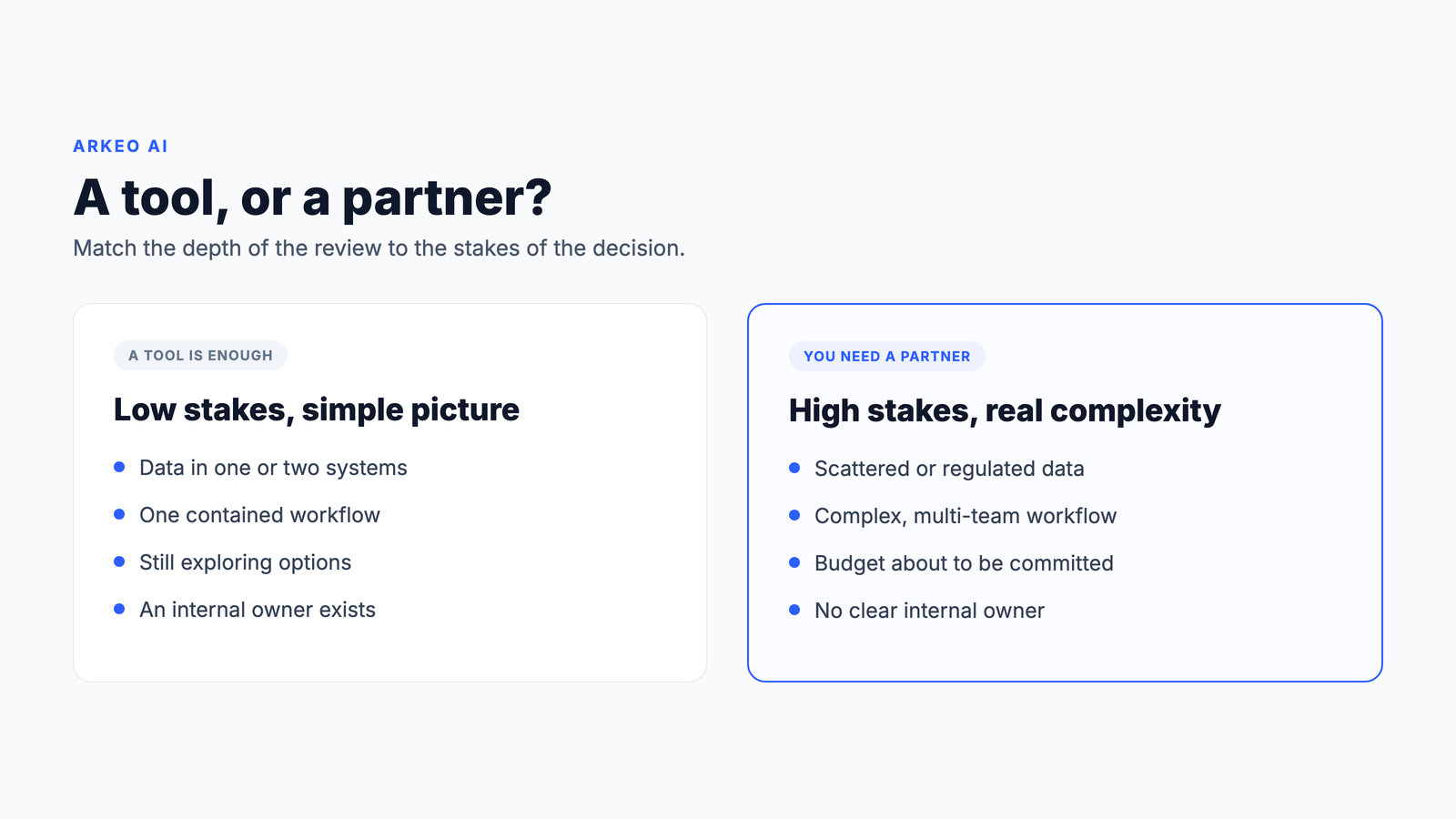
A tool is the right call when the stakes are low and the picture is simple. One or two systems hold your data, the workflow you are eyeing is contained and well understood, you are still in the exploring phase, and you have someone internal who can own the follow-up. In that situation a self-service read is genuinely all you need to take the next sensible step.
The signals that you have outgrown a tool are just as concrete. When data is scattered across many systems or includes sensitive and regulated records, a quiz cannot judge whether it is safe to use. When the workflow is complex, exception-heavy, or spans several teams, no questionnaire can map it. When budget is about to be committed, the cost of a wrong answer jumps, and a generic score is the wrong thing to bet six figures on. And when there is no internal owner, the most important readiness gap is one a tool can flag but never fix.
Consider an operations lead at a mid-sized firm whose data sits in an ERP, a CRM, and a stack of spreadsheets, with customer records that fall under privacy rules. A free tool might score them as moderately ready and suggest a chatbot. A workflow-specific review would notice that the records cannot leave their environment without controls, that the real bottleneck is a manual reconciliation between the ERP and the spreadsheets, and that automating that reconciliation would return far more value than a chatbot ever could. The tool is not wrong, exactly. It is just blind to the things that decide the outcome. This is why Gartner expects over 40% of agentic AI projects to be canceled by the end of 2027, often because the early read was right about the appetite and wrong about the operational reality.
The honest framing is simple. A tool answers roughly how ready are we. A partner-led assessment answers what specifically do we automate first, with what data, governed how, owned by whom. The first is free and fast and worth doing. The second is what turns a readiness score into a plan you can fund. Arkeo's free AI Assessment is built to be that second step, a 60-minute planning session that reviews your actual workflows rather than your answers to a quiz, and the paid Consult that some teams move into afterward goes deeper into a full diagnostic and roadmap. The point is to start with the tool, then escalate the moment the stakes do.
Turn your readiness score into a real plan
The free AI Assessment maps your bottlenecks, data, and the single workflow worth automating first, so you stop guessing and start building on solid ground.
Book Your Free AI Assessment →