Category
AI Readiness Assessment Template for Ops Teams
Last updated: May 2026
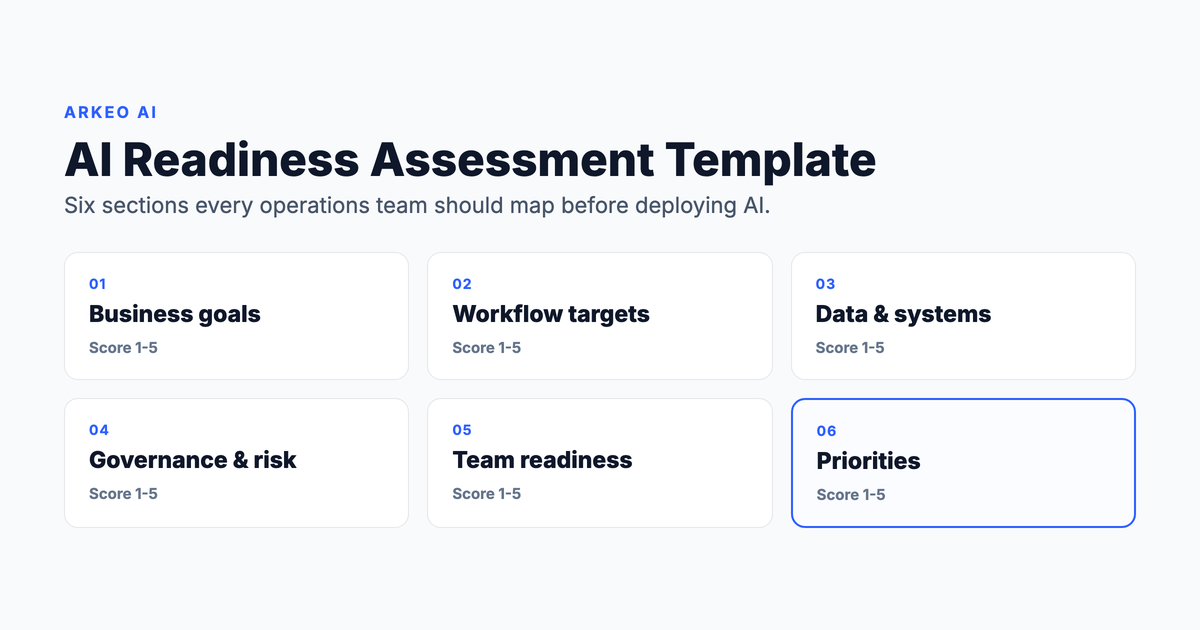
You have been asked to figure out where AI fits in your operation, and you would rather not start from a blank page. You want a structure you can put in front of the team on Monday, fill in over a week, and use to decide what is worth doing first. That is a reasonable instinct. Arkeo has spent three years deploying AI agents into mid-market operations, and the single biggest predictor of whether a project survives is not the model. It is whether the team did this kind of honest mapping before anyone bought anything. The template below is the same six-section structure Arkeo uses to open a readiness conversation, written so you can copy it into a doc and run it yourself. The reason it matters: Gartner projects that at least 30% of generative AI projects will be abandoned after proof of concept by the end of 2025, driven by poor data quality, weak risk controls, and unclear business value (Gartner). Most of those failures are decided before a line of code is written. A template will not save you on its own, but skipping the mapping is how teams join that 30%.
Quick Answer
• What it is: a free, copy-and-fill template that maps your business goals, workflows, data, systems, governance, and team readiness across six sections.
• Who it is for: operations leaders who want a reusable internal document for readiness conversations, not a one-off consultant report.
• Cost: free; the full template lives in the body of this post, ready to copy.
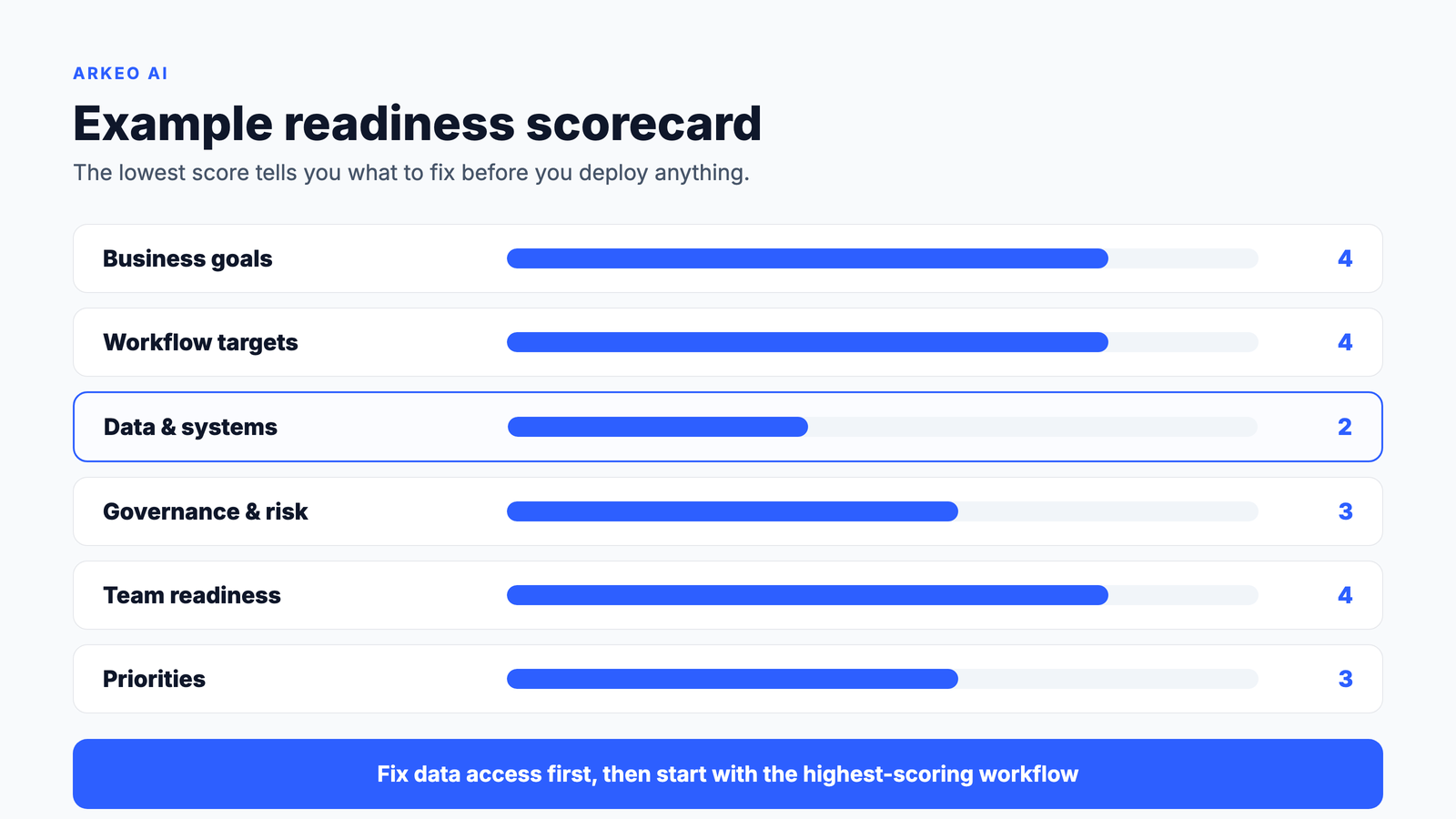
• How to use it: fill each section, score it 1 to 5, and let the lowest scores tell you what to fix before you deploy anything.
• Why it matters: the gap between using AI and getting value from it is a readiness problem, and readiness is what this template forces you to confront.
What Is an AI Readiness Assessment Template?
An AI readiness assessment template is a reusable document that walks a team through the questions you must answer before deploying AI: what you are trying to achieve, which workflows are candidates, whether your data and systems can support it, what governance and risk you are taking on, and whether your team can run it. It is a worksheet, not a verdict. The output is not a grade. It is a shared, written picture of where you are strong and where you are not ready, scored honestly enough that the next step is obvious.
The point of putting it in a template is repeatability. You run the same structure for the invoicing workflow this quarter and the customer-support workflow next quarter, and you can compare them. You hand it to a new department head and they know what "ready" means without a meeting. If you want to see how this maps to a deeper, scored review, the free AI Assessment uses the same six dimensions and adds a prioritized roadmap on top.
Who Should Use This Template?
This template is built for the person who owns operational outcomes and is being pushed, by a board, a CEO, or their own curiosity, to find AI's place in the business. That is usually an operations leader, a COO, a head of a function, or a founder still close to the work. You do not need a data science background to use it. Every section is written in business language, and the technical questions are framed so you know what to ask, not so you have to answer them like an engineer.
It is most useful when you are early: exploring rather than committed, and trying to decide whether the next move is a free experiment, an internal build, or a paid engagement. It is less useful once you are mid-deployment, when you need monitoring and change management more than a readiness map. Use it before the spend, not after.
The reason a structured template beats a hallway conversation is that the gap between adopting AI and profiting from it is enormous, and the difference is readiness. McKinsey's 2025 State of AI report found that 88% of organizations now use AI in at least one function, but only about a third have scaled it and just 39% report any EBIT impact, with roughly 6% qualifying as high performers (McKinsey). Almost everyone is using AI; almost nobody is being paid for it. A template forces the conversations that move you from the first group toward the second, before you commit budget.
See where AI fits your operation
Arkeo's free AI Assessment runs this same six-section structure with you live, then hands you a prioritized roadmap and the top use cases worth pursuing, before you spend a dollar on a build.
Book Your Free AI Assessment →
What Does the AI Readiness Assessment Template Include?
Six sections, in order. Each one has a few fields to fill in, a scoring line, and a short note on what a strong answer looks like. Copy the whole thing into a shared document, give every section an owner, and fill it in over a week of short conversations rather than one long meeting. The scoring is deliberately simple: 1 means "not ready, this is a blocker," 5 means "ready, no concerns," and the sections that score lowest are the ones to fix before you deploy anything.
Business goals
What outcome are you actually buying? Tie AI to a number, not a vibe.
Fill in: The business outcome you want (cost, capacity, speed, quality). The metric you would watch. The cost of doing nothing for another year.
Strong answer looks like: "Cut invoice-processing time from 3 days to same-day, measured by cycle time, worth roughly two FTE of capacity."
Readiness score (1-5): ____
Workflow targets
Which specific, repetitive workflows are the real candidates?
Fill in: The 2 to 4 workflows that are high-volume and rule-based. Who does each one today and how many hours it consumes. How clearly the steps are documented (or not).
Strong answer looks like: A named workflow with a known volume, a clear owner, and steps you could write down in an afternoon.
Readiness score (1-5): ____
Data and systems
Can the AI actually reach the data it needs, in usable shape?
Fill in: Where the data for each workflow lives (which systems). Whether it is structured or scattered across email, PDFs, and spreadsheets. Whether the systems have an API or have to be touched by hand.
Strong answer looks like: "Order data is in one ERP with an API; nothing critical lives only in someone's inbox."
Readiness score (1-5): ____
Governance and risk
What data is exposed, where does it go, and who is accountable?
Fill in: Whether the workflow touches customer, financial, or regulated data. Whether sending that data to a public cloud tool is acceptable, or whether it must stay in-house. Who signs off, and what a wrong AI output would cost.
Strong answer looks like: A clear statement of what data is in scope, a named owner for sign-off, and a documented rule on where the data is allowed to go.
Readiness score (1-5): ____
Team readiness
Who will own this once the consultant or the novelty is gone?
Fill in: The internal owner for the AI workflow once it is live. Whether the team is curious or resistant. Who fixes it when it produces a bad output (because it will).
Strong answer looks like: A named owner with time allocated, and at least one person who is genuinely interested in making it work.
Readiness score (1-5): ____
Priorities and next steps
Given the scores above, what do you do first, and what do you leave alone?
Fill in: The one workflow with the highest value and the fewest blockers. The lowest-scoring section that has to be fixed before you start. Your decision: free experiment, internal build, or bring in a partner.
Strong answer looks like: "Start with invoice processing; fix the data-access gap in Section 3 first; run a free experiment before committing budget."
Readiness score (1-5): ____
Add the six scores. If the total is low, the honest finding is that you are not ready to deploy yet, and that is a genuinely useful result. It is far cheaper to discover a data-access gap in a worksheet than three months into a stalled pilot. The free AI Assessment runs this exact scoring with you if you would rather not score yourself.
How Do You Run a Template-Based Readiness Workshop?
The template is the agenda, not the meeting. The most common mistake is to send it around as a survey and collect six politely optimistic answers. Readiness only surfaces in conversation, where someone can say "actually, that data lives in three places and two of them are spreadsheets." Run it as a short working session, or a few of them.
Who to involve. You need three voices in the room: the operations owner who feels the bottleneck, someone who actually does the workflow day to day, and whoever understands the systems and data. Skip any one of them and a section will get scored on assumptions. The person who does the work will know things about the data that no system diagram shows.
How to document findings. Fill the template live, on screen, where everyone can see it. Capture the disagreements, not just the conclusions, because the disagreement is usually where the real risk is. When a section cannot be scored confidently, that is itself the finding: "we do not actually know where this data lives" is a Section 3 score of 2, and it tells you exactly what to investigate next.
Can a Template Replace a Full AI Readiness Assessment?
Here is the honest version, because a vendor selling assessments would not lead with it: for a simple environment, yes, a template is often enough, and you should not pay anyone. If your data lives in one or two systems you understand, the workflow is contained, and a wrong guess costs you a week rather than a quarter, a self-run template will teach you more than a generic deck. Use it, act on it, and keep your budget.
Most businesses think a readiness assessment has to be an expensive engagement to be worth anything. They are wrong about that. The expense should track the complexity, not the other way around. A template fully covers the simple end of that range.
Where a template stops being enough is when complexity crosses a threshold. When AI has to read and write across several systems that were never designed to integrate, when the data is regulated or sensitive enough that "where does it go" becomes a compliance question, or when the opportunity spans multiple teams and the entire game becomes prioritization, a worksheet can surface the questions but cannot answer them. Those answers need someone who has built and broken these systems before. That experience is the difference between a template that lists risks and an assessment that resolves them, and it is the reason the AI readiness assessment exists as a deeper, scored review for complex environments.
A blunt truth worth stating plainly: AI agents break, and they break in production, not in the demo. Roadmaps slip because the data was messier than anyone admitted in the discovery call. A template that scores your team and your data honestly is the cheapest insurance you can buy against that. The teams that fill it in truthfully, low scores and all, are the ones that do not end up in the abandonment statistics.
How Does Arkeo Use This in Practice?
Arkeo approaches readiness from the deployment side, not the slide-deck side. The company was founded in 2023 on 25 years of running real businesses and three years of deploying AI agents in production, including the Arkeo Operating System (AOS) that runs internally. The standing principle is that we use what we sell, which means this template is not a marketing artifact. It is a stripped-down version of the same structure used to open every real engagement, with the scoring kept simple so a team can run it without help.
The free AI Assessment is the 60-minute version of this template run with you, the free lead magnet, not a paid engagement. It follows the same six dimensions, then adds what a worksheet cannot: a prioritized set of quick wins for the first 30 to 90 days, the top custom agent opportunities, and a sketch of the longer-term architecture. If that session shows your environment warrants a deeper diagnostic, the paid Consult is the logical next step, but that decision is yours to make after you have seen the free version. Start with the template here, and if the scores point to complexity you cannot resolve internally, the assessment is the next move.
Turn your scores into a roadmap
Bring your filled-in template to a free 60-minute AI Assessment and leave with your bottlenecks mapped, your top use cases ranked, and a phased plan, at no cost and no obligation.
Book Your Free AI Assessment →