Category
AI Readiness Assessment Services: What to Expect
Last updated: May 2026
You have been told your business needs an AI readiness assessment. A handful of firms will happily sell you one for a five-figure fee, and the proposals all read the same: gap analysis, opportunity mapping, a roadmap. Arkeo has spent three years deploying AI agents into mid-market operations, and the pattern is consistent: the assessments that change outcomes are the ones tied to a team that actually ships, not the ones that end at a slide. What you cannot tell from the outside is whether you are buying a real diagnostic that survives contact with your data and your team, or a polished deck that confirms what a sales call already told you. The stakes are not trivial. Gartner projects that at least 30% of generative AI projects will be abandoned after proof of concept by the end of 2025, citing poor data quality, weak risk controls, escalating costs, and unclear business value (Gartner). A readiness assessment exists to keep you out of that 30%. A bad one charges you to join it.
Quick Answer
• What it is: a structured review of your data, workflows, team, and use cases that produces a prioritized plan for where AI actually fits.
• Who it is for: buyers deciding whether to use internal staff, a strategy consultant, or a deployment partner.
• Market cost: paid diagnostics run roughly $10K to $25K, scaled to your environment.
• Arkeo's price: the entry-level AI Assessment is free, no obligation to buy a build after.
• Real deliverables: gap analysis, prioritized use cases, a phased roadmap, risk flags, and a concrete implementation path.
• Why it matters: the gap between using AI and getting value from it is a readiness problem, not a model problem.
What Are AI Readiness Assessment Services?
AI readiness assessment services are structured engagements that evaluate whether your business is positioned to deploy AI successfully, then hand you a prioritized plan for doing it. A good one looks at four things together: the state of your data, the shape of your workflows, the capacity of your team, and the specific use cases worth pursuing. The output is not a verdict of "ready" or "not ready." It is a map: here is where AI pays off in 90 days, here is what needs cleanup first, and here is what to leave alone.
The reason these services exist is that most AI failure is not technical. McKinsey's 2025 State of AI report found that 88% of organizations now use AI in at least one function, but only about a third have scaled it and just 39% report any EBIT impact, with roughly 6% qualifying as high performers (McKinsey). Almost everyone is using AI. Almost nobody is getting paid for it. That gap is what a readiness assessment is supposed to close, and it is the reason a real one is worth more than a tool recommendation. If you want to understand the underlying review before you shop for a service, the free AI Assessment walks the same ground without the invoice.
Before going deeper, here is how Arkeo sees the three paths buyers actually choose between, an internal self-assessment, a strategy consultant, and a deployment partner. The comparison below is Arkeo's own framing, drawn from running these engagements, not a third-party benchmark.
Self, consultant, or deployment partner — three honestly different services
The procurement decision is not a feature comparison, it is a fit decision. Each path solves a different problem. The mistake is assuming a consultant deliverable becomes a deployment.
Internal self-assessment
Free, run by your team, two to four weeks. Honest baseline if the team knows AI well enough to ask the hard questions.
Strategy consultant
$10K to $25K. Outside perspective. Strong on benchmarking and roadmap. Weak on the deployment that follows the slides.
Deployment partner
Assessment paid for by the deployment. Same team writes the plan and ships the first workflow. Skin in the game.
What Do AI Readiness Assessment Services Include?
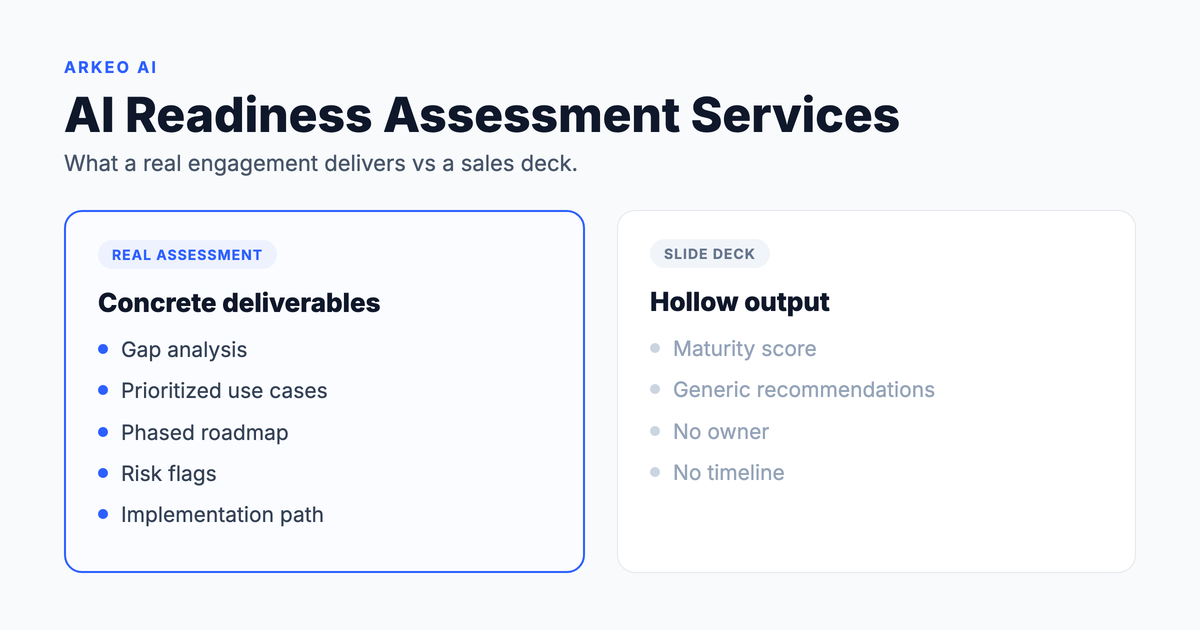
Strip away the branding and a competent engagement should produce five concrete artifacts. If a proposal does not name all five, you are looking at a partial service dressed as a full one.
1. A gap analysis. Where your current data, infrastructure, and processes fall short of what the AI you want would actually require. This is the unglamorous part, and it is the part that separates a diagnostic from a brochure. Most readiness gaps live in the data: it is fragmented, undocumented, or locked in systems that do not talk to each other.
2. Prioritized use cases. Not a list of forty things AI could theoretically do. The three to five workflows where automation returns the most for the least effort, ranked by value and feasibility. A real assessment tells you what to do first and what to ignore.
3. A phased roadmap. A sequence with timelines, not a wish list. The credible ones move from quick wins in the first 30 to 90 days, to a small number of custom workflow agents in the mid term, toward a longer architecture decision about where your AI lives and who controls it.
4. Risk flags. Data governance, privacy exposure, regulatory constraints, and the workflows where an automated mistake is expensive. A vendor who never raises a risk is selling, not assessing.
5. An implementation path. The single most-skipped deliverable, and the one that matters most. A roadmap with no answer for who builds it and how is a document, not a plan.
When Is an Internal Self-Assessment Enough?
Here is the honest version most providers will not lead with: you do not always need to pay anyone. If your environment is simple and you are early in exploration, an internal self-assessment is often the right first move.
A self-assessment is enough when a few conditions hold. Your data lives in one or two systems you understand well. The workflows you want to improve are contained, like drafting first-pass documents or summarizing inbound email, rather than spanning departments. You are exploring rather than committing, and a wrong guess costs you a week, not a quarter. And you have someone internal who is genuinely curious and willing to test off-the-shelf tools against real work.
In that situation, the value of a paid engagement is low, because the gap analysis would be short and the risks contained. Spending a few hours mapping your own bottlenecks and testing a couple of tools will teach you more than a generic deck. The mistake is not doing a self-assessment. The mistake is mistaking it for the whole job once your environment grows past simple.
See exactly where AI fits your operation
Arkeo's free AI Assessment is a 60-minute planning session that maps your bottlenecks, ranks the use cases worth pursuing, and gives you a phased roadmap, before you spend a dollar on a build.
Book Your Free AI Assessment →
When an internal self-assessment is enough, and when you need a partner
Self-assessments are honest tools when the team knows AI well enough to ask the hard questions. They become wishful thinking when the team is learning from scratch. The fork below maps the most common decision.
Internal team can carry the diagnosis
External diagnosis pays back fast
When Does a Partner-Led Assessment Make Sense?
A partner-led assessment earns its cost when complexity crosses a threshold that an internal review cannot reach honestly. Three signals tell you that you are there.
Complex systems. When AI has to read from and write to multiple systems that were never designed to integrate, the hard part is no longer choosing a model. It is the plumbing, the data contracts, and the failure modes. An internal reviewer rarely has the time or the scar tissue to map that cleanly.
Sensitive data. If the workflows you want to automate touch customer records, financial data, health information, or anything under a regulatory regime, the readiness question is not "can AI do this" but "where does the data go and who can see it." That is where the choice between a public cloud tool and an on-premise or private deployment stops being abstract and starts being a compliance decision.
Multiple workflows. When the opportunity spans several teams at once, prioritization becomes the entire game. Doing the wrong workflow first is how pilots stall. A good partner forces the ranking conversation and makes you defend the order.
This is exactly where the abandonment numbers bite. Gartner separately predicts that over 40% of agentic AI projects will be canceled by the end of 2027, driven by escalating costs, unclear business value, and inadequate risk controls (Gartner). Those are not model failures. They are readiness failures, and they happen in precisely the complex, multi-workflow, sensitive-data environments where someone skipped the diagnostic or bought a shallow one.
Three signals that the assessment warrants a deployment partner
Partner-led assessments cost real money. The three signals below tell you when the cost is the right move. Without at least two of them, run a self-assessment first and bring a partner in for delivery only.
Complex systems
Mix of mainstream and legacy systems, custom builds, or systems with no native AI connectors. Integration cost is the hidden risk.
Sensitive data
Regulated industries, IP-heavy operations, or any workflow where data leaving the firewall triggers compliance review.
Multiple workflows
Three or more workflows in scope across departments. The sequencing decision is what makes or breaks the roadmap.
What Should You Look for in a Provider?
Most businesses think the right AI assessment provider is the one with the deepest technical bench. They are wrong. The deepest technical bench is the one that recommends the most technology, which is not the same as the most value. The provider you want sits at the intersection of three things, and is weak in none of them.
Business understanding. They ask about your margins, your bottlenecks, and your capacity constraints before they say the word "model." If the first meeting is about technology instead of your P&L, you are talking to a vendor who will sell you their stack regardless of fit.
Technical depth. They can tell you, specifically, where your data is not ready and what it would take to fix it. Vague reassurance is a tell. Real depth sounds uncomfortable, because the honest answer is usually that your data needs work.
Implementation credibility. They have actually built and run what they recommend, not just diagrammed it. This is the differentiator that the slide-deck firms cannot fake. The most useful provider is one who deploys what they assess, because their roadmap is constrained by what genuinely ships rather than what sounds good in a meeting. To go deeper on the dimensions a thorough review actually scores, the AI readiness assessment breakdown lays out each one.
Four things a good assessment engagement actually delivers
Good engagements deliver concrete artifacts your team can act on. Bad engagements deliver slide decks that compliment your industry without naming a workflow. The four below are the deliverables to insist on at scoping.
Prioritised use cases
Ranked list of workflows with baselines, owners, and expected payback. Specific to your business, not generic.
Data and systems audit
Map of data sources, access paths, and integration gaps. The audit that prevents six-month surprises later.
Governance baseline
Current RBAC, audit log, and human-in-the-loop posture. Gaps named, not glossed.
Deployment roadmap
Concrete sequencing — what ships in 30 days, 90 days, 12 months. Not a maturity ladder, a calendar.
What Are the Red Flags to Avoid?
Now the blunt truth, because a vendor will not put this in a brochure. AI agents break. Roadmaps slip. Data is messier than the discovery call admitted. A provider who promises a clean, risk-free path is either inexperienced or lying, and either way you should walk. Watch for three specific red flags.
Vague outputs. If the deliverable is a maturity score and a set of "recommendations to explore," you bought a survey. Real outputs are specific: this workflow, this data source, this timeline, this owner. Vagueness is how a provider avoids being held to anything.
Tool-first recommendations. If the assessment arrives at a named product before it has finished understanding your business, the conclusion was written before the engagement started. Tool-first thinking is the single most common reason pilots fail. The tool is the last decision, not the first.
No deployment path. The most expensive red flag. A beautiful roadmap with no answer for who builds it, how long it takes, and what it costs leaves you exactly where you started, just poorer. If the provider does not deploy and cannot point you to who will, the assessment is a dead end.
Three red flags to walk away from in any assessment provider
These three patterns show up in the engagements that produce expensive slides and no shipping agents. If a provider exhibits any of the three at scoping, the deliverable will not be worth the invoice.
Vague outputs
Deliverables described as "strategic insights" or "transformation roadmap" with no concrete artifacts named. Walk away.
Tool-first recommendations
Provider arrives at scoping with a preferred vendor or product already in mind. The assessment is a sales motion.
No deployment path
Provider does the assessment and hands you a slide deck. No team, no delivery option, no skin in the game.
Picture an operations lead who pays for a thorough-looking assessment, receives a forty-slide deck with a maturity heat map, and then asks the obvious question: now what? If the answer is "engage a separate firm to scope a build," the readiness assessment did not save time or money. It added a hop. The whole point of the diagnostic is to shorten the distance between deciding and doing.
How Does Arkeo's AI Assessment Fit?
Arkeo approaches this from the deployment side, not the slide-deck side. The company was founded in 2023 on 25 years of running real businesses and three years of deploying AI agents in production, including the Arkeo Operating System we run internally. The standing principle is that we use what we sell, which means every roadmap is constrained by what actually ships, not by what sounds impressive in a proposal.
The entry point is deliberately free. Arkeo's AI Assessment is a 60-minute planning session, the free lead magnet, not a paid engagement. In it you map your current bottlenecks and data, identify quick wins in the first 30 to 90 days, surface the top custom agent opportunities, and sketch the longer-term architecture toward a private AI operating system. You walk away with a prioritized plan you can act on whether or not you ever pay Arkeo a dollar.
If the free session shows that your environment warrants a deeper, hands-on diagnostic, the paid Consult ($10K to $25K) is the logical next step, and from there a build and managed operation. But that sequence is buyer-led. The free assessment is designed to give you enough clarity to decide for yourself, which is the opposite of the tool-first, deck-only services this post warned you about. You can also start from the Arkeo homepage if you want the broader picture first.
Get a real readiness review, not a sales deck
In 60 minutes you will leave with your bottlenecks mapped, your top use cases ranked, and a phased roadmap, free, and with no obligation to buy anything after.
Book Your Free AI Assessment →
What do AI readiness assessment services include?
A complete engagement includes five deliverables: a gap analysis of your data and infrastructure, a prioritized set of three to five use cases ranked by value and feasibility, a phased roadmap with timelines, risk flags covering data governance and privacy, and a concrete implementation path that names who builds the solution and how. If any of these five is missing, you are buying a partial service.
How much should an AI readiness assessment cost?
Paid market diagnostics typically run from about $10,000 to $25,000, depending on the size and complexity of your environment. That said, cost should track scope. A simple, single-system environment rarely justifies a five-figure engagement, and an internal self-assessment may be enough. Arkeo's entry-level AI Assessment is free, so you can establish readiness before committing budget to a paid Consult.
Do you need a consultant to assess AI readiness?
Not always. If your data lives in one or two systems you understand, the target workflow is contained, and you are still exploring, an internal self-assessment is usually enough. A partner-led assessment makes sense once complexity crosses a threshold: multiple integrated systems, sensitive or regulated data, or opportunities that span several teams at once. The deciding factor is complexity, not company size.
What are the red flags when choosing an AI assessment provider?
Three stand out. Vague outputs, where the deliverable is a maturity score and recommendations to explore rather than specific workflows and owners. Tool-first recommendations, where the assessment arrives at a named product before it has understood your business. And no deployment path, where the roadmap has no answer for who builds it. The strongest signal of a good provider is that they deploy what they assess.
Why do so many AI projects fail even after an assessment?
Because most failures are readiness failures, not technical ones. Gartner projects at least 30% of generative AI projects abandoned after proof of concept by the end of 2025, and over 40% of agentic AI projects canceled by the end of 2027, driven by poor data quality, unclear business value, and weak risk controls. A shallow assessment that skips the gap analysis and the implementation path does not prevent those failures; it postpones them.