Category
AI Readiness Assessment Framework: A Working Model
Last updated: May 2026
You can feel that AI should help your business. Your team is already pasting work into chatbots, a vendor is pitching agents, and a board member keeps asking what the plan is. What you do not have is a defensible way to answer one question: is the company actually ready to deploy this, or are you about to fund another pilot that quietly dies? That is not a small worry. Gartner expects at least 30% of generative AI projects to be abandoned after proof of concept by the end of 2025, driven by poor data quality, weak controls, and unclear value.
A checklist tells you whether you ticked the boxes today. A framework tells you where you stand, how far you have to go, and what to do next. After three years deploying AI agents inside operating businesses, the pattern is consistent: companies that score readiness before they build move faster than companies that build first and discover the gaps in production. The fastest way to put a number on your own position is a free AI assessment, but the model below is yours to run today.
Quick Answer
• What it is: A repeatable model that scores AI readiness across five business categories, not a one-off yes/no checklist.
• How it works: Score each category 1 to 5 against a diagnostic question, add them, then read your total against three maturity bands.
• Cost: The framework is free to apply; a guided Arkeo assessment to apply it to your business is also free.
• Why it matters: It converts a vague feeling about AI into a prioritized roadmap your leadership team can actually fund.
Why Do You Need a Framework, Not Just Enthusiasm?
An AI readiness assessment framework is a structured, repeatable model that scores how prepared your business is to deploy AI across the dimensions that decide whether a project survives contact with production: workflows, data, systems, governance, and ROI. Enthusiasm picks a tool. A framework picks the right problem, in the right order, with a number attached so you can defend the decision later.
Here is the false belief worth killing early. Most leaders think readiness is a technology question: do we have the right model, the right vendor, the right integration. They are wrong. Readiness is overwhelmingly an operations and data question. The model is rarely the bottleneck. The bottleneck is a workflow nobody has documented, data trapped in five systems that disagree with each other, and no owner accountable for the outcome.
Why Do So Many AI Pilots Stall?
Pilots stall for boringly predictable reasons, and a framework exists to surface them before you spend the budget. The data backs this up across the funnel of adoption. McKinsey's 2025 State of AI found that 88% of organizations now use AI in at least one function, yet only about a third have scaled it and only 39% report any EBIT impact. Usage is everywhere. Readiness is rare.
Blunt truth a vendor will not put in a deck: AI agents break, regularly, and they break loudest where the surrounding business is weakest. A pilot that runs fine on a clean demo dataset falls over the moment it meets your real exceptions, your undocumented edge cases, and the spreadsheet someone maintains by hand. A framework scores those weak points up front so the build targets them, instead of pretending they do not exist.
What Goes Into the Framework?
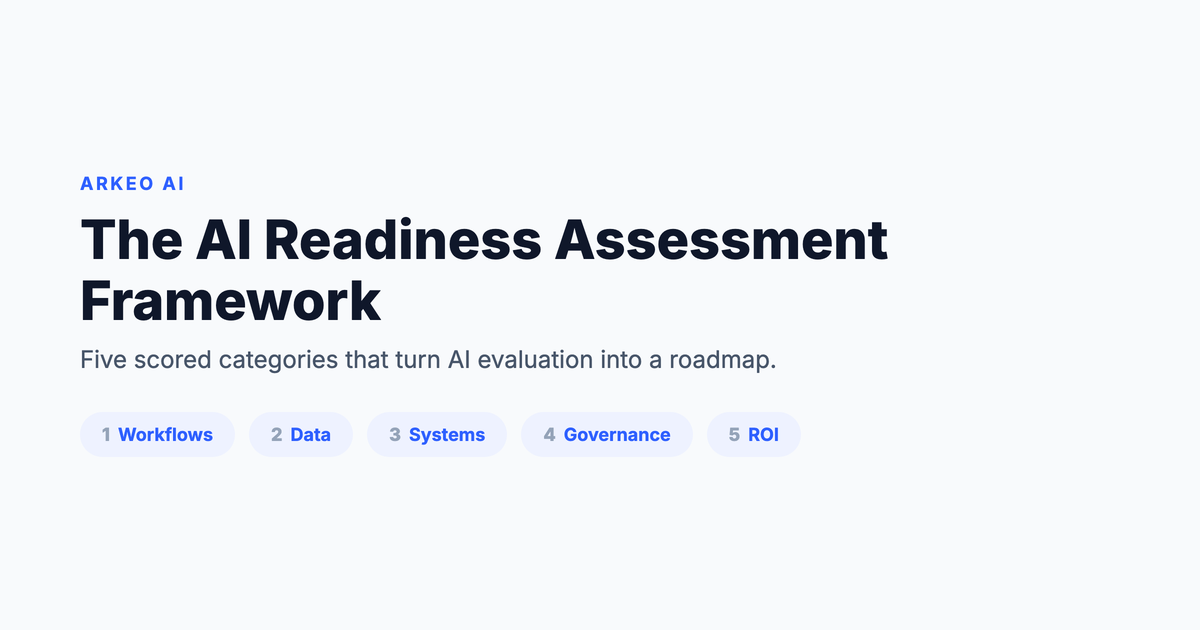
The framework has five categories. Each maps to a real business signal, not an abstract capability label, and each carries one diagnostic question, a 1-to-5 score range, and a recommended next action. Score every category, and you have both a diagnosis and a starting point for the work.
| Category | Diagnostic question | Score range | Recommended next action |
|---|---|---|---|
| Workflows | Can you name the repetitive, high-volume workflow AI should touch first, end to end? | 1 = no documented process; 5 = mapped, measured, owned | Document the top workflow before any tooling decision |
| Data | Is the data that workflow depends on accessible, accurate, and in one trusted place? | 1 = scattered and unreliable; 5 = clean, governed, queryable | Consolidate and clean the source data the agent will read |
| Systems | Can your core systems be connected through APIs or a private integration layer? | 1 = closed, manual handoffs; 5 = open, integrated, automatable | Map integration points and access before scoping the build |
| Governance | Do you control where data goes, who approves AI output, and how it is logged? | 1 = no policy, shadow usage; 5 = clear policy, oversight, audit trail | Set an AI use policy and approval path before scaling |
| ROI clarity | Can you state the dollar or hour value of solving this workflow, with a baseline? | 1 = no baseline or target; 5 = quantified value and a measurable goal | Define the baseline metric you will move before you build |
Notice what is missing from that table: the model, the vendor, the chatbot brand. None of those are readiness categories, because none of them are where projects fail. They are the easy 10% you choose last, after the framework has told you the hard 90% is in order.
See where your business actually stands
A free Arkeo assessment scores your operation across these five categories and hands you a prioritized starting point, not a sales pitch.
Book Your Free AI Assessment →
Five categories the framework scores, four highlighted, all five required
The framework scores five categories on a 1-to-5 scale. Below are the four where mid-market firms most often miss points. The fifth is talent — your team's capacity to absorb AI deployments and own the agents after handover.
Workflows
Are the bottleneck workflows mapped, stable, and repeatable enough that automating them pays back?
Data
Is the data the model needs reachable, clean, and authorised to leave the system of record?
Systems
Can an agent actually integrate with your CRM, ERP, and document store? Native connectors or custom work?
Governance
Are RBAC, audit logs, human-in-the-loop, and escalation paths in place before the first deployment?
How Do You Score Each Category?
Score every category on a simple 1-to-5 scale, where 1 means "we have not started" and 5 means "this is documented, governed, and owned." Keep it honest. The point of the scale is not a flattering number; it is a true picture you can act on. Use these anchors so different people scoring the same business land in roughly the same place.
1 to 2 (Absent): The capability is undocumented, unowned, or unreliable. AI built on top of it will inherit the mess.
3 (Emerging): The capability exists in pockets but is inconsistent across teams. Workable for a tightly scoped pilot, risky to scale.
4 to 5 (Solid): The capability is documented, measured, and has a named owner. AI can be deployed here with real confidence.
Add the five category scores for a total out of 25. That single number is your readiness score, and it maps onto a maturity band you can read in seconds.
Three honest bands on the readiness ladder
The framework scores you out of 25. The three bands below tell you what to do with that number. The ladder rungs are not equal in difficulty — the move from low to moderate is governance work, the move from moderate to high is architecture work.
Low readiness
Foundational gaps in data, governance, or ownership. Off-the-shelf agent before any custom build. Build trust first.
Moderate readiness
Ready for a scoped first agent on the strongest workflow. Custom build feasible. Governance solid.
High readiness
Architecture-stage. Cross-departmental agent network. Private deployment on owned data. Compounding moat.
How Do You Apply the Framework Across Departments?
The same five categories travel across every function, but the diagnostic questions sharpen as you move from team to team. Score each department separately, because readiness is rarely uniform. It is common to find one function ready to deploy this quarter while another needs six months of data work first.
Operations
Operations usually has the highest-volume, most repetitive workflows, which makes it the most tempting starting point and the most data-dependent. Score the data category hard here. If the scheduling, dispatch, or fulfillment data lives across disconnected systems, that low data score outranks the high workflow score and tells you where to spend first.
Sales and Support
Sales and support score well on workflow clarity and ROI, because the value of faster responses and better follow-up is easy to quantify. Governance is the category to watch: customer data, call records, and contracts raise the bar for where information can travel. A strong workflow score paired with a weak governance score is a signal to deploy privately, not publicly.
Finance and Reporting
Finance scores high on ROI clarity and data structure but often low on systems openness, because finance tools are deliberately locked down. The framework keeps you honest here: do not promise a finance agent until the systems category proves the data can be reached safely and the governance category proves the outputs will be reviewed.
How Do You Interpret Your Readiness Score?
Your total out of 25 lands you in one of three maturity bands. The band does not just describe you; it prescribes a different next move. Picture an operations lead who scores their company a 12: the number itself is less useful than knowing it puts them in the middle band, where the right move is targeted fixes, not a full build.
Low Readiness (5 to 11): Foundations First
A low score is not a verdict that AI is wrong for you. It means the foundations are not in place yet, and deploying now would produce an expensive pilot that stalls. The work here is unglamorous and high-leverage: document the top workflow, consolidate the data behind it, and assign an owner. This is the band where most companies live, and where a framework saves the most money by stopping a premature build.
Moderate Readiness (12 to 18): Targeted Wins
A moderate score means at least one category is solid and one or two are dragging. This is the most actionable band. The play is a tightly scoped agent on the strongest workflow, run in parallel with focused remediation on the weakest category. You earn a real result and close a real gap at the same time, which is exactly how durable AI programs are built.
High Readiness (19 to 25): Scale With Discipline
A high score means you can deploy with confidence across multiple functions, but it raises a different risk: moving too fast and skipping governance. Gartner predicts over 40% of agentic AI projects will be canceled by the end of 2027, often because scaling outran the controls. High readiness is permission to scale, not permission to skip the audit trail.
If you want the longer view on how this scoring connects to a full evaluation, the AI readiness assessment hub walks through the broader process the framework feeds into.
How Do You Turn the Framework Into a Roadmap?
A score is a diagnosis. A roadmap is a treatment plan. The bridge between them is three moves, and this is where the framework stops being an assessment and starts being a plan your leadership team can fund.
Prioritization
Rank opportunities by readiness, not by excitement. The workflow with the highest combined category score is the one to deploy first, because it is the one most likely to survive production. The framework gives you that ranking automatically: highest category scores go first, lowest become foundation work. This is the heart of the Arkeo methodology, which sequences quick wins in the first 30 to 90 days before committing to the harder, custom workflow agents.
Ownership
Every category needs a named human owner before any build begins. Unowned AI is how shadow usage takes root. Nearly half of workers admit to using AI tools without employer approval, and that number climbs fastest where governance has no owner. Assign owners as part of the roadmap, not as an afterthought.
Quick Wins
Use the moderate-band logic everywhere: pair one fast win with one foundation fix. A quick win funds belief and buys time. A foundation fix raises the next score. Run them together and the readiness number climbs while the business sees results, which is the only way an AI program keeps its budget past the first quarter. If sequencing that work is the part that stalls, a free planning session is built to do exactly this.
This is the same model Arkeo runs internally. Founded in 2023 by operators with 25 years of running real businesses, the firm deploys these agents on its own work first, often on private, on-premise infrastructure, before recommending anything to a client. The framework above is the front door to that process, and a free assessment is the fastest way to apply it to your numbers instead of generic ones.
Turn your score into a roadmap
Apply this framework to your business in a free planning session and leave with a prioritized, owner-assigned next step.
Book Your Free AI Assessment →