Category
AI Maturity Model vs AI Readiness Explained
Last updated: May 2026
You are weighing two assessment frameworks, and the vendors selling them keep using the words interchangeably. One consultant wants to score your AI maturity. Another wants to run an AI readiness assessment. Both promise clarity, both cost real money and calendar time, and from the outside they look like the same exercise wearing different labels. They are not. Picking the wrong one means you either benchmark yourself into a comfortable number that changes nothing, or you skip the strategic context you actually needed. Arkeo has spent three years deploying AI agents inside real operations, and the distinction between these two tools is one of the most consequential calls a mid-market leader makes before spending a dollar on AI.
Quick Answer
• AI maturity model: a staged scorecard that benchmarks how far along your whole organization is, usually on a five-level scale.
• AI readiness assessment: a pre-deployment check on whether a specific workflow can ship, and what data, security, and ownership gaps stand in the way.
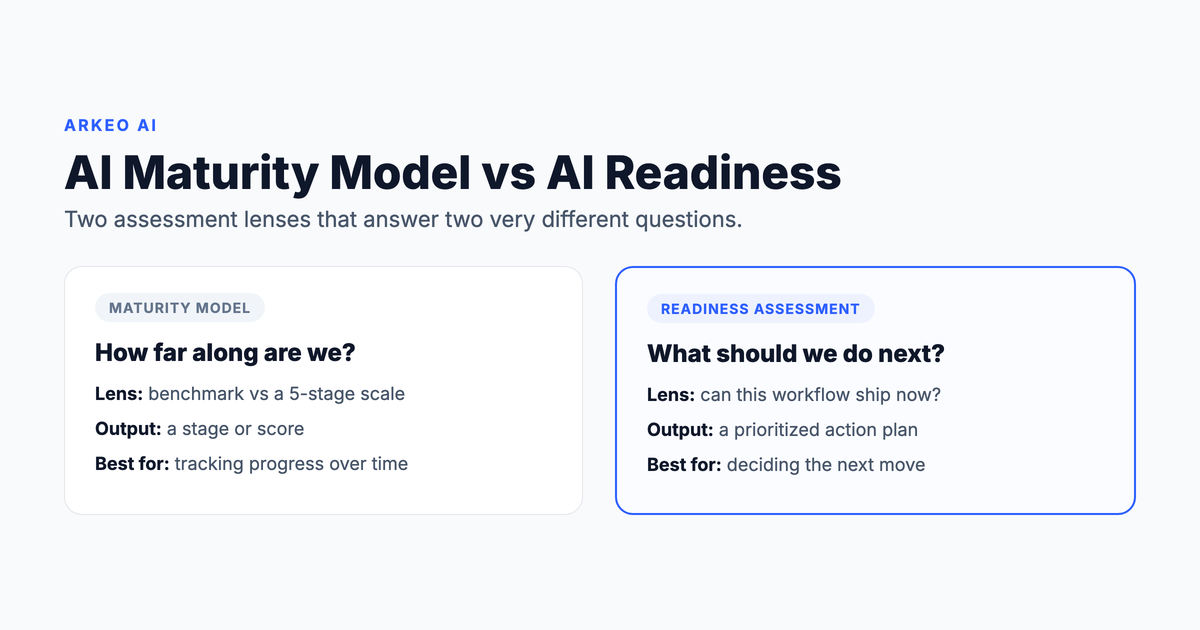
• The difference: maturity tells you where you stand; readiness tells you what to do next.
• Which first: for most mid-market operators, readiness is the more useful near-term tool, because it ends in a decision rather than a number.
The good news is that the choice is not subtle once you separate the questions, and a focused free AI Assessment resolves it in a single session. The short version, then the detail. An AI maturity model benchmarks how far along your whole organization is on a fixed scale; an AI readiness assessment decides whether a specific workflow can be deployed now and what is blocking it. Maturity is a measurement. Readiness is a decision. Conflating the two is the most common reason an AI program produces a polished report and zero deployed agents.
What Is an AI Maturity Model?
An AI maturity model is a staged framework that rates how advanced your organization is at adopting and operating AI, typically across five levels. The lowest stage is no meaningful AI activity. The highest is AI embedded across the business, governed, measured, and improving on its own cadence. In between sit the stages most companies actually live in: scattered experiments, a few isolated wins, the early work of standardizing.
A maturity model scores you across dimensions like strategy, data infrastructure, talent, governance, and operating model. The output is a stage, sometimes a numeric score, and a sense of which dimension is dragging the rest down. It is a benchmarking instrument. Its real value is comparison: against where you were last year, against a stated target, and against a shared definition that lets a leadership team stop arguing about words and start arguing about evidence.
What an AI Maturity Model Measures
Maturity models measure organizational capability, not project feasibility. They ask whether you have an AI strategy, whether your data is governed, whether you have the talent and the operating disciplines to scale. Those are fair questions. The catch is that they are answered at altitude. A model can place you at "stage two of five" with real rigor and still tell you nothing about whether the invoice-processing workflow your CFO wants automated is anywhere near ready to ship.
What Is an AI Readiness Assessment?
An AI readiness assessment is a pre-deployment evaluation of whether a specific workflow, dataset, and team are ready to put AI into production, and what concrete gaps stand in the way. Instead of rating the whole organization, it goes narrow and deep on the thing you are actually trying to do. Is the data clean and accessible. Who owns the workflow. What is the cost of the agent being wrong. What has to be true before you flip the switch.
The deliverable is not a score. It is a prioritized, owned action plan: a gap analysis, a shortlist of use cases ranked by value and feasibility, a phased roadmap, and a set of risk flags. A readiness assessment ends in a decision and a sequence, which is exactly what a maturity score cannot give you.
What an AI Readiness Assessment Measures
Readiness measures deployment feasibility for a defined use case. It looks at data quality and access, integration points, security and compliance constraints, the human owner who will run the workflow after launch, and the failure modes that have to be contained. Where maturity surveys the landscape, readiness inspects the one bridge you are about to drive a truck across. That is the harder work, and it is where projects quietly die before they ever launch.
Turn the comparison into a decision
A free AI Assessment maps your bottlenecks and data, then hands you a prioritized 30-to-90-day plan, so you leave with a next move, not just a maturity score.
Book Your Free AI Assessment →
Maturity tells you where you stand. Readiness tells you what to deploy next.
Both frameworks have their place. The mistake is using one to answer the other's question. Use maturity to benchmark a whole organisation across time. Use readiness to decide whether a specific workflow is shippable today.
Where the organisation stands
What can be deployed now
AI Maturity vs AI Readiness: How Are They Different?
Here is the distinction that matters in practice. A maturity model tells you where you stand. A readiness assessment tells you what to do next. You can be a "stage three" organization and still have a flagship use case that is nowhere near deployable, because maturity averages across the business while readiness drills into one workflow. The two frameworks answer different questions, on different time horizons, at different units of analysis.
The side-by-side below is the asset to bookmark. It is the fastest way to see why these are not interchangeable, and why reaching for the wrong one wastes a quarter.
| Dimension | AI Maturity Model | AI Readiness Assessment |
|---|---|---|
| Core question | How far along are we as an organization? | Can we deploy this specific use case now, and what is in the way? |
| Output | A stage or score on a fixed scale (often five levels) | A prioritized, owned action plan with a sequence and timeline |
| Time horizon | Multi-year trajectory and trend | The next 30 to 90 days, then the path beyond |
| Unit of analysis | The whole organization or a function | A specific workflow, dataset, and team |
| Best for | Benchmarking, board reporting, and tracking change over time | Pre-deployment decisions about what to build and in what order |
| Risk if used alone | A score that feels like progress but never moves a workflow | A strong near-term plan with no long-term picture to anchor it |
Read down the "core question" row first. "How far along are we?" and "Can we deploy this now?" are not the same question, and they do not have the same answer. Most of the confusion in the market collapses once you separate those two sentences, and the cost of getting it wrong is a quarter spent measuring instead of building.
Three bands on a typical AI maturity ladder
The ladder usually has five rungs, but the rungs cluster into three honest bands. Most mid-market firms sit somewhere in the middle and want to talk about the top. The work is honest about where the ladder actually says you are.
Exploring
Pilots running, no central governance, shadow AI live. Most mid-market firms today.
Operating
Two or three workflows in production. Owner named per workflow. Audit logs starting to land.
Compounding
Cross-departmental agent network. Private deployment on owned data. Hard to copy.
When Should You Use Each One?
Both tools are legitimate. The mistake is using them out of order, or expecting one to do the other one's job.
Use a maturity model for benchmarking. If you are reporting to a board, aligning multiple business units on a shared definition, or tracking whether your AI program is genuinely advancing year over year, a maturity model is the right instrument. It gives leadership a common scorecard and a trend line. McKinsey's 2025 State of AI research found that 88% of organizations now use AI in at least one function, yet only about a third have scaled it and only 39% report any EBIT impact. A maturity model is a reasonable way to track which side of that gap you are on over time.
Use a readiness assessment for pre-deployment decisions. When budget is about to be committed, when a specific workflow is on the table, or when you need to know what to build first, an AI readiness assessment is the tool. It surfaces the data, security, and ownership gaps that decide whether a project ships or stalls. This is where most of the value, and most of the risk, actually lives.
Why Do Most Companies Reach for the Wrong One?
Most businesses assume that scoring their AI maturity is the responsible first step. They are wrong, and the data backs up why it stings. Gartner predicts that at least 30% of generative AI projects will be abandoned after proof of concept by the end of 2025, driven by poor data quality, weak risk controls, escalating costs, and unclear value. Notice what every one of those failure causes has in common: they are workflow-level and data-level problems. A maturity model operates above that level. You can score well on strategy and governance and still abandon a project because the underlying data was never clean enough to trust.
That is the blunt truth a benchmarking vendor will not put in the brochure: a maturity score can feel like progress while moving nothing. A staged report that lifts you from stage two to stage three reads as momentum on a slide and produces no deployed agent. The score went up. The work did not happen. The pattern Arkeo sees again and again is organizations that have a thick maturity deck and an empty production environment, because the assessment they bought measured posture instead of feasibility. A readiness-led AI Assessment would have caught those gaps before the money was spent.
Which One Matters More for Mid-Market Operators Right Now?
For a mid-market company under pressure to show AI results this year, readiness is the more useful first move, and it is not close. The reason is simple: a readiness assessment ends in a decision, and a maturity score ends in a number. Decisions move budgets and workflows. Numbers move slide decks.
This is where Arkeo's approach is deliberately operational rather than academic. The free AI Assessment runs a readiness lens across your operation: it maps the current state and your data, names the 30-to-90-day easy wins, identifies the top custom-agent opportunities, and sketches the long-term architecture toward a private AI operating system. Because Arkeo deploys these agents in production and runs its own operations on the same systems it sells, the assessment is grounded in what actually ships, not what scores well. The point of separating readiness from maturity is not theory. It is to make sure the next thing you do is build something, not file a report.
None of this means maturity models are useless. Once you are deploying, a maturity model is a sound way to track the trajectory your readiness-driven decisions create. The sequence is what matters: lead with readiness so you act, then use maturity to measure whether the program is genuinely advancing. Leading with the score is how good intentions turn into a binder nobody opens.
Know what to build first
In one 60-minute session, the free AI Assessment pressure-tests your highest-value workflow and tells you whether it is ready to deploy now.
Book Your Free AI Assessment →
Pick the framework that answers the question you actually have
Boards ask the maturity question. Operators ask the readiness question. Confusing them is how a strategy document ships without anyone able to point to the workflow it is paying for.