Category
Moving Up the AI Maturity Curve
Last updated: June 2026
If you run a $10M to $200M company and you already know where you sit on the AI maturity curve, the only question left is which move actually advances you a stage and which one quietly burns a quarter and a budget. The companies that pick the wrong move next year do not come back to the board with a working agent; they come back with a paused pilot, a vendor invoice, and a slide that says “learnings.” In this guide, you will get the stage-by-stage actions that move a mid-market operation up the curve, the readiness gate to clear before each move, and the discipline that keeps the climb workload-specific so you advance one process at a time instead of trying to graduate the whole company at once.
The bottom of the curve is now nearly universal — the Stanford HAI 2025 AI Index records the largest year-over-year jump in adoption in the Index’s history. The top is not. Arkeo has spent three years deploying agents on its own operations and on mid-market client engagements, and the firms that climb the curve fastest do not have more AI talent; they have a tighter answer to the question “what is the next move for this specific workflow.”
of organizations used AI in 2024, up from 55% in 2023 — the largest year-over-year jump in the AI Index’s history.
Source: Stanford HAI 2025 AI Index
Quick Answer
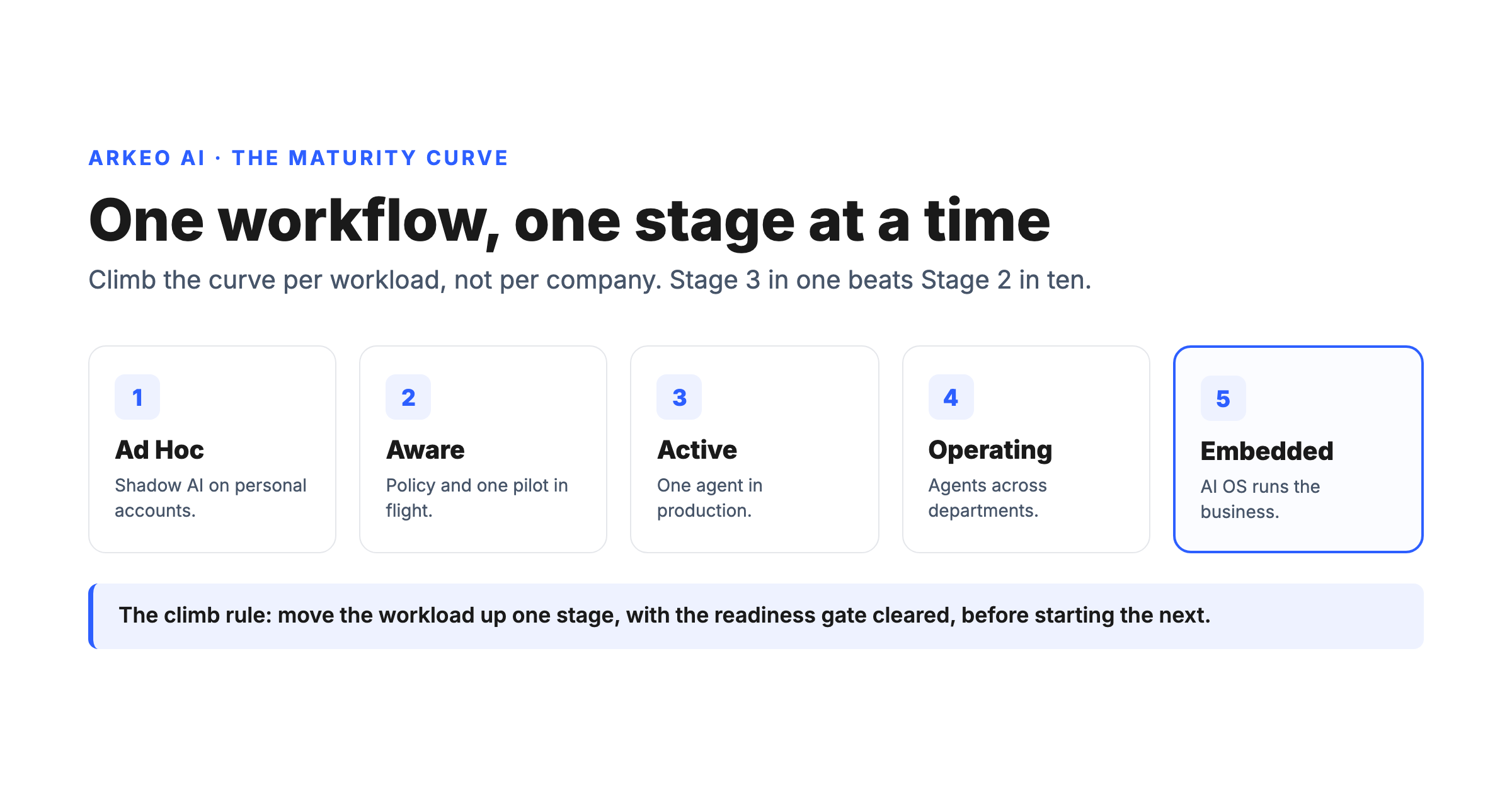
• What it is: The AI maturity curve is the path from shadow AI on personal accounts to a private AI operating system that runs the business. Five stages: Ad Hoc, Aware, Active, Operating, Embedded.
• The climb rule: Move one workload up a stage, not the whole company. Stage 3 in one workflow beats Stage 2 across ten.
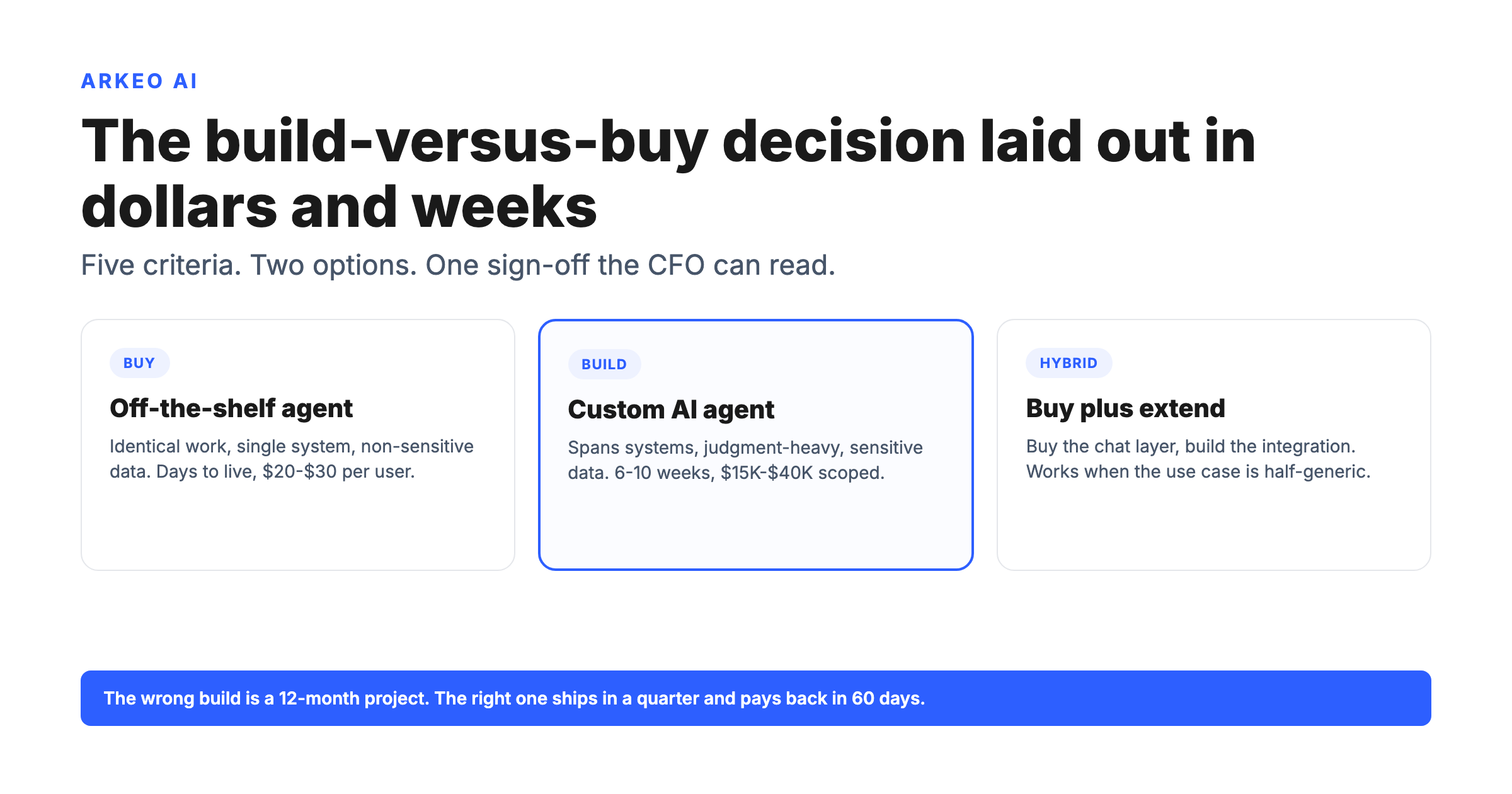
• What it costs: A scoped single-workflow agent runs about $15K to $40K and reaches production in 6 to 10 weeks. Off-the-shelf copilots are $20 to $30 per user per month and live in days.
• Why it matters: More than two-thirds of enterprises expect 30% or fewer of their AI experiments to scale in the next three to six months (Deloitte Wave 4). Picking the next move well is what separates the climbers from the stalls.
• Next step: Book a free AI Assessment — Arkeo will audit your workflows to see if you are ready for custom agents.
What does “moving up the AI maturity curve” actually mean?
Moving up the AI maturity curve means advancing one specific workload through the five stages of operating discipline (Ad Hoc, Aware, Active, Operating, Embedded), not raising a single company-wide AI score. Maturity is workload-specific. A 200-person manufacturer can sit at Stage 3 for its quoting workflow and Stage 1 for its finance close on the same Monday morning. The climb is per-workload, and the right operator question is never “how do we move the company up” but “what is the next move on this workflow.”
The curve is the same five-stage ai readiness model Arkeo uses on engagements. Stage 1 (Ad Hoc) is employees on personal ChatGPT accounts with no policy. Stage 2 (Aware) is policy in place, paid copilot seats, one pilot underway. Stage 3 (Active) is at least one custom workflow agent in production, with documented data and approvals. Stage 4 (Operating) is three or more agents across two or more departments, integrated with the ERP or CRM and monitored daily. Stage 5 (Embedded) is an AI operating system running the business, with new agents standing up in days. The climb is the deliberate sequence of moves that takes a workflow from wherever it sits today to the next stage above it, without skipping the readiness gate in between.
How do you actually climb from Stage 1 to Stage 2?
Stage 1 is shadow AI. The Stanford HAI 78% adoption figure includes you whether the CFO believes it or not, because employees are already pasting customer data, contract clauses, and forecast spreadsheets into public ChatGPT. The first move up is not a build; it is a policy and an inventory.
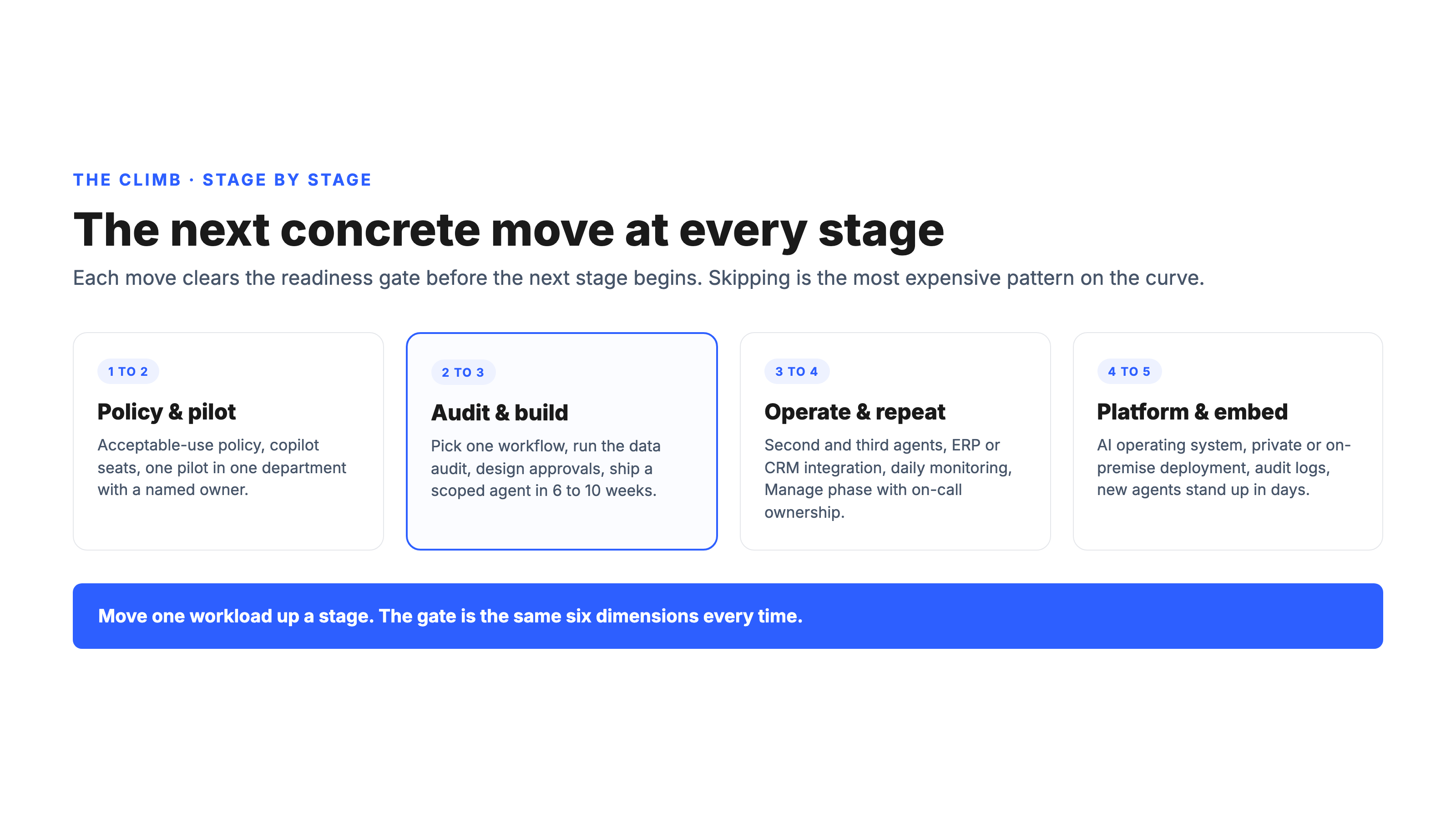
The Stage 1 to Stage 2 climb has four concrete moves. First, publish an acceptable-use policy that names which tools are sanctioned and which categories of data are off-limits. Second, buy enterprise seats for one copilot (Microsoft 365 Copilot or ChatGPT Enterprise are the two mid-market defaults), at roughly $20 to $30 per user per month. Third, pick one department and one workflow that will run a 30-to-90-day pilot, with a named owner. Fourth, take an honest inventory of where employees are already using AI on personal accounts so the policy is enforceable rather than aspirational.
The reason this move is non-negotiable is the cost of skipping it. The IBM 2025 Cost of a Data Breach report puts the global average at $4.44 million. Companies that sit at Stage 1 for too long are not saving money; they are accruing a tail risk that surfaces on a single bad Tuesday.
U.S. average breach cost in 2025 — an extra $670K when shadow-AI usage is high, and 97% of breached AI apps lacked proper access controls.
Source: IBM 2025 Cost of a Data Breach
How do you climb from Stage 2 to Stage 3?
Stage 2 to Stage 3 is the most important transition in the curve and the one most mid-market operators get wrong. Stage 2 is a pilot; Stage 3 is one custom workflow agent in production with documented data, designed approvals, and a measurable output on the operating P&L. The line matters here: a copilot rolled out company-wide is still Stage 2, no matter how many seats are paid for, because nothing has been built into a workflow yet.
The five moves that close the gap:
STAGE 2 TO STAGE 3
The five moves that close the gap
One workflow, one owner, one P&L line. Each move is a decision before the build, not a discovery after.
MOVE 01
Pick one workflow
One process, one owner, one P&L line. Quoting, invoice routing, RFP triage, customer onboarding, RFQ response. Workloads with structured inputs and clear approval points climb fastest.
MOVE 02
Run the audit
Inventory every data source the workflow touches, pull a 100-row sample, document integration cost, and flag regulated fields. Skip this and the build stalls at week six.
MOVE 03
Design the approvals
Decide before the build where a human signs (invoices over $5K, refunds, contract clauses). Human-in-the-loop rules belong in the spec, not the post-launch fire drill.
MOVE 04
Build the agent
Scoped single-workflow agents typically cost $15K to $40K and ship in 6 to 10 weeks (8 to 12 for private or on-premise). The first quick win lands inside 30 to 90 days.
MOVE 05
Name the owner
A named internal operator owns the agent the day after it ships. Without ownership, the agent dies in 90 days and the workflow slides back to Stage 2.
A copilot rolled out company-wide is still Stage 2. Stage 3 is one workflow agent in production, owned by a named operator.
Most mid-market operators believe they are already at Stage 3 because a copilot is in use. That belief is the most expensive mistake on the curve. The PwC AI Agent Survey of 300 senior US executives reports 79% of US businesses say AI agents are already being adopted and 88% plan to increase AI-related budgets in the next 12 months. The budget is coming. Whether the operation can turn that budget into a deployed agent is what the Stage 2 to Stage 3 climb decides.
Find out which stage your workflows are actually atThe free AI Assessment audits one of your workflows end-to-end, places it on the maturity curve, and tells you the next move to get to Stage 3. No pitch deck.
Book Your Free AI Assessment →
How do you climb from Stage 3 to Stage 4?
Stage 3 is one agent in production. Stage 4 is operating discipline at scale: three or more agents across two or more departments, integrated with the ERP or CRM, monitored daily, with a Manage phase that has on-call ownership and a runbook. The climb here is not a bigger build; it is the addition of operating muscle that was tolerable to skip with one agent and lethal to skip with three.
The three moves that close the Stage 3 to Stage 4 gap. First, repeat the audit-and-build cycle on a second and third workflow, ideally in a different department, so the company learns to ship more than once. Second, install a Manage phase: a morning check by an internal owner, a quarterly review with the build partner, and a logged incident process for the failure modes that will surface (and they will). Third, integrate the agents with the systems where decisions actually get made. An agent that emails recommendations into a manager’s inbox is Stage 2 wearing a Stage 3 hat. An agent that writes back to the ERP or CRM under a designed approval rule is Stage 4 in the making.
An agent that emails recommendations into a manager’s inbox is Stage 2 wearing a Stage 3 hat.
The reason operating discipline becomes existential at Stage 4 is failure mode density. The IBM IBV CEO Study of 2,000 CEOs across 33 countries reports 54% of CEOs are already hiring for AI roles that did not exist a year ago, 31% of the workforce will require retraining or reskilling over the next three years, and 65% plan to use automation to address skills gaps. Read those as one sentence: the people side of the curve is now a board-level capital allocation question. Arkeo has been in business for 25 years operating real companies before deploying agents on top of them, which is why the Manage phase looks like operations work: owner names, on-call rotations, incident logs.
How do you climb from Stage 4 to Stage 5?
Stage 5 (Embedded) is an AI operating system: agents are first-class workers with scoped permissions, audit logs, private or on-premise deployment, and a managed lifecycle. A new agent stands up in days, not quarters, because the platform, the data pipelines, the approval rules, and the on-call ownership have all been built once and are reused. Most mid-market companies will not reach Stage 5 in the next two budget cycles, and that is fine. The companies that do reach it have decided AI is a permanent operating capability, not a project.
The climb from 4 to 5 is the conversation about deployment model. At three or more agents touching customer data, regulated fields, or competitive IP, the question is no longer “which copilot” but “where does the workload actually run.” Public-cloud SaaS is the cheapest. Private cloud and on-premise add cost and add control. Arkeo deploys private and on-premise AI workforces under the Assess, Deploy, Manage model so data never leaves the building, and uses the same operating system internally; we use what we sell. The Stage 5 conversation belongs in ai readiness only insofar as it is the gate that lets you have it; the platform decision itself belongs in the architecture and private-AI conversation.
What is the readiness gate before each climb?
Every move up the curve has the same gate: a six-dimension workload score that has to clear 3 out of 5 in every dimension before the move is sanctioned.
THE READINESS GATE
Six dimensions, every climb
Score the workload 1 to 5 in each dimension. Clear 3 of 5 in every one before the next move is sanctioned.
DATA
Data availability
Is the data the agent needs already captured digitally, in a system reachable via API or export? PDFs in a shared drive score zero until parsed.
DATA
Data quality
Is the data correct, current, deduplicated, labeled? An agent on dirty CRM contacts scales bad outcomes faster, not better.
SYSTEMS
System integration
Can the agent reach the ERP, CRM, ticketing system, and approval queue where decisions get made? If it’s a CSV emailed twice a day, the agent lives as a suggestion box.
PROCESS
Workflow clarity
Has the current workflow been written down? An agent cannot automate a process that lives only in the head of one senior operator about to retire.
GOVERNANCE
Governance & approvals
Where does the agent need a human signature? Dollar thresholds, refund authority, contract clauses. Approval design belongs before the build, not after.
PEOPLE
Culture & ownership
Does a named operator own the agent the day after launch? If the answer is the consultant, the agent dies in 90 days.
No dimension below 3. Every climb, every workload, every stage.
The NIST AI Risk Management Framework organizes the same gate around four functions: Govern (policy and ownership), Map (workflow and data audit), Measure (the maturity score plus ROI), and Manage (on-call ownership and lifecycle). Most mid-market operators do not need to implement NIST line-by-line; they do need to know it exists, because regulators, insurers, and enterprise customers will start asking inside the next two budget cycles.
What slows the climb and how do you avoid it?
Three patterns slow the climb. The first is the “everything pilot” trap: ten experiments running at once, none scoped tightly enough to graduate to production. BCG research published in October 2024 puts a number on this gap. The fix is the move-one-workload-up rule, paired with a disciplined ai audit on the workflow before any build is sanctioned.
of companies struggle to scale value from AI, and only 4% have built cutting-edge AI capabilities that consistently generate significant value.
Source: BCG, October 2024
Two workloads at Stage 3 beat ten workloads at Stage 2 every quarter.
The second is buying a platform before running an audit. The platform license shows up before the workflow is mapped, the data is sampled, or the approvals are designed, and the platform ends up as expensive abandonware. The fix is the audit-before-contract rule. Run an ai readiness assessment first and sign nothing larger than a free assessment until the workload has cleared the six-dimension gate above.
The third is forgetting the operating model. Stage 3 is not the finish line; it is the foundation. Without a Manage phase — ownership, runbook, on-call — the first agent reverts to a quiet utility nobody quite trusts, and the climb stalls. Arkeo has been deploying agents since 2023 on this exact pattern, including the agents that run Arkeo’s own operations, and the Manage phase is the difference between a working agent and a paused one.
Pick the next move on one workflowArkeo’s free AI Assessment scores one of your workflows against the six readiness dimensions and names the next move that actually advances a stage. 30 minutes, working session.
Book Your Free AI Assessment →