Category
AI Audit Software: Build vs Buy
Last updated: June 2026
If you are a mid-market CEO, COO, or technical leader and the board has asked you to evaluate AI audit software before you spend the next dollar on AI agents, you have probably already opened tabs for Anecdotes, OneTrust, MetricStream, and Credo AI, and your engineering lead has quietly suggested coding something internal in two weeks. Pick the wrong path and the cost is not the license, it is the six months of integration work that produces a dashboard nobody on the executive team trusts, plus a renewal invoice in twelve months for a tool that never moved a workload past Stage 2 of the maturity model. This guide gives you the five-question decision matrix Arkeo runs on its own engagements, the honest cost ranges for both paths, and the specific signals that tell you which one fits your operation so you can take the build-versus-buy recommendation to your board with the math already done.
The failure mode that repeats inside the audit-software question is not tool quality. The platforms are competent and the in-house builds usually work. The mistake is buying or building before the underlying readiness work has been done, which produces a $40K SaaS subscription that audits nothing useful because the data, workflows, and approvals were never mapped first. Arkeo has seen this across three years of client engagements and its own operations.
Quick Answer
• What it is: AI audit software inventories AI use across the company, scores risk, and produces a defensible record of models, data flows, and approvals.
• Cost (buy): commercial platforms typically run $25K to $150K per year in the mid-market, plus 4 to 12 weeks of integration work.
• Cost (build): a lightweight internal audit system is roughly 80 to 200 engineering hours plus an owner; ongoing cost is the owner's calendar.
• Decision rule: buy when audit is a board or regulator deliverable on a hard deadline; build when audit is an internal operating discipline you intend to evolve every quarter.
• Next step: Book a free AI Assessment, Arkeo will audit one of your workflows to see if you are ready for custom agents.
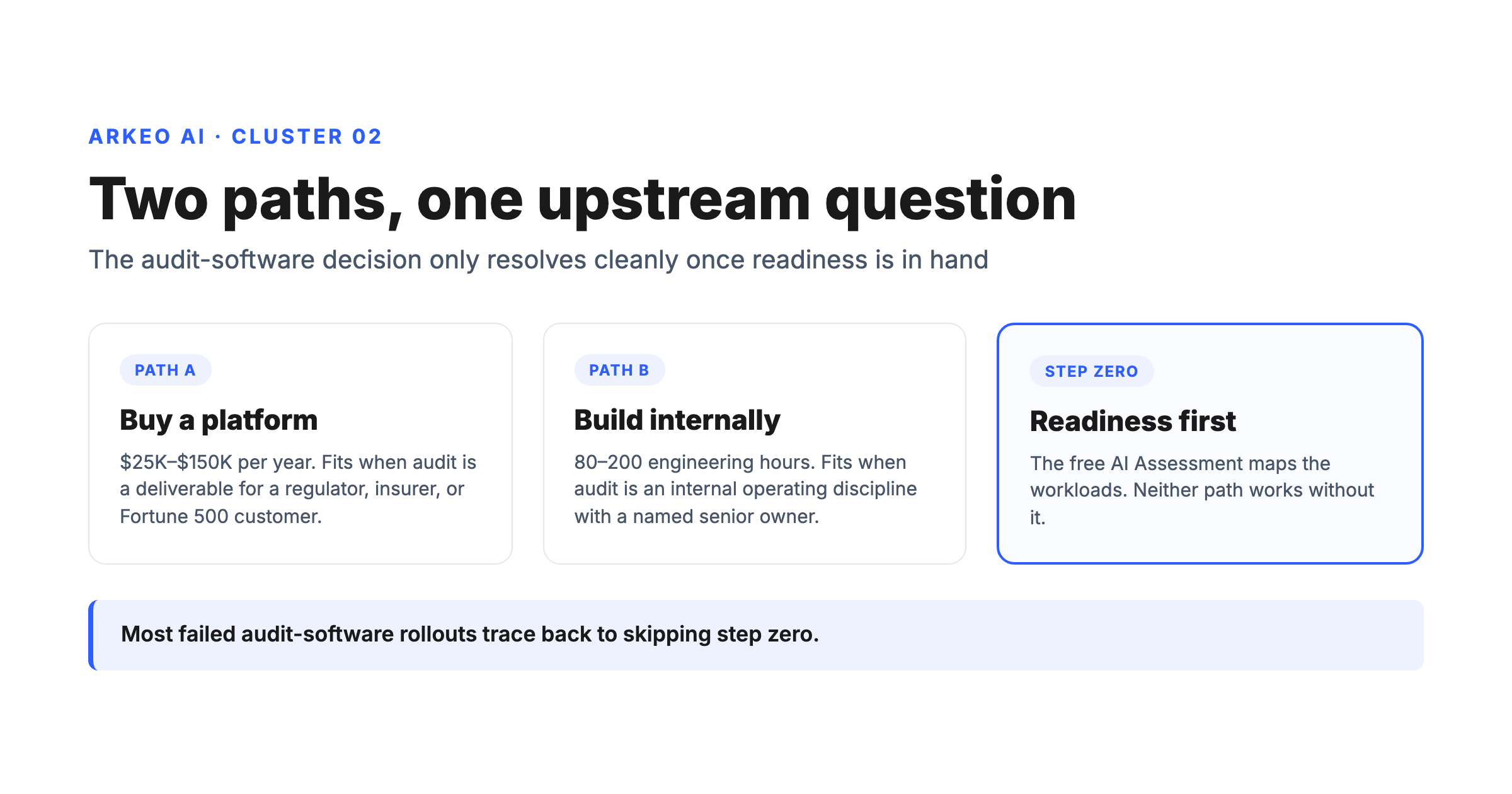
Buy a platform or build internally?
Audit is an external deliverable on a hard deadline (regulator, insurer, Fortune 500 customer review). Inventory exceeds 30 use cases. Cost: $25K–$150K/year. Timeline: 4–12 weeks to roll out.
Audit is an internal operating discipline. Under 30 use cases. Sensitive data needs private deployment. Senior owner runs the cadence. Cost: 80–200 engineering hours. Timeline: 2–4 weeks to first review.
What does AI audit software actually do?
AI audit software is a system of record for every AI model, agent, copilot, and data flow inside the business, scored against a risk and governance framework so the company can produce a defensible answer to a regulator, an insurer, an enterprise customer, or a board. The category sits between governance, risk, and compliance (GRC) tooling on one side and ML observability on the other. The good products do four things: they inventory AI usage (often by integrating with single sign-on and SaaS discovery), they score risk against a framework (frequently the NIST AI RMF), they capture data lineage and approvals, and they produce the artifact a third party can audit.
The reason this question is on the board agenda now: 78% of organizations reported using AI in 2024 per the Stanford HAI 2025 AI Index, the largest year-over-year jump in the Index's history. The board is hearing the number, the legal team is hearing the EU AI Act, and the CFO is hearing the breach figures. Skipping the audit layer is what produces the numbers in IBM's 2025 Cost of a Data Breach report: 97% of organizations that suffered a breach of an AI model or application lacked proper AI access controls, and organizations with high shadow-AI usage incurred an extra $670,000 per breach on top of a US average that hit an all-time high of $10.22 million.
of organizations reported using AI in 2024 — the largest year-over-year jump in the Index’s history.
Source: Stanford HAI 2025 AI Index
U.S. average breach cost in 2025, an all-time high. Shadow-AI usage added $670K per breach.
Source: IBM Cost of a Data Breach 2025
Option A: when buying AI audit software fits
The buy case is real and you should not pretend it is not. The platforms exist because building governance tooling from scratch is genuinely expensive when the deliverable has to satisfy an external auditor, an insurer underwriting an AI rider, an EU customer asking about AI Act compliance, or a board that wants to see a vendor logo behind the dashboard. Anecdotes, OneTrust, MetricStream, Credo AI, and the GRC majors all compete here. The functional core is similar: a control library mapped to NIST AI RMF and ISO 42001, a workflow engine for evidence collection, a risk register, and a reporting layer.
The buy path fits when three conditions are true. First, audit is a deliverable on a hard external deadline (an EU AI Act conformity check, a SOC 2 expansion, a Fortune 500 customer security review). Second, the company already runs a GRC platform and audit-software is a module the existing vendor offers. Third, the leadership team values third-party-auditable evidence over operational depth. In those cases, the SaaS option compresses the time to a defensible answer from quarters to weeks.
The honest cost: mid-market commercial AI audit platforms typically land between $25K and $150K per year, depending on seat count and modules. Plan for 4 to 12 weeks of integration, an internal owner allocated at 0.25 to 0.5 FTE during rollout, and an annual budget line that survives the first CFO review cycle. Tools that price below $25K usually lack the inventory automation that justifies the spend; tools above $150K are typically enterprise-tier and overbuilt for a 50 to 500 person company.
Option B: when building your own AI audit system fits
The build case is also real, and it is the one most mid-market operators underestimate. A lightweight AI audit system is a structured registry (often a spreadsheet, Notion database, Airtable base, or a thin internal app) that captures the same four things the commercial platforms do, scoped to the company's actual AI usage. For an operator with 5 to 30 AI use cases across the company, a spreadsheet with disciplined columns plus a quarterly review meeting often outperforms a $50K platform in operational value.
The build path fits when three conditions are true. First, the audit is an internal operating discipline rather than an external compliance artifact. Second, your engineering team can carve out 80 to 200 hours over two to four weeks for the initial build (registry schema, ingestion of existing AI inventory, integration with the access management system, and the first round of risk scoring). Third, a named owner (a fractional CTO, a chief of staff, a head of operations) will run the audit cadence quarterly without it sliding to the bottom of the queue.
The risk on the build path is not the build, it is the maintenance. The IBM IBV 2025 CEO Study of 2,000 CEOs across 33 countries reported that lack of expertise is the top barrier to AI innovation, that 54% of CEOs are already hiring for AI roles that did not exist a year ago, and that 31% of the workforce will require retraining or reskilling over the next three years. If the named owner leaves or shifts roles, the in-house audit will be unmaintained inside two quarters and the company will be paying a different kind of price.
Where most operators get stuck (and the cost of getting it wrong)
Most mid-market operators think they have an audit-software problem when they actually have a readiness problem. The buying decision feels like the leverage point because it sits on a procurement deadline, but the leverage point is one step upstream. A $60K SaaS subscription auditing an unreadied operation produces a dashboard full of empty fields. A $0 spreadsheet auditing a readied operation produces a decision the CFO can act on. BCG research published in October 2024 found that 74% of companies struggle to achieve and scale value from AI and only 4% have built cutting-edge AI capabilities that consistently generate significant value. The cost of buying audit software for a Stage 1 operation is paying the platform tax while still landing in the 74%.
A $0 spreadsheet on a readied operation beats a $60K platform on an unreadied one. Every time.
The second failure mode is buying or building to a generic framework when the company actually needs a workload-specific audit. The platforms ship with a control library mapped to NIST AI RMF, which is the right reference, but the operator-grade question is whether a specific workflow agent ships safely, not whether the company is generically compliant. That question requires sitting in front of the workflow, not a dashboard.
Stuck between build and buy?The free AI Assessment audits one of your workflows end-to-end and tells you whether the platform tax or the in-house build fits your operation. Arkeo picks the right path based on your stack and data, not a vendor scorecard.
Book Your Free AI Assessment →
The five-question decision matrix
Run a candidate workload through these five questions before you sign a platform contract or open a build ticket. The matrix sits underneath every Arkeo recommendation on this question.
DECISION MATRIX
Five questions before build or buy
Walk these with the executive team in one sitting. The answer becomes obvious by question five.
QUESTION 01
Is the audit a deliverable for an external party?
A regulator, an insurer, a Fortune 500 customer security review, a board with public-company directors. If yes, the platform path usually wins because third-party auditability is what you are buying.
QUESTION 02
How many distinct AI use cases are in scope today?
Under 30 use cases, a structured registry handles it. Over 30 with a clear ramp to 100-plus, the inventory automation in a commercial platform earns its license.
QUESTION 03
Do you have a named owner who will run the cadence?
If no owner, neither path works. If owner exists and is a senior operator, build. If owner exists but is junior or part-time, buy so the platform enforces the cadence.
QUESTION 04
Will sensitive data flow through the audit system?
PII, PHI, financials, regulated workloads. If yes, evaluate where the audit data is stored. Some operators need a private or on-premise deployment, which often pushes the answer toward an internal build.
QUESTION 05
Has a readiness assessment been done first?
If no, do that before either path. Audit software cannot find what the company has not yet mapped. Most failed audit-software rollouts trace back to skipping this step.
Readiness assessment comes before either path. That is the discipline that separates operators who get value from those who pay a platform tax on an unreadied operation.
How do you actually run an AI audit?
Whatever path the matrix points to, the audit itself follows the same four passes. Pass one is the source inventory: list every AI tool, model, agent, copilot, and shadow-AI use across the company. Pull this from single sign-on logs, expense reports, and a 10-minute survey of each department head. In Arkeo's experience, mid-market operators routinely discover far more AI usage than they expected, mostly in shadow form. Pass two is the use-case scoring: for each entry, score the workload against six dimensions (data sensitivity, decision authority, integration depth, approval design, owner clarity, regulatory exposure). Pass three is the gap list: rank the workloads where the score is below 3 out of 5 in any dimension, because those are the ones that need work before any agent ships. Pass four is the runbook: every workload gets a named owner, a review cadence, and an incident protocol.
Whether that lives in a $60K platform or a $0 spreadsheet matters far less than whether the four passes actually get run. The platform makes pass one cheaper; the spreadsheet makes pass four faster to iterate on. The work is the same.
Can AI audit financial statements?
AI is already used inside the audit function for financial statements, but as a research and anomaly-detection assistant, not as the auditor of record. The Big Four firms publicly use AI for transaction sampling, journal-entry anomaly detection, contract review, and risk scoring. None of that displaces the partner sign-off. For a mid-market company, the relevant use of AI audit software is upstream: making sure the AI systems the finance team uses are inventoried, scoped, and reviewable, so the external auditor does not flag an uncontrolled AI model touching the books. If a finance workflow uses an AI agent to summarize transactions, the audit-software question becomes which records the model touched, what version it was, and who approved the output. That is the artifact AI audit software is designed to produce.
Can AI audit your content?
Yes, and this is a more common starting wedge than financial audit. Marketing teams use AI audit tooling to inventory every AI-generated piece of content, score it for brand compliance, detect prompt-leaked PII, and produce a defensible record for the rare case where a customer asks how a piece of copy was generated. The build path is usually correct here because the volume is high, the risk per piece is low, and the workflow is well-defined. A structured registry plus a guardrail layer in the publishing workflow handles 90% of the requirement.
What about the maturity model?
The build-versus-buy question is downstream of where the company sits on the ai readiness model. Stage 1 operators (shadow AI on personal accounts) should not buy audit software, because there is nothing to audit yet; the right move is a readiness assessment plus an acceptable-use policy. Stage 2 operators (policy in place, pilots underway) should build a lightweight registry. Stage 3 and above (custom agents in production) earn the case for either path depending on the five-question matrix above. Buying at Stage 1 is the most expensive mistake in this category.
Arkeo runs the ai readiness assessment as the front door to this decision precisely because the audit-software question only resolves cleanly once readiness is in hand. The Assess phase produces the inventory, the maturity score, and the go-or-no-go on each candidate workload. The Deploy phase puts the first agent into production. The Manage phase keeps the audit current as new workloads land. That is the Arkeo Operating System, and Arkeo runs it on its own operations: we use what we sell.
Audit your workflows before you sign anythingThe free AI Assessment audits one of your workflows against the readiness model and gives you a build, buy, or fix-first decision you can take to the board. No platform pitch, no slide deck.
Book Your Free AI Assessment →