Category
What Is AI Readiness? A Guide for Operators
Last updated: June 2026
If you are a CEO or COO at a $10M to $200M business and a vendor pitched you AI agents last quarter, the question your CFO is going to ask in the next board meeting is not whether AI is real. It is whether your operation is actually ready to run it. The wrong answer surfaces six months from now as a stalled pilot, a six-figure write-off, and a budget line that gets quietly cut for next year while a competitor that took readiness seriously ships its first agent into production. In this guide, you will get a plain-language definition of AI readiness, the four things it is commonly confused with, a six-dimension readiness test you can run against your business today, and the next move so you can answer the board with a credible plan instead of vendor talking points.
Arkeo has been deploying AI agents on its own operations and on mid-market client engagements for three years, and we use what we sell. The failure mode that repeats is almost never model quality. It is readiness: the data is not clean, the workflow is not written down, the approvals are not designed, and the company is shipping a pilot when it should be running an audit. The Stanford HAI 2025 AI Index reports that 78% of organizations were using AI in 2024, up from 55% in 2023, the largest year-over-year jump in the Index's history. Adoption is no longer the question. Whether your specific operation can put a custom agent into production is. If you want the audit applied to your business, book a free AI Assessment and Arkeo will audit one of your workflows end-to-end to tell you exactly where you sit.
Quick Answer
• What it is: AI readiness is the workload-specific diagnosis of your data, infrastructure, workflows, and people that says whether a custom AI agent can ship in your business today.
• What it is not: An AI strategy, a vendor maturity quiz, a slide deck, or a single company-wide score.
• How you measure it: Six dimensions per workload, each scored 1 to 5: data availability, data quality, system integration, workflow clarity, governance, ownership.
• Why it matters: Companies that diagnose first ship agents in 6 to 10 weeks; companies that skip the audit are the ones writing off pilots and triggering the breach costs IBM measures.
• Next step: Book a free AI Assessment. Arkeo will audit your workflows to see if you are ready for custom agents.
SIX-DIMENSION TEST
Score each 1-5
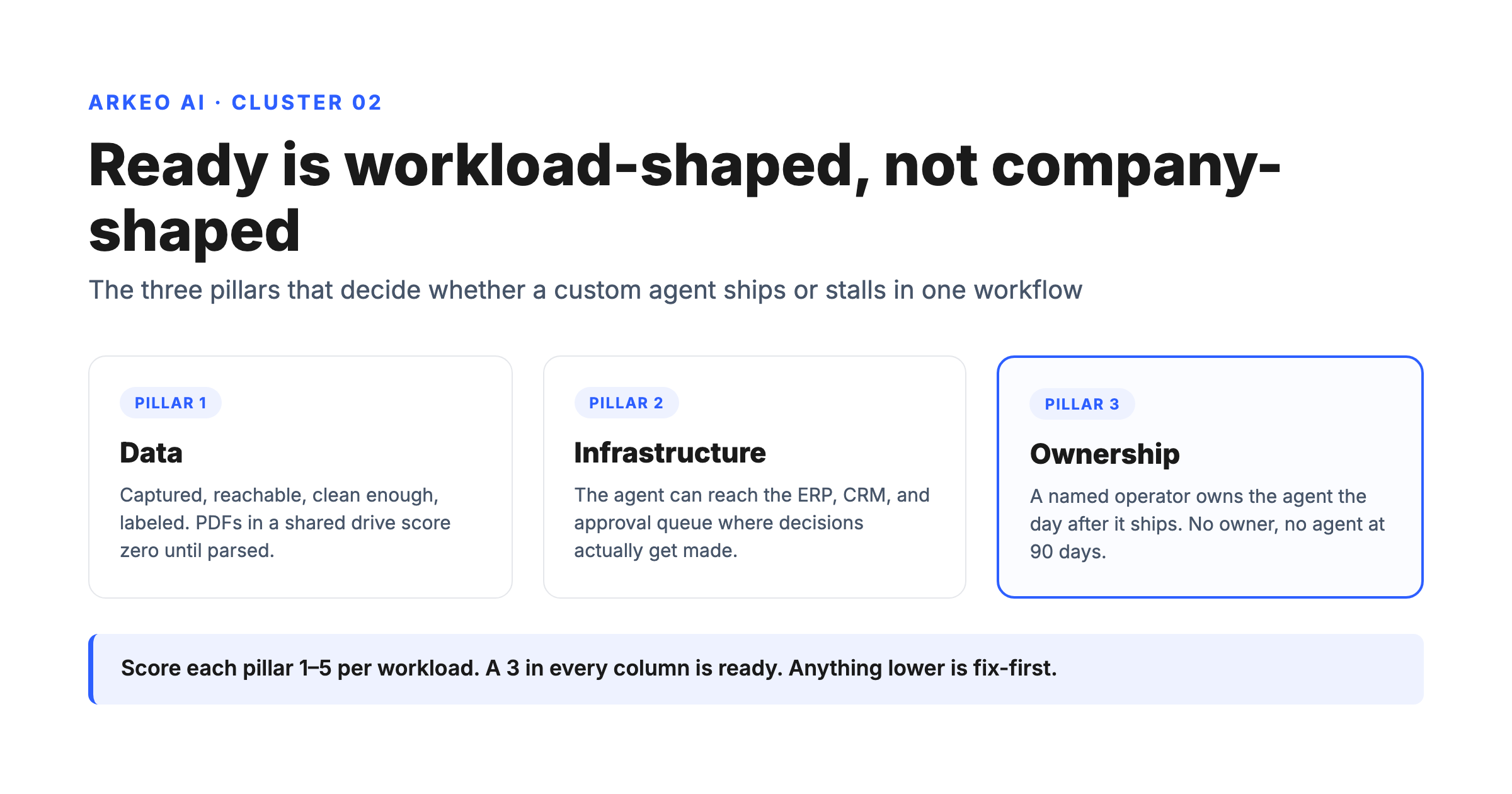
A 3 in every dimension is ready. Anything lower is fix-first, not a build. Workload-scoped, not company-wide.
01 DATA
Data availability and quality
Captured digitally, reachable via API or export, correct, current, deduplicated, and labeled. PDFs in a shared drive score zero.
02 INFRASTRUCTURE
System integration
The agent reaches the ERP, CRM, ticketing system, and approval queue, not a twice-daily CSV export.
03 PROCESS
Workflow clarity
The current workflow is written down step by step, not living only in the head of one senior person.
04 GOVERNANCE
Approvals designed
Human-signature points (invoices over $5K, refunds, contract clauses) are designed before the build, not bolted on after.
05 PEOPLE
Named operator owns it
A named internal operator owns the agent the day after it ships. If the answer is the consultant, the agent dies in 90 days.
06 ROI
Known dollar value
A scoped agent runs $15K-$40K and ships in 6-10 weeks. A ready workflow has a payback you can write on one line.
A 3 across every dimension is ready. The same business can be ready for one workload and not ready for another on the same day.
What is AI readiness, in one operator-grade sentence?
AI readiness is the organizational, data, and infrastructure condition of your business measured against the operating requirements of a specific AI workload, not a single company-wide grade. The exact same company can be ready for an off-the-shelf copilot in marketing, not ready for a custom workflow agent in finance, and nowhere near ready for an autonomous multi-agent process in operations, all on the same Tuesday. Readiness is workload-specific. That is the first thing most readiness frameworks get wrong, and it is why so many board-level AI conversations end with a vague yes-or-no instead of an actionable next step.
The reason the workload-specific framing matters: 78% of organizations are using AI in some form, but the Deloitte State of Generative AI Wave 4 survey of 2,773 C-suite and director-level leaders across 14 countries found that more than two-thirds of enterprises expect 30% or fewer of their GenAI experiments to be fully scaled in the next three to six months. The gap between using AI and operating AI is exactly the gap readiness measures. BCG research published in October 2024 put a number on the same gap: 74% of companies struggle to achieve and scale value from AI, and only 4% have built cutting-edge AI capabilities that consistently generate significant value. The default outcome for an unready company is not a dramatic failure. It is purgatory.
What does AI readiness actually mean in mid-market practice?
For a mid-market operator, AI readiness boils down to a question your COO can answer in one sentence: "For workflow X, is the data clean enough, reachable enough, owned clearly enough, and governed clearly enough that a custom agent can run it in production without breaking the business?" If the answer is yes for a specific workflow, that workflow is ready. If the answer is no, the gaps that produced the no are the work that has to happen before the build.
Three things distinguish the mid-market version of readiness from the enterprise version. First, the budget is real but finite, so a six-figure write-off on the wrong pilot actually hurts. Second, the team is small enough that one named operator can credibly own an agent after it ships, which is a Stage 3 prerequisite. Third, the data is usually fragmented across an ERP, a CRM, a few SaaS tools, and a stack of inboxes and shared drives, which is exactly the integration shape custom agents are designed for. Mid-market readiness is therefore an audit of fitness for one or two well-chosen workloads, not a 200-page transformation study.
What is AI readiness NOT? Four common confusions
Most of the work in answering "what is AI readiness" is clearing away what people often mean when they use the term. Here are the four most common confusions and the line that separates them from readiness.
CONFUSION 01
Readiness is not an AI strategy
Strategy answers "in what order do we build and over what timeline?" Readiness answers "can we ship the first agent in the workflow we picked, today?" Strategy owns the future state; readiness owns the current state. Skipping readiness is how a 12-month AI strategy crashes at month three.
CONFUSION 02
Readiness is not a single company-wide score
Vendor quizzes that hand back "Your company is a 6.4 out of 10 on AI maturity" are sales tools, not diagnostics. Real readiness scores per workload because the same company is genuinely ready for some agents and not ready for others on the same day.
CONFUSION 03
Readiness is not buying copilot seats
Microsoft 365 Copilot, Google Gemini for Workspace, and ChatGPT Enterprise are useful productivity tools at roughly $20 to $30 per user per month. They are not custom agents and their rollout does not prove your operation can run an agent that touches the ERP. Seat counts are not a readiness signal.
CONFUSION 04
Readiness is not a one-time event
The data, integrations, and approval design that made workflow A ready last quarter do not automatically make workflow B ready next quarter. Each new agent triggers a fresh, scoped readiness check. Treat readiness as a repeating diagnostic, not a graduation ceremony.
The most expensive of those four confusions is the first. Mid-market companies routinely sign for a six-figure AI build before anyone has audited whether the workflow the build targets can actually accept it. The deck looks good. The numbers in it are not anchored to anything the data can support. The pilot launches and quietly dies at month four when nobody can find the inputs the agent needs.
Why does AI readiness matter, in dollar terms?
Three numbers from independent primary sources frame the cost of getting readiness wrong.
First, on the people side, the IBM IBV CEO Study of 2,000 CEOs across 33 countries reports that 54% of CEOs are already hiring for AI roles that did not exist a year ago, 31% of the workforce will require retraining or reskilling over the next three years, and "lack of expertise and knowledge" is the top barrier to AI innovation. Unready companies pay this in stalled hires and quarters lost to figuring out who owns the agent.
Second, on the security side, the IBM Cost of a Data Breach 2025 report puts the global average breach cost at $4.44 million and the US average at an all-time high of $10.22 million. Organizations with high shadow-AI usage incur $670,000 more per breach, and 97% of organizations that suffered a breach of an AI model or application lacked proper AI access controls. The 13% of breached organizations who reported an AI model or application breach are the leading edge of a problem that grows every quarter readiness gets postponed.
Third, on the budget side, the PwC AI Agent Survey of 300 senior US executives in May 2025 finds 79% of US businesses say AI agents are already being adopted and 88% of executives plan to increase AI-related budgets in the next 12 months. The money is coming whether or not your operation is ready to absorb it. Readiness is what turns an inflated AI budget into a working agent instead of a written-off pilot.
Put those together and the cost of skipping readiness is concrete: one to two quarters of stalled progress, a $670,000 surcharge on any breach that surfaces, and an AI line item that gets cut as soon as the first pilot disappoints. The cost of doing the work is measured in days, not dollars.
See if your operation is ready for custom agentsThe free AI Assessment audits one of your workflows end-to-end, scores it against the six readiness dimensions, and gives you a go, fix-first, or no-go decision you can take to the board.
Book Your Free AI Assessment →
What does AI readiness actually look like? The six-dimension test
The most honest way to answer "what is AI readiness" is to show the diagnostic. Arkeo runs every readiness assessment, free or paid, against the same six dimensions. Each one is scored 1 to 5 for the specific candidate workload. A workload that scores 3 or higher across every dimension is ready for a custom agent build. A score below 3 on any single dimension is a fix-first signal: close that gap before the build, not after.
DIMENSION 01
Data availability
Is the data the agent needs already captured digitally in a system Arkeo can reach via API or export? PDFs in a shared drive score zero until they are parsed and structured. Decisions made on phone calls and never written down score zero, too.
DIMENSION 02
Data quality
Is the data correct, current, deduplicated, and labeled? An agent that runs on a dirty CRM will scale your existing bad outcomes faster, not better. Blunt truth: most mid-market CRMs sit somewhere between 60% and 80% accurate, and that is the ceiling on any agent running on top.
DIMENSION 03
System integration
Can the agent reach the ERP, CRM, ticketing system, and approval queue where decisions actually get made? If the only available route is a CSV export emailed twice a day, the agent will live as a suggestion box, not a worker.
DIMENSION 04
Workflow clarity
Has the current workflow been written down step by step? Most have not. An agent cannot automate a process that lives only in the head of one senior person who is about to retire or take parental leave.
DIMENSION 05
Governance and approvals
Where does the agent need a human signature? Any invoice over $5K, any customer refund, any contract clause. These approval points must be designed before the build, not bolted on after. This is also where the NIST AI Risk Management Framework Govern function lives.
DIMENSION 06
Culture and ownership
Does a named operator own the agent the day after it ships? If the answer is "the consultant," the agent will die in 90 days. Ownership is the single most undersold and most decisive readiness dimension.
Three details about that test are worth flagging. First, every score is anchored to a specific workflow. "Quote-to-order in industrial sales" gets a fresh six-score grid. "Vendor invoice processing in accounts payable" gets a separate one. That is the only honest way to answer the readiness question, because data and integration realities are not company-wide; they are workflow-shaped. Second, a 3 in every dimension is the floor for ready, not the ceiling. A workload at 4s and 5s is not just ready; it is the one to ship first. Third, the test is workload-portable: once you understand it, you can apply it to any candidate process in your business in about 30 minutes, which is exactly the format of the free AI Assessment.
How does AI readiness connect to the AI maturity model?
The dimension test is the readiness scoring grid. Stack the workload-level scores across the business and you get the company's distribution across a five-stage ai readiness maturity model: Ad Hoc (employees using public ChatGPT with no policy or audit trail), Aware (policy in place, copilot seats purchased, one pilot underway), Active (one custom workflow agent in production with documented data, approvals, and a first ROI number), Operating (three or more agents across two or more departments, integrated with the ERP or CRM and monitored daily), and Embedded (an AI operating system runs the business, new agents stand up in days, not quarters).
Most mid-market operators sit at Ad Hoc or Aware and believe they are at Active. That belief is the most expensive mistake in the whole AI conversation, because it justifies signing a build contract with no audit. The remedy is not aspirational; it is mechanical. Run the six-dimension test against one carefully chosen workflow. If it scores ready, ship one agent into production and run it for a quarter before scaling. If it scores fix-first, do the data and integration work before any build. If it scores no-go for every candidate workflow, you have a current-state problem, not an AI problem.
The reason this is good news for mid-market operators: a scoped single-workflow agent runs about $15,000 to $40,000 and reaches production in 6 to 10 weeks, or 8 to 12 weeks when the deployment is private or on-premise. The first quick win, off-the-shelf copilots included, typically lands within 30 to 90 days. Those are operator ranges from Arkeo's own builds, including the agents that run Arkeo itself. We use what we sell. The numbers say that a ready workflow is closer to revenue than most boards realize, and the only obstacle is the readiness diagnosis nobody has run yet.
One blunt truth before you take the next step: most "AI strategy" engagements deliver a 40-slide deck and disappear. Arkeo's positioning is the opposite. Arkeo is a vendor-neutral AI strategy and implementation partner, founded in 2023, with 25 years of operating-company experience underneath the AI work. We deploy private and on-premise agent systems under an Assess, Deploy, Manage model, which means the readiness assessment is the first step toward a deployed agent, not a stand-alone consulting deliverable.
Audit one workflow in 60 minutesArkeo will run the six-dimension readiness test against one of your workflows live, then tell you whether it is ready, fix-first, or no-go for custom agents. No pitch deck, no obligation.
Book Your Free AI Assessment →