Category
On-Premise AI vs Cloud AI: What Mid-Market Business Owners Get Wrong
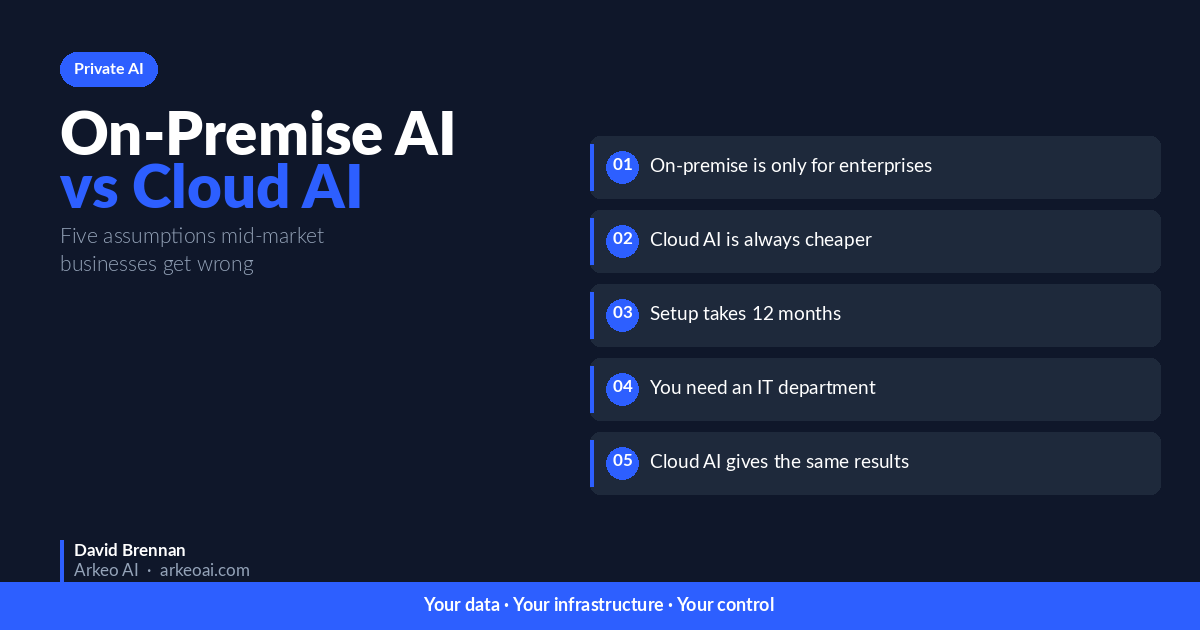
When business owners compare on-premise AI to cloud AI, they usually make the comparison badly. Not because they lack intelligence — because they are working from assumptions that made sense five years ago but do not reflect how either technology works in 2026.
This article identifies the five most common wrong assumptions and corrects them. The goal is not to argue that on-premise is always better. It is to give you an accurate frame for deciding which approach actually fits your business.
Quick Answer
- The question is not which technology is better. It is which approach fits your data, your compliance exposure, and your AI usage volume.
- Cloud AI is appropriate for low-sensitivity workflows with limited usage volume.
- On-premise AI makes more sense when you have sensitive data, compliance requirements, or plan to scale AI use significantly.
- Managed deployment has eliminated most of the complexity objections to on-premise AI. Core is live in under a week.
Wrong Assumption 1: On-Premise AI Is Too Complex for a Mid-Market Business
This was true in 2021. It is not true now.
The assumption comes from a mental model of on-premise AI that involves raised floors, full-time infrastructure engineers, and a multi-year implementation project. That model described enterprise on-premise deployments from several years ago. It does not describe managed deployment in 2026.
Arkeo's Core tier — a private AI assistant trained on your documents and running on your own infrastructure — is live in under one week. There is no IT project. There is no engineer hire. There is no lengthy configuration process. Arkeo handles the infrastructure setup, model configuration, and training. Your team gets a browser-based interface and a working system. Under a week, start to finish.
The complexity objection applies to DIY deployment. It does not apply to managed deployment from a provider who has been doing this since 2023.
Wrong Assumption 2: Cloud AI Is Cheaper
Cloud AI has lower upfront costs. That is accurate. The rest of the cost comparison depends heavily on usage volume and time horizon.
Cloud AI pricing is consumption-based. Per token, per API call, per seat. When your team uses the tool occasionally, costs are modest. When AI becomes genuinely embedded in your operations — running reports, drafting correspondence, processing documents, qualifying leads — usage volume rises significantly. Cloud AI costs rise with it, and the pricing is entirely at the vendor's discretion.
On-premise AI has a higher upfront investment. After that, the marginal cost of usage is close to zero. Your infrastructure is running regardless of how many queries your team sends.
Dell's Enterprise Strategy Group found a four-year ROI of 1,225% for enterprises running on-premise AI infrastructure at scale. The crossover point for mid-market businesses is lower usage volume than most assume, typically within 12 to 18 months of meaningful AI adoption.
The cost comparison also needs to include vendor risk. Cloud AI pricing can change at any time. Your operational dependency on an AI system increases over time. So does your exposure to pricing decisions made by a third party.
Wrong Assumption 3: The Data Risk Is Theoretical
This is the most dangerous assumption.
When an employee uses ChatGPT for work, their prompts travel to OpenAI's servers. Depending on account settings, they may be used to improve the model. The terms of service governing this are long, written by lawyers for OpenAI's benefit, and subject to change.
The 2026 NTT DATA Enterprise AI study found that 95% of enterprises say private and sovereign AI are important to their business. Only 29% have a concrete plan for it. The gap is not because the other 71% have assessed the risk and found it acceptable. It is because the risk is invisible until it is not.
Consider what actually moves through cloud AI in a typical mid-market business. Subcontractor pricing models in an estimating tool. Client operational details in a project management summary. Sales pipeline data pasted into a chatbot for analysis. Proprietary process documentation fed into an AI assistant for drafting.
None of this is theoretical exposure. It is current exposure, happening now, in most businesses that use cloud AI tools without a governance framework.
The question is not whether to take the risk seriously. The question is whether the workflows that matter most — the ones with competitive value or compliance exposure — should be running through infrastructure you do not control.
Map Your AI Data Exposure
The AI Capacity Assessment identifies which of your workflows carry the highest data sensitivity and gives you a specific recommendation. Free, 30 minutes, no obligation.
Wrong Assumption 4: Cloud AI Tools Are More Capable
This assumption made sense in 2022. It does not in 2026.
The quality gap between frontier cloud models (GPT-4, Claude Opus, Gemini Ultra) and high-quality open-source models has narrowed substantially. For most business workflows — drafting, summarising, classifying, researching, generating reports — open-source models running on your own hardware perform at a level that is indistinguishable from cloud models in practice.
More importantly, a model fine-tuned on your specific business data — your SOPs, your contracts, your historical reports, your processes — will outperform a generic cloud model on tasks that are specific to your business. A construction company's private AI, trained on years of project documentation and estimating frameworks, will produce more accurate and useful outputs for construction-specific tasks than a generic model accessed through an API.
The capability argument for cloud AI is strongest for cutting-edge research tasks, complex reasoning at frontier-model level, and tasks that genuinely require the latest model updates. For the operational workflows that mid-market businesses want to automate, the capability difference is minimal and often reversed once fine-tuning is factored in.
Wrong Assumption 5: You Have to Choose One or the Other
Most mid-market businesses should not choose exclusively. They should be deliberate about which workflows run where.
The framework is straightforward:
- Low-sensitivity, low-volume workflows: Cloud AI tools are fine. Writing assistance for public content, summarising non-confidential information, drafting external communications with no proprietary detail.
- High-sensitivity workflows: These should run on infrastructure you control. Client data, proprietary pricing, compliance documentation, internal operational information with competitive value.
- High-volume operational workflows: Consider the long-term cost model. If this workflow will generate significant AI usage over years, the economics of on-premise deployment likely favour private infrastructure.
Arkeo's Connected and Orchestrated tiers are designed to work this way: the private AI system handles the sensitive, high-value workflows, while cloud tools remain available for low-stakes tasks. The goal is not ideological purity about cloud AI. It is defensible governance for the workflows that matter.
Making the Comparison Properly
The right comparison between on-premise AI and cloud AI is not a features list. It is a decision framework:
- What data are you actually feeding into your AI workflows?
- What are the consequences if that data is exposed, used to train a model, or accessed by a third party?
- What is your realistic AI usage volume over a two-to-three-year horizon?
- What are your industry-specific compliance requirements?
- How much governance visibility do you need over what the AI is doing?
Answer those five questions honestly, and the right approach for your business usually becomes clear. If you want help working through them, that is what the AI Capacity Assessment is designed to do.
Get a Clear Recommendation for Your Business
The AI Capacity Assessment gives you a specific answer: cloud, hybrid, or on-premise, with a cost model. 30 minutes, no obligation.
Frequently Asked Questions
What is the main difference between on-premise AI and cloud AI?
On-premise AI runs on infrastructure you control. Your data does not leave your environment. Cloud AI runs on a vendor's servers (OpenAI, Google, Microsoft), and your data is processed there under the vendor's terms of service.
Is on-premise AI always more expensive than cloud AI?
Not over a multi-year horizon. Cloud AI has lower upfront costs but usage-based pricing that scales with adoption. On-premise AI has higher upfront costs but near-zero marginal usage costs. The crossover point for most mid-market businesses is 12 to 18 months of meaningful AI adoption.
Is the security difference between on-premise and cloud AI significant?
It is a different security model, not automatically a better one. The advantage of on-premise is that you own the security perimeter. Data does not leave your environment. Cloud AI relies on the vendor's security controls. For businesses with regulated data or sensitive client information, owning the perimeter is generally the stronger position.
Can cloud AI tools be used for sensitive business data?
In principle, enterprise tiers of cloud AI tools offer better data handling terms. In practice, the data still moves to the vendor's infrastructure, and the terms are written by the vendor. For data with genuine compliance exposure or competitive value, on-premise processing is the more defensible choice.
Do open-source AI models perform as well as cloud models?
For most business workflows, yes. The quality gap between leading open-source models and frontier cloud models has narrowed substantially since 2022. For construction, O&G, and professional services workflows, fine-tuned on-premise models often outperform generic cloud models on tasks specific to the business.
The on-premise vs cloud AI decision is not a technology question. It is a governance and risk question. Get the question right, and the technology decision usually follows. If you want help working through it for your specific business, the AI Capacity Assessment provides a clear, obligation-free recommendation.