Category
The Role of Leadership in AI Readiness
Last updated: June 2026
If you sit in the CEO, COO, CIO, or CFO seat at a 50 to 500 person company and the board has started asking who owns AI, the wrong answer is to point at the most enthusiastic person in the room. Twelve months later that turns into a stalled pilot, a budget cut, and a board minute that reads "AI initiative paused pending leadership clarity," which is a polite way of saying nobody was on the hook. In this guide, you will get the four-seat accountability map for AI readiness, the weak-leadership signals that surface before the pilot fails, and the decision-rights matrix that tells your team who calls the shot when a workflow agent costs $40,000, touches customer data, and has to integrate with the ERP, so you can answer the board with a credible plan instead of a working group.
Arkeo has spent three years deploying AI agents on its own operations and on mid-market client engagements, and the failure mode that repeats is not model quality, it is leadership clarity. According to the IBM IBV CEO Study of 2,000 CEOs across 33 countries, "lack of expertise and knowledge" is the top barrier to AI innovation, 54% of CEOs are already hiring for AI roles that did not exist a year ago, and 65% say their organizations will use automation to address skills gaps. Translate that out of survey language: the executive team is being asked to allocate capital toward a capability they did not build their careers around, and most are doing it without a written accountability map. Book a free AI Assessment if you want Arkeo to audit your workflows and tell you which seat owns each piece on Monday morning.
Quick Answer
• What it is: Leadership in AI readiness is the named, written accountability of the CEO, COO, CIO or CTO, and CFO for the four pieces of an AI program: capital, operations, infrastructure, and risk.
• Signal of weak leadership: No single executive can answer, in one sentence, what AI is for at this company this year.
• Why it matters: Without decision rights, every workflow agent stalls at the first cross-functional gate (data access, approvals, ownership after ship).
• Next step: Book a free AI Assessment. Arkeo will audit your workflows to see if you are ready for custom agents.
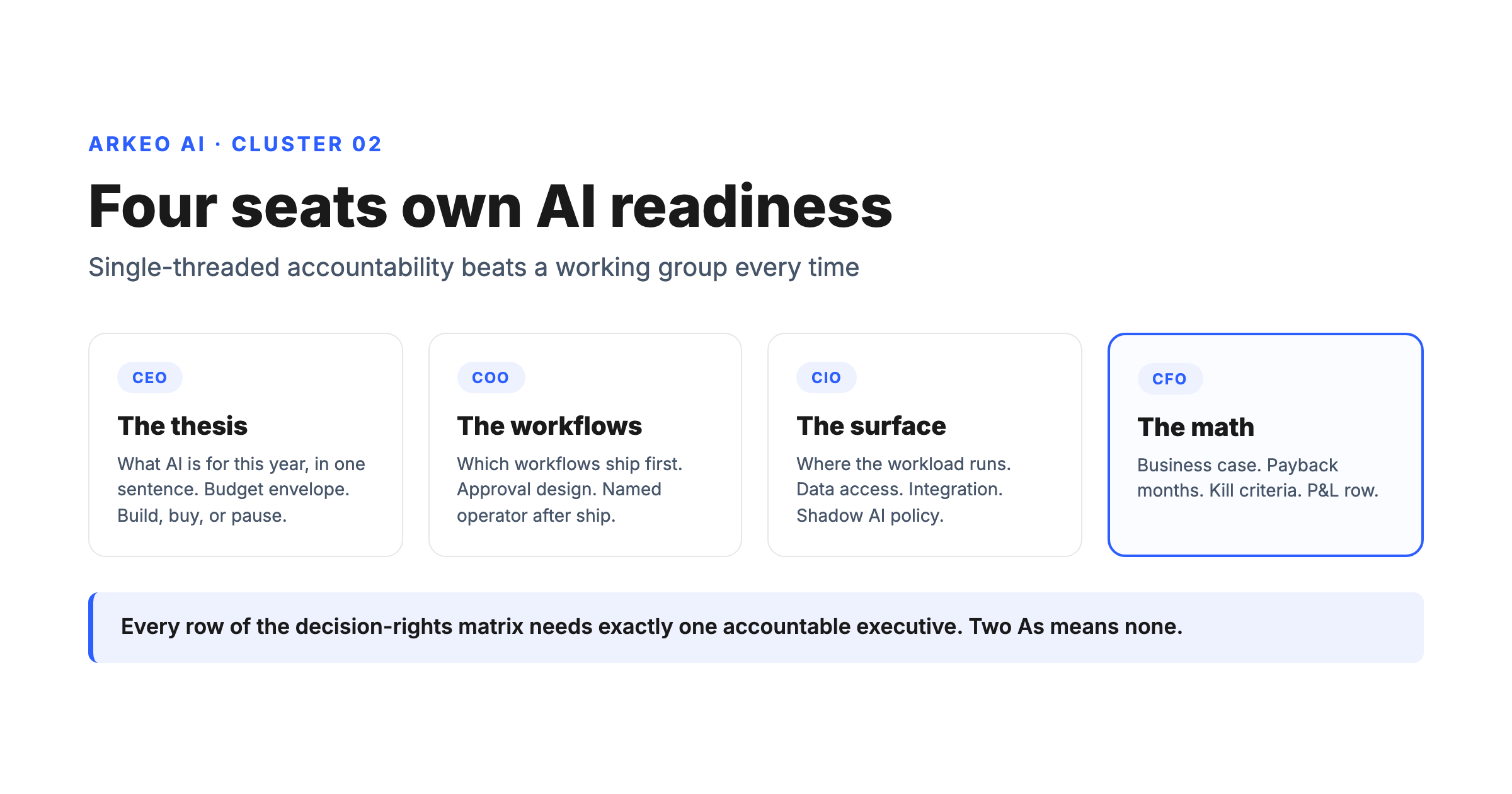
FOUR SEATS
Who owns what
Single-threaded accountability for the four pieces of an AI program: capital, operations, infrastructure, and risk.
CEO
The thesis
Names what AI is for this year in one sentence. Sets the budget envelope. Calls build, buy, or pause.
COO
The workflows
Picks the first workflow by bottleneck and margin. Designs the approval points. Names the operator after ship.
CIO
The surface
Decides cloud, private cloud, or on-premise. Owns data access, integration, identity, and shadow AI suppression.
CFO
The math
Forces a single-page business case before the build. Writes kill criteria. Owns the operating P&L row.
Every decision-rights row needs exactly one accountable executive. Two As means none.
Why does AI readiness rest on leadership, not the AI team?
AI readiness is an operating-capacity problem, not a tooling problem, which means it is owned at the executive level or it is not owned at all. Tools, models, and vendors are now broadly available and largely commoditized. What is not commoditized is the executive decision-making that determines whether your business can actually absorb a custom agent into a real workflow. The Stanford HAI 2025 AI Index reports that 78% of organizations used AI in 2024, up from 55% in 2023, the largest year-over-year jump in the Index's history. Usage is not the gap. Operating capacity is.
BCG research published in October 2024 put a number on the same gap: 74% of companies struggle to achieve and scale value from AI, and only 4% have built cutting-edge AI capabilities that consistently generate significant value. That gap is leadership, made visible. The companies in the 4% have an executive who can name, in one sentence, what AI is for at the company this year, who owns each piece, and what gets cut if something must be cut. The 74% have a working group.
What does each executive seat actually own?
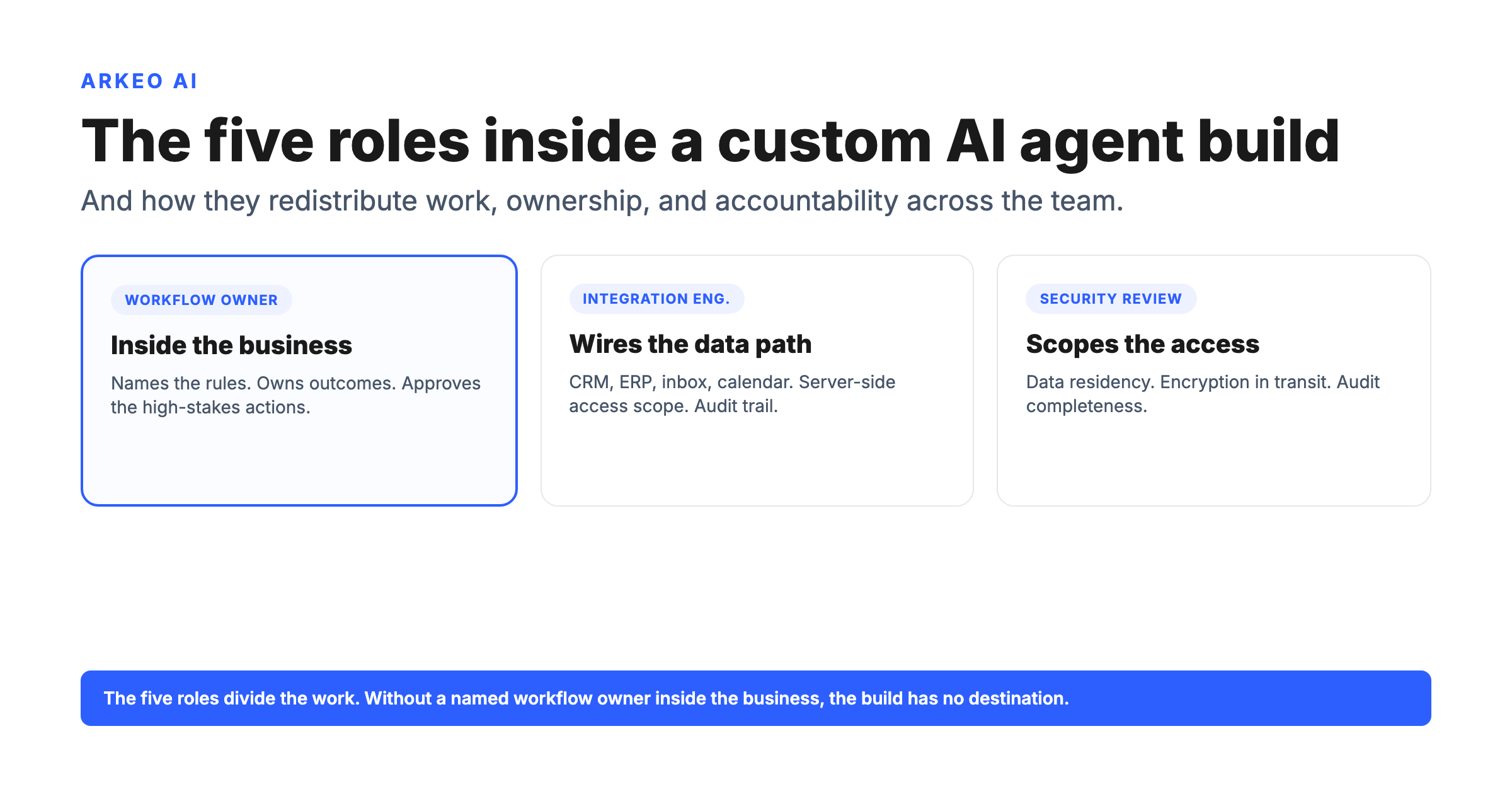
Treat AI readiness as four named accountabilities, one per seat. None of them are delegable to a working group. None of them are owned by "the AI team." The work is cross-functional, which is exactly why it needs single-threaded owners in the C-suite. The ai readiness framework Arkeo uses on engagements maps every diagnostic question onto one of these four seats.
CEO
Owns the thesis
Names what AI is for at this company this year, in one sentence the board can repeat. Sets the budget envelope. Decides build versus buy versus pause. Signs the hire of the first AI accountable executive. Without this seat, every other seat freelances.
COO
Owns the workflows
Picks which workflows go first, based on bottleneck and margin impact, not vendor demos. Owns the approval design (where a human must sign). Owns the named operator who runs the agent the day after it ships. Owns Stage 3 production, not Stage 1 experiments.
CIO / CTO
Owns the surface area
Decides where the workload runs: public cloud, private cloud, or on-premise. Owns data access, integration into the ERP and CRM, identity, logging, and acceptable use. Owns shadow AI suppression with a sanctioned alternative, not a ban that pushes activity to personal devices.
CFO
Owns the math
Forces every agent into a single-page business case before the build: cost in, cost out, payback in months, on what evidence. Owns the kill criteria. Reads the operating P&L row that AI now sits on. Refuses to fund pilots that have no path to Stage 3.
The PwC AI Agent Survey of 300 senior US executives in May 2025 found that 79% of US businesses say AI agents are already being adopted and 88% plan to increase AI-related budgets in the next 12 months. The budget is showing up at the CFO's door whether the four-seat map is named or not. If it is not named, the budget gets allocated by the loudest voice, which is almost never the right voice.
What are the signals of weak AI leadership?
Weak AI leadership rarely announces itself. It looks busy. The team is running pilots, the CIO is evaluating platforms, the CFO is approving licenses, and the CEO is giving keynote remarks about agentic AI. The signals show up in the gaps between those activities. Watch for these.
SIGNAL 01
No one-sentence thesis
Ask the CEO, COO, and CFO separately what AI is for at this company this year. If the three answers do not match, the thesis does not exist. The cost of this gap is every pilot becoming an island.
SIGNAL 02
A working group instead of an owner
An "AI Committee" that meets biweekly with no single accountable executive is a delay mechanism. The committee can recommend. It cannot ship. Real AI work needs a named executive whose bonus depends on production agents.
SIGNAL 03
Shadow AI tolerated quietly
Employees pasting customer data into public ChatGPT, on personal accounts, with no sanctioned alternative. The CIO knows. The CEO has not asked. The CFO is not seeing the breach math yet.
SIGNAL 04
No Stage 3 in 12 months
A year of pilot activity with no custom workflow agent in production. Per Deloitte's State of Generative AI Wave 4 survey of 2,773 C-suite and director leaders, more than two-thirds expect 30% or fewer of their GenAI experiments to be fully scaled within the next three to six months. Default outcome is purgatory, not failure.
SIGNAL 05
The CFO has no kill criteria
If the CFO cannot tell you, on the day a pilot starts, what evidence would cause it to be canceled, the pilot will run until the budget runs out. Kill criteria are a leadership artifact, not a finance artifact.
SIGNAL 06
The agent has no operator
If the COO cannot name the person who will run the agent in production on day 91, the agent will die in 90 days. Consultants do not own production. Named operators do.
Want to talk about this against your specific situation? Book a free assessment with Arkeo. Thirty minutes, working session, no pitch deck. The output is a one-page diagnosis of which of the four seats is currently weakest in your operation and what to do about it inside the next budget cycle.
Audit your workflows for agent readinessArkeo's free AI Assessment audits one of your workflows end-to-end and tells you which executive seat owns each gap. Working session, not a pitch deck.
Book Your Free AI Assessment →
How do you write the AI decision-rights matrix?
The decision-rights matrix is the operating document that turns the four-seat map into Monday-morning behavior. It is one page. Each row is a recurring AI decision. Each column is one of the four seats plus the named operator. Each cell is one of four roles: Recommend, Accountable (exactly one per row), Consulted, or Informed. The rule that matters most: every row has exactly one A. If two seats are accountable for the same decision, neither is.
Picture the matrix for a mid-market specialty manufacturer running its first custom workflow agent: a quoting agent that reads inbound RFQs, queries the ERP, drafts the quote, and routes it to the sales engineer for approval. Six rows decide whether this agent ships or stalls. The CEO is accountable for the thesis row (is quoting the right first workflow at all). The COO is accountable for the workflow design row (where the human signs) and the operator-after-ship row. The CIO is accountable for the deployment-surface row (cloud, private cloud, or on-premise based on the customer-data classification) and the integration row. The CFO is accountable for the business-case row (payback, kill criteria, P&L line). The named operator is consulted on every row and informed on the rest. No working group. No committee. Six As across six rows.
Where does the AI Assessment fit? It is the input. The assessment surfaces the rows that need decisions. Leadership owns the As across those rows. If the assessment surfaces 14 rows and the executive team can only name an A for six of them, that is the gap, named, on a page. The rest of the program is closing those eight rows in order. Book the free AI Assessment if you want Arkeo to draft the matrix on real workflows from your operation.
How does the NIST AI framework anchor leadership accountability?
The NIST AI Risk Management Framework 1.0 is the US government's reference standard for AI risk and trustworthiness, organized around four core functions: Govern, Map, Measure, and Manage. The framework is voluntary, sector-agnostic, and increasingly the language insurers, regulators, and enterprise customers use when they ask about AI readiness. Mid-market leaders do not need to implement NIST line by line. They do need to know it exists and to map their four executive seats onto its four functions.
Govern is the CEO's thesis and the CFO's kill criteria, written down. Map is the COO's workflow inventory and the CIO's data and system surface. Measure is the operator's runbook plus the CFO's P&L row, in numbers that survive a board meeting. Manage is the COO's on-call ownership after the agent ships. If a single executive seat is empty across any of those four functions, the program is not NIST-shaped, regardless of the AI strategy slide. Strategy owns the future state, the 30/90/12-month roadmap that decides what gets built when. Readiness owns the current state, the audit that decides whether you can build at all. Leadership is what makes the audit honest.
What does "leadership ready for AI" look like at Stage 3?
Picture a 200-person specialty manufacturer with one custom agent in production, one named operator running it, and an executive team that can answer four questions on demand. The CEO can name what AI is for this year in one sentence. The COO can show the workflow map, the approval design, and the operator name. The CIO can show the deployment surface (private cloud), the integration path (ERP REST API plus a Slack approval queue), and the shadow AI policy with a sanctioned alternative. The CFO can show the business-case page with payback in months and the kill criteria that would cause the agent to be retired. The board minute reads "AI program: one agent in production, two in build, $180K committed to date, payback at month nine." That is leadership-ready for AI. It is not a moonshot. It is the executive operating discipline of any other capital program, applied to AI.
Arkeo has been deploying agents on this pattern since 2023, including the agents that run Arkeo itself. We use what we sell. A scoped single-workflow agent typically runs $15,000 to $40,000 and reaches production in 6 to 10 weeks, 8 to 12 weeks when the deployment is private or on-premise. Off-the-shelf copilots run roughly $20 to $30 per user per month and live in days. The first quick win typically lands inside 30 to 90 days. Those are operator ranges from Arkeo's own builds, not sourced benchmarks. Leadership clarity is what compresses those ranges. Leadership confusion is what blows them out.
Name the seats. Ship the agent.Arkeo's free AI Assessment audits one workflow end-to-end, maps every gap to a named executive seat, and gives you a one-page decision-rights matrix you can take to the next board meeting.
Book Your Free AI Assessment →