Category
Integrating Claude Cowork Plugins With Your Secure Data
The Security Dilemma of Cloud AI Plugins
As artificial intelligence continues to shift from simple chat interfaces to agentic workflows, the role of the AI plugin has become central to business operations. Claude’s new cowork plugins and tool use capabilities allow the AI to reach directly into your databases, CRM systems, and internal wikis to retrieve the specific context it needs to answer complex questions or execute tasks. We are no longer talking about just generating emails or writing marketing copy; we are talking about AI agents that can actively query live operational data, cross-reference inventory levels with supply chain logistics, and automatically draft vendor communication based on real-time shortages.
For a business leader, the value proposition is undeniable. Why have an employee spend four hours cross-referencing three different systems when an AI agent can retrieve the data and format the report in forty seconds? The efficiency gains are massive, and the companies adopting these workflows are seeing dramatic reductions in administrative overhead. However, there is a fundamental security dilemma that mid-market operators, CTOs, and compliance officers are rapidly discovering as they attempt to scale these solutions across their organizations.
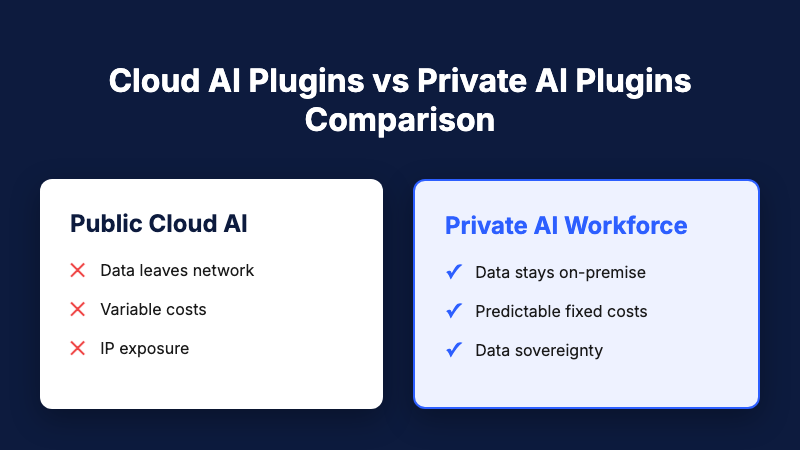
When you use standard cloud-based AI plugins to connect a public large language model (LLM) to your internal systems, you are creating a direct, bi-directional pipeline between your proprietary data and a third-party cloud infrastructure. Every query the AI makes, every customer record it pulls, every financial summary it generates, and every internal operational metric it accesses is transmitted outside your building. In the era of data sovereignty, strict compliance audits, and stringent privacy regulations, this operational model presents an unacceptable risk profile for mature businesses.
If you are a professional services firm handling sensitive client data, a healthcare provider managing patient records, or a manufacturing company with closely guarded intellectual property and supply chain pricing, you cannot afford to have your competitive advantage passing through a cloud AI provider's servers. The risk of data exfiltration, whether through a breach at the provider level, a misconfigured API endpoint, or through unintentional model training ingestion, is simply too high. You are placing your operational truth in the hands of a system you do not control.
This is where the concept of "Shadow AI" emerges with alarming frequency. Employees, desperate for the efficiency gains of AI and frustrated by legacy software, begin connecting cloud plugins to company data without IT oversight. They might be trying to be productive—perhaps asking a cloud AI to summarize a messy Excel spreadsheet of client contacts—but they are inadvertently creating massive compliance liabilities. They are bypassing the secure perimeters your IT team has spent years building.
The solution is not to ban AI plugins entirely. Companies that ban AI will simply be out-competed by those that figure out how to harness it. The solution is to fundamentally change the architecture of how these plugins operate. You need the immense reasoning power of Claude's advanced models combined with the deep data access of a plugin, but executed entirely within your own controlled, private environment.
Three exposure paths cloud AI plugins open by default
Plugins are the part of the AI stack that touches the most internal data and gets the least security review. The three exposure paths below are the ones we see in every plugin postmortem.
Vendor egress
Plugin sends prompts and context out to vendor cloud on every call. Default settings rarely log what crossed the boundary.
Token sprawl
Plugin holds API keys and tokens for your systems. Compromise of the plugin compromises every system it can reach.
No SSRF control
Plugins often have unrestricted outbound network access. An LLM hallucination can become an outbound HTTP call.
What Are Claude Cowork Plugins?
Before we can secure these AI systems, we need to thoroughly understand how they function under the hood. Claude cowork plugins (and the broader concept of tool use or function calling in modern LLMs) act as the hands, eyes, and operational levers of the AI. On its own, a large language model only knows the data it was trained on, which is inherently static and generalized. It does not know your current inventory, your client's name, or yesterday's sales figures. A plugin provides the AI with a standardized API bridge to query real-time, proprietary information directly from your systems.
Consider a practical scenario. When an operations manager asks Claude, "What were our top-selling SKUs in the Northwest region last quarter, and how does that compare to the previous year?", Claude cannot answer this from its static training data. Instead, the model recognizes that it needs external, real-time information to fulfill the user's request. It formulates a specific, structured query and sends it to the relevant plugin—for example, a secure connection to your ERP system or a dedicated SQL database.
The plugin executes the query, retrieves the raw numerical data, and passes it back into Claude's context window. Claude then analyzes the raw data, applies its advanced reasoning capabilities to identify trends or anomalies, and generates the final, human-readable response for the user. It turns raw database rows into actionable business intelligence in seconds.
This architecture is incredibly powerful because it separates the reasoning engine (the LLM itself) from the storage engine (your proprietary database). It allows the AI to act as a highly intelligent, tireless analyst that can synthesize data from multiple disparate sources simultaneously. It can pull a client's purchase history from your CRM, cross-reference it with support tickets in your helpdesk software, and draft a personalized renewal email, all in one fluid motion.
However, in a standard, off-the-shelf cloud deployment, this entire exchange happens over the public internet. The query leaves your network, hits the LLM provider's cloud infrastructure, the cloud sends a request back to your exposed plugin endpoint, your database answers the cloud, and the cloud finally sends the synthesized answer back to the user. This multi-hop process over public networks, often involving multiple third-party servers, is the core vulnerability we must address to make AI safe for the enterprise.
Is your company data leaking through Shadow AI?
Don't let employee productivity create a massive compliance liability. Get a clear picture of your AI risks and learn how to deploy secure, private agents.
Book Your AI Assessment →The Architecture of Private AI Plugins
At Arkeo AI, our core operational philosophy is built entirely around the Private AI Workforce. We believe that your data is your most valuable asset, and it should never, under any circumstances, leave your infrastructure to train a public model. To utilize the power of Claude's advanced reasoning while maintaining absolute data sovereignty, we deploy a completely different architectural model: the private, on-premise AI plugin ecosystem.
When we deploy an AI agent system for a client, we do not connect it to public cloud endpoints that expose your databases to the internet. Instead, we containerize the necessary middleware, the vector databases, and the plugin connections, running them securely on your own hardware or within your deeply private, dedicated cloud tenant (such as a locked-down AWS VPC or an isolated Azure environment).
Here is how the secure architecture functions in practice, step by step:
- The Secure Authentication Gateway: All user interactions with the AI workforce pass through a highly secure, heavily audited gateway that integrates seamlessly with your existing identity provider (such as SSO, Entra ID, or Active Directory). No anonymous access is permitted, and every query is tied to a specific user for complete auditability.
- Local RAG (Retrieval-Augmented Generation): Before the AI attempts to answer a business question, the secure private plugin queries your internal vector database or your localized SQL servers. This data retrieval process happens entirely behind your corporate firewall. The AI searches your data, but your data does not go to the AI provider.
- Sanitized Context Window Assembly: Only the specific, strictly necessary data required to answer the prompt is assembled into the context window. If the architecture utilizes a cloud-based LLM API for reasoning (such as Claude via an enterprise API), the data is routed through enterprise agreements that mathematically guarantee zero data retention (zero-day retention policies). However, for maximum security and absolute peace of mind, we frequently pair these private plugins with locally hosted, open-weight models (like Llama 3 or local variants) running on your own bare-metal servers. This ensures that literally zero bytes of data ever leave your physical building.
- Secure Action Execution: If the plugin is designed not just to read data, but to take an action (e.g., updating a CRM record, modifying a project timeline, or sending an internal notification email), the command originates from within your secure network. It is authenticated as an internal service account with strict, least-privilege access, ensuring the AI cannot perform actions outside its designated scope.
This localized architecture provides the "magic" of modern AI—the ability to converse naturally with your operational data and automate complex, multi-step workflows—without the existential risk of data exposure. It fundamentally transforms an AI tool from a rogue shadow-IT application into a governed, manageable, and highly secure corporate asset.
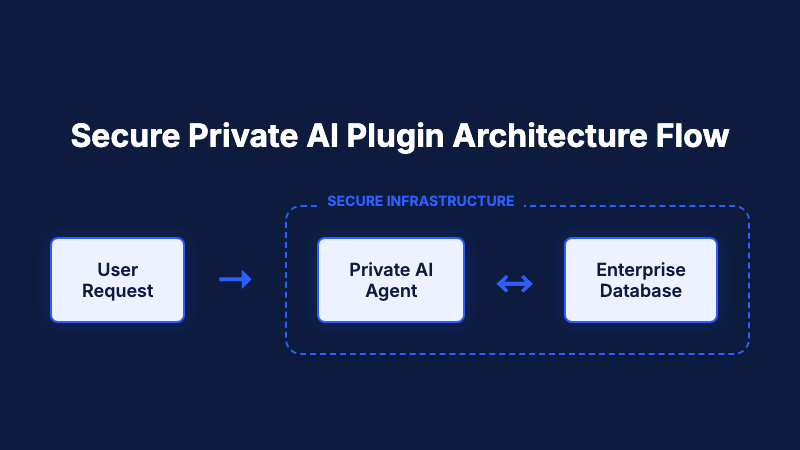
Public plugin architecture vs private plugin architecture
The plugin pattern is correct. The default cloud architecture is wrong for any business data. Private deployment runs the same plugin pattern with a boundary your auditor can read in five minutes.
Default cloud, unbounded
Owned infrastructure, scoped
3 High-Impact Use Cases for Secure Plugins
When you deploy Claude cowork plugins securely within a Private AI Workforce model, the operational possibilities expand dramatically. Because the system is locked down and secure, you can confidently grant it access to highly sensitive, mission-critical data that you would never dream of exposing to a public cloud AI interface. Here are three high-impact deployments we are actively building for the mid-market right now.
1. The Operations War Room and Dispatch Agent
In heavy industries like oil & gas, commercial construction, and complex manufacturing, operational data is notoriously siloed. It lives across dispatch systems, safety management software, HR certification databases, and equipment maintenance logs. A site superintendent or operations manager usually spends hours every morning aggregating this data just to get a clear picture of the day's readiness and identify potential roadblocks.
With secure AI plugins, you can create a dedicated "Operations Agent." When the superintendent logs in at 6:00 AM and asks, "Are we clear to pour concrete on Site B today?", the agent springs into action. It uses its secure internal plugins to simultaneously check the local weather API for site conditions, query the HR database to ensure the assigned crew has current, valid certifications for the specific machinery, check the equipment maintenance log to ensure the concrete pump is operational and not tagged out, and review the safety system for any outstanding hazard reports on that specific site.
It synthesizes all this internal, highly sensitive operational data into a single, confident answer in seconds. It might reply, "Weather is clear, but John Doe's fall protection certification expired yesterday, and the primary pump requires its 500-hour service." Because the plugins operate entirely behind the firewall, employee certification data, proprietary site schedules, and equipment statuses remain completely secure and private.
2. Automated Financial Reconciliation and Auditing
Finance teams spend an inordinate amount of time performing manual data entry, cross-referencing invoices against purchase orders, and reconciling bank statements. This data is the literal lifeblood of the company, highly confidential, and heavily targeted by malicious actors.
A secure financial AI agent can be equipped with private plugins directly connected to your ERP (like SAP, NetSuite, or Sage), your localized accounts payable inbox, and your secure banking portal. When a complex invoice arrives from a vendor, the agent automatically reads it, uses the ERP plugin to verify the original purchase order, checks the receiving log plugin to confirm the physical goods were actually delivered to the warehouse, and drafts the approval workflow for the controller. It executes this reconciliation instantly, accurately, and securely. No sensitive financial data, vendor pricing agreements, or bank routing numbers are ever transmitted to OpenAI or Anthropic for model training.
3. Legal, Contract, and Compliance Analysis
For professional services, engineering firms, and legal departments, client confidentiality is not just a preference; it is legally mandated. Uploading client contracts, engineering schematics, or proprietary project plans to ChatGPT or a public Claude interface is a fast track to lost contracts, massive lawsuits, or regulatory penalties.
By utilizing private plugins connected directly to a secure document management system, teams can securely query an AI against hundreds of gigabytes of proprietary case law, active client files, and historical project data. An agent can be instructed to "Review all our subcontractor agreements from 2025 across the Western division and flag any that do not include the updated indemnity clause for the new provincial regulations."
The agent uses the secure document plugin to fetch the files, analyzes them locally within the protected environment, and generates a comprehensive report flagging the exact contracts that need remediation. The firm gains the 100x speed multiplier of AI-assisted document review without ever compromising attorney-client privilege, client confidentiality, or proprietary engineering data.
Four plugin patterns that pay back for mid-market operations
These are the four plugin shapes we have shipped on private deployments. Each one is high-volume, document-heavy, and previously consumed senior staff hours that should be going elsewhere.
CRM plugin
Reads accounts, contacts, deal history. Writes back updates, follow-ups, enrichment. Inside your firewall.
ERP plugin
Reads invoices, POs, vendor records. Writes back reconciliations and exception flags. Audit-logged.
Document plugin
Reads contracts, RFIs, submittals from your shared drive. Drafts responses for human review. No vendor cache.
Internal API plugin
Calls into your own internal systems. SSRF-controlled, RBAC-enforced, every call audited. Custom built.
The Cost of Getting This Wrong
The urgency around securing AI plugins is not a theoretical exercise for IT to debate next year. The costs of getting this wrong are severe, immediate, and multifaceted. Business leaders must understand the full spectrum of risk associated with unregulated cloud AI.
First, there is the direct, quantifiable cost of a data breach. If an improperly secured cloud plugin exposes a database endpoint to the public internet, or if an employee accidentally uploads a spreadsheet of customer PII to a public AI model, it is only a matter of time before it is discovered by malicious actors or regulatory bodies. The financial penalties, legal liabilities, forced audits, and reputational damage of exposing customer data or proprietary IP can be catastrophic, often ending in severe revenue loss or executive termination for a mid-market business.
Second, there is the silent, insidious cost of IP leakage. Many public AI tools explicitly state in their terms of service that user prompts and uploaded data may be used to train their future generalized models. If your senior engineers are pasting proprietary code snippets into a cloud AI to debug them, or if your sales leadership team is pasting client negotiation strategies into a chat window to refine an email, you are slowly but surely giving away your competitive advantage. You are effectively training your competitors' future AI models with your own hard-won, expensive operational intelligence.
Third, there is the massive cost of regulatory non-compliance. Depending on your specific industry (such as healthcare, finance, defense contracting, or heavily regulated energy sectors), you are likely subject to strict data governance frameworks (HIPAA, SOC 2, ISO 27001, CMMC). Allowing unregulated, un-auditable cloud AI plugins to access and process governed data is a direct violation of these frameworks. This results in failed compliance audits, lost enterprise contracts, and heavy regulatory fines that can cripple growth.
Finally, there is the opportunity cost of stagnation. We see companies that ban AI entirely out of fear of these risks. This is a losing strategy. These companies will inevitably be outmaneuvered, outpaced, and underpriced by competitors who figure out how to deploy AI securely. You cannot afford to ignore AI, because the efficiency gains are too massive to pass up. But you also cannot afford to deploy it recklessly. The Private AI Workforce model is the only sustainable, secure path forward for the mid-market.
Deploying Your AI Workforce Securely
Moving from ad-hoc, risky cloud AI usage to a governed, structured Private AI Workforce is a strategic operational process. It requires a deliberate, engineered approach that perfectly balances the business need for operational speed with the absolute imperative of data security and governance.
At Arkeo AI, we have deployed these systems across multiple industries. We guide our clients through a proven, repeatable 3-phase model: Assess, Deploy, and Manage.
Phase 1: Assess
Before writing a single line of code, installing any hardware, or purchasing any licenses, we conduct a deep-dive AI Assessment. We map out exactly how your employees are currently using AI in the shadows, evaluating your existing data infrastructure, and identifying the highest-ROI use cases for private AI agents. We look for the operational bottlenecks that are slowing down your team—the manual data entry, the complex scheduling, the siloed reporting. We then design a secure plugin architecture specifically tailored to solve those exact problems without exposing your data.
Phase 2: Deploy
We build the system on your terms, not the cloud provider's terms. We deploy the AI agents and the necessary secure plugins directly on your infrastructure, whether that is on-premise hardware in your local server room or a private, isolated cloud tenant you fully control. We integrate the system deeply with your SSO and active directory, establish the secure API gateways, and rigorously test the data flow to ensure absolute zero leakage. We build the exact tools your team needs to move faster, ensuring the AI operates within the strict boundaries we define.
Phase 3: Manage
Deploying the AI is only the beginning of the journey. A true AI workforce requires ongoing management, maintenance, and optimization, just like a human workforce. We monitor the agents for uptime, refine their reasoning models based on real-world performance data, update the secure plugins as your internal software APIs inevitably change, and ensure continuous, unbroken compliance with your security standards. We act as your fractional AI operations team, ensuring the system delivers reliable, measurable ROI month after month, year after year.
The integration of Claude cowork plugins and advanced AI agents into your core business systems is inevitable. The technology is simply too powerful to ignore. The question for business leaders is not whether you will adopt this technology, but whether you will control it when you do. By choosing a private, on-premise architecture, you can harness the full, transformative power of artificial intelligence while maintaining absolute sovereignty over your most critical corporate asset: your operational truth and your data.
Ready to secure your AI strategy?
Stop guessing about data security and compliance. Let's build a private AI workforce that accelerates your operations without ever compromising your intellectual property.
Book Your AI Assessment →FAQ: Secure AI Plugins in the Enterprise
What is the fundamental difference between a public AI plugin and a private AI plugin?
A public AI plugin routes your proprietary data through third-party servers over the public internet, exposing it to potential interception, API vulnerabilities, or model training ingestion. A private AI plugin operates entirely within your own secure network infrastructure or isolated cloud tenant, ensuring your data never leaves your direct control and is never used to train public models.
Can we use advanced models like Claude securely without building everything on-premise from scratch?
Yes, you can utilize enterprise-tier API agreements (which provide legal and technical guarantees of zero data retention) combined with a secure, private middleware gateway (like the Arkeo AI architecture). This provides a highly secure environment while still leveraging the reasoning power of cloud LLMs. However, for maximum security—especially for highly sensitive financial, healthcare, or defense data—on-premise local open-weight models are strictly recommended.
How do we effectively prevent our employees from using risky Shadow AI plugins?
Policy alone is rarely enough. The most effective way to eliminate Shadow AI is to provide a superior, secure internal alternative. When you deploy a Private AI Workforce that has sanctioned, secure access to real company data, employees will naturally gravitate toward the authorized tool. It is simply more capable, more accurate, and better integrated than any public alternative they could piece together themselves.
How long does it typically take to deploy a secure AI plugin ecosystem in a mid-market company?
Depending on the complexity of your internal legacy systems and the cleanliness of your existing databases, a targeted pilot deployment of a secure AI agent with 1-2 core operational plugins can typically be launched in 4 to 8 weeks following the initial assessment phase. This allows you to prove ROI quickly before scaling the workforce across the organization.