Category
Claude Cowork in Oil & Gas: Mid-Market Playbook
Last updated: May 2026
Mid-market oil and gas operators are sitting on vast repositories of unstructured data, from drilling logs to safety audits, that hold the keys to operational efficiency. Leveraging this data with standard public AI tools introduces unacceptable security risks to proprietary intellectual property, geological models, and bidding strategies.
Deploying Claude Cowork as a private AI workforce allows operators to automate complex technical analysis and field reporting while maintaining total data sovereignty. This guide provides the blueprint for implementing a secure AI layer that moves your operation from manual data parsing to automated, intelligent reasoning without compromising security.
Quick Answer
• Data Sovereignty: Private AI deployments keep sensitive drilling and geological data on your own infrastructure, ensuring proprietary IP never leaves your control.
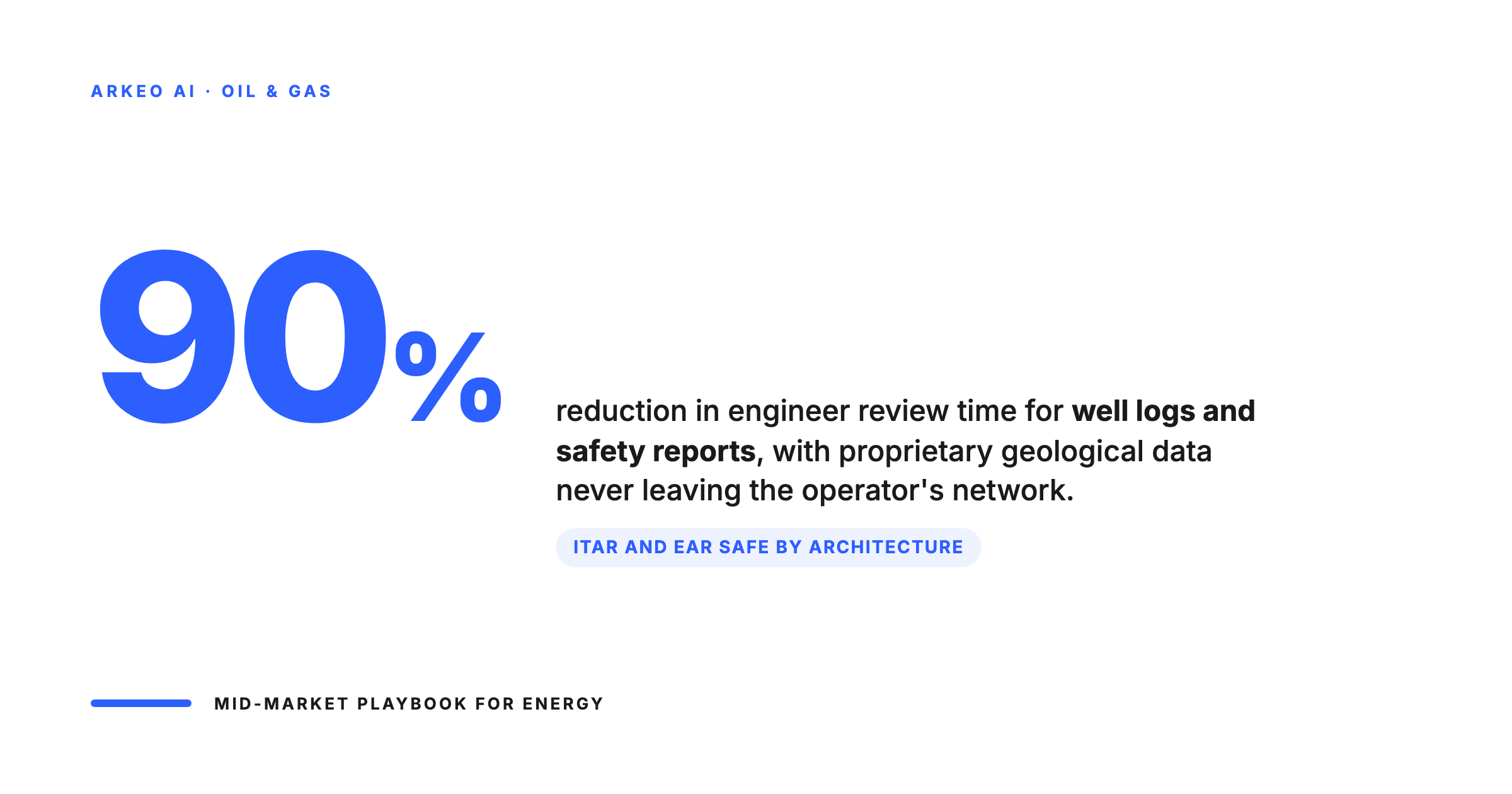
• Technical Efficiency: Automates the parsing of unstructured technical documentation, reducing engineer review time for well logs and safety reports by up to 90%.
• Implementation: A structured three-phase rollout (Crawl, Walk, Run) ensures AI agents integrate with legacy workflows without disrupting critical field operations.
The energy sector runs on data, but it is drowning in it. Every day, mid-market oil and gas operators generate thousands of pages of well logs, geological surveys, safety incident reports, and maintenance records. Historically, making sense of this data required teams of expensive engineers spending hours manually parsing PDFs and spreadsheets. Today, Artificial Intelligence promises to solve this bottleneck. But there is a massive catch: data security.
For most mid-market energy companies, throwing sensitive intellectual property into public cloud AI tools is not just risky. It is a breach of operational security and compliance. Enter the private AI workforce. By deploying models like Claude Cowork securely on your own infrastructure, operators can finally harness advanced AI reasoning without compromising data sovereignty. In this guide, we will explore why standard cloud AI fails the energy sector, what makes Claude Cowork uniquely suited for complex operations, and how to deploy a custom AI workforce using a proven three-phase model.
The Data Security Challenge in Energy Operations
In the oil and gas industry, your data is your competitive advantage. Geological models, bidding strategies for new leases, proprietary drilling techniques, and operational efficiency metrics are the lifeblood of a profitable operator. When this data leaks, the financial consequences are catastrophic.
Yet, a silent risk is growing within many mid-market energy companies: Shadow AI. To save time, engineers and administrative staff are increasingly copying and pasting sensitive documents into public AI tools like ChatGPT or standard cloud-based LLMs. They want quick summaries of massive reports or help drafting compliance documents. But standard cloud AI deployments process this data on shared infrastructure, often using it to train future models. For an industry built on guarded IP, this is unacceptable.
Furthermore, energy operations are subject to rigorous regulatory frameworks. Environmental compliance, safety incident reporting, and procurement liabilities require a strict chain of custody for all documentation. A generic cloud AI deployment cannot guarantee that your data will not cross jurisdictional boundaries or be exposed to unauthorized entities. The reality is clear: mid-market oil and gas operators need the power of advanced AI, but they require the security of an on-premise, private AI workforce.
Where well logs, drilling reports, and bid documents live during analysis
Energy data is sensitive on two axes: the geological intellectual property of your operations, and the regulatory exposure of ITAR and EAR controlled technical data. Cloud AI fails on both. Private deployment fails on neither.
Data leaves your network
Data stays inside the operator network
What is Claude Cowork? Designed for Complex Operations
While many AI tools are built for general consumer use, Claude Cowork powered by Anthropic's advanced models is engineered for the complexities of enterprise operations. What sets it apart is its massive context window and sophisticated reasoning capabilities. Unlike basic chatbots that lose the thread after a few paragraphs, Claude Cowork can ingest and analyze hundreds of pages of dense technical documentation simultaneously.
But the true power of Claude Cowork is realized when it is deployed as part of an Agent Operating System (AOS) on your own infrastructure. We are not talking about a simple web interface; we are talking about a custom AI workforce. In a private deployment, Claude Cowork acts as the analytical engine, securely accessing your internal databases, legacy systems, and real-time sensor feeds without that data ever leaving your building.
This deployment model transforms AI from a basic tool into an active participant in your operations. It can cross-reference historical drilling logs with current performance data, ensuring that the operational truth is always accessible to your leadership team. Because it operates within a private AI framework, you maintain absolute control over permissions, governance, and data retention.
Stop Guessing on Your AI Strategy
Shadow AI is already happening in your operations. Regain control and deploy secure, private AI systems that protect your IP while drastically reducing administrative overhead.
Book Your Free AI Assessment →
Top 4 Use Cases for a Private AI Workforce in Oil & Gas
Deploying a private AI workforce powered by Claude Cowork unlocks immediate operational efficiencies. Here are four high-impact use cases where mid-market energy operators are seeing rapid ROI.
1. Analyzing Massive Geological and Drilling Reports
A single well can generate terabytes of data and hundreds of pages of operational logs. Traditionally, analyzing these reports to extract actionable insights or draft RFP responses takes weeks of engineering time. Claude Cowork can process these massive documents in seconds. By deploying it on-premise, your engineers can query historical well data instantly, comparing current drilling performance against past models to optimize extraction strategies without risking your proprietary data models.
2. Automating Compliance and Safety Documentation
The administrative burden of safety compliance is staggering. Incident reports, near-miss documentation, and environmental impact assessments require meticulous attention to detail. A private AI agent can automatically cross-reference daily field reports against regulatory requirements, flagging anomalies and drafting compliance documentation for human review. This ensures that your safety records are always accurate and up-to-date, reducing the risk of costly audits.
3. Interpreting Predictive Maintenance Logs
Equipment failure in the field costs millions in downtime. While predictive maintenance sensors generate vast amounts of data, interpreting that data quickly is a constant challenge. By integrating Claude Cowork with your internal sensor logs, the AI workforce can analyze failure patterns and maintenance histories, alerting operations managers to potential equipment issues before they result in catastrophic failure. The operational truth is delivered directly to the people who need it, exactly when they need it.
4. Optimizing Supply Chain and Procurement
Managing the supply chain for a mid-market oil and gas operator involves navigating complex contracts and procurement agreements. A private AI agent can parse thousands of pages of vendor contracts, identifying liability clauses, hidden costs, and performance bottlenecks. By automating this level of contract analysis, procurement teams can negotiate better terms and ensure that vendors are meeting their obligations.
Four high-impact agent deployments inside upstream and midstream operations
These are the four workflows that show up in every mid-market energy deployment. Each one is high-volume, document-heavy, and currently consumed by senior engineering or compliance time that the operator would rather spend on actual production.
Well log analysis
Parse and summarize unstructured well log data for faster engineer review. Up to 90 percent time reduction.
Regulatory reporting
Draft and validate regulatory filings against current rules. Compliance reviews compressed by weeks.
Predictive maintenance
Read equipment telemetry and inspection reports. Flag failure-risk patterns ahead of unplanned outages.
Vendor and bid review
Compare bids against historical pricing, contract terms, and performance. Procurement loop tightens.
The Financial Case: Predictable Costs vs. Cloud Surprises
When evaluating AI solutions, many mid-market operators default to cloud-based subscriptions. However, standard cloud AI pricing models are fundamentally misaligned with the realities of the energy sector. Cloud AI relies on per-token pricing, meaning you pay for every word of data ingested and generated. When you are processing 500-page well logs and terabytes of sensor data, those costs spiral out of control rapidly.
A private AI workforce operates on a fundamentally different financial model. By deploying the agent systems on your own infrastructure, you move away from unpredictable variable costs and toward a fixed-cost operational model. The infrastructure investment provides predictable OPEX, allowing you to scale your AI operations without being penalized for processing large datasets.
More importantly, the true ROI comes from resource reallocation. When a private AI agent handles the heavy lifting of data wrangling, document analysis, and compliance drafting, your high-value engineers are freed to focus on what actually drives revenue: optimizing operations and solving complex field challenges. We know this because we use what we sell. Arkeo AI runs its own systems, allowing a lean team to execute at the level of an enterprise operation.
Two pricing models, two very different operator economics
Per-token billing looks cheap on a vendor demo and turns expensive the moment you deploy to a full upstream team. Fixed-cost private deployment inverts that math the moment usage becomes steady.
Cost rises with usage. Every additional engineer, every additional report, every additional document multiplies the bill.
Hardware cost is a known number. Usage can triple without the bill moving. The math gets better at scale.
Deploying on Your Infrastructure: The Arkeo AI 3-Phase Model
Transitioning from ad-hoc AI usage to a structured, private AI workforce does not have to be a disruptive process. Since 2023, Arkeo AI has perfected a structured methodology for implementing secure agent systems in complex industrial environments. We execute this through a proven 3-phase model.
Phase 1: Assess
We do not start by throwing technology at the problem. The Assess phase involves a deep dive into your operational bottlenecks. Where are your engineers spending too much time on administrative tasks? Where is your data siloed? We identify the high-impact use cases where a private AI workforce can deliver immediate ROI.
Phase 2: Deploy
In the Deploy phase, we implement the Agent Operating System (AOS) directly on your infrastructure. This is where the security architecture is established. We configure Claude Cowork and other specialized agents to access your internal systems securely. Your data never leaves the building, ensuring complete data sovereignty and IP protection.
Phase 3: Manage
This is the critical differentiator. AI agents are incredibly powerful, but they break. APIs change, data structures evolve, and models require tuning. Standard IT teams do not have the specialized skills to maintain these systems. The Manage phase provides ongoing managed operations, where Arkeo AI continuously monitors, optimizes, and updates your AI workforce, ensuring that it remains the single source of operational truth.
Crawl, walk, run — the proven Arkeo deployment model for energy operators
No big-bang rollouts. Each phase ships a working capability into production, with the next phase starting only after the previous one has paid back. Six to nine months from kickoff to a managed agent workforce.
Assess
Map shadow AI use, regulated data flows, and the top three workflow candidates. Set the perimeter.
Deploy
Stand up the private environment with ITAR and EAR constraints baked in. Ship the first workflow.
Manage
Add workflows two and three. Continuous monitoring, audit log review, regulatory update handling.
Conclusion: The Operational Truth About AI
The energy sector is at an inflection point. The operators who figure out how to securely deploy AI will outmaneuver their competition, operating with leaner teams and higher margins. Those who ignore it or rely on insecure public cloud tools will face unacceptable risks to their intellectual property and an escalating administrative burden.
Implementing a private AI workforce is not a theoretical exercise; it is an operational necessity. It requires structure, security, and a partner who understands the realities of running a business. It is time to stop experimenting with AI and start deploying a system that works for you.