Category
Claude Cowork in Financial Services: Compliance AI
Last updated: May 2026
Financial services firms are at a critical juncture: the efficiency gains of Large Language Models (LLMs) are undeniable, but the compliance risks of public AI platforms are unacceptable. Analysts are currently losing hours to manual data extraction and reporting, while "shadow AI" usage creates significant regulatory exposure. Bridging this gap requires moving beyond generic chatbots toward a private, on-premise AI workforce that integrates directly with existing data infrastructure without compromising security.
This guide outlines how Claude Cowork provides a compliance-ready AI solution specifically for wealth management, private equity, and regional banking. By deploying high-reasoning models within a sovereign environment, firms can automate high-stakes workflows, from regulatory document parsing to complex financial modeling, while maintaining strict FINRA, SEC, and OSFI alignment.
Quick Answer
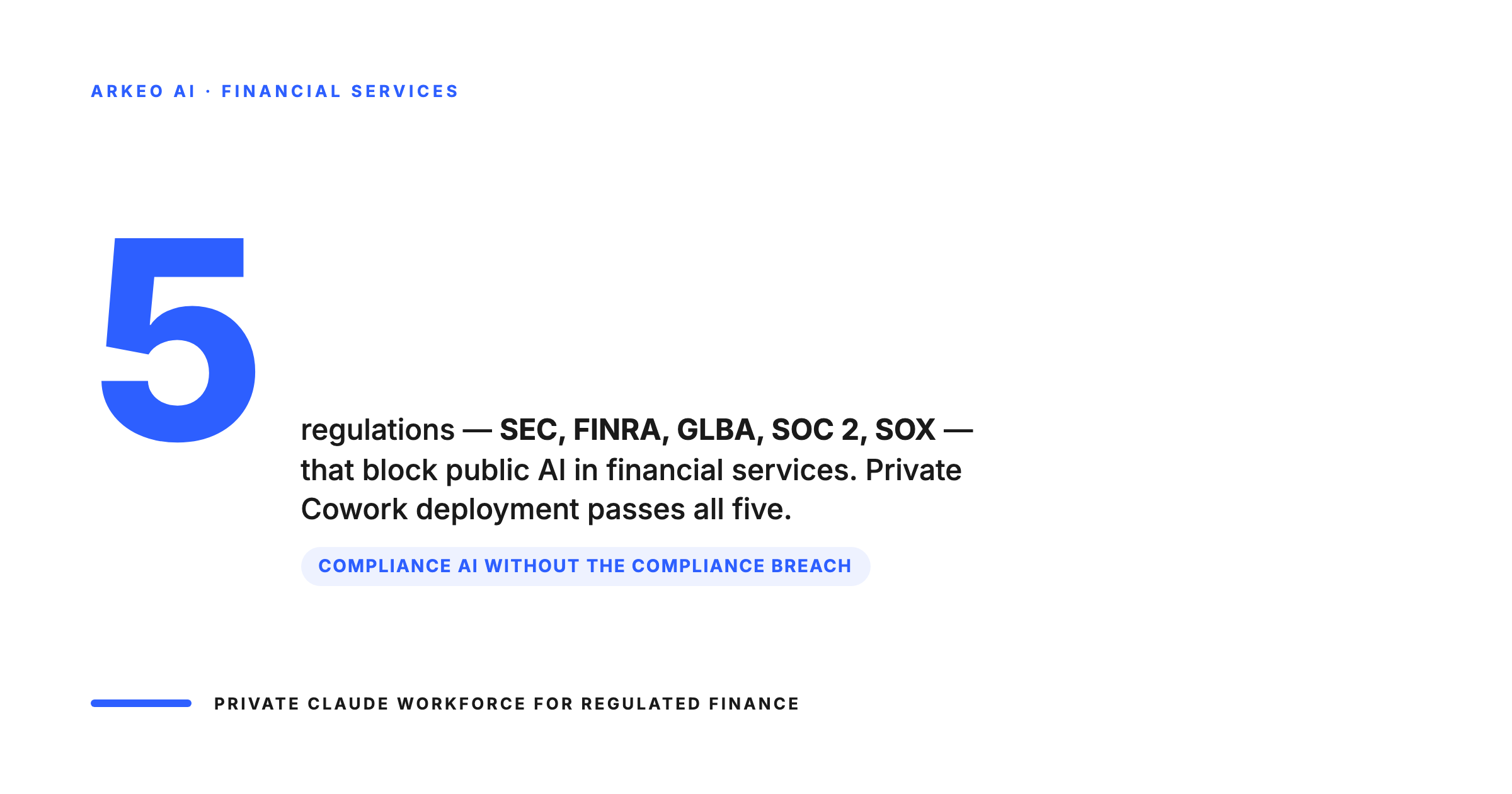
• The challenge: Financial services firms cannot deploy generic cloud AI without breaching SEC, FINRA, GLBA, SOC 2, and SOX compliance requirements.
• The solution: A private Claude Cowork deployment keeps client portfolio data, KYC records, and compliance correspondence inside your regulated perimeter.
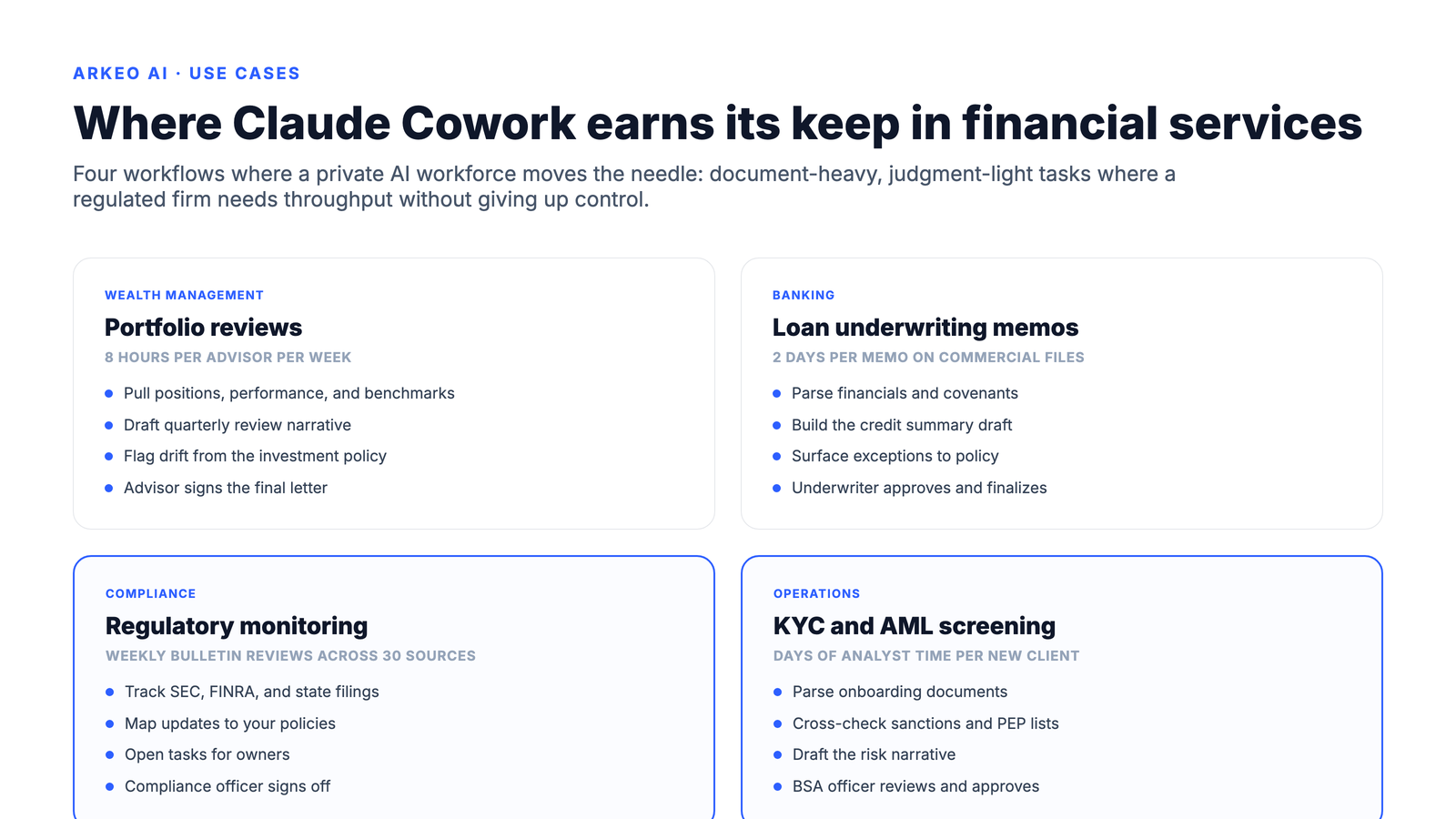
• The use cases: Wealth management portfolio reviews, banking loan underwriting memos, compliance regulatory monitoring, KYC and AML screening.
• The path: Assess compliance-sensitive workflows first, deploy on a secure perimeter with regulatory constraints built into agent system prompts, then manage continuously.
The Shadow AI Problem in Financial Services
Walk the floor of any mid-market financial services firm today, wealth management, private equity, regional banking, or insurance, and you will see the same operational truth: your analysts and advisors are already using AI. They are using public, cloud-based tools like ChatGPT or Claude to summarize earnings transcripts, draft client communications, and parse regulatory documents. They are doing this because the tools save them ten hours a week. They are doing this outside of your compliance perimeter. This is shadow AI, and in a heavily regulated industry, it is a ticking time bomb for data governance and client confidentiality.
Financial services firms are caught in a hard bind. On one side, competitors who figure out how to deploy an AI workforce will strip away their margins by operating faster and leaner. On the other side, deploying standard cloud AI means handing over sensitive client data, intellectual property, and proprietary trading strategies to a third-party model that may train on that very data. When you are regulated by FINRA, the SEC, or OSFI, "we hope they don't train on our data" is not a defensible compliance strategy.
You need the cognitive capabilities of top-tier models, but you need the data sovereignty of a locked server room. You need a private AI workforce. Since 2023, we have been building and deploying these exact systems on-premise for operators who cannot afford data leaks. In the financial sector, the emerging gold standard for this architecture is deploying Claude in a dedicated, private cowork environment.
Shadow AI exposing your firm's sensitive data?
Stop guessing what tools your analysts are using on the side. Book an AI Assessment to see exactly how to deploy a private, compliant AI workforce on your own infrastructure.
Where regulated client data leaks today in a typical financial services team
Analysts under deadline pressure are pasting portfolios, KYC files, and compliance correspondence into public AI chatbots. Each paste is a compliance event the firm has no logs for. Private deployment eliminates the exit path entirely.
Analyst copy-paste exits the perimeter
No exit path exists to use
What is Claude Cowork?
When we talk about "Claude Cowork" in an enterprise context, we are not talking about buying a subscription to Anthropic's public web interface. We are talking about deploying the Claude family of models, specifically Claude 3.5 Sonnet or Opus, within your own secure, private infrastructure to act as a digital workforce. This is a deliberate shift from treating AI as an external utility to treating it as an internal operating system.
A true private AI deployment means the model operates entirely within your Virtual Private Cloud (VPC) or bare-metal servers. The data stays in the building. The prompts stay in the building. The outputs stay in the building. Claude Cowork represents a collaborative environment where human operators (analysts, advisors, compliance officers) work alongside AI agents that have been specifically permissioned to access your internal knowledge bases, CRM data, and document repositories, without ever sending that data back to the model provider.
In this architecture, Claude becomes the reasoning engine for an Agent Operating System (AOS). It is not just answering questions; it is executing workflows. It can read a 300-page prospectus, extract the covenants, compare them against your firm's risk criteria, and draft a memo. It does this at scale, repeatedly, while maintaining strict adherence to your firm's compliance controls.
Two architectures, two compliance postures
Same Claude models in both cases. The difference is where the data lives during inference. For regulated finance, that single boundary is everything.
Vendor-hosted, data leaves
Self-hosted, data stays
The Compliance Barrier: Why Public AI Fails
The financial sector operates on trust and data security. The standard SaaS AI model breaks both.
Consider the typical flow of a public cloud AI tool. An analyst uploads a client portfolio summary to ask for optimization suggestions. That data leaves your firm's controlled environment, traverses the public internet, and lands on a server owned by the AI provider. Even if the provider claims they do not train on API data, you have still created a new data vector outside of your auditing perimeter. If that provider is breached, your client data is breached. If that provider changes its terms of service overnight, you are exposed.
For mid-market financial firms, this creates three insurmountable compliance barriers:
1. Data Residency and Sovereignty
Depending on your jurisdiction, financial data may be legally required to remain within certain geographic borders. Cloud AI providers route data dynamically through global server networks to balance compute loads. You cannot guarantee data residency when you use public multi-tenant APIs. A private deployment of Claude ensures that the data never leaves your specified geography, let alone your servers.
2. Auditing and Access Controls
Regulatory bodies require strict auditing of who accessed what data and when. When an employee uses a public web interface, you lose the audit trail. You do not know what prompts were run, what data was uploaded, or what outputs were generated. An on-premise AI workforce integrates directly with your existing identity and access management (IAM) systems. Every prompt, every retrieval, and every output is logged, traceable, and fully auditable by your compliance team.
3. Proprietary Intellectual Property
If you run a boutique private equity firm, your thesis and due diligence processes are your competitive edge. If your analysts are feeding due diligence materials into a public model, you are essentially outsourcing your IP to the cloud. Over time, large language models internalize patterns. A private AI workforce ensures your proprietary logic remains strictly yours.
The five regulations that gate every financial services AI deployment
Public AI fails on all five for different reasons. Private deployment passes all five cleanly because the data architecture is provable by inspection, not by vendor promise.
Investment adviser and broker-dealer rules. Client portfolio and trading data cannot transit vendor cloud without controls.
Gramm-Leach-Bliley Act. Customer PII must be safeguarded with auditable boundaries and breach disclosure.
Service organisation controls and financial reporting integrity. Provable controls over data and process.
Data Sovereignty and On-Premise Deployment
Solving the compliance barrier requires a shift in infrastructure. You must move from "renting cognitive power in the cloud" to "hosting cognitive power on your infrastructure."
Deploying Claude in a private environment typically involves utilizing secure enclaves or dedicated instances provided by major cloud providers (like AWS Bedrock or GCP Vertex) under strict Business Associate Agreements, or running open-weight equivalents on bare-metal servers. The goal is the same: zero-data-retention from the model provider. The model weights are accessed, but the context window, the data you feed it, is ephemeral and completely isolated from the provider's training mechanisms.
This allows your firm to build Retrieval-Augmented Generation (RAG) pipelines over your secure documents. The AI agent can read your internal compliance manuals, past trading histories, and client CRM records to provide highly contextual answers. Because the entire pipeline lives behind your firewall, you can implement role-based access controls. A junior analyst asking the agent about a client will only receive information they are explicitly authorized to see. The agent respects the same data boundaries as a human employee.
Practical Use Cases for Claude in Wealth Management & Banking
Theory is useless without execution. We use what we sell, and we have seen what actually drives ROI when you deploy a private AI workforce in a financial context. Here are the core operational workflows where Claude excels.
Automating Due Diligence and Document Parsing
A mid-market PE firm spends hundreds of hours reading through target company data rooms. Contracts, financials, employee agreements, and risk disclosures. A dedicated Claude agent can ingest these documents, extract specified clauses (like change-of-control provisions or non-compete terms), and populate a structured database. It does not replace the analyst; it replaces the first 40 hours of manual reading, allowing the analyst to focus entirely on the anomalies the agent flags.
Client Communication and Portfolio Summaries
Wealth advisors spend a significant portion of their week drafting personalized quarterly reviews for high-net-worth clients. An AI agent securely connected to the CRM and the portfolio management system can generate a first draft of these communications. It can analyze the portfolio performance, cross-reference it against the client's stated risk tolerance, and draft a highly personalized email. The advisor reviews, edits, and sends. The time saved per advisor scales linearly across the firm.
Regulatory Compliance Monitoring
Compliance teams are constantly monitoring communications for violations of SEC or FINRA rules. Rather than relying on simple keyword flags (which generate massive amounts of false positives), an on-premise Claude model can understand the nuance and intent of an email. It can accurately identify promises of returns, inappropriate guarantees, or unauthorized advice, drastically reducing the noise and allowing the compliance officer to focus on actual risks.
Meeting Ingestion and Action Extraction
Using transcription tools paired with a secure Claude model allows firms to turn hours of client meetings into structured data. The agent extracts the key decisions, the follow-up tasks, and the updated client preferences, pushing them directly into the CRM. No details are lost, and the advisor does not spend an hour typing up notes after the meeting.
Four data sources, one regulated perimeter, one Cowork deployment
Inside the perimeter: portfolios, CRM, compliance vault, and research. Outside the perimeter: nothing your firm cannot attest to. SSO governs identity, role-based scopes govern access, full audit logs prove it.
Portfolio data
Holdings, trades, valuations. The most sensitive data your firm holds. Stays inside the perimeter, no exceptions.
CRM and client
Client records, KYC, communications. PII under GLBA, controlled at the role boundary.
Compliance vault
Filings, attestations, regulator correspondence. SOX-relevant. Audit-trail mandatory.
Research feed
Internal research, external feeds, market data. Fed to Cowork via the retrieval layer, not training.
Measuring ROI: Cost vs Cloud AI
The immediate objection to deploying private AI infrastructure is cost. Yes, setting up a secure, dedicated environment requires upfront capital compared to paying $20 a month per user for a SaaS subscription. But that comparison is fundamentally flawed.
First, you must factor in the cost of risk. A single compliance violation, data leak, or IP loss dwarfs the infrastructure costs of a private deployment. When you operate in financial services, security is a non-negotiable line item.
Second, look at the scaling economics. Cloud AI charges per token. As your firm starts processing thousands of pages of documents and running complex workflows, those per-token costs scale exponentially. With an on-premise or dedicated infrastructure model, you are paying for the compute (the server time). Once you hit a certain threshold of usage, running your own hardware or dedicated instances becomes significantly cheaper than renting cloud capacity. Your marginal cost per query drops to near zero.
The true ROI, however, is measured in operational velocity. If you deploy an AI workforce that saves 50 analysts 10 hours a week, you have reclaimed 500 hours of highly compensated human capital. You are not just saving money; you are increasing the firm's capacity to take on new clients and execute more deals without linearly scaling headcount.
Per-token cloud pricing versus fixed private deployment at regulated-document scale
Regional banks and wealth-management firms churn through document volume that punishes per-token pricing fast. Five years out, the gap is wide enough that the procurement decision is rarely close.
Per-token billing climbs steeply as regulated-document volume scales across portfolio reviews, KYC, and compliance.
Fixed hardware and operations cost. Five years of usage at regional-bank scale, the bill barely moves.
The 3-Phase Deployment Model
Since 2023, we have seen dozens of AI projects fail because companies try to do everything at once. They buy a tool, throw it at their team, and expect magic. That is not how you build a private AI workforce. You need a structured approach.
Phase 1: Assess
We do not start by writing code. We start by mapping your operational truth. Where are your bottlenecks? Where is shadow AI already happening? What are your strict compliance boundaries? The assessment phase identifies the high-value, low-risk workflows that should be automated first. We map the data architecture required to keep your firm compliant.
Phase 2: Deploy
We build the systems on your infrastructure. This involves setting up the secure environment, deploying the Claude models (or appropriate open-weight alternatives), connecting the retrieval pipelines to your data sources, and establishing the role-based access controls. We deploy specific agents for specific tasks, an analyst agent, a compliance agent, a drafting agent.
Phase 3: Manage
This is where most deployments fail. Companies think AI is software you install once. It is not. AI agents are powerful, but they break. Data schemas change, models drift, and edge cases cause hallucinations. You must manage an AI workforce the same way you manage a human workforce. You need ongoing governance, performance monitoring, and continuous optimization.
Crawl, walk, run — the regulated-finance deployment model
Each phase ships into production with regulatory guardrails baked in. The next phase starts only after the previous one has been reviewed and signed off by Compliance.
Assess
Map compliance-sensitive workflows, document volumes, and the top three workflow candidates. Wire Compliance into the design review.
Deploy
Stand up the private model with regulatory guardrails written into system prompts. Ship workflow one, sign off with Compliance.
Manage
Add workflows two and three. Continuous monitoring, regulatory update handling, quarterly Compliance review.
Why "Manage" Matters
The "Manage" phase is the critical differentiator between an AI experiment and an AI operation. When a human analyst makes a mistake, you coach them. When an AI agent fails to extract a specific clause from a new type of contract, you must adjust its prompts, update its context window, or refine its retrieval pipeline.
If you do not actively manage your private AI workforce, its utility will degrade over time. Employees will lose trust in the outputs, revert to their old manual processes, and your investment will sit idle. At Arkeo, our model is built on ongoing managed operations. We don't just hand you the keys; we ensure the engine keeps running, adapting to your firm's changing data landscape and evolving compliance requirements.
Ready to build a compliant AI workforce?
You can't afford shadow AI, but you can't afford to fall behind, either. Start with an AI Assessment to build a secure deployment roadmap for your firm.
Conclusion
Financial services firms no longer have the luxury of waiting out the AI cycle. The operational leverage provided by models like Claude is too massive to ignore. But the standard SaaS playbook is fundamentally incompatible with the regulatory and security realities of the sector.
The solution is not to ban AI. The solution is to control it. By deploying Claude within a private, on-premise, or strictly dedicated environment, you bridge the gap. You give your team the cognitive horsepower they need to operate faster and leaner, while maintaining the absolute data sovereignty your clients and regulators demand. It is not easy, and it requires a deliberate shift in how you view infrastructure, but a managed, private AI workforce is the only sustainable path forward for the mid-market financial operator.