Category
Claude Cowork Enterprise Pricing vs Private AI Infrastructure
Claude Cowork Enterprise Pricing vs Private AI Infrastructure
Every mid-market operator knows that artificial intelligence is no longer optional. But the path to deploying an AI workforce is filled with conflicting advice. Business leaders are currently weighing two very different approaches to integrating AI into their daily operations. On one side, cloud-based agent platforms like Claude are pushing per-seat subscriptions such as Claude Cowork. On the other side, a growing number of data-conscious operators are shifting to Private AI Infrastructure, deploying models directly inside their own networks.
The decision you make today will determine your operational overhead and your data security posture for years to come. The problem with simply buying seats for cloud-based tools is that costs scale linearly with your workforce, while the security of your proprietary data remains largely out of your control. We have spent the last three years building and managing Private AI Workforces, and the operational truth is clear. Relying entirely on cloud AI providers creates a predictable financial trap.
This guide breaks down Claude Cowork enterprise pricing, compares the long-term total cost of ownership against Private AI Infrastructure, and explains why data sovereignty is the only sustainable strategy for mid-market businesses.
The Cloud AI Pricing Trap
When you look at standard cloud AI tools, the initial entry point always looks manageable. Twenty dollars a month per user seems like a reasonable operational expense. But as you scale, this pricing model reveals its true structure. The cloud AI pricing trap is built on the per-seat licensing model, a system designed to maximize recurring revenue for the vendor while punishing the company that scales.
In a typical mid-market company with 150 employees, a standard cloud AI deployment can easily cost thousands of dollars a month just in base licensing. That number does not include the cost of governance tools, data compliance monitoring, or the administrative overhead required to manage hundreds of individual cloud accounts. As your team grows, your software bill grows in exact proportion. There are no economies of scale when you are renting access to intelligence on a per-head basis.
We see companies constantly struggling with shadow AI. Employees use their personal credit cards to buy individual subscriptions to tools like ChatGPT or Claude, bypassing IT and exposing company data. When the company finally decides to standardize and purchase enterprise licenses to regain control, they are hit with massive recurring bills. The per-seat model guarantees that your costs will always increase as your workforce grows.
Stop Renting Intelligence
Tired of unpredictable cloud AI costs and per-seat licensing fees? Start your AI Assessment with Arkeo AI and discover exactly how Private AI Infrastructure can give you a fixed-cost AI workforce.
Book Your AI Assessment →Per-seat enterprise pricing compounds with success, fixed infrastructure does not
Variable cloud pricing looks cheap at small scale and turns into a recurring tax the moment usage becomes steady. For a mid-market firm running real operational AI, the crossover with fixed private infrastructure is usually inside eighteen months.
Annual cost climbs as the team scales. Adding seats, adding workflows, adding context windows — every variable multiplies.
Hardware and ops cost set up front. Doubling team size barely moves the invoice. Fixed beats variable at steady state.
Claude Cowork Enterprise Pricing: What It Actually Costs
Claude Cowork is positioned as a collaborative workspace for teams, offering access to Anthropic's powerful models. But to understand the true impact on your balance sheet, you need to look past the marketing and examine the hard numbers.
While standard Claude Pro subscriptions sit at a fixed monthly rate per user, enterprise pricing is often opaque. Enterprise tiers usually require minimum seat commitments, annual contracts, and add-on costs for advanced security features or higher usage limits. When you are negotiating a Claude Cowork enterprise contract, you are not just paying for the AI model. You are paying for the infrastructure required to host your data in their cloud, the support tier, and the administrative controls.
Let us look at a realistic scenario for a 200-person professional services firm. If enterprise licensing averages thirty dollars per user per month, the base cost is $72,000 annually. However, that figure only covers access. It does not account for the integration costs, the training required to get employees using the system effectively, or the potential overage charges if your team relies heavily on complex data analysis tasks that consume significant compute resources.
Furthermore, cloud providers frequently change their pricing structures and usage limits. A model that is affordable today might see a price increase tomorrow, or usage caps might be introduced that throttle your team's productivity unless you upgrade to a higher tier. You are entirely at the mercy of the vendor's pricing strategy.
Three line items most Claude Cowork enterprise quotes downplay
The published per-seat number is not the bill. Three additional line items routinely show up in procurement reviews. Mid-market buyers should price them honestly before signing.
Per-seat compound
Per-seat pricing compounds across the org. Every adjacent team that wants access doubles the spend.
Context add-ons
Long-context, model upgrades, and premium-tier features priced separately. Often not in the headline quote.
Egress and audit
Audit log exports, retention extensions, SSO integrations frequently sit outside the standard contract.
The Data Sovereignty Problem with Cloud Agents
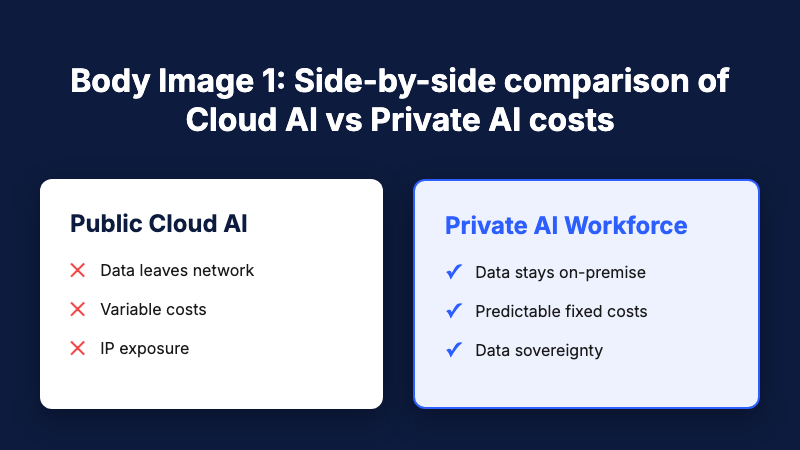
Cost is only half of the equation. The far more critical issue for any business operator is data sovereignty. When you use a cloud-based AI service like Claude Cowork, your proprietary data leaves your building. Your financial projections, your client emails, your internal source code, and your strategic plans are transmitted to third-party servers for processing.
Enterprise contracts often include clauses stating that the provider will not use your data to train their foundational models. But that promise does not eliminate the risk. Your data is still sitting on someone else's infrastructure, subject to their security vulnerabilities, their compliance audits, and their terms of service. For industries like healthcare, legal, or financial services, this is often a non-starter due to strict regulatory requirements.
Data sovereignty means having absolute, undeniable control over where your data lives and who has access to it. It means knowing that a breach at a cloud provider will not expose your company's intellectual property. When your employees paste sensitive client contracts into a cloud AI prompt, they are creating a massive liability. You cannot govern what you do not control.
What Is Private AI Infrastructure?
The alternative to the cloud AI rental model is Private AI Infrastructure. Instead of sending your data to a cloud provider's servers, you bring the AI models into your own environment. You run open-source or commercially licensed models on hardware that you own or lease, within your own secure network perimeter.
At Arkeo AI, we build Private AI Workforces. This means we deploy the necessary hardware, configure the software stack, and manage the ongoing operations of your agent systems. The AI operates entirely behind your firewall. When an employee asks an agent to summarize a confidential meeting transcript, that transcript never leaves your local network. The processing happens internally.
This approach fundamentally shifts how a business integrates artificial intelligence. It moves AI from being a risky, external software-as-a-service expense to being a core piece of your internal operational capability. You own the infrastructure, you own the data, and you have complete visibility into every action the system takes.
Fixed Costs vs Subscription Scaling
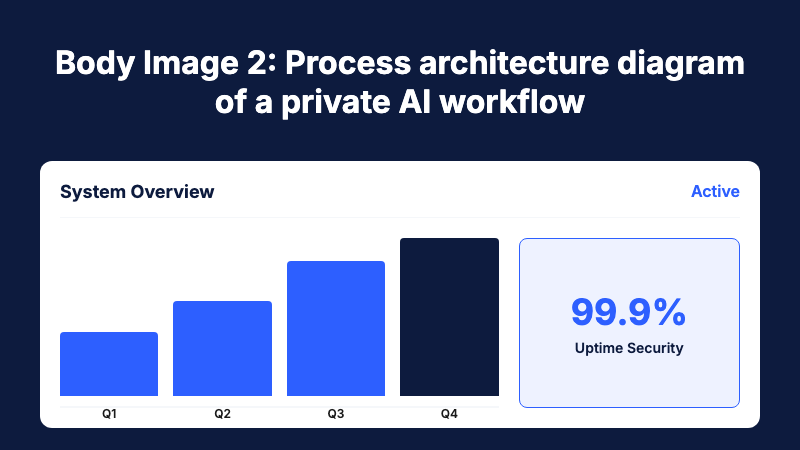
The financial argument for Private AI Infrastructure becomes undeniable when you look at a multi-year timeline. Cloud AI costs scale linearly. If you double your headcount, you double your AI licensing costs. Private AI Infrastructure operates on a fixed-cost model.
When you deploy private AI, your primary costs are the initial hardware investment and the ongoing management fee for the operating system and agent maintenance. Once the system is running, whether you have 50 employees using the agents or 500, your infrastructure costs remain essentially flat. The marginal cost of adding a new user to your internal AI system is practically zero.
Consider the math for a growing manufacturing company. Instead of paying $100,000 a year in perpetual cloud licenses that offer no equity, they invest in a private AI server and a managed service contract. By year three, the private infrastructure has paid for itself in offset licensing fees. More importantly, the company has built a proprietary asset. Their AI agents have been customized to their specific workflows, integrated deeply into their local databases, and secured behind their own firewall.
Control and Governance in Your Own Building
Governance is the difference between a toy and an enterprise tool. Cloud AI systems offer administrative dashboards, but you are still limited to the controls the vendor decides to expose. Private AI Infrastructure gives you granular, absolute control over every aspect of the system.
With a Private AI Workforce, you decide exactly which models have access to which databases. You can implement strict role-based access controls, ensuring that your HR agents cannot read financial projections and your marketing agents cannot access employee records. You maintain comprehensive audit logs of every prompt, every response, and every data retrieval action. If a compliance auditor asks to see exactly how AI is being used in your organization, you have the complete, unfiltered operational truth.
This level of governance is impossible in a multi-tenant cloud environment. You cannot inspect the underlying hardware, and you cannot verify the security boundaries between your data and another company's data. With private infrastructure, the security perimeter is your own building.
Secure Your Proprietary Data
Do not let your company's intellectual property leave the building. Deploy a Private AI Workforce that keeps your data strictly internal. Start your AI Assessment today.
Book Your AI Assessment →Building an AI Workforce, Not Just Buying Tools
We do not just deploy AI tools. We build an AI workforce. There is a massive operational difference between giving an employee a chat interface and deploying an autonomous agent that handles a specific business process from start to finish.
When you rely on Claude Cowork or similar platforms, you are largely providing your team with a smarter search engine and a drafting assistant. The employee still has to initiate the work, guide the AI, and verify the output. It is a tool that requires constant human intervention.
A Private AI Workforce operates differently. We design agent systems that integrate directly with your ERP, your CRM, and your internal file servers. These agents can monitor email inboxes, extract data from incoming invoices, update project management boards, and generate daily reports without human prompting. They do not just assist your employees. They execute specific operational roles. This level of deep, autonomous integration requires direct access to your internal databases, access that is far too risky to grant to an external cloud provider.
How to Deploy Private AI Infrastructure
Deploying a Private AI Workforce is a structured, operational process. It requires three distinct phases: Assess, Deploy, and Manage.
First, we conduct a rigorous AI Assessment. We identify the specific operational bottlenecks in your business that can be solved with agent automation. We look at your current data architecture, your security requirements, and your operational workflows. We do not guess. We build a clear, data-driven deployment plan.
Second, we handle the deployment. We rack the hardware, configure the operating systems, and deploy the foundational models. We build the agent workflows and integrate them securely into your existing software stack. We test everything extensively before it goes live.
Finally, we manage the system. AI agents are powerful, but they break. Models need updates, workflows need adjustment, and hardware requires maintenance. Our managed service ensures that your AI workforce remains operational, secure, and optimized for your business. You get the benefits of advanced AI without having to hire a $200,000 data science team.
Conclusion
The choice between Claude Cowork enterprise pricing and Private AI Infrastructure is a choice between renting a tool and owning an asset. Cloud AI provides immediate access, but it traps you in a cycle of escalating subscription costs and externalized data risk. Private AI Infrastructure requires operational commitment, but it delivers fixed costs, absolute data sovereignty, and the ability to build a truly integrated AI workforce.
For mid-market operators who are serious about their data security and their long-term operational efficiency, the cloud is no longer the default answer. Bring your AI in-house. Secure your data. Stop paying per seat, and start building an infrastructure that scales with your ambition, not your headcount.
Cloud subscription vs private AI infrastructure
The procurement decision is not about which is "better". It is about which fits your operating envelope. Cloud subscription wins for light, variable usage. Private infrastructure wins the moment AI becomes operational.
Variable cost, vendor controlled
Fixed cost, owned
Frequently Asked Questions
What is the main difference between Claude Cowork and Private AI Infrastructure?
Claude Cowork is a cloud-based subscription service where your data is processed on Anthropic's external servers, and you pay a recurring fee per user. Private AI Infrastructure runs locally on hardware you control, keeping your data entirely behind your firewall and operating on a fixed-cost basis regardless of user count.
Is Private AI Infrastructure more expensive than cloud AI?
While Private AI Infrastructure requires an initial hardware and setup investment, it becomes significantly cheaper over time. Cloud AI costs scale linearly with your headcount, leading to massive recurring bills as your company grows. Private AI has fixed infrastructure costs, making the cost per user approach zero as you scale.
How does Private AI protect our company data?
Private AI protects your data through absolute physical and network isolation. Because the AI models run on servers located within your own network perimeter, your sensitive documents, financial data, and client information never leave your building. This eliminates the risk of third-party data breaches and ensures compliance with strict data sovereignty requirements.
Do we need an internal IT team to manage a Private AI Workforce?
No. Arkeo AI provides a fully managed service. We handle the assessment, hardware deployment, software configuration, and ongoing maintenance. We act as your dedicated AI operations team, ensuring your agent systems run smoothly without requiring you to hire expensive internal specialists.
Can Private AI integrate with our existing software tools?
Yes. Private AI systems are designed for deep integration. Because the infrastructure sits inside your network, we can securely connect AI agents directly to your internal ERP, CRM, databases, and file servers, enabling true autonomous workflows that cloud AI platforms cannot safely replicate.