Category
Claude Code Subagents: A Mid-Market Operator's Guide to AI Workforces
Last updated: May 2026
For most mid-market operators, AI has meant a chatbot on someone's desktop. Claude Code subagents change that. With subagents and Plan Mode, you stop deploying a tool and start managing an AI workforce. Multiple digital workers run in parallel, each handling a slice of a real business workflow, with a human operator reviewing the plan before anything moves.
That shift, from one chatbot to many coordinated agents, is the part most operators have not yet absorbed. It changes what you supervise, where the risk is, and how value gets created. Arkeo has been building private AI agent systems for mid-market companies since 2023. This guide is what we tell operators when they ask what subagents actually mean for the business.
Quick Answer
• What it gives you: Multiple AI agents working in parallel on the same project, like assigning slices of a workflow to specialized team members.
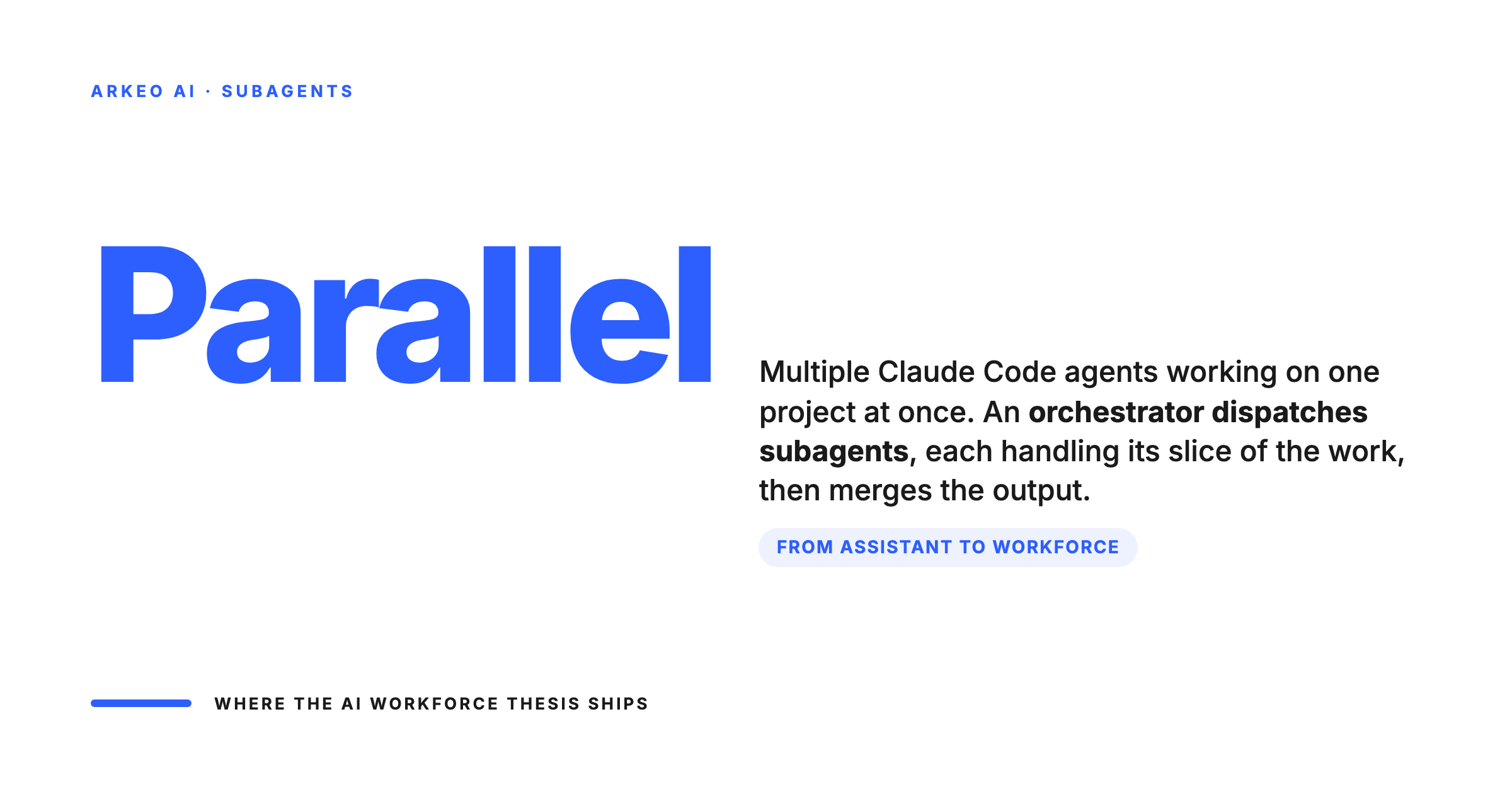
• Claude Code Subagents: Parallel worker agents spawned by a central orchestrator so distinct tasks run simultaneously instead of sequentially.
• Plan Mode: The agent writes the plan first, you approve it, then execution begins. No autonomous changes without sign-off.
• Operator impact: You stop managing tool usage and start managing approval gates on a digital workforce.
From Assistants to Orchestrators
Most mid-market businesses started their AI journey by handing employees generic cloud-based chatbots. Useful for drafting emails. Useless for actual operations. These tools have no memory of last week's decision, no access to internal systems, and no way to take action. They suggest. They do not execute.
Subagents change the shape of the work. When given a complex task, Claude Code does not start producing output immediately. It enters Plan Mode and writes out the full execution path first: what needs to happen, in what order, what data it needs to touch, and which steps can run in parallel. A human reviews the plan. The agents execute against it. The orchestrator coordinates handoffs.
For an operator, this is the difference between asking ChatGPT for a draft and giving a project to a team. You stop managing prompts and start managing a workflow that runs without you in the chair.
That is exactly what we map during a free AI Assessment: which processes in your business are the highest-cost, lowest-leverage uses of human time, and which ones an AI workforce can pick up next quarter.
How Claude Code Spawns Parallel Workers
Efficiency in complex operations requires parallel processing. In a sequential workflow, each step waits for the previous one to finish. Claude Code can break a task into multiple workstreams and spawn subagents to run them simultaneously.
A concrete example. A regional manufacturer running a month-end close needs three things to happen: reconcile 400 vendor invoices against received-goods records, flag pricing anomalies for the controller, and draft variance memos for the operations review. Sequentially, that is a multi-day job for a clerk. In parallel, three subagents handle one stream each, the orchestrator coordinates the handoffs, and the controller sees a complete reconciliation packet on her desk by 10am.
For an operator, this mirrors standard project management. You assign specific deliverables to specialized team members and review the combined output at predefined checkpoints. The technology is applying that proven operational model to digital workers.
An orchestrator routes work to specialised subagents and merges the output
The pattern looks unfamiliar but the org chart is the same as any human team: one coordinator, multiple specialists, a final merge. Below is a worked finance-reconciliation example with three subagents running at the same time.
Invoice reconciliation
Subagent A reads the invoice batch and matches each line against PO and receipt records. Flags exceptions.
Pricing anomaly check
Subagent B compares invoice prices against the master price list and contract terms. Flags outliers.
Variance memo draft
Subagent C drafts the variance memo for the controller using the outputs from A and B. Coordinator merges.
See Where AI Fits in Your Business
Book a free 30-minute AI Assessment. We'll map your highest-value automation opportunities, estimate ROI, and build a 90-day deployment roadmap. No obligation, no pitch deck.
Book Your Free AI Assessment →
Establishing Approval Gates for Digital Workers
An AI workforce without approval gates is a liability. The power of parallel subagents only works when paired with the right checkpoints.
In Claude Code's architecture, Plan Confirmation is the primary gate. Before any subagent runs, the orchestrator presents the complete execution plan. The operator reviews the steps, adjusts priorities, and explicitly authorizes execution. Additional checkpoints fire during execution to verify that intermediate output meets a defined standard before the next stage runs.
The same model applies whether your subagents are reconciling vendor invoices, drafting compliance filings, or routing customer support tickets. Pick the checkpoints that match your risk tolerance. Mid-market operators almost always need at least three: plan confirmation before execution, output review before anything touches a customer or a system of record, and rollback authority for any decision that cannot be reversed cleanly.
The most common failure mode we see in mid-market deployments is operators copying the gate structure from a brochure instead of mapping it to their actual decision rights. A bookkeeper has different rollback authority than a controller. A junior analyst should not be the human-in-the-loop on a multi-million-dollar variance. Get specific about who can approve what, write it down, and wire the agent to escalate to the right person when the dollar amount, the system touched, or the customer involved crosses a threshold you would not let a new hire cross unsupervised.
Three gates between an autonomous agent and any customer impact
Plan Mode is the first gate. Output review is the second. Rollback is the third. Each one is a deliberate human checkpoint. Skip any of them and the agent has more authority than it should.
Plan approval
Agent writes the plan first. Operator reads it, edits it, approves it. No execution begins before that.
Output review
Agent runs the plan and produces output. Operator reviews it before anything ships to a customer.
Rollback
Operator can roll back any approved action. The undo path is named and tested, not theoretical.
Managing Digital and Human Teams
Deploying a custom AI workforce means integrating digital workers alongside your existing human teams. That requires a shift in how you think about the asset. You are not buying software. You are onboarding a new type of employee.
That framing changes everything downstream. You design onboarding. You set scope. You assign supervision. And you decide whose data the new employee is allowed to touch. Cloud-based tools that send proprietary data to third-party servers fail this last test cleanly. This is why on-premise, private AI deployments matter for any operator handling sensitive financials, customer records, regulated data, or competitive IP. Your digital workers operate inside your environment. Your data never leaves the building.
How human managers run teams where some of the workers are subagents
The shift is from managing a team of humans to managing a team of humans and agents. Each subagent is treated like a digital employee: it has a role, a scope, and a named human reviewer. The org chart stops being purely human, but it does not stop being an org chart.
Sales
Human manager. Subagents handle pipeline hygiene, follow-up drafting, proposal assembly. Manager reviews and ships.
Operations
Human manager. Subagents handle status reports, exception flagging, schedule rollups. Manager intervenes on edge cases.
Finance
Human controller. Subagents handle reconciliation, anomaly detection, variance memos. Controller signs off, every time.
Get the approval gates right, build the orchestration to match how your business actually runs, and keep the whole stack on infrastructure you control. That combination is what scales an AI workforce without scaling your risk.
Ready to Deploy AI on Your Infrastructure?
Arkeo builds private AI systems for mid-market companies. No cloud dependencies, no data leaving your building, no per-token pricing. Start with a free 30-minute assessment.
Book Your Free AI Assessment →