Category
Claude Code Security: A Mid-Market Operator's Guide
Last updated: May 2026
AI coding agents like Claude Code are changing how fast development teams ship. They are also quietly moving your most valuable asset, your source code, into the public cloud. Without proper governance, these unmanaged tools create a massive shadow AI problem that puts your proprietary code, API keys, and database schemas at risk every single day.
Quick Answer
• The risk: Unmanaged AI coding tools leak proprietary IP, algorithms, and database schemas to public cloud models.
• The reality: Built-in security features protect your machine from the AI. They do not protect your data from leaving the building.
• The solution: A private AI workforce keeps your code and data fully isolated on your own infrastructure.
• First step: Audit what your developers are already using and where source code is going right now.
What Happens When Developers Bypass IT?
Developers want to move fast. When faced with a complex debugging task or tedious boilerplate code, they will look for the quickest path to a solution. Often, this means performing a claude code login on their local machines to spin up an AI assistant. The problem is that this happens completely outside of enterprise controls.
If a developer pastes a core database schema to optimize a slow query, that schema just left your secure network. If they ask the agent to refactor a proprietary algorithm, your competitive advantage is now sitting on a third-party server. Mid-market operators cannot afford to have their intellectual property walking out the digital front door because an employee wanted to save thirty minutes of typing.
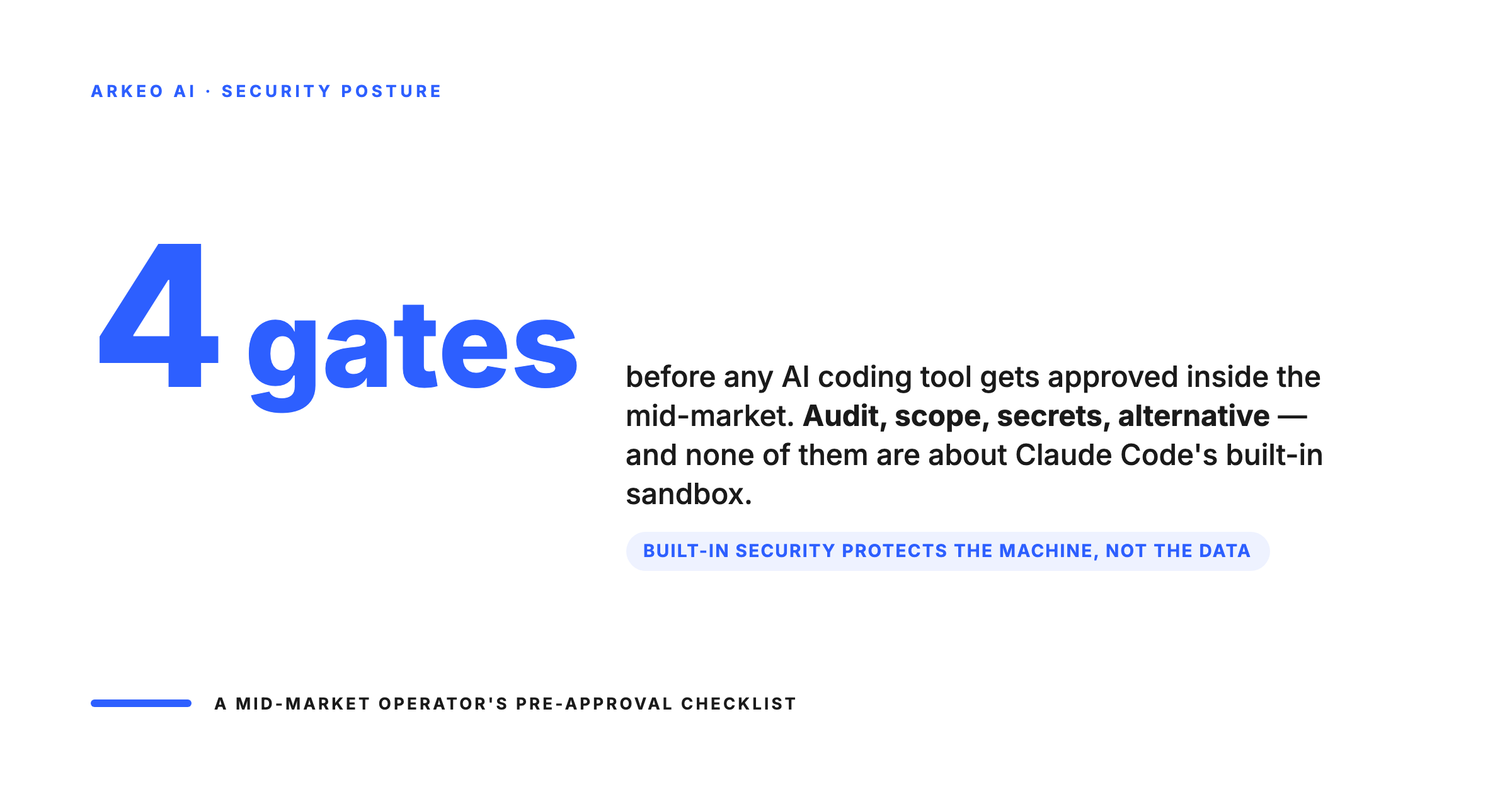
Four gates that have to clear before any AI coding tool gets a green light
Claude Code's built-in sandbox is good. It is not the threat model that matters here. The threat model is data leaving the building — and these four gates are how mid-market firms answer it.
Audit logging
Every prompt, every read, every write traceable to a user. SIEM-ready. Without this, you have no story for the auditor.
Scoped repo access
Per-developer scope. Engineering does not get to read the executive folder. Enforced at the agent boundary.
Secrets pre-paste scan
Outbound prompt scan for keys, tokens, credentials. Block before the data leaves the machine.
Private alternative
A path for sensitive repos to use a private deployment instead of cloud AI. No exceptions for one-off pastes.
The True Risk of Cloud AI in Your Codebase
The specific data types at risk in software development are highly sensitive. We are talking about internal API structures, hardcoded credentials that accidentally made it into local files, and core business logic. When you use public cloud AI models, you are trusting that your data will not be used to train future public iterations of those models.
While tools like Claude Code have impressive built-in security features, those mechanisms are designed to protect the developer's local machine from the AI agent. They use permission-based architectures, sandboxing, and command blocklists to prevent the AI from running malicious commands locally. These features do not solve the fundamental issue of data sovereignty. The data still leaves your building. It still goes to the cloud.
Find Out What AI Your Team Is Already Using
Book a free 30-minute AI Assessment. We'll map your highest-value automation opportunities, identify your shadow AI exposure, and build a 90-day deployment roadmap. No obligation, no pitch deck.
Book Your Free AI Assessment →
Claude Code Security Features vs. Data Sovereignty
It is important to acknowledge that Anthropic takes security seriously. Claude Code defaults to read-only access and requires explicit developer approval to execute bash commands, edit files, or run tests. It restricts write access strictly to the project folder and isolates network requests. These are excellent protections against prompt injection attacks or rogue commands.
But security against malicious commands is entirely different from data sovereignty. A tool can be perfectly secure from hackers while still transmitting your source code to a public cloud provider. For a mid-market business handling sensitive client data, healthcare records, or proprietary manufacturing algorithms, any data leaving the building is a risk. You need to control the operational truth of your data.
Two different things both labeled "security"
The vendor security marketing usually covers the first column. The thing your auditor cares about is the second. Both matter, but conflating them is how mid-market firms ship data into public training sets.
Protects your machine from the AI
Protects your business from data leaving
The Pre-Approval Checklist for Any AI Coding Tool
Before any AI coding assistant gets a green light in your stack, it should clear the same four operator-level gates we apply to every client deployment. Most mid-market teams skip at least one of these and pay for it the first time an incident response review surfaces a leaked schema or a pasted API key.
Gate 1: Comprehensive audit logging. Every prompt, every response, and every file accessed must be captured in a reviewable log. If you cannot show an auditor exactly what code left the laptop, the tool is not approved.
Gate 2: Scoped repository access. The agent gets role-based access to specific repos or folders, not blanket access to the codebase. A frontend agent does not need to see the billing service. A junior developer's session does not need to see the security-critical authentication module.
Gate 3: Secrets pre-paste scanning. A lightweight scanner on the developer's local environment catches API keys, OAuth tokens, and connection strings before they ever cross the network boundary. This is a five-minute installation that prevents the single most common incident class.
Gate 4: A private AI alternative is available. If your only AI option is a public cloud tool, your policy is going to be ignored. Provide an internal alternative that is at least as fast and capable as the public tool so the secure path is also the easy path.
Four items to confirm before any AI coding tool gets approved at any team size
The same four gates as above, restated in the order an operator should sign them off. Treat them as a checklist. Sign each one before the next.
Audit logging
Every action traceable to a user and a timestamp. SIEM-ready exports. Tested, not theoretical.
Scoped repository access
Per-user and per-team scope. Engineering scope, executive scope, finance scope, each enforced separately.
Secrets pre-paste scanning
Outbound prompt scanning for keys, tokens, credentials, PII. Block before the data leaves the machine.
Private AI alternative
A documented path for sensitive repos to use a private deployment instead of public cloud AI.
Stopping Shadow AI With a Private AI Workforce
The solution to shadow AI is not blocking access to AI tools entirely. If you ban them on company laptops, developers will simply use them on their personal devices. The only effective strategy is to provide a secure, private AI alternative that matches or exceeds the capability of public tools.
Arkeo AI builds and manages private AI systems specifically for mid-market companies. We deploy an Agent Operating System directly on your infrastructure. Your developers get the speed and efficiency of AI agents, and you get the guarantee that absolutely no data ever leaves the building. That is exactly what we map during a free AI Assessment: where your team needs AI support and how to deploy it without the data exposure.
Ready to Deploy AI on Your Infrastructure?
Arkeo builds private AI systems for mid-market companies. No cloud dependencies, no data leaving your building, no per-token pricing. Start with a free 30-minute assessment.
Book Your Free AI Assessment →