Category
Claude Code MCP: Connecting Private AI to Your Data
Last updated: May 2026
Mid-market operators know that AI only becomes truly powerful when it can read their company's internal data. The problem is that pasting proprietary financials or operational data into public cloud tools is a massive security risk that most leaders are not willing to take. At Arkeo AI, we build private AI systems using the Model Context Protocol (MCP) to bridge the gap between secure internal databases and advanced tools like Claude Code without leaking intellectual property.
Quick Answer: Claude Code and MCP
• The Protocol: MCP is an open standard that securely connects AI models to your internal data sources through a client-server architecture.
• The Tool: Claude Code uses MCP plugins to access your private data locally, without sending your entire database to the cloud.
• The Risk: A misconfigured MCP architecture can give an AI unrestricted access to your entire company database, so professional scoping and access control are essential.
• First Step: Define which one or two workflows justify MCP access before standing up any servers.
The Hidden Risk of Connecting AI to Business Data
Every mid-market company is trying to figure out how to put AI to work. The dilemma is obvious. You need the AI to analyze your specific business data to get useful answers, but you cannot hand over your entire proprietary database to a public cloud provider. When employees bypass IT to use AI, they often copy and paste sensitive information directly into public interfaces. That is shadow AI, and it creates significant exposure for your business.
To solve this, companies are looking for ways to connect AI directly to their internal systems. If you get this architecture wrong, you are essentially giving a machine unrestricted access to your entire digital infrastructure. You need a secure bridge. That bridge is the Model Context Protocol.
What is the Model Context Protocol (MCP)?
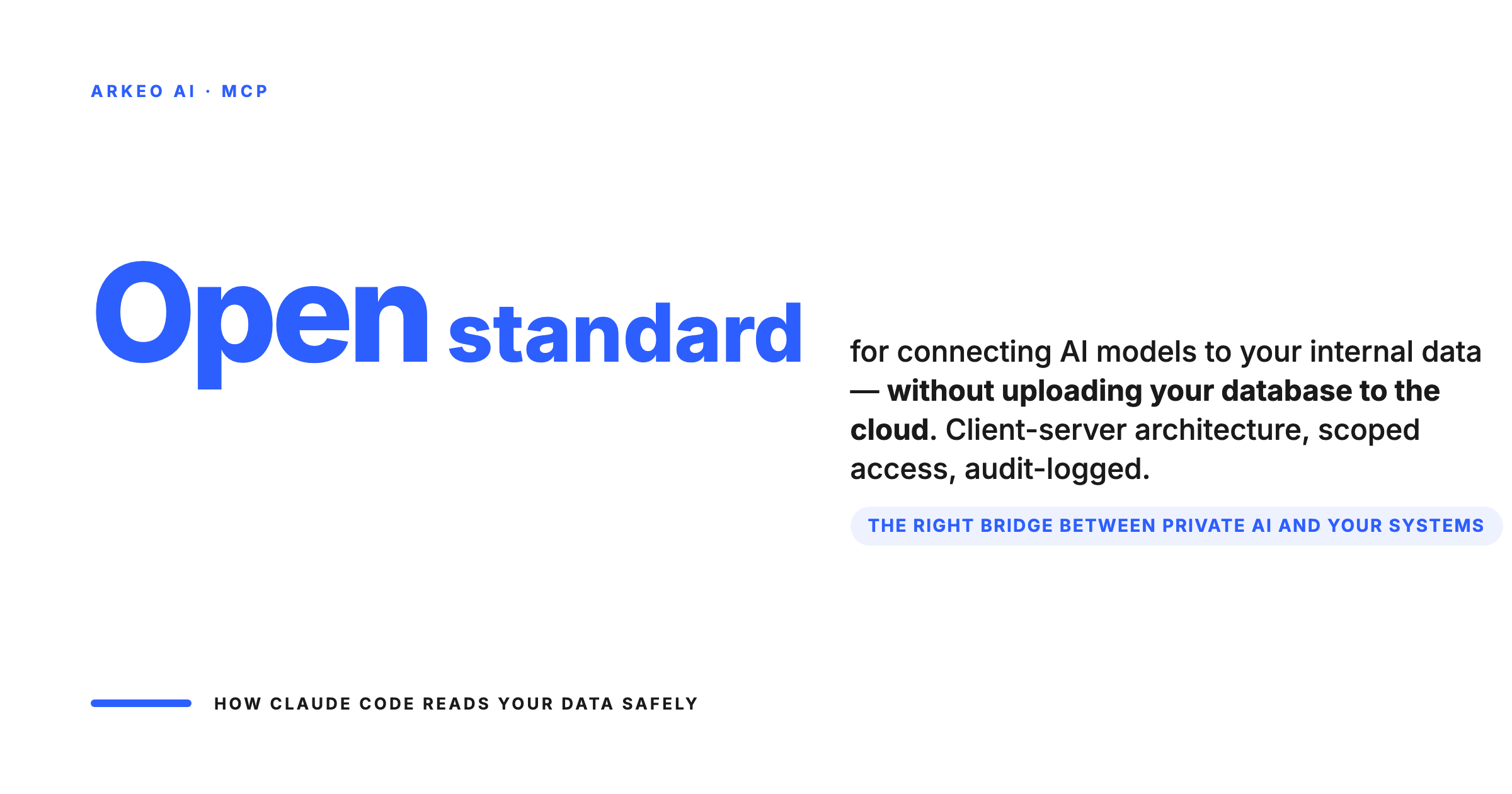
The Model Context Protocol (MCP) is an open standard introduced to standardize how AI models communicate with external data sources. Think of it as the universal plug for AI data access. Before MCP, every connection between an AI and a database required custom, brittle code.
MCP creates a standardized client-server architecture. In this architecture, the AI acts as the client and your internal systems host the MCP servers. When the AI needs context to answer a question, it queries the server. The server reads your local data and returns only the specific information required for that exact prompt. Your data stays securely on your premises until it is explicitly requested.
Three components inside the perimeter, one open protocol between them
Claude Code is the client. The MCP servers sit inside your network and broker scoped access to data sources. The agent talks to the servers, the servers talk to your systems, your data never has to leave the perimeter.
Claude Code
The client. Talks to MCP servers over the open protocol. Holds no direct credentials to your systems.
MCP servers
Per-tool servers inside your perimeter. Auth, scope, allow-list enforced here, not in the agent prompt.
Internal data
Drives, databases, ticket systems, source code. Stays on your network, served only through MCP.
How Claude Code Uses MCP Plugins
Claude Code is an agentic command-line tool that natively supports MCP. It operates locally on your machine or within your secure server environment. Instead of pushing your data to a public LLM, Claude Code uses MCP plugins to read from your specific tools like GitHub, Slack, or a custom internal database. These plugins act as heavily guarded doors. They allow Claude Code to see exactly what it needs to execute a task, and absolutely nothing else. It is a highly efficient way to deploy a private AI workforce that respects your data sovereignty.
See Where AI Fits in Your Business
Book a free 30-minute AI Assessment. We'll map your highest-value automation opportunities, estimate ROI, and build a 90-day deployment roadmap. No obligation, no pitch deck.
Book Your Free AI Assessment →
The Right (and Wrong) Way to Build the Bridge
Understanding MCP is one thing, but deploying it correctly is entirely different. The wrong way to build this bridge is to give the MCP server root access or unrestricted read permissions to your database. If you do this, a hallucinating AI or a poorly structured prompt could accidentally expose or alter critical enterprise data.
The right way to integrate Claude Code and MCP is through strict role-based access control. Endpoints must be read-only where appropriate, and the environment must be completely secured. This ensures that the AI only retrieves the data you explicitly allow it to see. An improperly secured MCP server is no different than handing a stranger the master keys to your office.
The right way and the wrong way to expose an MCP server to an agent
Same protocol, very different security posture. The wrong configuration gives the agent unrestricted access to your entire codebase, drives, and systems. The right configuration scopes the agent to exactly what it needs and logs everything.
Root access by default
Least privilege by default
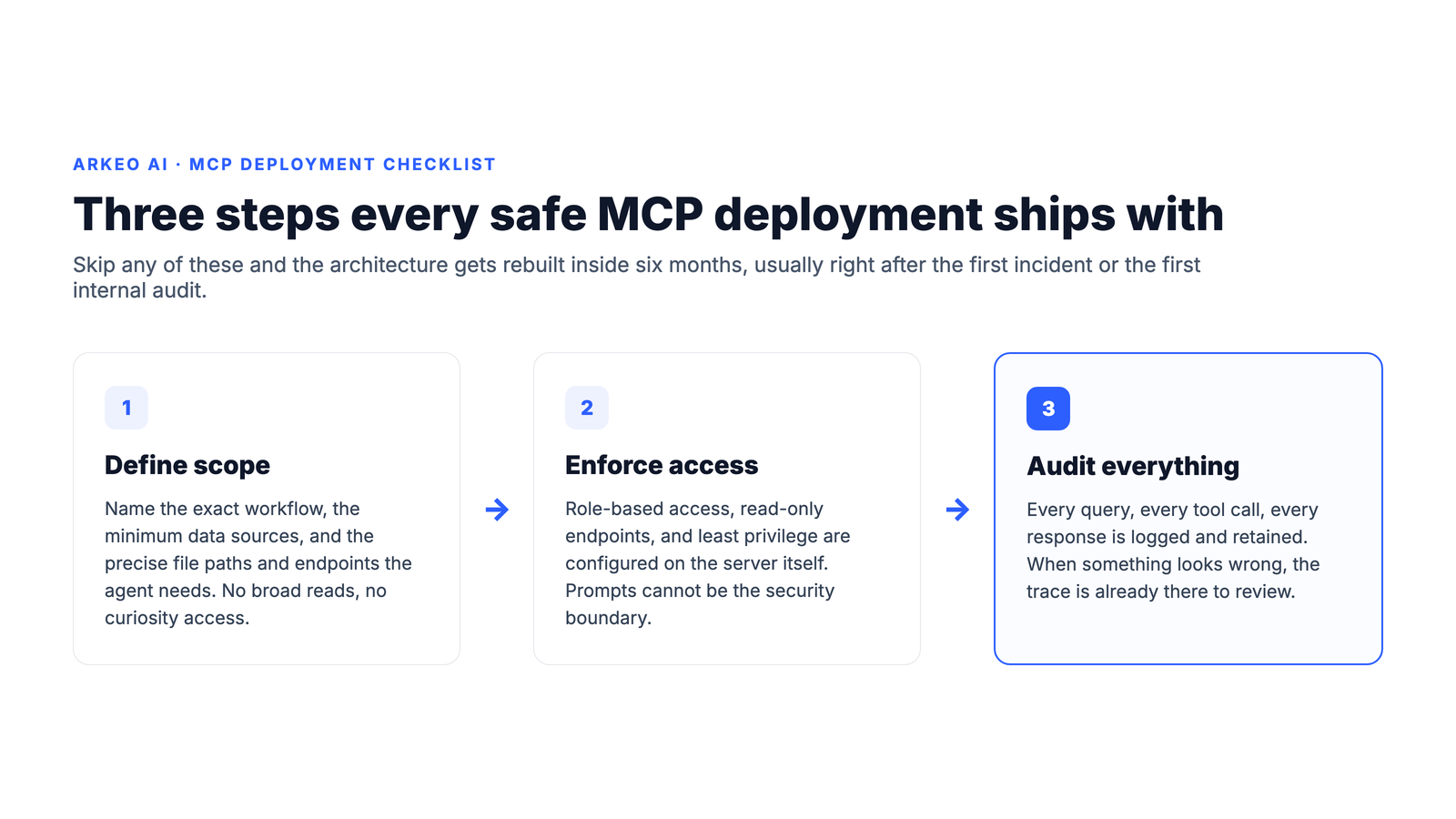
In practice, every safe MCP deployment we have shipped follows the same three-step pattern. Operators who skip any of these three steps end up rebuilding their architecture inside of six months, after the first incident or the first internal audit:
Step 1: Define scope first, code second. Before standing up any server, list the exact workflow the agent needs to perform and the minimum set of data sources, file paths, and API endpoints required to do it. Most deployments fail because the scope was set to "all of finance" instead of "vendor invoice records and the PO matching table for the AP inbox agent."
Step 2: Enforce access controls at the server, not the prompt. Role-based access control, read-only endpoints by default, and the principle of least privilege are configured on the MCP server itself. Do not rely on the prompt to constrain the agent. Prompts can be jailbroken; properly configured servers cannot hand back data the agent is not allowed to see.
Step 3: Audit every query and every response. Comprehensive logging is non-negotiable. Every prompt, every tool call, every file read, and every response must be captured and preserved. When an error or an unexpected output appears, you need a traceable record of exactly what the agent asked for and what the server returned.
Why Mid-Market Companies Need Private AI Architecture
Mid-market operators cannot afford to experiment with insecure AI deployments. You need the operational efficiency of an AI workforce without the risk of data leakage. That is exactly what we map during our free AI Assessment: which processes can be automated safely today, which require a private MCP deployment, and which are not yet worth the architectural lift.
By leveraging an architecture built on MCP, you maintain total data sovereignty. Nothing leaves your building unless the explicitly scoped agent requests it for a specific task. Do not try to build this enterprise architecture yourself. The decisions on scope, access control, and audit policy matter more than the code, and they are the exact decisions a botched deployment gets wrong.
Ready to Deploy AI on Your Infrastructure?
Arkeo builds private AI systems for mid-market companies. No cloud dependencies, no data leaving your building, no per-token pricing. Start with a free 30-minute assessment.
Book Your Free AI Assessment →