Category
How to Bridge the AI Readiness Gap
Last updated: June 2026
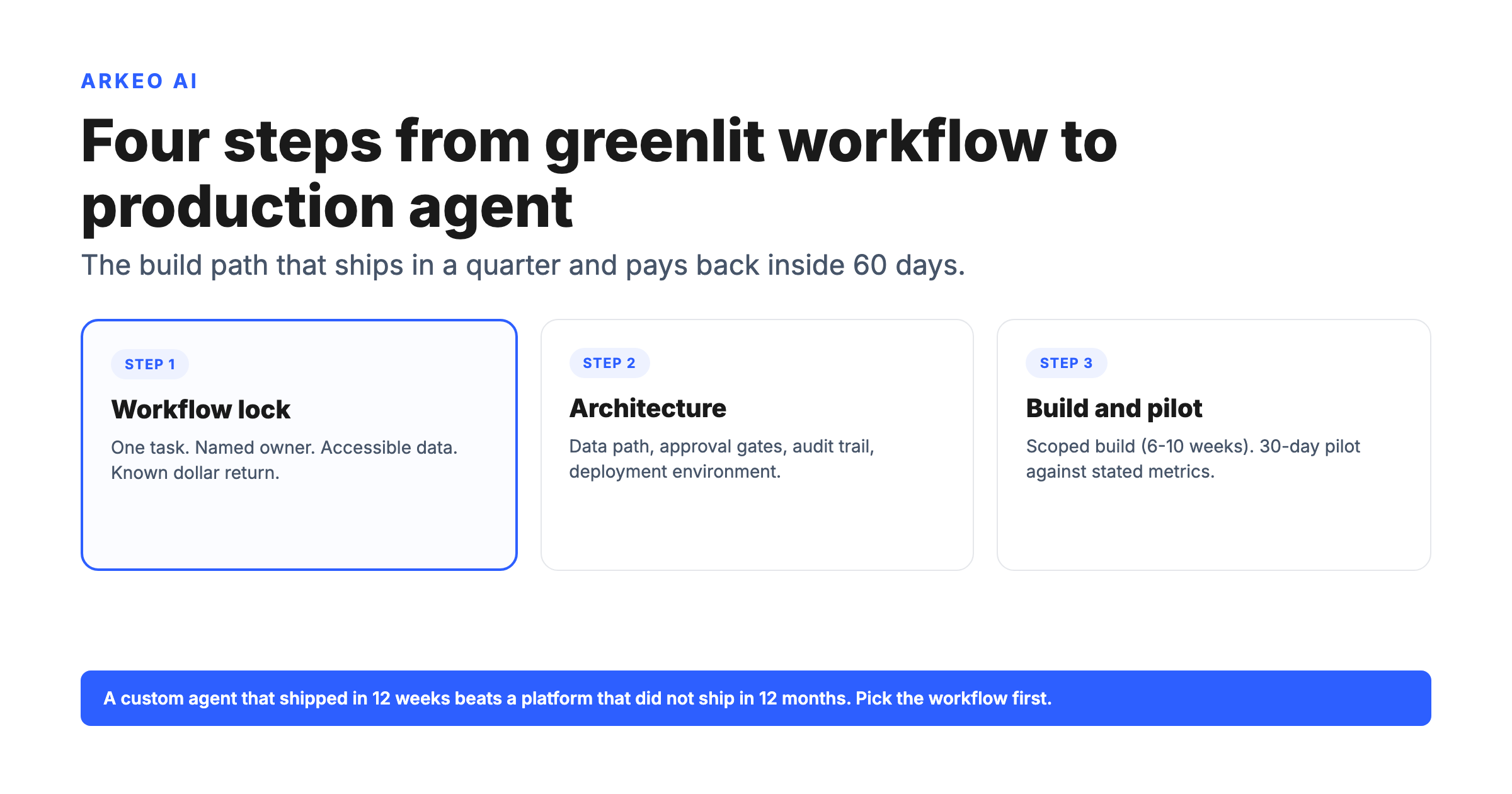
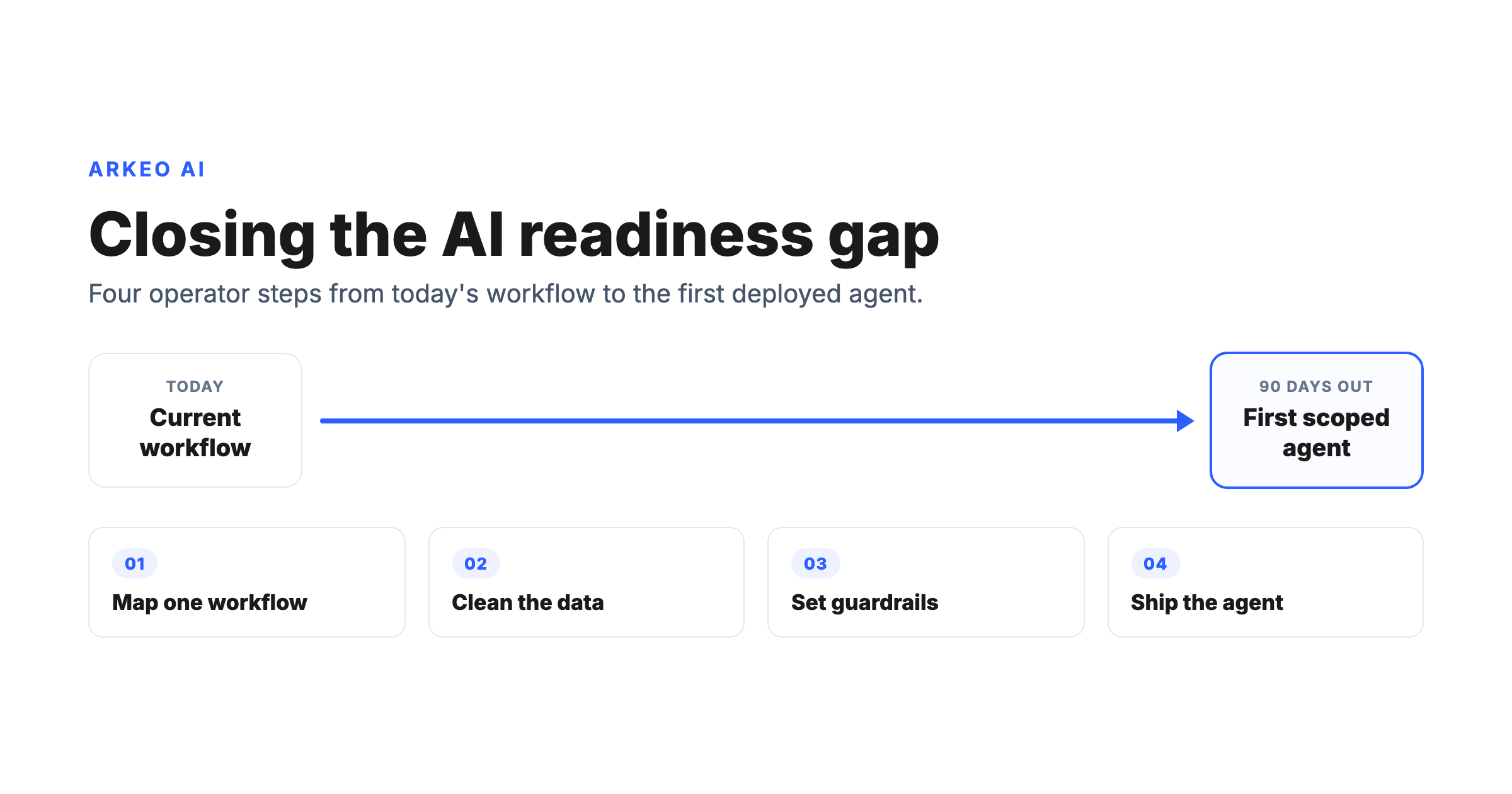
If you run a $10M to $200M business and the board has already asked you the AI question, the gap you feel is real: the team uses ChatGPT for emails, the data sits in five disconnected systems, and the first real agent is on the roadmap with nothing concrete behind it. The cost of getting this wrong is not a failed pilot. It is twelve months of motion without a deployed system, a security incident from shadow AI sitting on the audit committee's desk, and an operating budget that quietly absorbs another year of copy-paste admin work the agents were supposed to remove. This guide gives you a four-step bridge plan you can run in 90 days, so the next time finance asks where the agent investment lands, the answer is a workflow, a number, and a date.
Arkeo has spent three years deploying AI agents into mid-market operations, including its own, and the pattern is consistent: the gap between "curious about AI" and "running a private agent in production" is almost never a model problem. Stanford HAI's 2025 AI Index reports 78% of organizations used AI in 2024, up from 55% the year before. Adoption is now the baseline. Readiness to operate what you adopted is the bottleneck, and that is the gap this post closes. Before any of it ships, you need a clear-eyed view of where you actually stand, which is what the free AI Assessment is built to produce.
Quick Answer
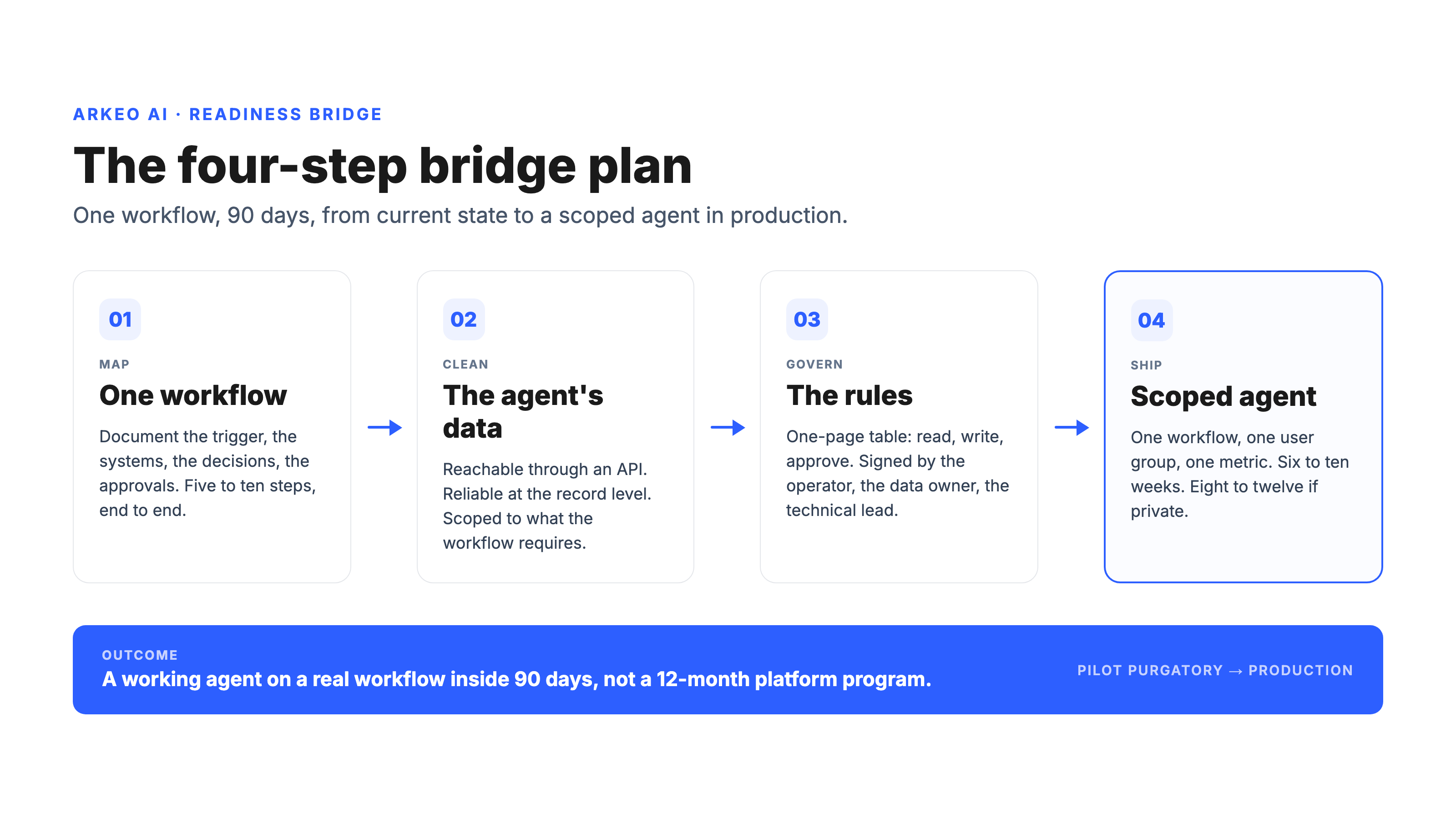
• What it is: A four-step 90-day plan to close the gap between today's workflows and what your first AI agent needs.
• Steps: Map the workflow, clean the data, set the guardrails, ship one scoped agent.
• Cost to plan it: Free, via the AI Assessment. A scoped first agent runs $15,000 to $40,000 and 6 to 10 weeks to production.
• Why it matters: Skip the bridge and you stall in pilot purgatory while shadow AI quietly creates a security and compliance exposure.
What does "the AI readiness gap" actually mean?
The AI readiness gap is the operational distance between the workflow you run today and the conditions a deployed AI agent needs to do that workflow safely and reliably. That distance is almost never about model intelligence. It is about four practical things: whether the workflow is documented well enough to hand off, whether the data the agent will read is clean and reachable, whether someone has set rules for what the agent is allowed to touch, and whether there is a scoped first job that proves the system works before scope creeps. The ai readiness pillar walks the full maturity model; this post focuses on the closing motion. Pillar covers the diagnosis. This post covers the bridge.
The gap matters because the consequences of skipping it have gotten more expensive. The IBM Cost of a Data Breach 2025 report found that organizations with high shadow-AI usage incur about $670,000 more per breach, that 13% of breached organizations reported a breach of an AI model or application, and that 97% of those AI-related breaches happened in environments without proper AI access controls. That is the real cost of letting the team use whatever public chatbot is open in their browser while the proper bridge plan keeps slipping to next quarter.
extra cost per breach for organizations with high shadow-AI usage. 97% of AI-related breaches happened without proper AI access controls.
Source: IBM Cost of a Data Breach 2025
How do you map the first workflow without mapping the whole business?
The first concrete action is the smallest one most operators skip. Pick a single, high-volume workflow the business already understands: quoting, invoice coding, lead qualification, change-order review, plant-shift handover. Map it the way an industrial engineer would: the trigger, every system the work touches, every human decision, every approval, every handoff. Do this on a wall or in one shared doc, not in a tool. Five to ten steps is plenty. If a step takes more than one sentence to describe, it is a sub-workflow and needs its own map later.
This is the step where the readiness gap stops being theoretical. You will discover that the workflow you thought was three steps is actually seven, that the "simple" data lookup hits two systems, and that the approval the agent will eventually replace involves a person reading email and pattern-matching against memory. None of that is bad. It is just the truth, and the agent needs the truth to be useful. Arkeo runs this same Current State mapping as the opening move of the free AI Assessment, which is the fastest way to get an outside operator to mark up the workflow with you before money is committed.
False belief most teams hold: "We can give the AI access to everything and let it figure out the workflow." That is not how production agents work. An agent without a defined workflow is a chatbot with extra permissions, which is the worst of both worlds: more risk than a chatbot, less utility than a deployed system.
Step 2: Clean the data the first agent will actually touch
The second action is targeted, not heroic. You do not need to clean every database in the business. You need to clean the data the first agent will read and write, which is usually a much smaller set than the "data lake transformation" conversation implies. For a quoting agent, that is the product catalog, recent quotes, the margin table, and the customer record. For a finance agent, it is the chart of accounts, the last 90 days of invoices, and the approval matrix.
DATA-READINESS CHECKS
Three concrete checks close most of the data-readiness gap in 30 days
Run all three against the data the first agent will read and write, not the whole business.
REACHABLE
Can the agent get to it?
Does an API, MCP server, or read-only connector exist? If the only path to the data is a person exporting a CSV every Monday, the workflow is not ready to be agentic yet.
RELIABLE
Is it accurate enough to act on?
A duplicate customer record is annoying for a human and toxic for an agent that will use it as ground truth. Spot-check 50 records. If error rates are above 5%, the cleanup is a prerequisite, not a nice-to-have.
SCOPED
Is access constrained?
The agent should see only the records it needs. Open access is how shadow-AI breach costs balloon. Read-only first, write access only on the records the workflow explicitly requires.
Clean the surface the first agent touches, not the whole business. That is what unblocks the 90-day bridge.
Blunt truth: AI agents break, regularly, and when they break on dirty data they do not fail loudly. They fail quietly, with confident-sounding wrong answers. The cleanup step is the difference between an agent the team trusts and one they stop using by week three.
See where the readiness gap actually sits in your operationLet's audit your workflows to see if you're ready for custom agents. Sixty minutes, no slide deck, a marked-up map of the workflow most ready to ship.
Book Your Free AI Assessment →
Step 3: Set guardrails before you build, not after
The third action is the one most teams defer and then regret. Before any code ships, three rules need to be written down: what the agent is allowed to read, what it is allowed to write, and which decisions still require a human approval. This is not a 60-page policy document. It is a one-page table the operator, the data owner, and one technical lead can sign in a single meeting.
The reason the rules go in before the build is not bureaucratic. It is that the rules shape the architecture. An agent that needs human approval on every dollar over $5,000 has a different system design than one approved to act autonomously up to $50,000. An agent allowed to read customer PII but never email it externally needs a different deployment than one whose data is allowed to flow through a public model. The NIST AI Risk Management Framework structures this work around four functions: Govern, Map, Measure, Manage. You do not need to implement the full framework to ship the first agent. You do need its Govern function written down before the build starts, because retrofitting guardrails after deployment is where teams lose months.
This is also the point in the bridge plan where the deployment model becomes an actual decision rather than a vague preference. If the workflow touches regulated data, customer PII, or anything the legal team would prefer never sees a public model, the conversation moves from "which SaaS copilot do we buy" to private deployment. Arkeo's stance, three years in: a private, on-premise AI workforce where the data never leaves the building is the deployment that lets mid-market operators say yes to agents without saying yes to a new category of risk. That is also why "we use what we sell" matters here; the same architecture sits behind Arkeo's own operations.
Why ship one scoped agent instead of a platform?
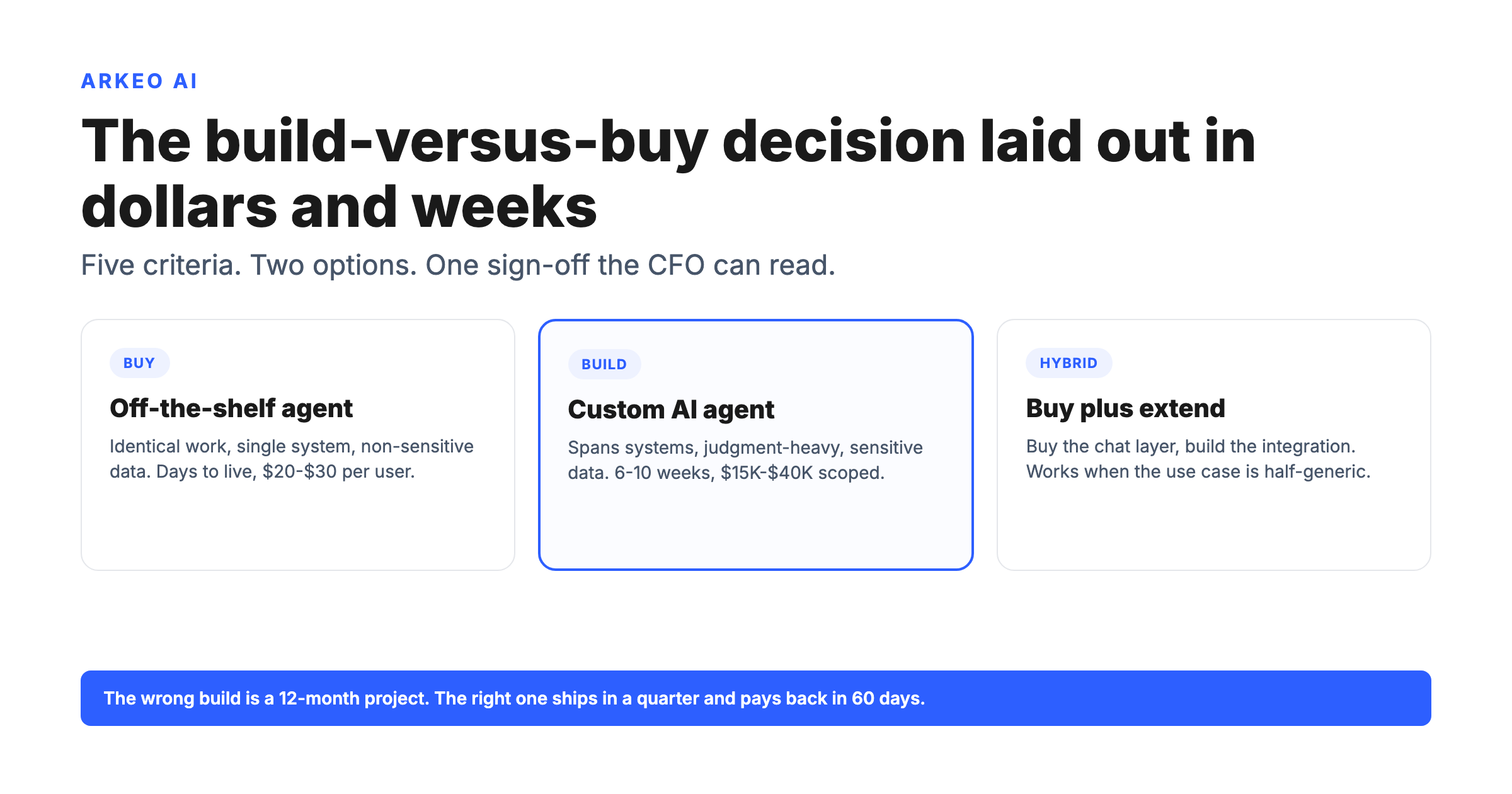
The fourth action is the one that closes the gap in the only way that actually counts: by putting a working agent in front of a real user on a real workflow. Scope discipline is the entire game. One workflow. One user group. One success metric. A scoped single-workflow agent reaches production in about 6 to 10 weeks, or 8 to 12 weeks when the deployment is private. Off-the-shelf copilots are faster to switch on, around $20 to $30 per user per month and live in days, but they will not close the operational gap on a real workflow because they cannot reach the systems where the decision lives.
The first quick win lands in 30 to 90 days when the bridge plan is run cleanly. That number is operator experience from deploying agents into Arkeo's own operations and into mid-market clients, not a market forecast. The scope discipline is what makes it possible. Every week a team adds "and could it also" to the build, the date slides by another month.
Want a walk-through against your own workflow? The free AI Assessment runs this four-step bridge on your actual operation in one 60-minute session and produces a marked-up plan, not a slide deck.
What goes wrong when teams skip the bridge?
Three failure modes recur often enough to name. The first is the platform trap: the team buys an enterprise AI platform and spends six months configuring it before any workflow is mapped. Deloitte's State of Generative AI in the Enterprise, Wave 4 found more than two-thirds of enterprise respondents expect 30% or fewer of their GenAI experiments to be fully scaled within the next three to six months. The platform was not the problem. The absence of a bridge plan was.
The second failure mode is the "everyone gets a copilot" move. A $20-per-user license rolls out, the team uses it for drafting and search, productivity feels slightly better, and twelve months later no actual workflow has been replaced. The copilot is a useful productivity tool. It is not a bridge across the readiness gap. The PwC AI Agent Survey from May 2025 shows 79% of US businesses already adopting AI agents and 66% of those reporting measurable productivity gains, which is the right benchmark to aim for. The copilot rollout, on its own, does not get there.
The third failure mode is the "wait for the strategy deck" pattern. The team hires a strategy firm, receives a slide deck twelve weeks later, and nothing ships. McKinsey research published in 2025 and BCG analysis from October 2024 have both highlighted how few companies move from AI adoption to scaled value. The bridge plan exists to break that pattern. Each of the four steps is a thing the team does, not a thing the team is told to do. The gap closes only when the workflow is mapped, the data is cleaned, the rules are signed, and one agent is in production.
The gap closes only when something gets done, not when something gets recommended.
How do you know you have actually closed the gap?
Five signals, observable inside the business, tell you the bridge worked. The mapped workflow runs end to end with the agent doing the work and a human approving the exceptions. The data the agent reads has owners and refresh cadence. The guardrail rules are signed and the audit log shows the agent staying inside them. A scoped success metric, picked before the build, has moved in the direction you predicted, by an amount that is not within noise. And the team has identified the next workflow on its own, because the first one freed enough capacity to look at the second.
If three or fewer of those signals are true 90 days after the first agent ships, the bridge is partial. Most often the missing piece is governance: the agent works but no one owns the rules, so the second workflow stalls when it should have started. The fix is not technical. It is sitting the operator, the data owner, and the technical lead back at the table with the one-page table from Step 3 and updating it for the next workflow.
Close the readiness gap in 60 minutes, not 60 daysBring one workflow you have been arguing about. Leave with a four-step bridge plan against it and a scoped first agent worth the spend.
Book Your Free AI Assessment →