Category
How to Use an AI ROI Calculator

Last updated: June 2026
If you have an AI ROI calculator open and a workflow on your desk, this guide is for you. Most calculators are vendor lead magnets with the deflection-rate slider pre-set at 90%, which inflates the projected return by a factor of three. In this guide, you will get the four-input operator walkthrough Arkeo uses with mid-market clients so you can run any calculator on a real workflow, defend the inputs, and spot the lever the vendor used to make the number look good.
The credibility signal first: only 25% of AI initiatives have delivered the ROI executives expected per the IBM Institute for Business Value 2025 CEO study, even though 78% of organizations used AI in 2024. The gap is operator-grade inputs versus vendor-grade inputs. Arkeo AI was built in 2023 by operators with 25 years of running a business and three years of deploying AI agents into mid-market operations, including the agents that run Arkeo itself.
Quick Answer
• What it is: A four-input model that takes a workflow baseline, a deflection rate, a full cost column, and a payback window.
• What it is not: A vendor lead magnet that ships with the deflection slider pre-set at 90%.
• Inputs to defend: Time-per-task, error volume, revenue lift, total cost (build + data + governance + change + Manage).
• Why it matters: A calculator with the wrong inputs is more dangerous than no calculator at all.
What is an AI ROI calculator?
An AI ROI calculator is the operator tool that turns workflow baseline data into a defensible net-return-over-cost number for a specific AI build. The credible calculator forces four inputs: hours returned, errors avoided, revenue lift, and total cost. The dangerous calculator hides the deflection-rate assumption and the Manage-phase line behind a polished UI.
Step 1: pull the baseline before you open the calculator
The biggest mistake is opening the calculator first and guessing the inputs. Pull the baseline from last quarter's operations data. Average time-per-task. Volume per week. Error rate. Cost per error (rework hours plus downstream impact). Constrained revenue (the part of revenue currently bottlenecked by this workflow). These five numbers are the only honest source of input. If the calculator does not ask for them, the calculator is selling you something.
Step 2: set the deflection rate at operator-grade
The deflection rate is the lever every vendor calculator uses to make the ROI number look good. Start at 60% for a new agent in pilot. Revise after 90 days in production. The vendor that pre-sets the slider at 90% has not run an agent in production for two years. PwC found 66% of executives running AI agents report measurable productivity gains; the cohort that books real gains uses conservative deflection in the model.
Step 3: enter the full cost column, not just license
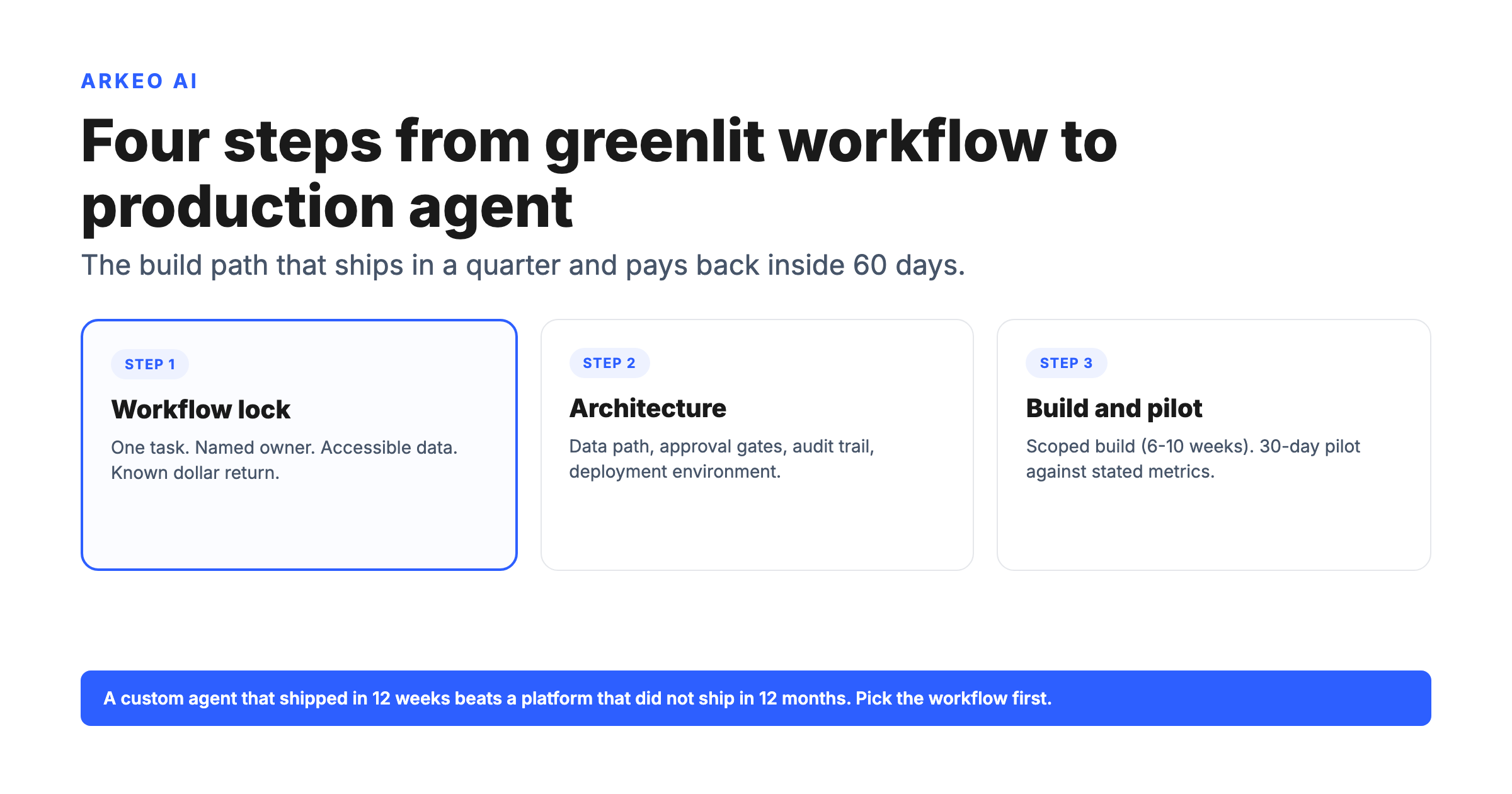
Most calculators ask for software license and integration cost. The honest cost column has six entries. Scoped build ($15K-$40K for a single-workflow agent, 6-10 weeks to production; 8-12 if private or on-premise). Data extraction and cleanup (20-40% of the build). Governance setup against a framework like the NIST AI RMF. Change management for the operator running the workflow today. The Manage phase ($1.5K-$5K per agent per month for prompt drift, evals, escalation tuning). And a kill-switch reserve. If the calculator does not give you all six fields, add them in a spreadsheet next to the calculator output.
Step 4: read the payback window, not the percentage
The headline ROI percentage is the line that loses the room. Read the payback window instead. A scoped single-workflow agent should pay back in one to two quarters. The first quick win lands in 30 to 90 days. If the calculator shows a 12-month payback, the workflow is probably wrong. The Deloitte State of GenAI Wave 4 report shows over two-thirds of organizations expect 30% or fewer of their GenAI experiments to fully scale in 3-6 months; the ones that scale post short paybacks early.
Four numbers to defend, one number to ignore
Deflection rate
Should sit at 60-70% in pilot, 75-85% after 90 days. Higher than 90% is a flag.
Full cost column
All six lines or the model is incomplete. Manage phase is the line that disappears.
Payback window
One to two quarters. If it is 12+ months, the workflow is wrong.
Sensitivity
Move deflection +/- 20% and watch the payback move. A robust model holds up.
A vendor calculator with the deflection slider pre-set is a sales tool, not a finance tool.
Find your top 3 highest-ROI agents before you spend a dimeThe free Arkeo AI Assessment uses your real workflow data to surface the three highest-return agents you should build first.
Book Your Free AI Assessment →
Common failure modes when running a calculator
BCG's 2024 study on AI value capture found roughly 74% of companies struggle to scale value from AI. The audit pattern across failed projections shows the same calculator mistakes. Deflection set at vendor levels. Error line missing. Manage phase left out. Revenue lift claimed on a workflow that was not the bottleneck. Each one is recoverable inside the Assessment phase if caught before the build starts.
Arkeo's operating model is Assess, Deploy, Manage: the Assessment turns the calculator output into a board-defensible business case, the Deploy phase ships the scoped agent, the Manage phase keeps the deflection rate where the model said it would be. Most AI strategy work delivers a deck and disappears; this model exists because the calculator output only matters if someone is still on the agent six months in. We use what we sell. For the formula behind the calculator, see how to calculate enterprise AI ROI. For the board-deck version of the math, see how to build an AI business case. For the prioritization rubric that picks which workflow to model first, see the ai use cases pillar.
Walk a defensible plan into the next board meetingBook the free Arkeo AI Assessment. Real workflows, real numbers, no vendor deck.
Book Your Free AI Assessment →
Frequently Asked Questions
What is AI ROI?
It is the net dollar return on a deployed AI workflow divided by the total cost to build and run it. The defensible number rests on four operator-grade inputs (hours, errors, revenue, total cost) computed against operations data, not vendor estimates.
How does a mid-market operator measure AI ROI with a calculator?
Pull the workflow baseline from last quarter's operations (time per task, volume, error rate, cost per error, constrained revenue). Set the deflection rate at 60% for a new agent. Enter the full cost column including the Manage phase. Read the payback window, not the headline percentage.
How to calculate the ROI of an AI project?
Net return divided by total cost. Net return is hours-returned dollars plus errors-avoided dollars plus revenue lift on the constrained workflow. Total cost is the six-line column: scoped build, data, governance, change, Manage phase, kill-switch reserve.
How long is a realistic AI ROI payback window?
One to two quarters for a scoped single-workflow agent. The first quick win lands in 30 to 90 days. If the calculator output projects 12 months or more, the chosen workflow is almost certainly not the right one.
What is the most common AI ROI calculator mistake?
A vendor-default deflection rate of 90%, no field for the Manage phase, and a headline percentage that hides the four real inputs. The fix is to never trust the calculator output without running the four-input model alongside it.