Category
AI Marketing Agents: The Operator's Guide
Last updated: May 2026
You sign a $10,000 monthly retainer with an outsourced marketing agency. Six months later you have a handful of generic blog posts, a recycled social calendar, and almost no new pipeline. The content reads like it was written by someone who has never set foot on a job site or a manufacturing floor, because it was. Arkeo AI was founded in 2023 on 25 years of running real businesses, and the company has spent three years deploying AI agents in production, including the marketing workforce that runs its own pipeline. Adoption is no longer the question: a 2025 PwC AI Agent Survey found agentic AI moving from pilots into core business functions across the mid-market. The pattern that experience exposes is consistent: the problem with mid-market marketing is rarely the agency you picked. It is the model you bought.
The fix is not a more expensive agency. The fix is deploying AI marketing agents: autonomous software workers that execute multi-step marketing workflows end to end, on your data and under your control, instead of waiting on a human to prompt them. A private AI marketing workforce knows your business, runs on your infrastructure, and does not reset its memory when an account team rotates off your logo.
Quick Answer
• What it is: autonomous agents that run marketing workflows (research, drafting, personalization, reporting) without step-by-step prompting.
• What it replaces: not your strategy, but the execution layer you currently rent from an agency or staff in-house.
• Cost shape (illustrative planning ranges): agency retainers run roughly $6k to $12k a month; a full in-house team can land near $450k a year loaded; a scoped agent build is typically $15k to $40k plus six to ten weeks.
• Why it matters: a private deployment keeps your proprietary data inside your building instead of training a public model your competitors also query.
Why Are Mid-Market Marketing Retainers So Disappointing?
Mid-market marketing agency retainers commonly run $6,000 to $12,000 per month, and scale higher as you move toward enterprise scope. You are paying for human account managers, recurring strategy meetings, and junior copywriters trying to absorb the nuances of a technical business in the hours they have billed to you. The math only works for the agency.
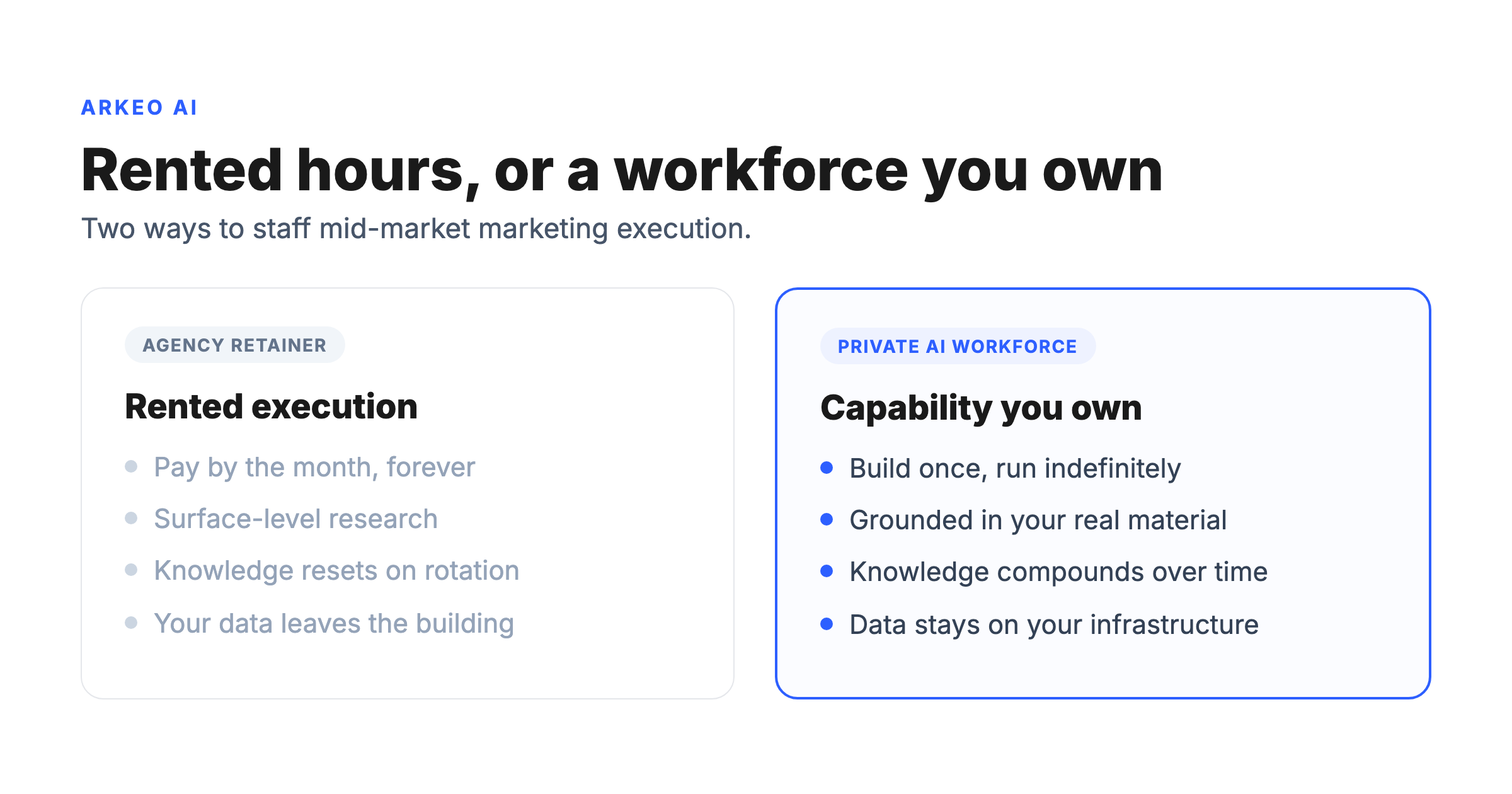
Most operators think the answer is a better agency. They are wrong. The problem is the operating model, not the vendor. An external agency cannot absorb the operational truth of your business fast enough to produce expert content at the cadence you need. It defaults to surface-level research, which produces commoditized marketing that a technical buyer sees through in one paragraph. Swapping one retainer for a pricier one buys you a different logo on the same problem.
A private AI workforce changes the math because it changes what you are buying. Instead of renting human hours, you fund a system that ingests your past proposals, spec sheets, and field reports once and then executes against them indefinitely. Before you can price that fairly against a retainer, you need to know which of your workflows are even worth automating, which is exactly what a free AI Assessment is built to surface. And before you assume a retainer is the cheap option, it pays to add up the true cost of a marketing agency over a full year, because the line item on the invoice is rarely the whole bill.
What Does an AI Marketing Agent Actually Do?
Most companies treat AI like a faster typewriter. They hand a marketing coordinator a chatbot subscription and expect output to spike. It rarely does, because the human still writes the prompt, reviews the result, formats it, and publishes it. The bottleneck just moved from writing to prompting.
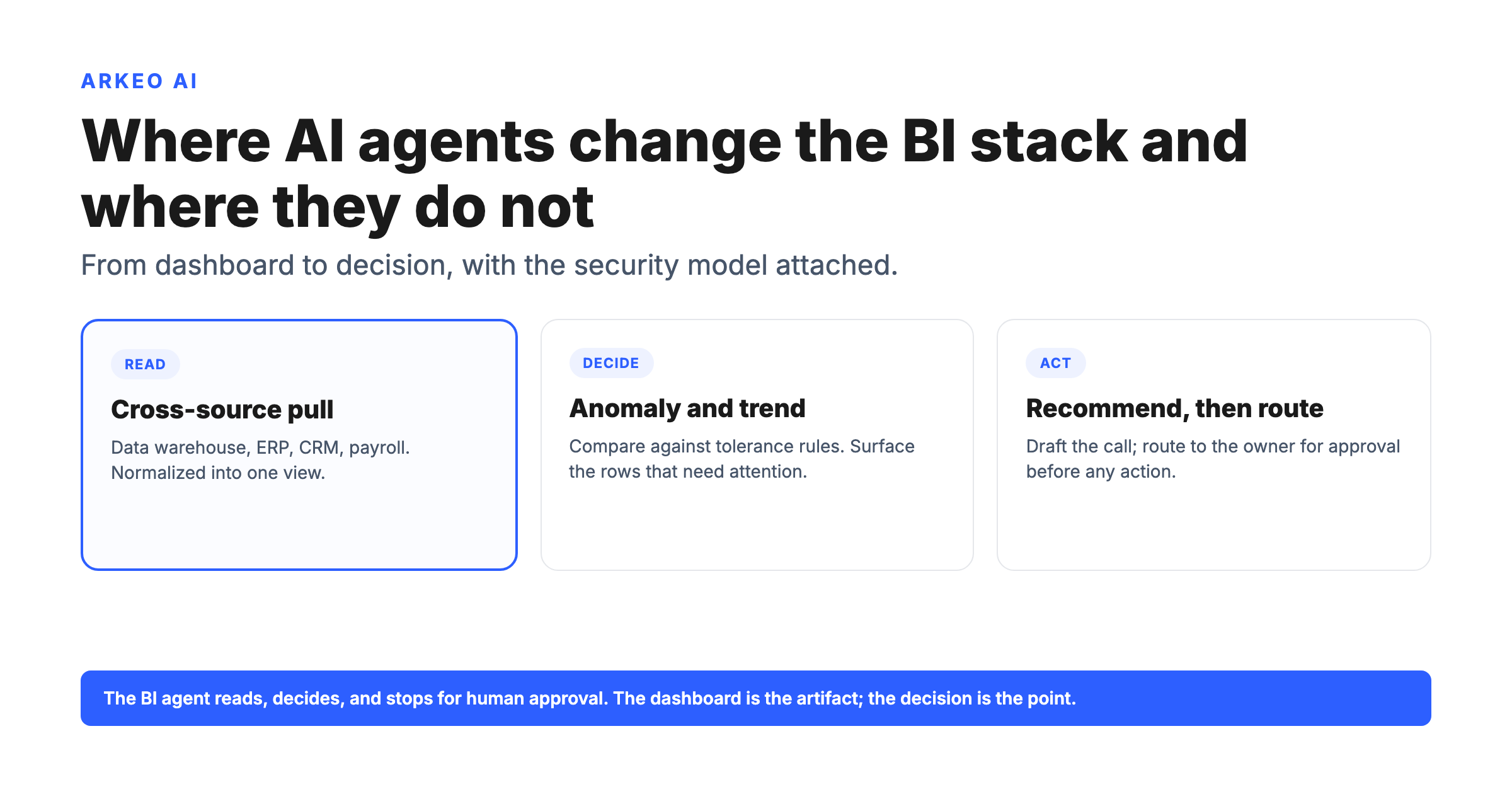
An agent works across the funnel instead of inside a chat window. It wakes on a schedule, pulls raw data from your CRM, drafts a campaign in your voice, personalizes it against what it knows about each account, and reports on what landed. The diagram below maps that span.
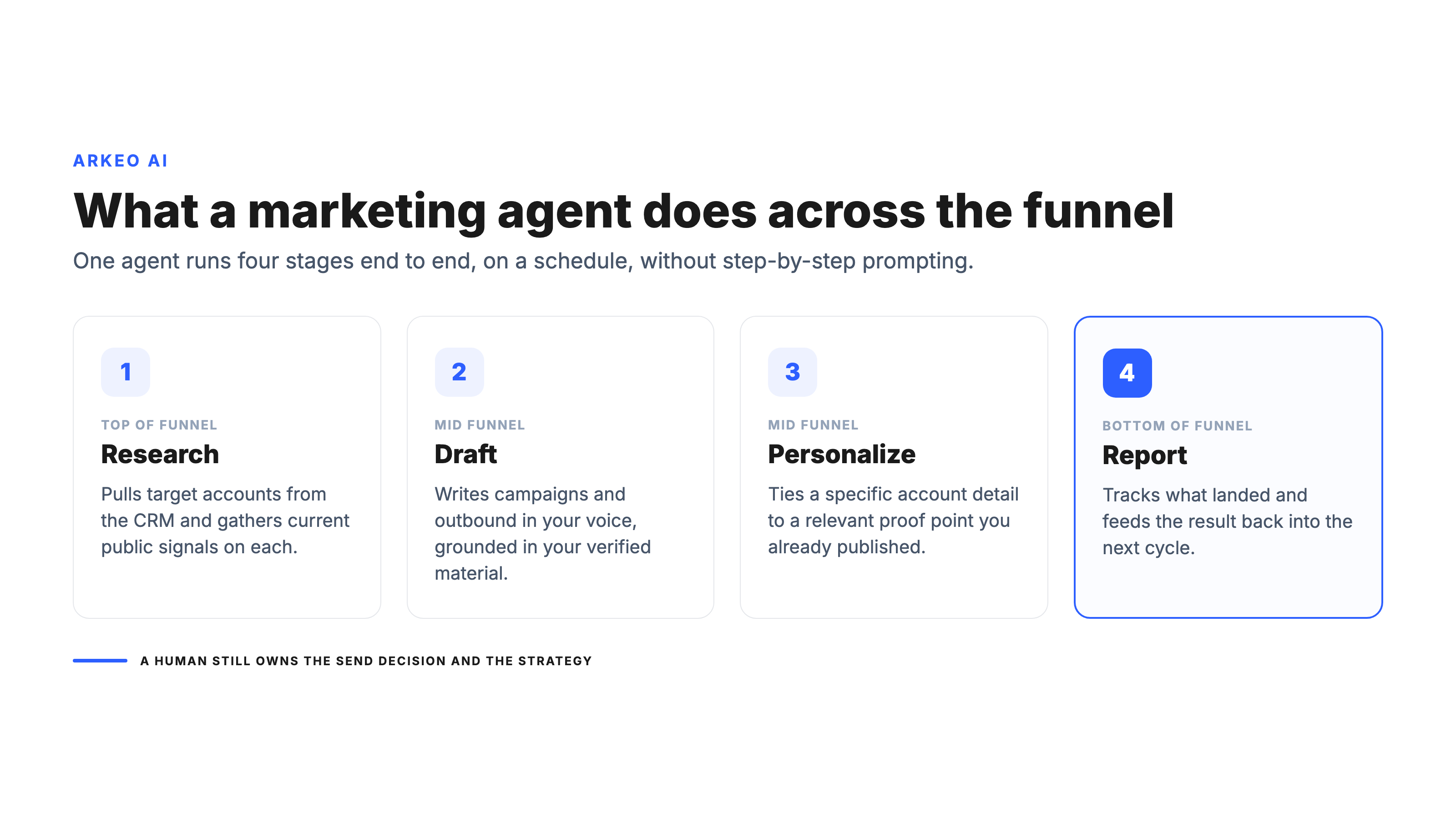
Outbound is where the difference gets concrete. As a rough practitioner estimate, a traditional sales development rep spends on the order of twenty minutes per prospect: researching on LinkedIn, checking the CRM for prior contact, drafting a personalized note. Multiply that across hundreds of accounts and the human becomes the bottleneck that chokes the pipeline. That bottleneck is exactly where the measured gains show up; Stanford HAI's 2025 AI Index documents AI driving real productivity and economic output across knowledge work, with the largest lift on the repetitive, research-heavy tasks that consume an outbound rep's day. An agent runs the same sequence differently. It pulls the target list from your CRM, gathers public signals on each account, cross-references them against your capabilities, and drafts a note that ties a specific, current detail about the prospect to a relevant proof point you already published. It then drops those drafts into your sending tool for human review, or sends them on the permission rules you set.
That is not a mail merge and not a spam blast. It is one-to-one execution at a scale a human team cannot reach, with a person still owning the send decision. This is the blunt truth no SaaS vendor prints in a brochure: piling more AI tools onto your team usually creates more admin, not less. If the system cannot run the workflow start to finish on its own, you have not bought leverage. You have bought another tab.
See where AI fits your marketing operation
Arkeo's free AI Assessment is a 60-minute planning session that maps your highest-payback marketing workflows, estimates the ROI of automating them, and sketches a phased deployment plan, before you commit any budget to a build.
Book Your Free AI Assessment →
How Much Do AI Marketing Agents Cost Versus the Alternatives?
The honest comparison is not agent versus chatbot. It is three ways to staff your marketing execution, priced against each other. An agency retainer is the lowest commitment and the highest long-run cost, because the knowledge never compounds in your favor. A real in-house team is the deepest capability and the heaviest fixed cost. A scoped agent build sits between them on commitment and below both on run-rate once it is live. The figures below are practitioner estimates drawn from typical mid-market deals, not reported survey averages, so treat them as planning ranges rather than quotes. The table lays out the trade. The broader shift is structural: Microsoft's 2025 Work Trend Index describes a new operating model where every employee becomes an "agent boss" directing digital labor, which reframes what a marketing team is even staffed to do.
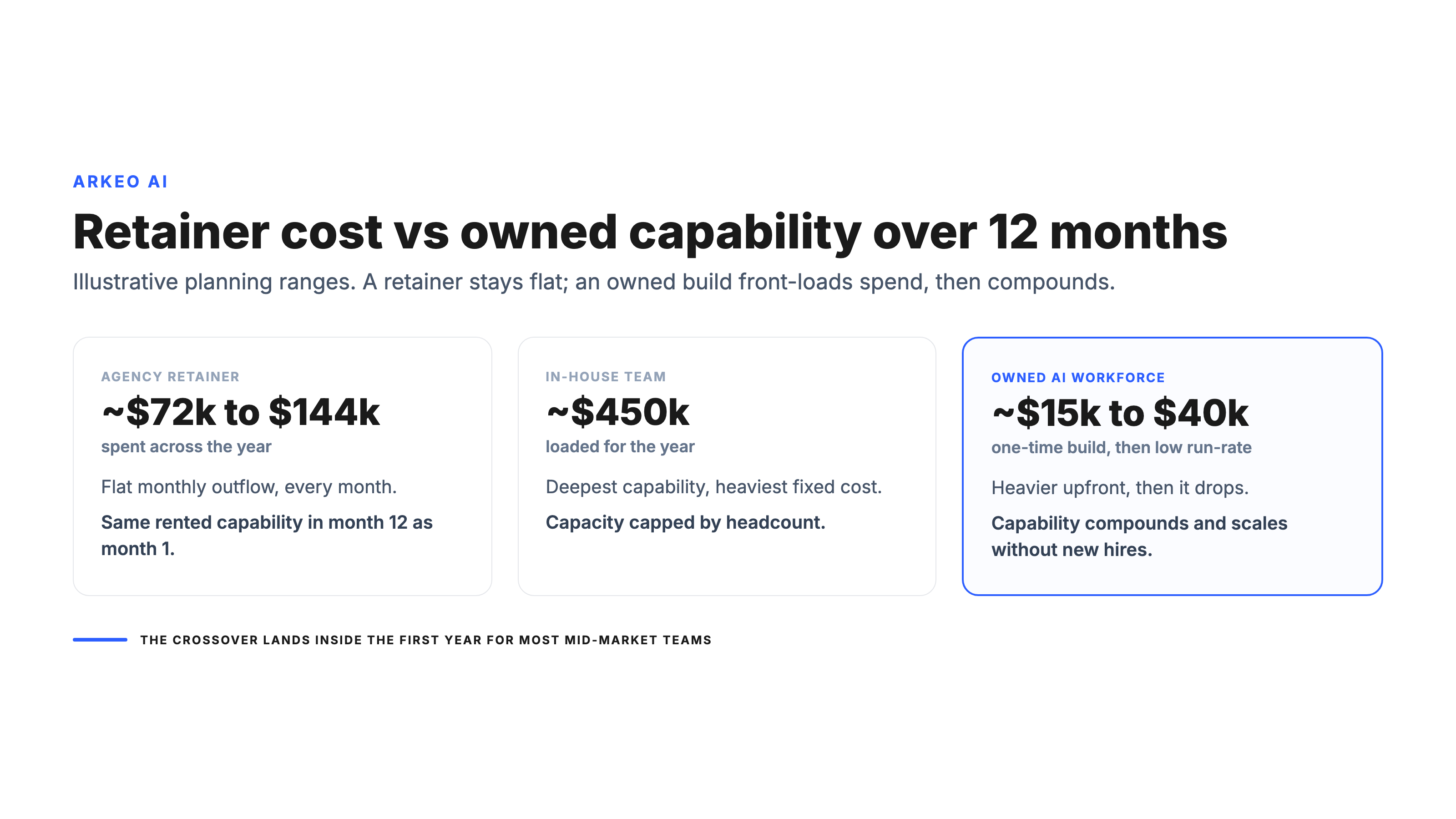
The shape over time matters as much as the sticker price. A retainer is a flat monthly outflow that buys the same rented capability in month twelve as in month one. A scoped agent build is heavier upfront, then drops to a low run-rate while the capability it bought keeps compounding. The chart above traces that crossover.
A copilot seat is the fourth, lighter option, the roughly $20 to $30 per user per month assistant (a typical list-price range) your team already knows. It is useful, and it is not a workforce. A copilot helps a person finish a task faster. An agent runs the workflow whether or not a person is at the keyboard. Most mid-market operations need a little of the first and a deliberate amount of the second. Run that math far enough and the real question stops being which vendor to hire and becomes whether marketing agencies are worth it at all once an owned workforce can carry the execution layer.
What Is the Hidden Cost of Running Marketing on Public AI?
You cannot train an agent to write like your senior engineer without feeding it proprietary material: your playbooks, your pricing logic, your bid packages, your field reports. The moment that content goes into a public cloud model, you have created an exposure that no agency retainer ever did. Public models can retain inputs and let them influence later outputs, which means your hard-won technical IP can surface, in diluted form, inside answers given to a competitor who asks the right question. The financial stakes are documented: IBM's Cost of a Data Breach 2025 reports a rising share of breaches involving AI tooling and the high per-incident cost when sensitive material leaks, and in practice most of that risk is self-inflicted through tools nobody formally approved.
This is why a private deployment is not a luxury tier. A private AI workforce runs exclusively on your infrastructure, so the data never leaves the building. You get the capability of the model without surrendering the asset that makes your marketing credible in the first place. It is also the operating principle behind everything Arkeo ships: the company uses what it sells, running its own agents on its own private stack rather than reselling someone else's cloud. Mapping where your sensitive material lives, and who can touch it, is the first thing the AI Assessment documents before any agent is built.
How Do You Deploy a Private AI Marketing Workforce?
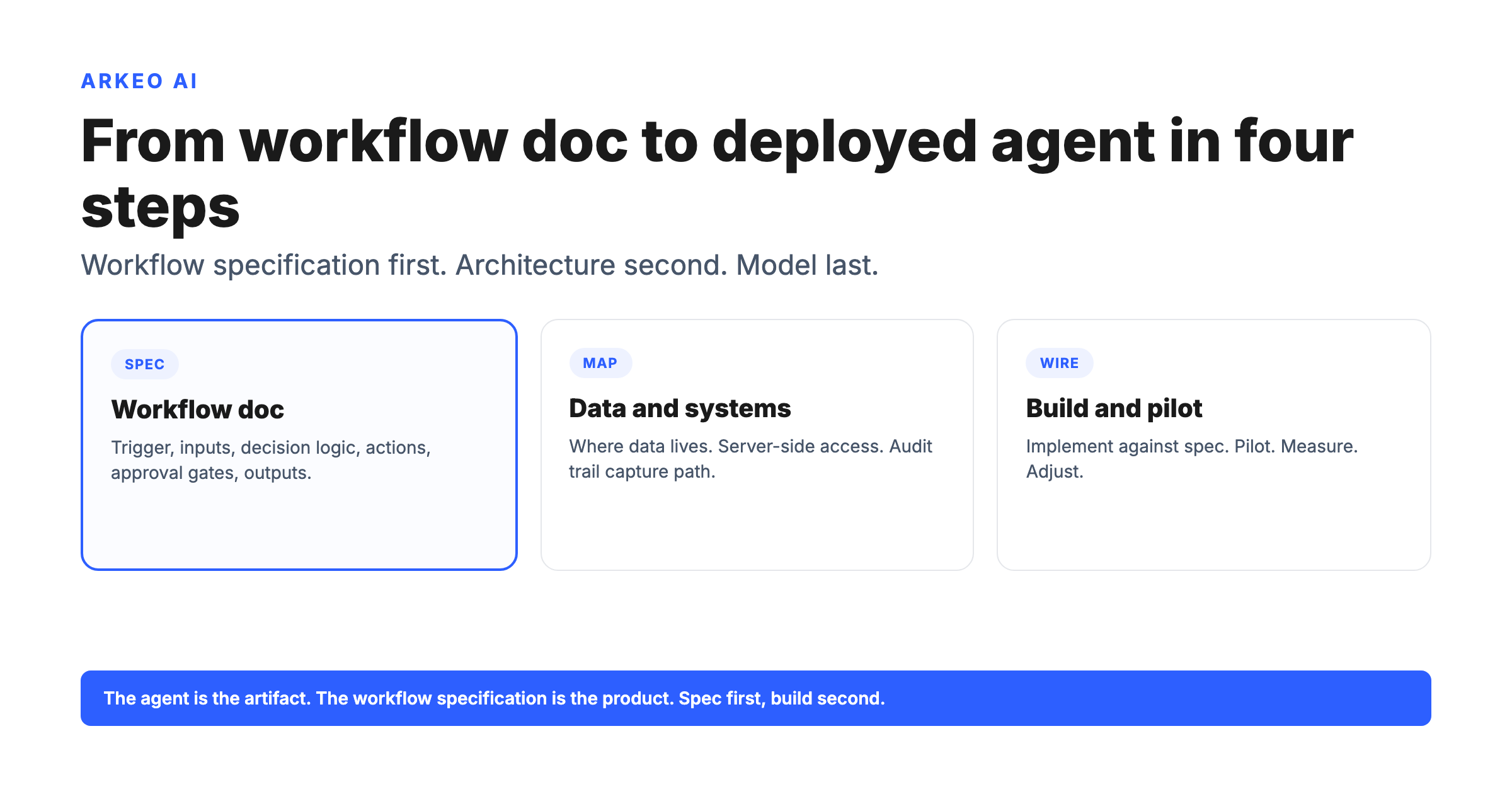
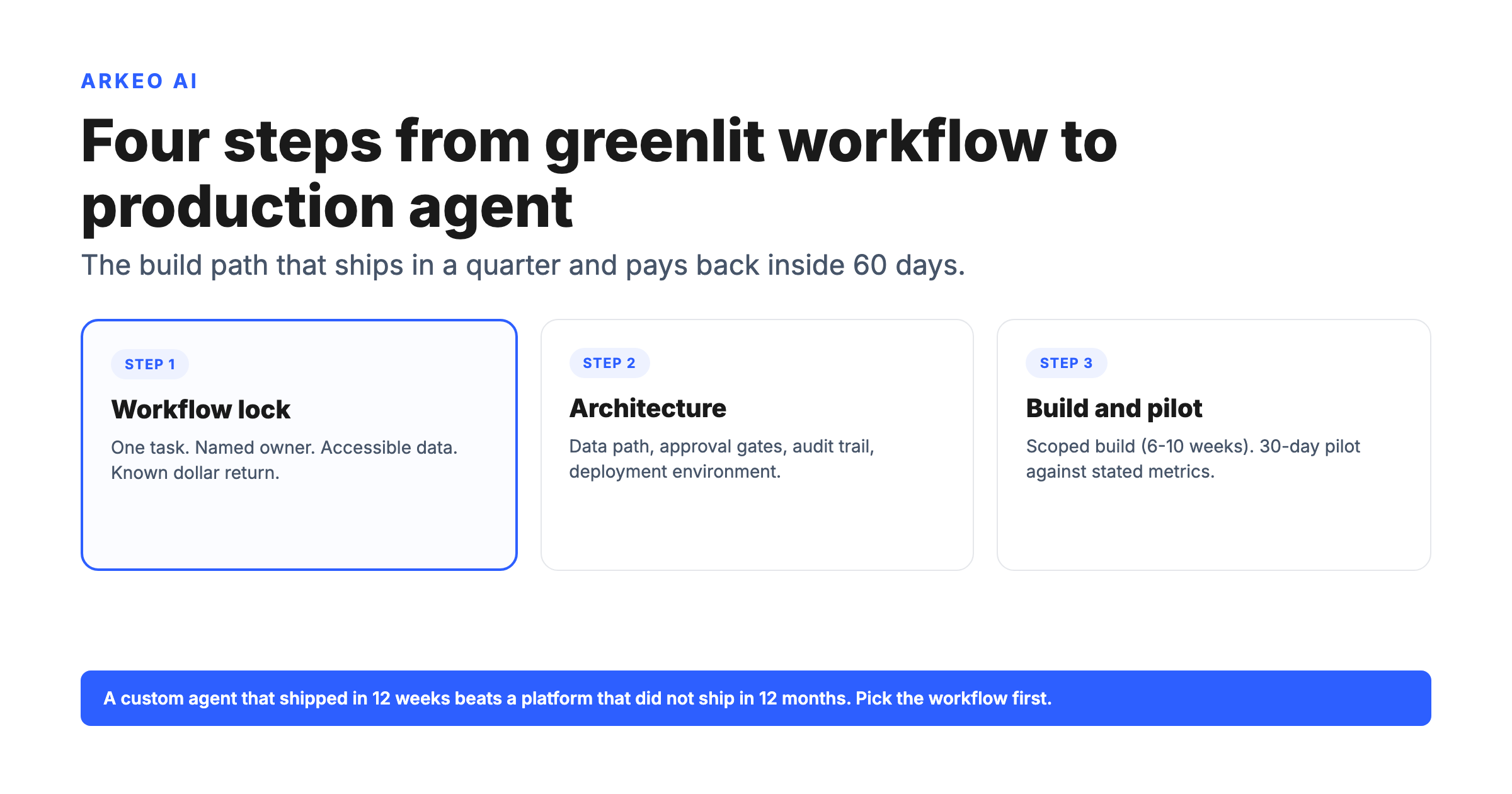
You do not flip a switch and turn on a workforce. Deployment follows the Arkeo Operating System, the same four-stage path the company runs internally: map the current state, ship 30-to-90-day easy wins, build the top custom agents, then manage them over time. The diagram traces the practical version of that arc for marketing.
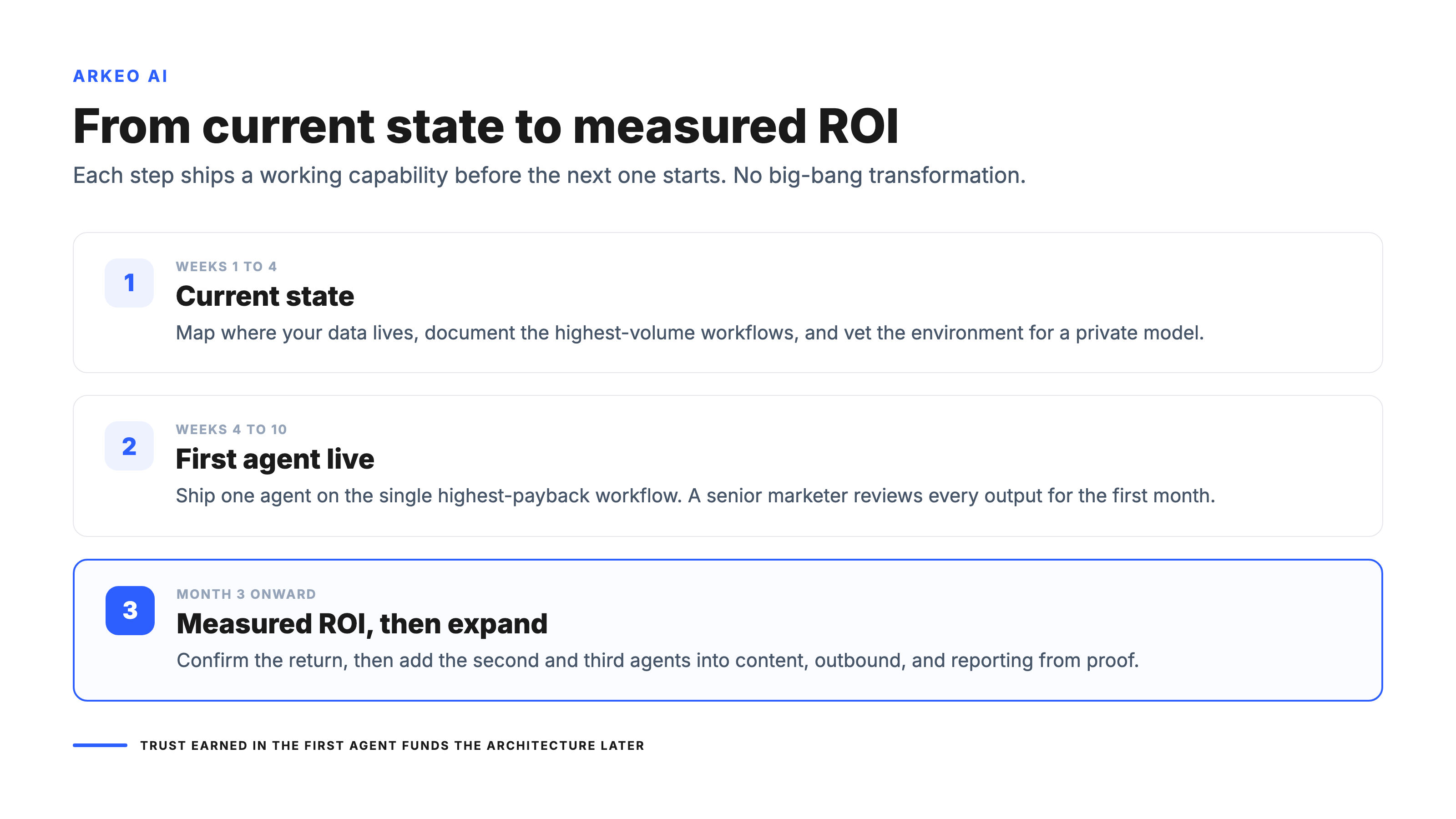
The first stage is an assessment, not code. The work is mapping where your proprietary information lives (SharePoint, scattered drives, a legacy CRM), documenting the highest-volume marketing workflows step by step, and vetting whether your environment can host a private model under your security rules. The output is a blueprint: which workflows get automated first, exactly how the data is secured, and the expected return. Picture an operations lead at a 60-person industrial firm who funds one outbound agent on the single most repetitive workflow, watches a senior marketer review its output for a month, and only then expands to content and reporting once the first agent has earned trust. That is the intended shape: measured ROI before architecture, not a big-bang transformation.
The second blunt truth is that agents break, and they break for boring reasons. A CRM changes an API endpoint. A platform tightens its scraping rules. A model drifts and starts producing generic copy six months in. An unmanaged agent simply stops, and your pipeline stalls with it. That is why a private workforce is run as a managed service: monitoring the connection points, re-indexing the knowledge base, catching drift against a quality baseline, and patching integrations before your marketing team notices. You treat the agent like a hire. When it stops performing, you do not debug code. You flag it and it gets fixed. This is the same operational discipline that separates a working B2B digital marketing agent from a brittle demo, and it is the difference between an asset that compounds and a science project that quietly rots.
Map your marketing automation before you build
The free AI Assessment gives you a prioritized list of the marketing workflows worth automating first, a data-governance plan for keeping your IP private, and a 90-day roadmap, with no obligation to buy a build after.
Book Your Free AI Assessment →