Category
AI Audit Services: The Operator's Buying Guide
Last updated: June 2026
If you are a CEO, COO, or technical leader at a 50 to 500 person company and the proposals for AI audit services are now stacking up on your desk, you have a vendor problem before you have an AI problem. The wrong audit firm will deliver a 40-slide PDF, an invoice for $60,000, and a workflow that is no closer to production than it was the day you signed. The right one will hand you a one-page diagnosis the CFO can read, a workload-by-workload go or no-go decision, and a build sequence that starts inside the next quarter. In this guide, you will get the scope of a real audit engagement, honest cost ranges from a firm that operates AI in production on its own books, the rule for hiring outside versus running it in-house, and the red flags to use as a filter before you sign anything.
Arkeo has spent three years deploying private AI agents on mid-market operations, including its own, and the pattern that holds across engagements is simple: companies that buy an audit from a firm that has never deployed an agent get a deck; companies that buy an audit from a firm that ships agents get a plan. According to the Stanford HAI 2025 AI Index, 78% of organizations reported using AI in 2024, up from 55% in 2023, the largest year-over-year jump in the Index's history. Adoption is now table stakes. Whether the audit you are about to buy moves your operation from ad-hoc usage to a production agent is the only question that matters, which is what the free AI Assessment is built to answer before you spend on a paid engagement.
Quick Answer
• What it is: AI audit services are a structured diagnostic engagement that inventories your data, systems, workflows, and risk controls against the requirements of a specific AI workload, ending in a go, fix-first, or no-go decision per workload.
• Cost in the mid-market: typically $15K to $50K for a single-workflow audit and $40K to $150K for a company-wide engagement, depending on scope and data sensitivity.
• Timeline: 5 working days for a focused single-workflow audit, 3 to 4 weeks company-wide.
• When to hire: when a senior internal operator cannot carve out 30 to 50 hours and finish, or when the board needs an outside voice before approving a six-figure AI budget.
• Next step: Book a free AI Assessment and Arkeo will audit one of your workflows end-to-end at no cost.
What is actually inside a real AI audit engagement?
An AI audit is a structured inventory of every data source, system integration, workflow step, and risk control that a candidate AI workload depends on, scored against operating requirements and concluded with a go, fix-first, or no-go decision for that workload. The deliverable is not a slide deck. It is a maturity score per workload, a list of go-no-go conditions, an integration cost estimate, and the shortest path to production for one chosen workflow.
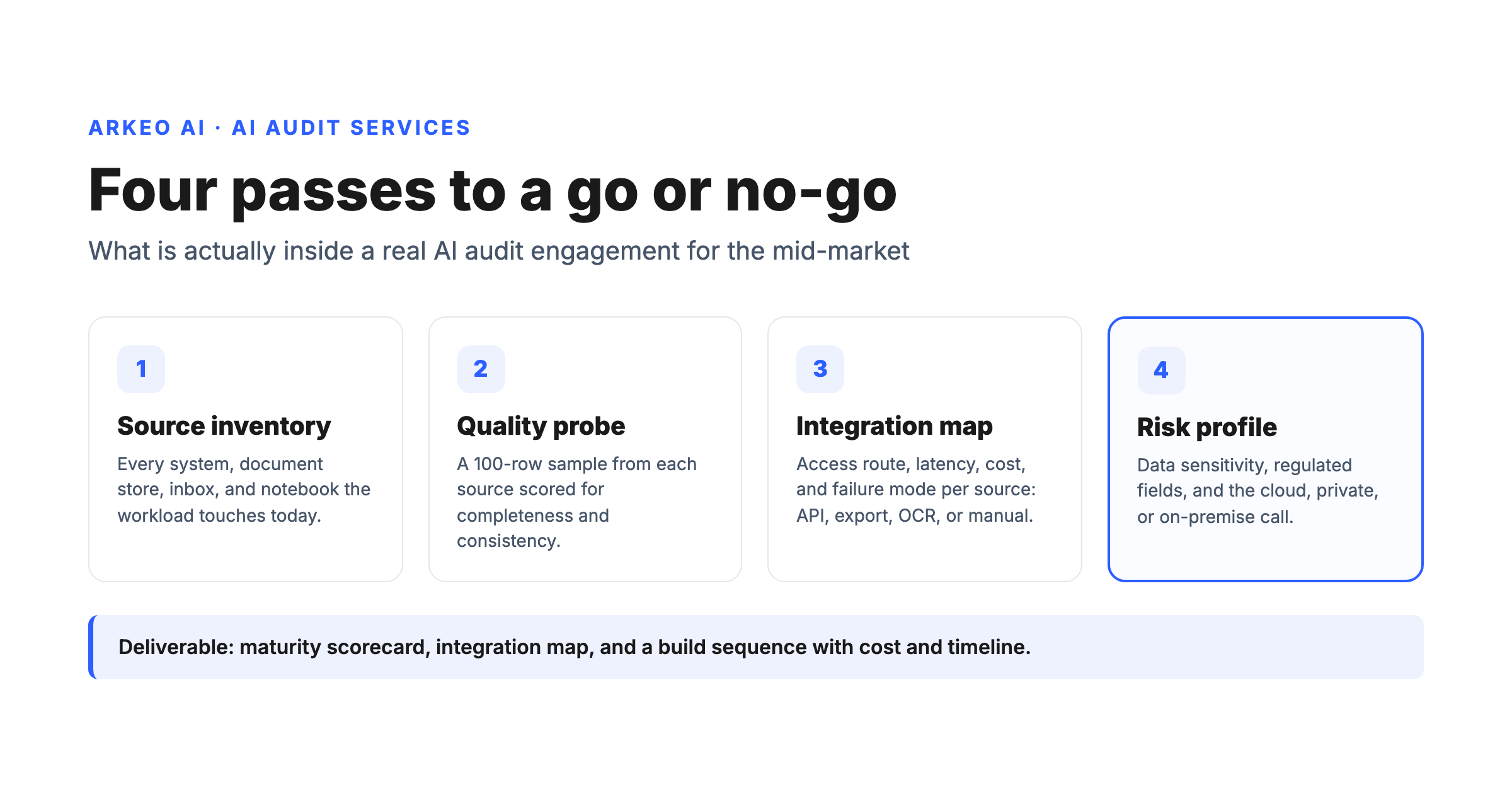
The work itself follows a four-pass routine that any credible audit firm should describe to you in plain language before they quote. Pass one is the source inventory: every system, document store, inbox, spreadsheet, and human notebook the workload touches. Pass two is the quality probe: a 100-row sample export from each source scored for completeness, correctness, and consistency. Pass three is the integration map: the access route (API, export, OCR, manual entry), the latency, the cost per call, and the failure mode for every source. Pass four is the risk profile: data sensitivity, regulated fields (PII, PHI, financials), and whether the workload must run on-premise, in a private cloud, or whether a public cloud deployment is acceptable.
The output of those four passes is what gets paid for. A real audit ends with three documents the CFO and COO can both read on Monday morning: a one-page maturity diagnosis, a workflow scorecard with the six readiness dimensions filled in, and a build sequence with a cost band and a timeline range. If the firm cannot describe in advance which three documents you will receive at the end, the engagement is sales theater dressed as diagnostic work.
What does it cost, and how long does it take?
Mid-market audit pricing clusters in two bands. A single-workflow audit (one quoting process, one finance close, one customer-support intake) typically runs $15,000 to $50,000 and takes 5 to 15 working days from kickoff to deliverable. A company-wide audit that scores every candidate workflow across two to four departments typically runs $40,000 to $150,000 and takes 3 to 4 weeks. Sensitivity is the biggest variance lever: a workflow that touches regulated data (HIPAA, PCI, SOX-relevant records) pushes the audit toward the high end of each band because the risk-profile pass takes meaningfully longer.
Those numbers are operator ranges from Arkeo's own engagements and the comparable pricing observed across the mid-market. They are not sourced statistics. What is sourced: Deloitte's State of Generative AI Wave 4, surveying 2,773 C-suite and director-level leaders across 14 countries, found that more than two-thirds of enterprise respondents expect 30% or fewer of their generative AI experiments to be fully scaled in the next three to six months. Most pilots that miss scale miss it for reasons the audit is supposed to surface up front: the data is dirtier than the team thought, the integration cost is higher than the budget assumed, or no named operator owns the workflow after the build ships.
The audit that produces a deployable plan is cheaper than the audit that produces a deck, even when its sticker price is higher.
A $50,000 audit that ends in a working agent inside the next quarter beats a $25,000 audit that ends in a PDF nobody opens. Filter on output, not on quoted hours.
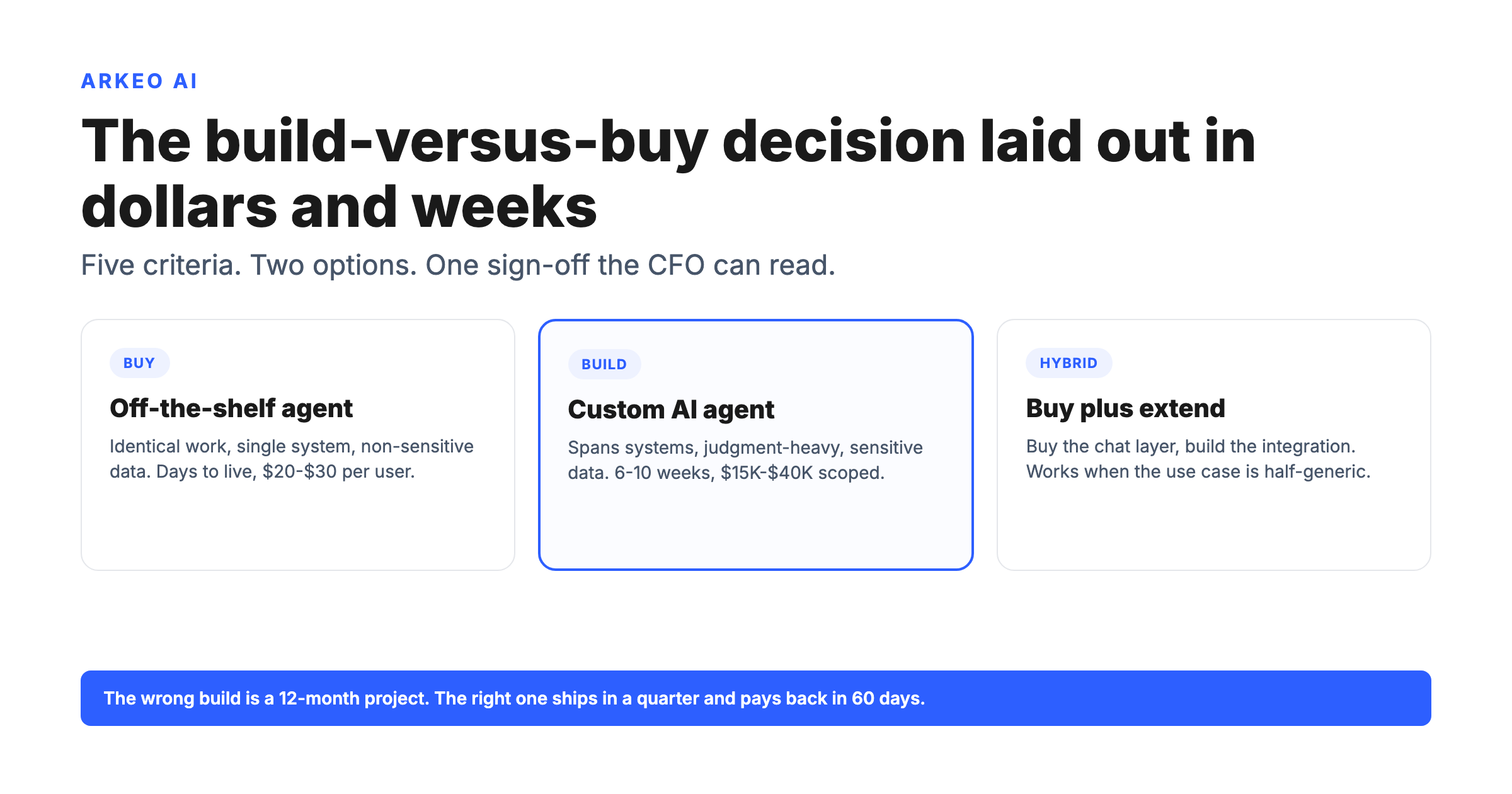
The follow-on costs are worth sequencing in your head before you commit. Once the audit says go on a workload, a scoped single-workflow agent build at Arkeo typically runs $15,000 to $40,000 and reaches production in 6 to 10 weeks, 8 to 12 weeks when the deployment is private or on-premise. Off-the-shelf copilots like Microsoft 365 Copilot or ChatGPT Enterprise run roughly $20 to $30 per user per month and live in days. The first quick win typically lands inside 30 to 90 days from kickoff. Those ranges come from Arkeo's own build history, not from a market study.
Audit one of your workflows for freeThe free AI Assessment runs the four-pass audit on one of your workflows end-to-end and gives you a go, fix-first, or no-go decision in 60 minutes. No pitch deck, no invoice.
Book Your Free AI Assessment →
When should you hire an outside firm versus run the audit in-house?
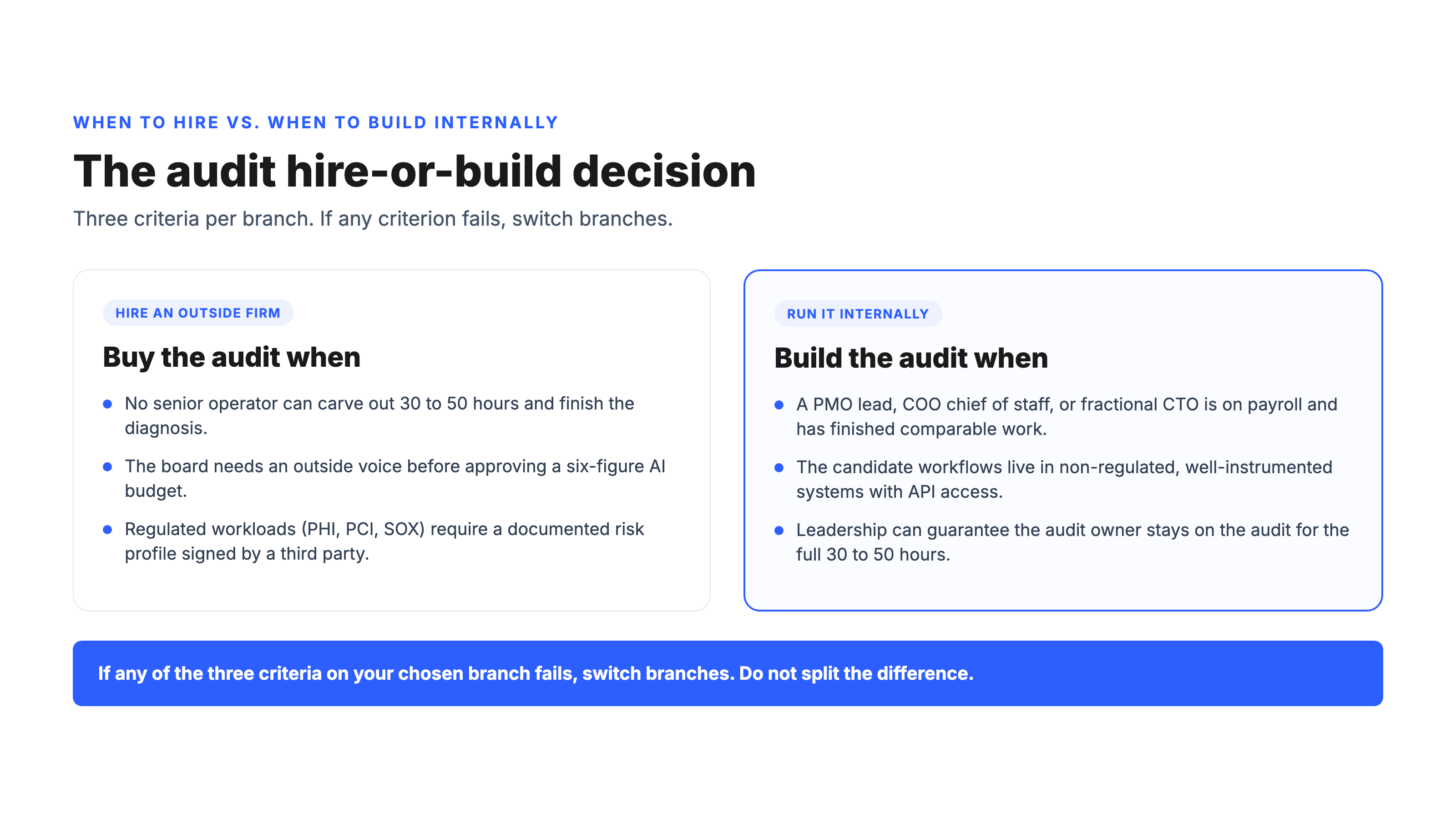
Two questions decide it. The first: do you have someone on payroll who can sit in the same room as your CFO, your COO, and your VP of Engineering for a week and produce a maturity diagnosis they all sign off on? The second: do you have an internal track record of finishing diagnostic work without it sliding for two quarters? If the answer to either is no, you are buying audit services. If the answer to both is yes, an internal audit using off-the-shelf templates is the cheaper path.
The most common in-house failure mode is not skill. It is finishing. A senior operator carves out 30 to 50 hours to run the audit, gets pulled into the actual job they were hired for at week three, and the audit becomes a half-finished spreadsheet nobody reads. The board meeting comes and goes, the AI budget gets cut by 40%, and the workflow that should have shipped sits another year. Most mid-market teams already know which of their initiatives finish and which do not. Be honest about which category this one falls into.
The other operator-grade signal: the IBM IBV CEO Study of 2,000 CEOs across 33 countries reports that 54% of CEOs are already hiring for AI roles that did not exist a year ago, lack of expertise is cited as the top barrier to AI innovation, and 65% of CEOs say their organizations will use automation to address skills gaps. Translation: most mid-market companies do not have the internal AI operating muscle they would need to run the audit themselves, and they know it. Outside help is the default, not the exception.
Most companies overestimate their internal capacity at the start of an audit and underestimate it by the end. That mismatch is what the false belief about readiness looks like in practice. The honest test runs in two minutes: name the person who would own the audit, name the hours they would carve out, and name the date the audit would be delivered. If any of the three names will not stand up to scrutiny, hire.
Want help on the build-versus-hire call? Book a free assessment, 30 minutes and you will have your answer. Start here.
What are the red flags when evaluating AI audit vendors?
The vendor red-flag list is short and worth using as a filter on every quote before you sign. Five signals show up over and over in the audits that end in a deck instead of a deployable plan.
VENDOR RED FLAGS
Five signals the audit will end in a deck, not a plan
Filter every quote on this list before you sign anything.
01
They have never deployed an agent
Ask the firm to describe one agent they built that is still running in production, including the integration, the approval design, and the on-call ownership. If the answer is a pilot from a year ago, the audit will not produce a build plan.
02
The deliverable is a deck
A real audit delivers a maturity scorecard, an integration map, and a build sequence. If the proposal lists a slide count instead of a document count, you are buying a presentation.
03
No data audit pass
If the engagement skips the 100-row quality probe and goes straight from interviews to recommendations, the audit will not surface the integration cost the budget actually has to absorb.
04
No risk profile for regulated data
If the proposal does not mention on-premise or private deployment as an option for regulated workloads, the firm is going to push you into a public cloud configuration that may not survive your compliance review.
05
Cannot describe the next agent
Ask the firm what the audit will tell you to build first. If they cannot describe the kind of agent they would deploy out of the diagnosis, the audit will end at the deliverable. No build, no Manage phase, no operating AI.
If a quote fails any one of these five, walk. The audit will not finish in production.
The cost of getting this wrong is on the record.
Extra cost per breach at organizations with high shadow-AI usage.
Source: IBM Cost of a Data Breach 2025
of organizations that suffered an AI model or application breach lacked proper AI access controls.
Source: IBM Cost of a Data Breach 2025
An audit that does not include a risk profile is what produces those numbers a year later. Filter the vendor on that pass alone if you have to filter on only one.
How does the audit connect to the rest of the AI readiness work?
The audit is the foundation, not the destination. Audit feeds the ai readiness diagnosis, which feeds the strategy roadmap, which feeds the ROI math, which feeds the build sequence. Skip the audit and every downstream document is built on a guess. Run the audit well and the rest of the cluster becomes mechanical.
The cluster boundary matters here. Readiness owns the current state: the audit, the data cleanliness pass, the maturity score per workload. Strategy owns the future state: the 30, 90, and 12-month sequencing of pilots into deployed agents. ROI owns the financial justification: which agents pay back first. An audit firm that drifts into strategy or ROI without first nailing the current state is selling you the wrong deliverable. The right reading order on your own desk is the same: audit first, strategy second, ROI third.
Arkeo runs this sequence under the Assess, Deploy, Manage methodology. Assess is the audit and the readiness diagnosis. Deploy is the build of the first scoped agent. Manage is the on-call ownership of the agent after it ships. The audit only matters if it produces an agent that runs in production for a full quarter, which is why the audit and the build live under one operating model rather than as separate consulting engagements. We use what we sell: every internal Arkeo workflow that can be agentized is, and the audits we run on client engagements use the same scoring grid we ran on ourselves first.
What about audits for finance, content, and other regulated workloads?
The four-pass routine is workload-agnostic, but the risk profile changes meaningfully when the workload sits inside finance, healthcare, content production, or any other regulated or high-trust domain. The shape of the audit is the same. The deployment recommendation at the end shifts toward private or on-premise infrastructure as the data sensitivity rises, and the approval design gets more granular because the cost of an automated mistake is higher.
For finance workloads, the audit pays particular attention to source-of-truth integrity (which ERP record is canonical), to reconciliation paths (where the agent reads versus where it writes), and to the dollar threshold at which a human signature becomes mandatory. For content workloads, the audit profiles the brand-voice corpus, the editorial approval routing, the rights and licensing of training material, and the legal review gate for AI-generated text. For workloads that touch PHI, the audit defaults to a private-deployment recommendation and includes a mapping of the proposed agent against the four NIST functions: Govern, Map, Measure, Manage.
Audit your workflows to see if you are ready for custom agentsThe free AI Assessment runs the same four-pass audit Arkeo charges for, on one of your workflows, and ends with a go, fix-first, or no-go decision you can take to the board.
Book Your Free AI Assessment →